
Java Developer Job Description Templates
Free Java developer job description templates: standard, junior, senior, backend, full stack, and Spring Boot, with duties, requirements, and salary.

Java developer is a broad title. It splits by specialization, backend, full stack, Spring Boot, and by seniority, from junior to senior, and the same work is often posted as software engineer instead. Writing the posting well starts with deciding which specialization and level you actually need, then naming your stack clearly enough that the right candidates recognize the role.
These six templates cover the common variants: standard Java developer, junior, senior, backend, full stack, and Spring Boot. Each includes the duties, requirements, and the exempt classification note, scaled to the type and level.
- Sign the offer letter
- Sign the employee handbook
- Workplace Safety course
What a Java Developer Does
A Java developer designs, builds, and maintains software written in Java. The work runs from writing clean, testable code to participating in architecture decisions, reviewing code, debugging, optimizing performance, and documenting. Because Java powers much of the server-side and enterprise software world, a large share of the work is backend: services, APIs, and integrations with databases and other systems.
The closest federal occupation is software developers (15-1252), which covers the role regardless of language. That occupation carries one of the higher medians of any field, which reflects where Java is used: large, complex systems at organizations with the budgets to match. For a job description, the practical takeaway is to name your specialization, level, and stack precisely, since the title alone covers a wide span of work and pay.
Types and Levels of Java Developer
Because the title is broad, the first job is to pin down both the specialization and the seniority. These six templates cover the variants employers hire for.
All six describe delivery inside a structure someone else owns and operates. If the person will instead own a system outright, including its interface contract and how it behaves in production, that posting is the Java software engineer job description and it is organized by ownership scope rather than by stack and rung.
| Variant | Focus | Level | FLSA |
|---|---|---|---|
| Junior Java Developer | Code under guidance, learn | Early-career | Exempt; confirm |
| Java Developer (standard) | Build and maintain apps | Mid | Exempt |
| Senior Java Developer | Architecture, mentoring | Senior | Exempt |
| Java Backend Developer | Server-side services, APIs | Any | Exempt |
| Java Full Stack Developer | Backend plus frontend | Any | Exempt |
| Java Spring Boot Developer | Spring Boot microservices | Any | Exempt |
Specialization and level combine: a senior backend developer or a junior Spring Boot developer are both common. Pick the row closest to your need, then adjust the experience and stack details to match.
Duties and Responsibilities
Java developer duties cluster into four areas: building and coding, collaboration and quality, systems and performance, and documentation and growth. A strong job description picks the specific responsibilities from each area that match the type and level you are hiring, rather than listing every possible task.
A junior role weights toward learning and supported coding; a senior role toward architecture and mentoring.
Which Template Should You Use?
Pick the template by specialization and level. The core structure is the same across all six, but each emphasizes the duties, experience, and focus that fit a specific variant. Use this guide to choose the closest fit, then adjust.
6 Free Java Developer Job Description Templates
Download all six as separate Word files in one ZIP, or copy individual templates. Each follows the same structure: company and job summary, key responsibilities, qualifications, and how to apply, with an EEO statement and an exempt classification line. Fill in the brackets and post.
Template 1: Java Developer (Standard)
The umbrella version: design, build, and maintain Java applications, collaborate on architecture, and deliver reliable software. The mid-level role most employers search for.
Template 2: Junior Java Developer
For an early-career hire: write code under guidance, learn the codebase and tools, and grow into independent development. Scale the requirements down to foundations.


Template 3: Senior Java Developer
For a senior hire: lead architecture, own technical decisions, mentor developers, and set code-quality standards. The highest-paid version of the role.
Template 4: Java Backend Developer
For server-side work: design APIs, model data, and build reliable, secure services. The specialization most Java roles lean toward.
Template 5: Java Full Stack Developer
For end-to-end work: build both Java backend services and the frontend interface, delivering complete features across the stack.
Template 6: Java Spring Boot Developer
For a Spring Boot stack: build microservices and APIs with Java and Spring Boot. A common, framework-specific backend specialization.
Salary, FLSA, and Hiring Context
Before you post, it helps to understand the context that shapes this role: where Java developers actually work, the salaried exempt classification, and the title and contractor choices that affect who you reach.
Skills and Requirements
Requirements scale with the specialization and level, but every Java developer role rests on strong Java and object-oriented fundamentals plus the tools around them. Tailor the bar to the level so you do not over-specify a junior role and shrink your pool.
| Requirement | What to look for |
|---|---|
| Education | Bachelor's in CS or related, bootcamp, or equivalent experience |
| Experience | 0 to 2 years (junior) up to 5+ (senior) |
| Core skills | Java, OOP, databases, APIs, version control, testing |
| Frameworks | Spring or Spring Boot; Hibernate, microservices by role |
| Modern stack | Cloud platforms and CI/CD for many roles |
| Classification | Exempt under the computer employee exemption |
Keep the posting neutral and inclusive, since the EEOC prohibits job advertisements that show a preference based on a protected characteristic, and the SHRM guide covers the standard sections of a job description.
Java Developer Salary
Java developers are among the higher-paid roles you can hire. Benchmark against the federal software developer occupation, then adjust for specialization, level, and your local market, which varies widely.
Pay scales sharply by location, with major tech metros paying a significant premium, and by specialization and seniority. The occupation is projected to grow about 15 percent from 2024 to 2034, so a competitive range matters. Benchmark to the level you are hiring and your market, and publish a range where required by law.
From Hiring to Onboarding
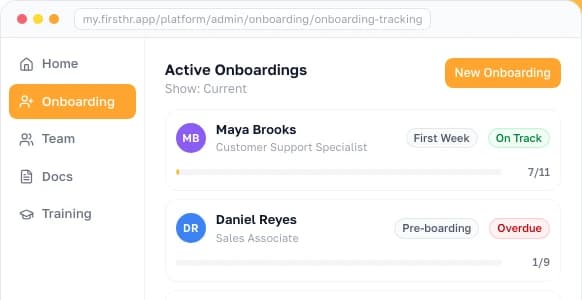
The job description is step one. Once a candidate accepts, the same document becomes the basis for the offer and a developer-appropriate onboarding, which matters because an engineer needs equipment, repository and system access, and signed IP and confidentiality agreements before the first day of real work.
Once your offer is ready, the offer letter template handles the next step, and an onboarding template gives the new hire a structured start. FirstHR connects the offer, e-signed confidentiality and IP acknowledgments, the equipment-and-access onboarding workflow, and document management in one place, which fits a developer hire's access-and-IP reality for a 5-to-50-person company. FirstHR is an onboarding and HR platform, not a developer-hiring, technical-assessment, or code tool, so pair it with your engineering process. Applicant tracking is coming soon to FirstHR.

Frequently Asked Questions
What does a Java developer do?
A Java developer designs, builds, and maintains software applications written in Java. Day to day, that means writing clean and efficient code, participating in architecture and design decisions, reviewing code, debugging and improving performance, writing tests, and documenting the work. Java is widely used for server-side and enterprise systems, so much of the work involves backend services, APIs, and integrations with databases and other systems. The specific focus depends on the role: a backend developer concentrates on server-side services, a full stack developer works across backend and frontend, and a Spring Boot developer builds services with that framework. Across all of them, the core is turning requirements into reliable, maintainable software. This is general information, not legal advice.
What are the different types of Java developer role?
Java developer is an umbrella title that splits by both specialization and seniority. By specialization, the common variants are backend developer, who builds server-side services and APIs; full stack developer, who works across backend and frontend; and Spring Boot developer, who focuses on that specific framework for microservices and APIs. By seniority, the role runs from junior, an early-career hire who writes code under guidance, to mid-level, to senior, who leads architecture and mentors others. These overlap: a senior backend Java developer using Spring Boot is one person. When writing a job description, decide both the specialization and the level you need, because they shape the required experience, the responsibilities, and the salary range. This is general information, not legal advice.
Is a Java developer exempt or non-exempt under the FLSA?
A Java developer is almost always exempt. Under the FLSA computer employee exemption, software developers and similarly skilled computer-field workers whose primary duties are systems analysis, design, and software development are exempt if paid at least the standard salary level on a salary basis, or at least the federal computer-employee hourly rate. Because Java developer pay typically sits well into six figures, the compensation threshold is easily met, and the duties clearly qualify. That means the role is salaried with no overtime, unlike hourly non-exempt positions. As always, exemption depends on the actual duties and pay rather than the job title, so confirm each role against the current tests, though for a genuine development role the exempt status is rarely in doubt. This is general information, not legal advice.
How much does a Java developer make?
Java developers are among the higher-paid roles. The closest federal occupation, software developers, had a median wage of $133,080 a year as of the May 2024 data, with the lowest 10 percent under $79,850 and the highest 10 percent over $211,450. Market data specific to Java developers places typical pay around the high $110,000s, with junior Java roles often still above $100,000 and senior roles well higher. Pay varies sharply by location, with major tech metros paying a significant premium, and by specialization and seniority. For a posting, benchmark to the level and specialization you are hiring and to your local market, and expect the range to sit well above most other roles. This is general information, not compensation advice.
What skills should a Java developer have?
A Java developer needs strong knowledge of Java and object-oriented programming, plus experience with the tools and frameworks around it. Core skills include working with databases, building and consuming APIs, using version control, and writing tests. Most roles also expect familiarity with a framework such as Spring or Spring Boot, and many expect Hibernate, microservices, cloud platforms, and CI/CD pipelines. Beyond the technical, problem-solving and collaboration matter, since developers work in teams, review each other's code, and make design decisions together. Requirements scale with level: a junior developer needs foundations and a willingness to learn, while a senior developer needs deep expertise and the ability to lead architecture and mentor others. Match the required skills to the level so you do not over-specify a junior role. This is general information, not legal advice.
What's the difference between a Java developer and a software engineer?
In practice, the titles overlap heavily and are often used interchangeably. Java developer specifies the primary language and tends to emphasize hands-on coding in Java. Software engineer is a broader title that may cover any language and often implies a wider scope including system design, architecture, and engineering practices. The market increasingly favors software engineer, backend engineer, or full stack engineer even for work that is essentially Java development, so the same role may be posted under different titles. When writing your posting, choose the title that will reach the candidates you want: Java developer signals the specific stack clearly, while software engineer casts a wider net. The underlying federal occupation, software developers, covers both. This is general information, not legal advice.
Should a small company hire a Java developer in-house or use a contractor?
It depends on whether the need is ongoing or project-based, and on the company. Most Java development hiring happens at larger organizations, so a smaller company hiring a Java developer is usually a software product company, a growing startup, or a small agency where engineering is core to the business. For ongoing product work, a full-time hire makes sense. For a defined project or a temporary need, many smaller companies use contractors or freelance platforms instead, which avoids the cost and commitment of a full-time engineer. If you do hire full-time, plan for the onboarding a developer needs: equipment, system and repository access, confidentiality and IP agreements, and a structured first few weeks. Match the engagement to whether the work is continuous or finite. This is general information, not staffing advice.
What should a Java developer job description include?
Start by deciding the specialization and level, backend, full stack, or Spring Boot, and junior, mid, or senior, because they shape everything else. Include a short company summary that names your tech stack and team, a job summary that makes the scope clear, and responsibilities grouped into building and coding, collaboration and quality, systems and performance, and documentation and growth. State the required education, years of experience, and specific technologies such as Java, Spring, databases, and version control, scaled to the level. Note the exempt classification and a realistic salary range, which for this role sits well into six figures. Specify on-site, hybrid, or remote, and add an equal opportunity statement and clear apply instructions. This is general information, not legal advice.
Make HR the easy part of running your business
Onboarding, e-signatures, training and core HR in one place. Up and running in 5 minutes.
- 7-day free trial
- No credit card required
- Cancel anytime