
Free Program Assistant Job Description Templates
Free program assistant job description templates for nonprofit, government, university, healthcare, and small business. With FLSA notes. Download as DOCX.

Program assistant is an umbrella title that means slightly different things depending on where you work. A nonprofit, a city government, a university, and a behavioral-health clinic all hire program assistants, and the administrative core is the same, but the context, the funding, and the classification language differ. Getting the version right is what makes a posting attract the right candidates.
This page covers the role by sector: a template for nonprofit, government, university, healthcare, and small business, plus a general version, each with the FLSA classification built in. It also answers the question many small employers reach this page with: whether they should post for a program assistant at all, or use a different title.
- Sign the offer letter
- Sign the employee handbook
- Workplace Safety course
What a Program Assistant Does
A program assistant provides administrative and coordination support so a program runs smoothly: scheduling activities, maintaining records, communicating with participants, preparing documents, coordinating event logistics, tracking data, and assisting with reporting. It is a support role, not a decision-making one, working under a program manager or coordinator.
There is no dedicated federal occupation for the title. The closest proxy is secretaries and administrative assistants (SOC 43-6014), and the federal equivalent is the GS-0303 Miscellaneous Clerk and Assistant series, where the role is titled Program Support Assistant.
Where the Role Actually Sits
The single most useful thing to know before posting is that the program assistant title concentrates in a few sectors, and a private small business is not the main one.
| Sector | Typical setting | Notes |
|---|---|---|
| Nonprofit | Social services, community programs | Largest segment; often grant-funded |
| Government | State, local, federal (GS-0303) | Formal pay grades; non-exempt |
| University | Colleges, school districts | Academic and student programs |
| Healthcare | Behavioral and community health | HIPAA privacy applies |
| Small business | Private companies | Usually called office or operations assistant |
The practical takeaway: pick the sector template that matches your setting. If you are a private company, the small-business version uses a title that fits the private sector and how candidates actually search.
Program Assistant Duties and Responsibilities
Across sectors, the duties cluster into four areas: administration, scheduling and events, communication, and data and reporting. The emphasis shifts by setting, with nonprofits weighted toward participants and grants and universities toward students.
Which Template Should You Use?
Pick the template by sector. The administrative core is the same across all six, but each one emphasizes the context, funding, and classification language that fit a specific setting, and every one includes the FLSA classification note that generic templates leave out.
6 Free Program Assistant Job Description Templates
Download all six as separate Word files in one ZIP, or copy individual templates. Each follows the same structure: organization overview, position summary, key responsibilities, qualifications, a classification note, and how to apply, with an EEO statement. Fill in the brackets and post.
Template 1: Program Assistant (General)
The core role: administrative and coordination support for a program team. Non-exempt and hourly, and adaptable to any sector.
Template 2: Nonprofit Program Assistant
For a nonprofit or social-services program: participant support, event logistics, and grant reporting. The most common setting for the role.


Template 3: Government / Program Support Assistant
For a public-sector role, including the federal GS-0303 series. Formal pay grades and classification, typically non-exempt and hourly.
Template 4: University / Education Program Assistant
For a college, university, or school-district program or department: student and faculty support, scheduling, and term logistics.
Template 5: Healthcare / Behavioral Health Program Assistant
For a healthcare or behavioral-health program: client scheduling and records, with HIPAA privacy and confidentiality built in.
Template 6: Small Business Program / Operations Assistant
For a small private business: the same support under an operations-assistant title that fits the private sector and how candidates search.
FLSA Classification
The classification answer is simple for this role and worth getting right, because the common mistake is costly.
Keep the posting neutral and inclusive: the EEOC prohibits job advertisements that show a preference based on a protected characteristic.
Program Assistant Pay
This is an entry-level, hourly role, so benchmark to your sector and region and budget for overtime since the role is non-exempt.
Pay runs higher in high-cost metro areas and in pharmaceutical, financial-services, and legal settings. For a posting, benchmark to your sector and region, set an hourly rate that reflects the local market, and include a good-faith range where pay transparency is required.
Program Assistant vs Coordinator vs Specialist
These three titles form a ladder, and matching the title to the actual scope keeps pay and classification expectations correct.
| Title | Scope | Typical classification |
|---|---|---|
| Program assistant | Administrative and logistics support | Non-exempt, hourly |
| Program coordinator | Runs program components, coordinates people | Often non-exempt; varies |
| Program specialist | Subject-matter or program ownership | Varies by duties |
| Program administrator | Manages the program or office | Often exempt |
If the role is primarily administrative support, program assistant is the right title. If the person will run program components or make decisions, a coordinator-level role fits better. Using the right title attracts the right candidates and sets accurate expectations.
From Hiring to Onboarding
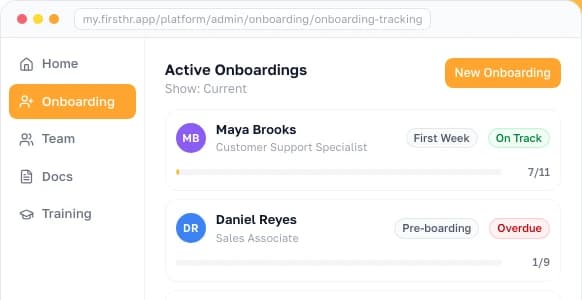
The job description is step one. Once a candidate accepts, the same role becomes the basis for the offer, the non-exempt classification, and a structured onboarding. A repeatable process matters whatever sector you hire in.
Once your offer is ready, the offer letter template handles the terms, and an onboarding template gives the new hire a structured start. FirstHR connects the offer, e-signatures, onboarding workflows, training modules, and document management in one place, with a way to record the non-exempt classification in the employee profile, so a smaller organization can run the hire without a dedicated HR department. FirstHR is an onboarding and HR platform, not a grants or program-management tool, and it does not run payroll or administer benefits, so connect those separately. Applicant tracking is coming soon to FirstHR.

Frequently Asked Questions
What does a program assistant do?
A program assistant provides administrative and coordination support to a program team so the program runs smoothly. The core work includes scheduling meetings and program activities, maintaining records and databases, responding to calls and emails from participants, preparing documents and correspondence, coordinating event and workshop logistics, tracking program data, assisting with reporting, and supporting program managers and coordinators. The role is a support position rather than a decision-making one: the program manager sets direction and the program assistant keeps the administration and logistics organized. Exact duties vary by sector, with nonprofit roles emphasizing participant support and grant reporting, government roles emphasizing records and classification, and university roles emphasizing student and faculty support, but the administrative core is consistent across all of them.
Where do most program assistant jobs sit?
Most program assistant roles sit in nonprofits and social services, state and local government, universities and school districts, and healthcare or behavioral-health organizations. These are the settings that run formal programs, often grant-funded, that need dedicated administrative support. The federal government uses a related title, Program Support Assistant, classified in the GS-0303 Miscellaneous Clerk and Assistant series. Genuine small private businesses rarely post for a literal program assistant, because they usually do not run formal programs; a small company that wants similar support typically hires an office assistant, administrative assistant, or operations assistant instead. This is why the templates here are organized by sector: the administrative work is similar everywhere, but the context, funding, and classification language differ enough to matter.
Is a program assistant the same as a program coordinator?
No, though they work closely together and the titles are sometimes used loosely. A program assistant is a support role focused on administration, scheduling, records, and logistics, and is typically entry-level and non-exempt. A program coordinator usually sits a level up, with more responsibility for running parts of the program, coordinating people and activities, and sometimes exercising independent judgment, and may be paid more. A program specialist or administrator is higher still, with subject-matter or management responsibility. When writing a job description, match the title to the actual scope: if the role is primarily administrative support, program assistant is correct; if the person will run program components and make decisions, coordinator or specialist fits better. Using the right title attracts the right candidates and sets correct pay and classification expectations.
Is a program assistant exempt or non-exempt under the FLSA?
A program assistant is almost always non-exempt and paid hourly. The role is administrative and coordination support that does not typically involve the exercise of independent judgment on significant matters, which is what the FLSA administrative exemption requires, and the pay is usually below the level where exemptions apply. Government and university classifications commonly designate the role non-exempt explicitly. Non-exempt means the employee must be paid overtime at one and a half times their regular rate for hours worked over 40 in a workweek, and that a salaried setup does not change this. The common, costly mistake is treating a salaried program assistant as exempt; classify by the actual duties, track hours, and pay overtime. Confirm against current federal and state thresholds. This is general information, not legal advice.
How much does a program assistant make?
A program assistant is an entry-level, hourly role. The closest federal occupation, secretaries and administrative assistants, had a median annual wage of $47,460 as of the May 2024 data, with the lowest 10 percent under $33,840 and the highest 10 percent over $76,550. National compensation surveys for the specific program assistant title tend to land in the mid-$40,000s a year, or roughly $22 an hour, with higher pay in high-cost metro areas and in pharmaceutical, financial-services, and legal settings. For a posting, benchmark to your sector and region, set an hourly rate that reflects the local market, and include a good-faith pay range where pay transparency is required. Because the role is non-exempt, remember to budget for overtime when hours exceed 40 in a week. This is general information, not legal advice.
Does a small business need a program assistant?
Usually a small business needs the work, just not under that title. The program assistant title is tied to nonprofits, government, and universities that run formal, often grant-funded programs, which most small private businesses do not. A small company that wants someone to handle scheduling, documents, communication, and day-to-day coordination is better served by hiring an office assistant, an administrative assistant, or an operations assistant. The duties are essentially the same, but the title fits the private sector and matches how candidates search. The small-business template on this page adapts the role accordingly, under an operations-assistant framing. If you do run a structured program, such as a community or training program, then program assistant is the right title even at a small scale.
What qualifications does a program assistant need?
Most program assistant roles require a high school diploma or equivalent as a minimum, with an associate or bachelor's degree preferred by some employers, particularly in universities and larger nonprofits. The core qualifications are practical rather than academic: strong organization and coordination skills, clear written and verbal communication, proficiency with office and scheduling software, attention to detail, and reliability. Prior administrative or program-support experience is a plus, and sector-specific experience helps, such as nonprofit or social-services background, familiarity with grant reporting, or comfort handling confidential information in a healthcare setting. Bilingual skills are frequently valued in community and social-services programs. Keep the requirements realistic for an entry-level, hourly role; over-specifying qualifications shrinks your candidate pool without improving the hire. This is general information, not legal advice.
What should a program assistant job description include?
A strong program assistant job description names the sector up front, whether nonprofit, government, university, healthcare, or private business, since that shapes the context and the classification language. It includes a short organization summary, a position summary that frames the role as program support, and responsibilities grouped into administration, scheduling and events, communication, and data and reporting. It sets the FLSA classification as non-exempt and hourly, states the schedule, and notes any sector-specific requirements such as HIPAA privacy in healthcare or grant-funding details in nonprofits. It lists realistic qualifications for an entry-level role, usually a high school diploma plus organizational and communication skills. Close with pay, a good-faith range where required, an equal opportunity statement, and clear application instructions. This is general information, not legal advice.
Make HR the easy part of running your business
Onboarding, e-signatures, training and core HR in one place. Up and running in 5 minutes.
- 7-day free trial
- No credit card required
- Cancel anytime