
Free Branch Manager Job Description Templates
Free branch manager job description templates for bank, retail, trades, logistics, and insurance. With FLSA executive-exemption and hiring guidance.

Branch manager is a title that means five different jobs depending on the industry. In a community bank it is a banker driving deposits and loans. In a distribution business it is a P&L owner running a location. In an HVAC company it is an operations leader running technicians and dispatch. The dominant meaning is the bank branch manager, but the head term is bank-leaning, not bank-only, so a generic posting attracts the wrong applicants.
At FirstHR, we build hiring templates for the multi-location small businesses that make this hire, often an owner opening a second location without an HR department. The six templates below cover the branch manager by industry: bank, assistant, retail or distribution, trades, logistics, and insurance, each handling the duties and compliance honestly.
- Sign the offer letter
- Sign the employee handbook
- Workplace Safety course
What Is a Branch Manager?
A branch manager runs a single location of a business: leading the team, owning the branch's performance, and managing its operations and compliance. That core is constant. What changes completely is the industry, which determines the goals, the staff, the required knowledge, and the compliance the role carries.
For the employer writing the posting, this is the whole game. The dominant meaning is the bank or credit union branch manager, and the featured snippet and most top results frame it that way. But the title is also used heavily by multi-location retail and distribution firms, trades and service companies, logistics operations, and insurance agencies, where the job is genuinely different. A generic branch manager posting attracts a confusing mix of applicants, so the fix is to name your industry in the title and overview. The next section lays out the industries so you can pick, and the templates below are written one per type.
Branch Manager by Industry
Branch manager splits across industries. Here is what each version manages, and the compliance that comes with it.
| Industry | Drives | Key compliance |
|---|---|---|
| Bank / Credit Union | Deposits, loans, service | BSA/AML, security, bonding |
| Retail / Distribution | Sales, P&L, inventory | Safety, employment law |
| Trades / Service | Service revenue, dispatch | OSHA, trade licensing |
| Logistics / Freight | Freight, 3PL, accounts | DOT/FMCSA where applicable |
| Insurance | Production, retention | Producer licensing |
These rarely overlap in practice: a bank branch manager and a trades branch manager are doing entirely different jobs that happen to share a title. Pick the row that matches your business, and use it to shape the title, the duties, and the requirements. The assistant branch manager template adapts to any of these as the deputy role.
Branch Manager Duties and Responsibilities
Across every industry, branch manager duties group into people and leadership, performance and growth, operations, and compliance and security. What fills each bucket differs by industry, but the structure is shared, which is why the templates follow the same shape.
A strong posting fills these with the specifics of your branch: the team size, the goals, the systems, and the compliance your industry requires.
Which Template Should You Use?
Pick the template by industry, then by level. Five cover the industries; the sixth is the assistant version that adapts to any of them. Use this guide to choose.
6 Free Branch Manager Job Description Templates
Download all six as separate Word files in one ZIP, or copy individual templates. Each follows the same structure: company overview, key responsibilities, qualifications with any required license, the FLSA status with a confirm note, compensation, and how to apply, with the specifics left as fields. Fill in the brackets and post.
Template 1: Bank / Credit Union Branch Manager
For a community bank or credit union branch: leads the team, drives deposit and loan growth, and owns branch operations, security, and BSA/AML compliance. The most common and highest-intent version.
Template 2: Assistant Branch Manager
For the deputy who supports the branch manager and steps in when needed. The one template here where the FLSA exempt status is genuinely in question, since the duties may be more execution than management.


Template 3: Retail / Distribution Branch Manager
For a retail store, showroom, or distribution branch: owns the branch P&L, leads the team, drives sales, and manages inventory and operations at the location.
Template 4: Trades / Service Branch Manager
For a multi-location HVAC, plumbing, electrical, or field-service company: owns the branch P&L, leads technicians and office staff, manages dispatch, and enforces safety.
Template 5: Logistics / Freight Branch Manager
For a freight, brokerage, or 3PL branch: owns the branch P&L, leads operations and sales staff, manages carrier and customer relationships, and grows the market.
Template 6: Insurance Branch Manager
For an insurance agency office: leads producers and service staff, drives new business and retention, and ensures licensing and compliance, with the producer license required.
Is a Branch Manager Exempt from Overtime?
A branch manager is usually exempt from overtime under the FLSA executive exemption, but it depends on the actual duties and salary, not the title, so it is worth confirming. The reason the answer is usually yes: a real branch manager manages a recognized subdivision of the business, directs a team, and influences hiring, which is the heart of the executive exemption.
The executive exemption applies only when all four of these tests are met. Run them on the real duties, not the title.
A genuine branch manager who leads a team of five to seven and influences hiring clears all four comfortably and is exempt. The role fails when it has no real reports, when the primary duty is doing the same frontline or trade work as the team rather than managing, or when the salary falls below the floor. The assistant branch manager and the working-lead variant are the common borderline cases. The federal salary floor is $684 per week; a 2024 rule that would have raised it was vacated in court, so the 2019 level remains in effect, and some states set a higher floor. This is general information, not legal advice.
Branch Manager Pay
Branch manager pay depends heavily on industry, because the title spans two different federal occupations, so benchmark against the specific role.
Within each, region, branch size, industry, and the revenue or assets the branch carries move pay significantly, and market data shows many branch roles add incentive or bonus tied to branch performance. Benchmark against the specific industry and market you are hiring in, factor in any incentive structure, and disclose a range where your state requires it. The templates leave compensation as a field so you can set it for your market.
Branch Manager Skills and Qualifications
Branch manager qualifications combine leadership with industry-specific knowledge, so name the experience and any license that fit the specific role rather than generic traits.
| Weak requirement | Strong requirement |
|---|---|
| Management experience | 3-5+ years leading a team, with P&L or goal ownership |
| Industry background | Direct experience in your industry (banking, trades, etc.) |
| Licensed | Required license named (NMLS, producer, trade) where it applies |
| Good with people | Proven coaching, hiring, and team development |
| Compliance-aware | Knowledge of the rules your branch must follow (BSA/AML, OSHA) |
The core is a proven leader whose experience matches the industry, with genuine command of the branch's operations, goals, and compliance. Name the right license and experience precisely, and keep each line job-related, the SHRM job description tools describe a good job description as a plain-language summary of a position's tasks, duties, and responsibilities. Keep the posting neutral, since the EEOC prohibits job advertisements that show a preference based on protected characteristics.
How to Write a Branch Manager Job Description
A strong branch manager posting starts with one decision, which industry you mean, and everything else follows from it. Done right it takes about 20 minutes and screens applicants accurately. Here is the process the templates are built around.
Hiring a Branch Manager for a Growing Business
A large company hires branch managers through a recruiting team that knows exactly which kind it needs and a compliance function that handles classification. A growing small business making its first branch manager hire, usually an owner opening a second location, has to get the industry framing, the classification, and the onboarding right themselves. Here is how to approach it for that reality.
After You Hire: Onboarding a Branch Manager
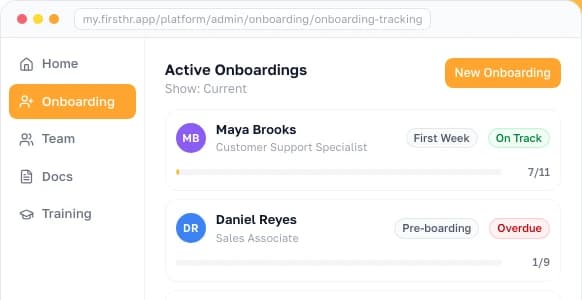
The job description is step one, and a branch manager is a high-stakes leadership hire, so the onboarding starts with the standard paperwork and then layers in the branch-specific setup. Send the offer and get it signed, then complete Form I-9 and the rest of the new hire paperwork and tax forms, along with your handbook and signed policy acknowledgments.
Then handle the branch setup: access and keys to the location, systems and signing authority, and the industry compliance training the role requires, such as BSA/AML for a bank branch or safety for a trades branch. Orient the new manager to the branch's goals, the team they are inheriting, and your reporting and approval processes. For a growing business without an HR department, a repeatable process keeps a leadership hire consistent and compliant. FirstHR connects the offer with e-signature, runs the onboarding workflow, assigns role-specific training, and stores signed policies in document management, built for businesses without an HR team. Applicant tracking is coming soon to FirstHR.

Frequently Asked Questions
What does a branch manager do?
A branch manager runs a single location of a business: leading the team, owning performance, and managing operations and compliance at that branch. The specifics depend heavily on the industry. A bank or credit union branch manager drives deposit and loan growth, manages tellers and bankers, and owns branch security and BSA/AML compliance. A retail or distribution branch manager owns the location P&L, leads staff, drives sales, and manages inventory. A trades or service branch manager runs technicians and dispatch and enforces safety. A logistics branch manager runs freight or 3PL operations, and an insurance branch manager leads producers and depends on licensing. Across all of them, the common thread is leading a location's team, hitting its goals, and owning its operations and compliance, but the actual work and required knowledge differ sharply by industry.
What is the difference between a branch manager and an assistant branch manager?
A branch manager has full responsibility for the branch, while an assistant branch manager supports the manager and steps in when needed. The branch manager owns the branch P&L or goals, leads the team, makes hiring and operational decisions, and is accountable for performance, compliance, and security. The assistant branch manager is the deputy: supervising staff, handling daily operations and service, covering for the manager, and supporting sales and compliance, but usually without final authority over the branch. This distinction matters for classification, because the branch manager almost always meets the FLSA executive exemption while the assistant branch manager is the more common borderline case. If the assistant mainly executes tasks under direction rather than independently managing, the role may be non-exempt and owed overtime. On a small branch, one person may carry both sets of duties.
Is a branch manager exempt or non-exempt from overtime?
A branch manager is usually exempt under the FLSA executive exemption, but it depends on the actual duties and salary, not the title. The executive exemption requires all four of: a salary of at least $684 per week, a primary duty of managing a recognized subdivision (the branch qualifies), customarily directing the work of two or more full-time employees, and authority to hire or fire or to make recommendations given particular weight. A real branch manager who leads a team of several and influences hiring generally clears all four and is exempt. The role fails the test, and becomes non-exempt and overtime-eligible, when it has no real reports, when the primary duty is doing the same frontline or trade work as the team rather than managing, or when the salary falls below the threshold. Some states set a higher salary floor than the federal level. This is general information, not legal advice; confirm classification for your situation.
How much does a branch manager make?
Pay depends on the industry, since the title spans two different federal occupations. For a bank or financial branch manager, the closest federal benchmark is financial managers, who earned a median annual wage of $161,700 in May 2024, with the lowest 10 percent under $86,490 and the highest 10 percent over $239,200. For a non-bank branch manager in retail, distribution, trades, or logistics, the closest benchmark is general and operations managers, who earned a median of $102,950 in May 2024. Within each, region, branch size, industry, and the revenue or assets under the branch move pay significantly, and many branch roles add incentive or bonus tied to branch performance. Benchmark against the specific industry and market you are hiring in rather than a single branch manager number, and disclose a range where your state requires it. The templates leave compensation as a field so you can set it for your market.
What should a branch manager job description include?
Start by naming the industry, then build the standard sections. The single most important choice is framing the role for your business: bank, retail or distribution, trades or service, logistics, or insurance, since that determines the duties, qualifications, and compliance. From there, include a company overview, the branch-specific duties, the qualifications and any required license, the FLSA status, and the compensation. List the real duties: leading the team, owning branch performance, managing operations, and ensuring compliance, framed for your industry. Name the right requirements, such as banking and BSA/AML knowledge for a bank, a trade or safety background for trades, or a producer license for insurance. Handle the FLSA status, since branch managers are usually exempt executives but the assistant role and working-lead variants may not be. Describe the branch and team so candidates understand the scope. Keep the language neutral and job-related.
Can a small business have a branch manager?
Yes, and small multi-location businesses are a core case for the role. A branch manager presupposes more than one location, so the typical employer is a multi-location small business: a community bank or credit union with a couple of branches, a three-location HVAC or plumbing company, a regional building-products distributor, a small freight or 3PL operation, or an insurance agency with more than one office. Many of these run lean, often five to fifty employees per location, and still need someone to own each branch. The most common hiring trigger is growth: an owner opening a second or third location and needing a manager to run it without being on site themselves. That makes the branch manager a classic first-leadership-hire moment for a growing business without a dedicated HR department, which is exactly the scenario these templates are built for. The role is rarer in single-site firms.
What compliance applies when hiring a branch manager?
Two layers apply: the classification call and the industry overlay. First, get the FLSA executive-exemption determination right, since misclassifying a non-exempt branch lead as exempt creates overtime liability. Second, handle the industry-specific compliance the branch manager owns and that you address at onboarding. For a bank or credit union, BSA/AML training is a mandatory federal pillar for branch staff, alongside bonding or fidelity coverage and any state requirements. For trades and service branches, OSHA and safety compliance apply, plus any trade licensing. For logistics, DOT and FMCSA requirements may apply. For insurance, the branch manager and producers need the right state licenses. Beyond the role-specific items, every new manager needs the standard paperwork: Form I-9, tax forms, and signed policy acknowledgments. A repeatable onboarding process keeps these from slipping, which matters more for a leadership hire at a company without an HR department.
What happens after I hire a branch manager?
Send the offer, complete the paperwork, and onboard with the branch and compliance in mind. Start with the offer letter and e-signature, then the standard new-hire paperwork: Form I-9, tax forms, your handbook, and signed policy acknowledgments. Then handle the branch-specific setup: access and keys to the location, systems and equipment, signing authority where relevant, and the industry compliance training the role requires, such as BSA/AML for a bank branch or safety for a trades branch. Then orient the new manager to your business: the branch's goals and P&L, the team they are inheriting, your reporting and approval processes, and your standards for service and compliance. For a growing business without an HR department, a repeatable onboarding process keeps a high-stakes leadership hire consistent and compliant. FirstHR handles the people side: the offer with e-signature, new-hire paperwork, an onboarding workflow, role-specific training assignments, and document management for signed policies. Applicant tracking is coming soon to FirstHR.
Make HR the easy part of running your business
Onboarding, e-signatures, training and core HR in one place. Up and running in 5 minutes.
- 7-day free trial
- No credit card required
- Cancel anytime