
Sales Executive Job Description Templates
Sales executive job description templates: standard, B2B/SaaS, inside, outside, senior, and first sales hire. With FLSA, commission, and OTE guidance.

Hiring a sales executive comes with two wrinkles the generic templates ignore. First, sales executive, sales manager, and account executive get used interchangeably, but they are different hires: one closes, one runs a team, and one is essentially a synonym for the first. Second, the overtime answer for a sales executive depends on whether the selling happens inside or outside, not on the title, and getting that wrong creates real back-pay risk. Settle those two, and the rest is a fairly standard revenue-role posting.
At FirstHR, we build templates for the small companies that make this hire, often a founder bringing on their first dedicated sales hire without an HR department. The six templates below cover the sales executive by type: standard, B2B/SaaS, inside, outside/field, senior, and a small-business first-hire version, each handling the commission structure and the FLSA classification honestly.
- Sign the offer letter
- Sign the employee handbook
- Workplace Safety course
What Does a Sales Executive Do?
A sales executive owns the full sales cycle as an individual contributor: prospecting, qualifying, presenting, negotiating, and closing deals against a quota. The role builds and manages a pipeline, runs demos, navigates decision-makers, and keeps the CRM accurate for forecasting, all on a base-plus-commission plan. There is no single federal occupation titled sales executive; the closest benchmarks are the BLS wholesale and manufacturing sales representatives occupations, whose profile notes most employers pay a combination of salary and commission or bonuses.
For the employer writing the posting, two things matter up front. First, despite the word executive, this is a quota-carrying selling role, not a management position, and it gets confused with both the sales manager (who runs a team) and the account executive (which is essentially the same role). Second, the role's FLSA classification and day-to-day work change sharply depending on whether it is inside or outside sales. That is why the templates below are split by type, with the compensation and classification built into each.
Sales Executive vs Sales Manager vs Account Executive
These titles get used loosely, and hiring the wrong one wastes a search. Here is how they actually differ.
| Sales Executive | Sales Manager | Account Executive | |
|---|---|---|---|
| Core job | Carries a quota, closes deals | Leads a team of reps | Carries a quota, closes deals |
| Track | Individual contributor | Management | Individual contributor |
| Manages people? | No | Yes | No |
| Relationship | Same as account executive | Distinct, parallel track | Same as sales executive |
A sales executive and an account executive are largely the same quota-carrying IC role, especially in SaaS; a sales manager is a distinct management track running parallel to the senior IC path, not above it. Write a sales executive or account executive posting to hire a closer, and a sales manager posting to hire someone who runs a team.
Sales Executive Duties, Responsibilities, and Skills
Sales executive duties cluster into four areas: pipeline and prospecting, closing and negotiation, CRM and forecasting, and account development and collaboration. The O*NET profile for sales representatives catalogs the underlying work activities the role draws from. A strong posting picks the responsibilities from each area that match your sales motion rather than listing every possible task.
The type shifts the emphasis: a B2B executive leans on consultative, multi-stakeholder cycles, an inside executive on high-volume outreach, an outside executive on territory and travel.
Which Template Should You Use?
Pick the template by sales motion first, then by seniority. The core structure is the same across all six, but the duties, the compensation shape, and especially the FLSA classification differ enough that the matched version reads more credibly to the reps who have done the job. Use this guide to choose, then adjust.
6 Free Sales Executive Job Description Templates
Download all six as separate Word files in one ZIP, or copy individual templates. Each follows the same structure: company and role overview, key responsibilities, qualifications, compensation with base, commission, and OTE, an FLSA classification note, and how to apply, with an EEO statement. Fill in the brackets and post.
Template 1: Standard Sales Executive
The universal baseline: full-cycle individual-contributor selling on a base-plus-commission plan, with the not-a-manager framing and the classification pointer built in.
Template 2: B2B / SaaS Sales Executive
The consultative version: multi-stakeholder cycles, a sales methodology, CRM pipeline, and an ARR quota, with the inside-selling non-exempt note.


Template 3: Inside Sales Executive
The remote-selling version: high-volume outreach by phone, email, and video without field travel, and the clear non-exempt classification with the overtime note.
Template 4: Outside / Field Sales Executive
The field version: a territory, travel, and in-person closing, with the outside-sales exemption note and the no-salary-test wrinkle flagged.
Template 5: Senior Sales Executive
The senior version: enterprise accounts, complex deals, informal mentoring, and a larger quota, on the IC track and explicitly not a management role.
Template 6: Sales Executive (Small Business / First Sales Hire)
For a company making its first revenue hire: own the sales motion end to end, build the process, and work directly with the founder, with the comp plan defined up front.
Inside vs Outside Sales Executive (and Why It Changes the Overtime Answer)
The inside-versus-outside split is the single most important distinction in this role, because it changes both the day-to-day work and the FLSA classification. An inside sales executive sells remotely; an outside sales executive sells in the field. That difference, not the title, decides whether overtime applies.
| Factor | Inside Sales Executive | Outside / Field Sales Executive |
|---|---|---|
| Where selling happens | Office or home office | Customer sites, territory |
| How they sell | Phone, email, video | In person, face to face |
| Travel | Little or none | Regular territory travel |
| Typical FLSA status | Usually non-exempt | Often exempt (outside-sales) |
| Salary-level test | Applies if claiming another exemption | No salary test for outside-sales |
Because a home office counts as the employer's place of business, a remote inside rep is still inside sales for FLSA purposes. Get this right in the posting and the offer, since misclassifying an inside role as exempt is a common and costly mistake.
Compensation: Base, Commission, and OTE
Sales executive compensation is a base-plus-commission plan, and stating it clearly is what separates a credible posting from a vague one. Here are the four pieces every offer should define.
The headline figure candidates look for is OTE, the on-target total at full quota, and the honest move is to publish the base, the OTE, and the commission logic together. A posting that hides the comp plan loses strong reps, who can read a deal as well as anyone.
Is a Sales Executive Exempt from Overtime?
A sales executive may be exempt or non-exempt from overtime, and the deciding factor is where the selling happens, not the title. The reason this matters: misclassifying an inside rep as exempt because the title says executive is a common error that creates back-pay liability.
The outside-sales exemption applies when the employee's primary duty is making sales and they are customarily and regularly engaged away from the employer's place of business; uniquely, it has no salary-level test. An inside sales executive, selling from the office or a home office, generally does not meet it and is usually non-exempt. Here is how the common cases shake out.
| Role | FLSA status | Why |
|---|---|---|
Outside / field sales executive | Often exempt | A sales executive whose primary duty is making sales and who is customarily and regularly engaged away from the employer's place of business can meet the outside-sales exemption. Notably, this exemption has no salary-level test. Verify both prongs are genuinely met against the duties test. |
Inside sales executive (office or home) | Usually non-exempt | An inside sales executive selling by phone, email, or video from the office, or from a home office (which counts as the employer's place of business), does not meet the outside-sales exemption, so the role is usually non-exempt and overtime-eligible. |
Commission-paid inside role | Sometimes exempt (7(i)) | A commission-paid inside sales executive at a retail or service establishment may fall under the narrow 7(i) overtime exemption if the regular rate exceeds 1.5 times the minimum wage and more than half of earnings come from commission. It exempts overtime only, is fact-specific, and differs by state. |
Any role, judged by title alone | Not how it works | The word executive in the title decides nothing. Classification turns on the actual primary duties and where the selling happens, not the job title or seniority. Set it from the facts of the role, and confirm borderline cases. |
The narrow 7(i) exemption can remove the overtime obligation for some commission-paid inside roles at retail or service establishments, but only when its specific conditions are met, and it is fact-specific and state-dependent. Set the classification from the actual duties and work location, document the basis, and confirm borderline cases rather than defaulting to exempt. This is general information, not legal advice.
Sales Executive Pay
Sales executive pay is base plus commission, so the total depends on the comp plan and performance against quota. With no exact federal occupation, the closest BLS benchmarks are the sales-representative categories.
In practice, base salary often sits below total target pay, with OTE reaching or exceeding six figures once commission is counted, and senior or enterprise roles run higher still. Pay varies widely by industry, product, deal size, territory, and individual performance, and salary aggregators report a range of averages for the sales executive title specifically. Benchmark against your own sales motion and market, and state the base, the commission structure, and the OTE in the posting and offer.
Hiring Your First Sales Executive
A large company hires sales executives through a recruiting team and a comp committee. A small business making its first revenue hire has the founder doing all of it, with no HR department and a comp plan to design from scratch. The same classification, paperwork, and offer-clarity rules apply anyway. Here is how to approach the posting and the hire for that reality.
From Job Description to Hire
The job description is step one. Once a candidate accepts, the comp plan, the classification, and the paperwork become the real work, and for a sales role the offer carries more weight than usual because the commission terms have to be exact.
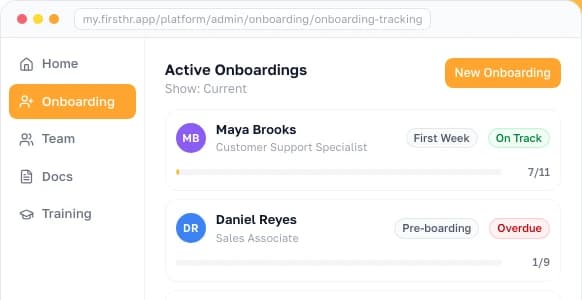
Once your offer is ready, the offer letter template handles the core terms with the commission plan attached, an onboarding template gives the new rep a structured start, and the new hire paperwork guide covers the I-9, tax forms, and state reporting. FirstHR connects the offer, signatures, onboarding workflow, 30-60-90 ramp plan, and document storage in one place so a small company can run the full process without an HR department. FirstHR is an onboarding and HR platform, not a payroll or commission system, so connect those separately. Applicant tracking is coming soon to FirstHR.

Frequently Asked Questions
What does a sales executive do?
A sales executive owns the full sales cycle as an individual contributor: prospecting, qualifying, presenting, negotiating, and closing deals against a quota. Day to day that means building and managing a pipeline, running discovery calls and demos, navigating buyers and decision-makers, negotiating terms, closing, and keeping the CRM accurate for forecasting. The role usually carries a base-plus-commission compensation plan with on-target earnings tied to hitting quota. Despite the word executive, it is a quota-carrying revenue role, not a management position. The specifics shift by type: a B2B or SaaS sales executive runs consultative, multi-stakeholder cycles; an inside sales executive sells remotely by phone and video; an outside or field sales executive owns a territory and sells in person; and a senior sales executive handles enterprise accounts and larger deals. Across all of them, the core job is the same: generate revenue by closing.
What is the difference between a sales executive, a sales manager, and an account executive?
These three titles overlap in conversation but mean different things when you hire. A sales executive is an individual contributor who carries a quota and closes deals; it is not a management role. A sales manager leads a team of sales reps and is responsible for their results, coaching, and pipeline, which is a management track, a parallel path to the senior IC track rather than a promotion above it. An account executive is, in most modern usage and especially in SaaS, essentially the same role as a sales executive: a quota-carrying closer who owns the full cycle. The terms sales executive and account executive are largely interchangeable, while sales manager is distinct. For a job posting, the rule is simple: write a sales executive or account executive posting if you want someone to sell, and a sales manager posting if you want someone to run a team, because the candidate pool, the compensation structure, and the interview process all differ.
Is a sales executive exempt or non-exempt from overtime?
It depends on where the selling happens, not on the title. An outside or field sales executive whose primary duty is making sales and who is customarily and regularly engaged away from the employer's place of business can qualify for the FLSA outside-sales exemption, which, unlike the other white-collar exemptions, has no salary-level test. An inside sales executive who sells by phone, email, or video from the office, or from a home office, which counts as the employer's place of business, generally does not meet the outside-sales exemption and is usually non-exempt and owed overtime. A narrow exception, the 7(i) retail or service commission exemption, can remove the overtime obligation for some commission-paid inside roles, but only when specific conditions are met, and it is fact-specific and differs by state. The word executive in the title decides nothing on its own. Set the classification from the actual primary duties and the work location, and confirm borderline cases. This is general information, not legal advice.
How much does a sales executive make?
Sales executive pay is base plus commission, so the headline number depends heavily on the comp plan and how the rep performs against quota. There is no single federal occupation titled sales executive, so the closest benchmarks are the BLS sales-representative occupations. Sales representatives in wholesale and manufacturing, except technical and scientific products, had a median annual wage of $66,780 in May 2024, while those selling technical and scientific products, the closest analog to a B2B or SaaS sales executive, had a median of $100,070. Those figures include commission. In practice, base salary often sits below total target pay, with on-target earnings reaching or exceeding six figures once commission is counted, and enterprise or senior roles run higher. Pay varies widely by industry, product, deal size, territory, and individual performance. For a posting, state the base, the commission structure, and the OTE honestly, and benchmark against your specific market and sales motion rather than a single number.
What is OTE in a sales executive job?
OTE stands for on-target earnings: the total compensation a sales executive earns when they hit 100 percent of their quota, combining base salary and commission at target. For example, a role with a $60,000 base and $60,000 in commission at full quota has an OTE of $120,000, often described as a 50/50 split between base and variable pay. OTE is a target, not a guarantee: a rep who beats quota can earn more, often through accelerators, and a rep who misses earns less. Stating OTE in the job description and offer sets honest expectations and is standard practice in sales hiring. When you post a sales executive role, define the base, the commission rate and what it is paid on, the OTE at quota, the quota itself, and any ramp period during which a new rep builds toward full quota. Clear comp terms up front prevent disputes and help you attract reps who can do the math on the opportunity.
Is a sales executive a manager?
No. A sales executive is an individual contributor, not a manager, despite the word executive in the title. The role carries a personal quota and is responsible for selling and closing, not for leading a team of other salespeople. The management equivalent is a sales manager, who is responsible for a team of reps, their collective numbers, and their coaching and development. In a well-structured sales organization, the senior individual-contributor track (senior sales executive, enterprise account executive) and the management track (sales manager, director of sales) run in parallel: a senior closer and a sales manager can earn comparable money on different paths, and neither sits above the other. This matters when you write the job description, because labeling an IC selling role as executive can mislead candidates who expect to manage people. If the role does not lead a team, say so plainly in the posting, as the templates on this page do.
What should a sales executive job description include?
A strong sales executive posting names the type of role up front, standard, B2B/SaaS, inside, outside/field, senior, or first hire, since that shapes the duties, the compensation, and the FLSA status. Include a company summary that makes the product, the buyer, and the sales motion concrete, because reps choose roles on territory, product, and comp plan. List the real responsibilities: pipeline and prospecting, closing and negotiation, CRM and forecasting, and account development. State the compensation honestly, the base, the commission structure, and the OTE, since vague pay drives away strong candidates. Address the FLSA classification based on inside versus outside selling rather than the title. Clarify that the role is an individual contributor, not a manager, if that is the case. Keep the requirements job-related, focused on sales experience, quota achievement, and the skills the role needs, and keep the language neutral. Close with an equal opportunity statement and clear apply instructions.
What happens after I hire a sales executive?
Send the offer with a clear comp plan, set the classification, complete the paperwork, and ramp the rep with a real plan. Start by confirming the base, commission structure, OTE, ramp, and quota in writing, ideally with the commission plan attached to the offer letter, and get it signed. Set the FLSA classification from the actual duties and work location, and document the basis. Complete Form I-9 with documents verified, the W-4 and state tax forms, and state new hire reporting, and have any non-solicitation or confidentiality agreement signed. Then ramp the new rep deliberately: CRM access, product and methodology training, and a structured 30-60-90 day plan so the ramp is intentional rather than improvised. For a small company without an HR department, a repeatable onboarding process keeps the comp agreement, the classification basis, and the signed documents organized. FirstHR handles the offer and signatures with e-signature, runs the onboarding workflow and 30-60-90 plan, and stores signed agreements in document management. Applicant tracking is coming soon to FirstHR.
Make HR the easy part of running your business
Onboarding, e-signatures, training and core HR in one place. Up and running in 5 minutes.
- 7-day free trial
- No credit card required
- Cancel anytime