Technology in the Workplace: A Practical Guide for Small Teams
Workplace technology for small teams: the six layers of a working stack, what it costs, security basics, the policies you need, and how to get adoption.

Technology in the Workplace
How small businesses choose, secure, and actually get people using the tools the company runs on
The first time I sat down with a 14-person company to work out why their software bill had passed their rent, we counted the subscriptions together. There were more than 30. Two of them did the same thing for different halves of the team, four were still charging for people who had left, and one had a single user who had stopped opening it months earlier.
None of that came from bad decisions. Every tool was bought by someone solving a real problem on the day they had it. That is how technology in the workplace actually arrives at a small company: one purchase at a time, each one sensible on its own, with nobody holding the list.
This guide covers the whole stack rather than the HR corner of it: the six layers a small business runs on, what they cost and where the money leaks, the security work that is cheap before an incident and expensive after, the policies that have to exist in writing, and how to roll out a new tool so people actually use it.
What Is Technology in the Workplace?
Technology in the workplace is the full set of hardware, software, and networks a business uses to produce, coordinate, and record its work. It covers the laptop someone types on, the chat tool the team argues in, the application the actual job is done in, and the system that holds the signed offer letter.
Two phrases get used interchangeably and should not be. Workplace technology is the whole stack. HR technology is one layer inside it, the part that handles employee records, onboarding, documents, and compliance. A business can have excellent design software and no record of who signed the handbook.
The word technology also hides how much of this is not software. Who owns the laptops, whether the wifi has a guest network, where the domain registrar login lives: these are workplace technology decisions that never appear in a tool comparison. They surface the week they break, usually when the person who set them up is unreachable.
The 6 Layers of a Small Business Technology Stack
Every small business stack has the same six layers, whatever the industry. Naming them is useful because it turns a scattered list of subscriptions into six questions with owners, and it makes the gap obvious: almost every company I talk to is strong in layers two and three and thin in layer five.
The order matters less than the coverage. A dental practice and a design agency will pick completely different work applications and land on nearly identical answers for identity, people systems, and storage. That is why the stack view beats a shopping list: it tells you which layer has no owner rather than which product has better reviews.
What Workplace Technology Actually Changes
Technology reliably changes five things at small scale: how fast work moves between people, whether the work survives the person who did it, whether you can prove what happened, how many hours go to administration, and how exposed your accounts are to takeover.
It does not change ownership, judgment, or an unagreed process, and buying a tool to fix one of those is how companies end up with expensive software nobody opens. The table pairs each outcome with the layer that delivers it and what that layer will not fix.
| What you want | The layer that delivers it | What it will not fix |
|---|---|---|
| Faster handoffs between people | Communication and collaboration, with a channel structure the team actually agreed on | Handoffs that stall because nobody owns the next step. A tool routes the message; it does not assign the work. |
| Work that survives a departure | People systems plus company-owned storage, so records are not in one person’s laptop | Knowledge that was never written down anywhere. Storage keeps only what you put in it. |
| Proof you did what you say you did | People systems: signed documents with timestamps, completion tracking, access logs | A process nobody follows. The log will faithfully record that the step was skipped. |
| Fewer hours on administration | Work applications and people systems automating the repeated steps | Decisions that need judgment. Automate the sending and the chasing, not the approval itself. |
| Lower risk of an account takeover | Identity and security: multi-factor authentication, a password manager, least privilege | One shared login that four people use for the system that matters most. |
Time tracking is where the difference between a tool and a process shows up most clearly. The Wage and Hour Division at the Department of Labor restated the rule in Field Assistance Bulletin 2020-5: an employer must pay for hours it knows or has reason to believe were worked.
The bulletin also gives the practical answer. Providing a reasonable procedure for employees to report unscheduled time is one way to meet that standard, and software makes the reporting procedure easy to run. It does not create the obligation, and it does not excuse ignoring hours you already know about.
The same logic applies to communication tools. Adding a chat platform to a team with no agreement about what belongs in chat versus a document produces faster noise, not faster work. The decision about channel structure and response expectations belongs in your team communication norms, and the tool then enforces something real.
Cost, Tool Sprawl, and the Annual Audit
Most small businesses do not have a technology budget problem. They have a technology inventory problem. The monthly total is rarely shocking on the day it is charged; it becomes shocking only when someone lists all of it on one page for the first time.
Sprawl accumulates in four predictable ways. A trial converts to a paid plan nobody notices. A tool bought for a one-month project renews annually. Per seat pricing that was fine at 8 people compounds at 20. And someone pays for a subscription on a personal card, which means it survives every review because it never appears on a company statement.
| Audit question | Where to look | What usually turns up |
|---|---|---|
| What are we actually paying for? | Twelve months of card and bank statements, not the tool list you remember having | Renewals nobody approved, and two tools doing the same job for different halves of the team |
| How many seats are we buying? | Each admin console, seat by seat, against your current employee list | Seats for people who left and for contractors whose project ended last spring |
| Who owns this tool? | One named person written next to each renewal date | Tools with no owner, which are reliably the ones that never get canceled |
| What does it cost at the headcount we expect? | The per seat price times the hiring plan, not the current invoice | A per seat tool that becomes one of your largest fixed lines after five more hires |
| Who still has access? | Admin user lists in every tool, including the ones teams forget: design files, the domain registrar, the bank portal | Former employees, and company data sitting in personal accounts |
Run this audit once a year, in the same week you plan headcount for the next year, because the two numbers interact. A per seat tool at $12 per user is a rounding error at 9 employees and a real line at 30.
Flat pricing that holds across a headcount range removes that recalculation, which is the main reason I built FirstHR on flat, predictable pricing instead of a per employee fee that changes with every hire.
Both passes land in the same workbook. The first tab is the page nobody has ever made: every subscription, its owner, its renewal date, and the seats you buy against the seats anyone opens. The second tab is the half hour above, one row per tool, recording what the admin list held that your roster does not.
| A | B | C | D | E | F | G | H | I | J | K | L | |
|---|---|---|---|---|---|---|---|---|---|---|---|---|
| 1 | Tool | What it is used for | Layer (devices, communication, work apps, people, identity, storage) | Named owner | Renewal date | Billed monthly or annually | Seats paid for | Seats actually used | Price per seat | Cost per year | Paid on which card or account | Decision: keep, cancel, consolidate |
| 2 | ||||||||||||
| 3 | ||||||||||||
| 4 | ||||||||||||
| 5 | ||||||||||||
| 6 | ||||||||||||
| 7 | ||||||||||||
| 8 | ||||||||||||
| 9 | ||||||||||||
| 10 | ||||||||||||
| 11 | ||||||||||||
| 12 | Build this from statements | Work from twelve months of card and bank statements rather than the tool list you remember having | ||||||||||
| 13 | A tool with no owner | Write a person's name in the owner column for every row before you close the audit |
Security: The Layer Small Teams Skip
The highest-value security work available to a small business costs almost nothing: turn on multi-factor authentication everywhere it is offered, put shared credentials in a password manager, give people only the access their role needs, and remove that access the day they leave. Those four items address most of what actually happens to companies this size.
Multi-factor authentication is the single best return. The Cybersecurity and Infrastructure Security Agency (CISA) publishes guidance for small and medium businesses that says it can significantly reduce the risk of account compromise, that any form of it is better than none, and that businesses should aim for a phishing-resistant method such as a physical security key.
Switch multi-factor authentication on for email, the bank portal, payroll, and the domain registrar first, in that order, because those four accounts can be used to reach almost everything else.
Beyond those four basics, add a verification rule for money. In the cases I have watched up close, the money did not leave through a technical breach. It left because a convincing email asked for it.
Any request to change bank details or send an urgent payment gets confirmed by phone on a number you already had, never a number in the message. Write that rule into your email security policy so it is a company standard rather than one cautious person's instinct.
The last piece is knowing where sensitive data lives. Employee records carry obligations that ordinary company files do not, and storing them in a shared drive that half the team can open is a problem no security tool solves.
Keep personnel data in a system with role-based permissions and an access log, and write your employee data privacy commitments down in one place people can read.
Access on Day One, Off on the Last Day
Access management is the part of workplace technology that HR and operations own together, and it is measured at two moments: whether a new hire can work on their first morning, and whether a departing employee is fully cut off by their last afternoon. Small companies are usually decent at the first and unreliable at the second.
Day one setup is a checklist, not a scramble. Accounts created, devices set up, tools granted at the permission level the role needs, and documents ready to sign before the person arrives.
Paperless is legally solid here. Under 15 U.S.C. 7001, a signature or record relating to a transaction in or affecting interstate or foreign commerce cannot be denied legal effect solely because it is electronic. That is what makes an e-signed offer letter or policy acknowledgment as enforceable as an ink one.
One document is different. Form I-9 still requires document examination, meaning the employer checks the identity and work-authorization documents of the new hire.
U.S. Citizenship and Immigration Services (USCIS) allows remote examination by live video only for employers enrolled in E-Verify and in good standing, who must also retain a clear and legible copy of every document they examined. If you are not enrolled, remote hires need an authorized representative to examine the originals in person.
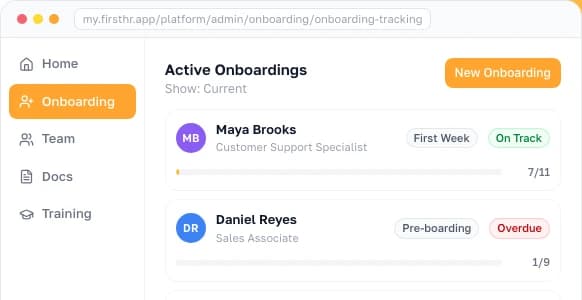
This is the seam where the people layer and the access layer meet, and it is why FirstHR runs onboarding as a workflow rather than a folder: the new hire signs their offer letter, acknowledges the acceptable use and device policies, and appears in the employee record with their start date and manager, so the access checklist has a single source to work from. The same record is what makes the last-day sequence fast.
Run the sequence on the day, not at the end of the week. The most common gap I see in a small company is an email account left live for a month after someone leaves, usually because it was forwarding to a colleague and nobody wanted to break the forwarding. Set up the forward properly and close the account.
Keep the full sequence on your IT offboarding checklist so it runs the same way whether the departure is planned or sudden.
The Policies That Have to Be Written Down
Three technology policies cover most of a small company's exposure: acceptable use, personal devices, and data protection with email security. Two more become necessary the moment the relevant tool appears: a monitoring notice if you monitor anything, and an AI use policy once people start pasting work into chat tools.
| Policy | What it settles | Where it gets tested |
|---|---|---|
| Acceptable use | What company accounts, devices, and networks may be used for, and what happens when they are not | The first time someone installs software the business did not buy and did not review |
| Personal devices at work | Whether personal phones and laptops may hold company data, and what the business may do to that data | The day a personal phone carrying the shared inbox leaves with its owner |
| Electronic monitoring notice | What the company monitors and the written notice employees receive before it starts | A state notice requirement discovered after the monitoring is already running |
| Data protection and email security | Which data counts as sensitive, where it may be stored, and how payment or wire requests get verified | An urgent payment request that arrives from a familiar name and a slightly wrong address |
| AI tools at work | Which AI tools are approved and what may never be pasted into one | Employee records or customer data typed into a free chat tool to save ten minutes |
Keep them short enough to be read on the first day. An acceptable use policy that runs two pages and gets acknowledged is worth more than a fifteen-page document nobody opens, and a personal device policy earns its place the first time a phone with the shared inbox on it walks out the door.
Monitoring is the one with real teeth. A handful of states require written notice before an employer monitors employee email, internet use, or calls, and the obligation attaches before the monitoring starts rather than after someone objects to it.
New York goes a step further and ties the written notice to the hiring moment. Notice is also the cheapest possible compliance step: a paragraph in onboarding, an acknowledgment on file, and a posted notice where employees can see it.
AI belongs in the policy set now rather than later. The realistic risk at small scale is not a rogue model. It is an employee pasting a customer list or a personnel file into a free tool to speed up a task.
In the policy, name the approved tools, name the categories of data that never go into any of them, and cover the rest in your broader approach to AI in HR.
Why New Tools Fail and How to Roll One Out
New tools fail for reasons that have almost nothing to do with the tool: no named owner, no migration of the one thing people would go back for, training delivered once in a meeting, and the replaced system left running. Fixing those four is worth more than a better product choice.
The step teams skip is the last one, and it is the costly one: with two systems running in parallel, every question about which one is current costs someone ten minutes. Pick the date at the start of the rollout, put it in writing, and treat the cancellation as part of the launch rather than as cleanup.
Rollout also has a documentation half. Where a process is written down determines whether a new hire can follow it without asking, which is the entire argument for keeping process documentation in a company system rather than in a chat history.
A distributed team, or one that works across different hours, has an even stronger case for keeping that documentation in one place: asynchronous communication works only when the answers exist somewhere findable, and a shared home for policies and process, whether that is a wiki or an internal portal, is what makes that possible.
Not every problem needs a new subscription. Before buying, check whether a tool you already pay for does the job adequately, because a mediocre feature inside a system people already open beats an excellent tool they have to remember to visit. That instinct is usually what separates a stack the team can name from a stack you only meet again on the statement.
Frequently Asked Questions
What is technology in the workplace?
Technology in the workplace covers every device, program, and network a company relies on to get work done, keep people connected, and keep a record of what happened. Think of laptops and phones, the office network, chat and video calls, the applications specific to your trade, the systems holding employee records and payroll, the sign-in and security controls that decide who can reach what, and the places where files and email are stored. Small businesses rarely plan any of this. Tools pile up one at a time, each bought by whoever ran into a problem first. So the useful management question is not which product is best in the abstract. It is which layers you already have, who is responsible for each one, and what happens to a person’s access on the day they join or leave.
What are examples of workplace technology in a small business?
A typical small business stack has six layers with a few tools in each. Devices and network cover laptops, phones, and wifi. Communication and collaboration cover a chat tool, video calls, and a shared document space. Work applications are industry specific: accounting software, a point of sale, customer relationship management (CRM) software, scheduling, or design tools. People systems cover employee records, onboarding workflows, e-signature, time tracking, payroll, and training. Identity and security cover multi-factor authentication, a password manager, and permission levels. Records and storage cover company file storage, email archives, and document retention. The list is usually longer than anyone expects, because tools accumulate one problem at a time and overlap goes unnoticed until someone puts every subscription on a single page.
What are the benefits of technology in the workplace?
The benefits that hold up at small scale are speed, continuity, and evidence. Speed comes from removing the manual steps between people: a request that routes itself, a document that is signed the same hour it is sent, a schedule everyone can see. Continuity comes from work living in company systems rather than in one person’s inbox or laptop, so a departure or a vacation does not take a process with it. Evidence comes from timestamps, completion records, and access logs, which is what you need when an agency, an auditor, or a former employee asks what happened and when. What technology does not deliver is judgment. It routes work faster, but it will not decide who owns an unclear task or fix a process the team never agreed on.
What are the risks of workplace technology for a small business?
Four risks matter more than the rest at this size. The first is account takeover, because a small company usually has a handful of accounts that control everything, and shared logins without multi-factor authentication are a common entry point. The second is data leaving with people: former employees keeping access, company files in personal drives, and shared credentials nobody rotated. The third is cost drift, where per seat pricing and forgotten renewals grow faster than headcount. The fourth is legal exposure from tools used without the policy that should accompany them, especially monitoring software, personal devices holding company data, and AI tools receiving employee or customer information. Each has a cheap fix that has to happen before the incident, not after it.
What technology policies does a small business need?
Three policies cover most of the exposure, and two more become necessary once the relevant tools show up. The first is acceptable use, which spells out how company accounts, devices, and networks can be used and the consequences when they are misused. The second covers personal devices: can employees keep company data on their own phones and laptops, and what can the business do to that data when they leave? The third combines data protection with email security, naming the sensitive data, where it is allowed to live, and the check that happens before a payment request is honored. If you monitor email, internet use, or calls, add a monitoring notice, because several states require written notice up front. Once staff begin pasting work into chat tools, add an AI use policy as well.
How do you get employees to actually use a new tool?
Treat adoption as a rollout problem rather than a training problem. Start by naming one owner and writing down the single problem the tool is meant to solve. Then let two or three people who are frustrated with the current process try it on real work for about two weeks, because their feedback shows whether it holds up in a busy week. Before launch, find the one document or history that would drag people back to the old system and move it across. Teach only the three things people do every day, and answer questions in the team channel for the first couple of weeks. Finally, pick a date to switch off the old tool and stick to it. Paying for two systems at once means paying twice and keeping your records in two places.
Who should own technology decisions in a company with no IT department?
Give each tool one named owner rather than waiting for a department that does not exist. The person who does the work every day should own the work application. Whoever handles HR alongside their other duties should own the people systems. The founder or operations lead should own identity and security, because nobody else naturally fits that role. Put each owner’s name beside the renewal date on a single list. At this size, that list is your whole governance process: it tells you who to ask, who approves a change, and who cancels a subscription. The real danger is not a bad decision. It is a tool that everyone uses and nobody is responsible for.
Make HR the easy part of running your business
Onboarding, e-signatures, training and core HR in one place. Up and running in 5 minutes.
- 7-day free trial
- No credit card required
- Cancel anytime