
FirstHR

100+ Questions to Ask New Employees (By Timeline and Role)

The complete guide to new hire check-in questions for small business managers. Questions organized by Day 1, Week 1, 30/60/90 days, plus role-specific add-ons and compliance guidance.

Nick Anisimov

Nick Anisimov

FirstHR Founder

Onboarding
18 min

Questions to Ask New Employees

The complete check-in guide for small business managers

You have 44 days. That is how long you have to convince a new hire to stay, according to research from a major HR study of over 1,500 US employees. Within that window, 70% of new hires decide whether the job is the right fit. Miss it, and you are back to recruiting.

The problem is that most small business owners have no idea what to say in those critical early check-ins. You know you should meet with new hires regularly. But what do you actually ask? How do you know if things are going well or if someone is about to quit?

TL;DR
Use a decreasing-frequency, increasing-depth model: daily 10-minute touchpoints in Week 1, transitioning to formal 30/60/90-day reviews. Let the employee drive the agenda in every 1:1 - their items first, yours second. The single most important question at Day 90 is "Is there any reason you would consider leaving?" - take any answer seriously and act within 48 hours. One more thing most guides miss: psychological safety declines over time, not improves, so how you respond to the first few honest answers sets the tone for everything that follows.

This guide gives you everything you need: over 100 questions organized by timeline (Day 1 through 90 days), role-specific add-ons for different positions, a clear meeting structure, and something no other guide covers: what to do when you get concerning answers. Whether you are a founder who has never managed anyone or a team lead preparing for your first direct report, this is your complete playbook for new hire check-ins.

Looking for Questions to Ask Your Manager?
This guide is for managers and business owners checking in with new employees. If you are a new hire looking for questions to ask your boss, see our new hire check-in questions guide for the employee perspective.
44 daysto convince new hires to stay
70%decide within first month if job fits
82%better retention with good onboarding
3.4xmore likely to rate onboarding exceptional when manager is involved

Why Check-Ins Matter More at Small Businesses

At a company of 500, losing one new hire is a rounding error. At a company of 15, it is a crisis. Every person represents a larger percentage of your team, your budget, and your institutional knowledge. When someone leaves in their first 90 days, you lose not just the recruiting costs (typically $4,700 per hire) but also the productivity you never got and the time other employees spent training them. The true cost of employee turnover for small businesses often exceeds 50% of the departing employee's annual salary.

The Manager Effect
Gallup research shows managers account for 70% of the variance in employee engagement. Employees are 3.4x more likely to rate their onboarding as exceptional when their manager was actively involved. And 45% of employees who voluntarily left reported that no one discussed their job satisfaction, performance, or future with them in the three months before departure.

Regular check-ins are not just nice to have. They are your early warning system. When a new hire feels confused, overwhelmed, or disconnected, you want to know in Week 2, not when they hand in their resignation. The questions in this guide are designed to surface those signals early, while you still have time to fix things. SHRM reports that up to 20% of employee turnover happens within the first 45 days.

Strong onboarding with regular manager check-ins improves new hire retention by 82% and productivity by over 70%. Yet only 12% of employees strongly agree their organization does a great job onboarding. The bar is low. Consistent, thoughtful check-ins put you ahead of most employers your new hire has ever had.

The Ideal Check-In Schedule for 90 Days

The research consensus points to a decreasing-frequency, increasing-depth model. Start with frequent, short touchpoints to catch issues early, then transition to longer, more substantive reviews as the employee settles in.

Recommended Check-In Schedule
Week 1
Daily or every other day
10-15 min
Logistics, comfort, immediate questions
Weeks 2-4
2-3x per week → weekly
20-30 min
First impressions, early friction, tools
Day 30
Formal review
30-45 min
Expectations vs. reality, integration
Day 60
Formal review
30-45 min
Independence, skill gaps, development
Day 90
Formal review
45-60 min
Performance, retention, career trajectory

This schedule assumes you are the direct manager. If you are a founder or business owner without a formal management structure, you are the manager. Do not delegate these conversations to someone else for the first 90 days.

In Week 1, daily check-ins can be as simple as stopping by their desk (or sending a quick Slack message for remote employees) to ask how things are going. These are not formal meetings. They are quick touchpoints to catch confusion before it compounds.

The 30, 60, and 90-day reviews should be scheduled on the calendar in advance. Send the agenda beforehand so the new hire can prepare. Employees give more thoughtful, honest answers when they know what to expect.

How to Structure Your 1:1 Meeting

A common mistake is treating 1:1s as status updates. The manager asks what the employee is working on, the employee reports progress, and everyone leaves without learning anything useful. Effective 1:1s with new hires follow a different structure.

30-Minute 1:1 Structure
3-5 minPersonal check-inHow are you? How is your week going?
10 minEmployee agenda firstLet them drive. This is their meeting.
10 minManager agendaProgress updates, feedback, onboarding questions
5-10 minGoals and planningReview milestones, set next objectives
2-5 minClosing questionHow can I help you this week?

Let the employee drive. Their agenda comes first. This is their meeting, not yours. If they have nothing to discuss, that is a data point: either they are not comfortable raising issues, or they genuinely have none. Ask follow-up questions to find out which.

Always end forward-looking. The closing question, "How can I help you this week?", signals that you are there to support them, not evaluate them. It also gives you specific action items for follow-up.

Send the agenda in advance. A calendar invite with no context is intimidating. A message saying "Looking forward to our check-in tomorrow. I want to hear how things are going and if there is anything you need from me" sets a collaborative tone.

Day 1 Questions: Building Comfort

Day 1 is not about productivity. It is about making your new hire feel welcome and reducing anxiety. Questions should be warm, low-pressure, and focused on logistics and connection.

Icebreakers and Personal Connection

  • What do you prefer to be called? Any nickname?
  • What is the best way to communicate with you: email, Slack, phone, or in person?
  • What are your hobbies or interests outside of work?
  • What was your first-ever job, and what did you learn from it?
  • What is your go-to coffee or drink order?
  • Do you have any dietary restrictions we should know about for team lunches?

Logistics and Setup

These questions reveal whether your preboarding process worked. If answers are consistently negative, fix the pre-Day 1 experience.

  • Did you receive all the information you needed before today (start time, parking, dress code)?
  • Were you able to access your email and required systems?
  • Is there anything you need right now that would help you feel more settled?
  • Do you know who to go to if you have a question about your responsibilities?

Early Expectations

  • What are you most excited about in starting this role?
  • Is there anything you are nervous or uncertain about?
  • On a scale of 1 to 5, how excited do you feel about your new role?

What to do with the answers: Day 1 answers establish a baseline. Note their communication preferences and follow them. If they mention nervousness about something specific, address it directly or connect them with someone who can help.

Still Using Spreadsheets for Onboarding?

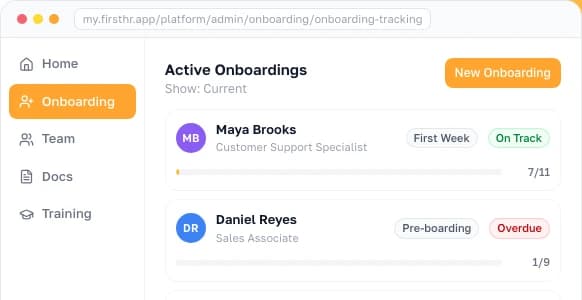
Automate documents, training assignments, task management, and track onboarding progress in real time.

See How It Works

Week 1 Questions: Early Diagnostics

Week 1 shifts toward identifying friction before it compounds. You are looking for signs of confusion, overwhelm, or misalignment between expectations and reality.

First Impressions

  • How has your first week been? Any surprises?
  • What was your first impression of your team and manager?
  • Do you feel welcomed by the team so far?
  • What is one thing we could have done differently to improve your first week?

Role Clarity

  • Do you feel you have a clear understanding of what your role involves?
  • How well do you understand how your role contributes to the company's goals?
  • Is there anything about the onboarding process that felt confusing or overwhelming?

Resources and Support

  • Have you been able to access everything you need (email, tools, accounts)?
  • What tools, resources, or information do you wish you had?
  • Do you know where to find the information you need to do your job?
  • What can I focus on helping you with this week?

Quick Checkpoints

  • Have you completed your onboarding Week 1 checklist?
  • On a scale of 1 to 10, how would you rate the onboarding process so far?

What to do with the answers: If they mention missing access or tools, fix it immediately. If they report feeling confused about their role, schedule time to walk through expectations in detail. A score below 7 on the onboarding rating warrants follow-up: "What would make it a 9?"

30-Day Questions: The Critical Retention Checkpoint

This is the most important check-in. Research shows 70% of new hires decide whether a job is the right fit within the first month. Questions should probe expectations vs. reality, team integration, and early satisfaction signals.

Overall Experience

  • How have your first 30 days been overall?
  • What is going well so far? What do you like most about your role?
  • How is the job lining up with your initial expectations?
  • Are there any challenges or frustrations you are currently facing?

Role and Responsibilities

  • Do your responsibilities match what was described during the interview?
  • Do you have adequate time to do your work, or is there too much or too little on your plate?
  • Do you feel you have the tools and resources to do your job successfully?
  • Is there any specific training you feel you need but have not received?

Team Integration

  • Do you feel like you are integrating well with your team?
  • Has anyone on the team been especially helpful?
  • Do you feel welcomed by staff in other departments?
  • What has your team done to welcome you?

Culture and Satisfaction

  • How do you feel about our company culture?
  • Do you understand your role within the company's mission?
  • Do you feel motivated and fulfilled at work?
  • Does this role provide a good work-life balance?

Forward-Looking

If you have not already, now is the time to review the employee's 30-60-90 day plan and assess progress against milestones.

  • Do you feel you have reached your 30-day goals?
  • What goals do you want to set for the next 30 days?
  • What improvements can we make to the onboarding process?
  • What feedback do you have for me as your manager?
  • Is there anything you want to share that I have not asked about?

What to do with the answers: A mismatch between interview expectations and reality is a red flag that needs immediate attention. If they report feeling isolated from the team, increase social touchpoints. If work-life balance is already a concern at 30 days, something is wrong with workload distribution.

60-Day Questions: The Ownership Phase

By Day 60, employees should be taking initiative and working more independently. Questions probe for growing confidence while identifying lingering skill gaps or support needs.

Progress and Confidence

  • How do you feel after your second month with the company?
  • What is something you discovered recently that you wish you had known sooner?
  • Is this job still what you expected?
  • Do you find your position challenging but not overwhelming?

Feedback and Development

  • Are you getting constructive and timely feedback on your performance?
  • Are there things missing from your training?
  • What skills do you need to develop to improve?
  • How are your colleagues and manager supporting your development?

Workload and Support

  • Do you have enough, too much, or too little work?
  • Do you have a clear understanding of what is expected of you?
  • What challenges are you facing right now?
  • What are the missing pieces you would like to learn in the next 30 days?

Team Dynamics

  • Have you met everyone on the team? Are your team members supportive?
  • Do you feel respected and valued by your coworkers?
  • Are you creating a healthy work-life balance?

Goal Setting

  • What goals should be your priority going forward?
  • Has your manager worked with you to develop goals?
  • What can we do to improve the effectiveness of new employees during their first 60 days?

What to do with the answers: If they still feel like they are missing key skills at 60 days, your training process has gaps. Address specific development needs immediately. If they are not getting regular feedback, that is on you as the manager.

90-Day Questions: Performance and Retention

The 90-day review shifts from "settling in" to "growing here." This is your first performance-oriented conversation and a critical retention decision point. Questions should assess both their performance and their commitment to staying.

Satisfaction and Fit

  • Are you happy with your decision to accept this job?
  • What do you look forward to when you come to work each day?
  • What would make your job more satisfying?
  • What do you like least about working here?
  • What motivates you in your position?

Expectations and Surprises

  • What has been the most surprising about your role? About the company?
  • How has the role lived up to your expectations?
  • Do you feel that your onboarding process was successful?
  • How would you grade our onboarding program?

Performance Self-Assessment

  • How would you rate your own job performance so far?
  • What talents do you have that are not being used?
  • If you could change something about your job, what would it be?
  • Are you satisfied with your current responsibilities?

Team and Manager Relationship

  • What can your team and manager do to support you better?
  • How do you like to be recognized for accomplishments?
  • Who has been most helpful during the learning process?
  • How do you feel you fit in with the team?
  • Do you feel comfortable bringing suggestions to your manager?

Retention Signals

  • Is there any reason you would consider leaving?
  • Do you feel like you belong at this company?
  • What would you tell a friend who was about to start working here?

Career Development

  • How do you see your role progressing?
  • How do your career goals align with the company's vision?
  • What skills or knowledge do you need to develop to reach your professional goals here?
  • Where would you like to see yourself long-term with the company?

What to do with the answers: The question "Is there any reason you would consider leaving?" is your most important retention signal. Take any answer seriously. If they mention concerns, address them immediately. A 90-day employee who is already thinking about leaving will leave unless something changes.

Role-Specific Questions

The questions above work for any role. But different positions have different onboarding needs. Add these role-specific questions to your check-ins based on who you are onboarding.

Sales
How confident do you feel with the product pitch?
Have you shadowed enough calls?
Do you understand the sales process and CRM?
Developer
Is the codebase documentation clear?
Do you have all the access you need?
How is pair programming going?
Customer Support
Do you feel ready to handle tickets solo?
Are the support scripts clear?
What customer questions stump you?
Admin/Operations
Are the processes documented clearly?
Do you know who handles what?
What tasks feel unclear?

Sales and Business Development

Sales roles have unique pressures: quotas, territory, and pipeline building. Check in on these early.

  • Do you understand your territory and target accounts?
  • Do you feel confident with our sales process and CRM?
  • Have you had enough product training to speak confidently with prospects?
  • Are your quota expectations clear and realistic?
  • Do you have access to enough leads to build your pipeline?
  • What objections are you hearing that you do not know how to handle?

Customer-Facing Roles (Support, Success, Service)

These roles face customers immediately. Preparation and escalation paths are critical.

  • Do you feel prepared to handle customer inquiries independently?
  • Do you know when and how to escalate difficult situations?
  • Have you shadowed enough calls or tickets to feel comfortable?
  • Do you understand our SLAs and response time expectations?
  • What customer questions have come up that you did not know how to answer?
  • Do you feel supported when dealing with frustrated customers?

Administrative and Operations

Admin roles often lack structured onboarding. They are expected to figure things out. Do not assume they will.

  • Do you have access to all the systems and files you need?
  • Are the processes you are responsible for documented somewhere?
  • Do you understand the priorities when multiple people make requests?
  • Who do you go to when you need approval for something?
  • Is anything taking much longer than it should because of missing information or access?

Technical Roles (Developers, Engineers, IT)

Technical hires need access, documentation, and clear ownership. Blockers kill productivity.

  • Do you have access to all the repositories, environments, and tools you need?
  • Is the codebase documentation helpful, or are you figuring things out on your own?
  • Do you understand the deployment process and your role in it?
  • Are expectations for code review turnaround clear?
  • Do you have clarity on what you own versus what requires collaboration?
  • What is blocking you from shipping your first contribution?

Manager/Team Lead Additions

  • Have you had 1:1s with each of your direct reports?
  • Do you understand the performance expectations for your team?
  • What challenges do you see with the team you inherited?
  • Do you have the authority you need to make decisions?
  • Are there team dynamics or conflicts you need help navigating?

Companies Using FirstHR Onboard 3x Faster

Join hundreds of small businesses who transformed their new hire experience.

See It in Action

Remote and Hybrid Check-In Adaptations

Research shows 74% of employees rated remote onboarding as a failure. When you cannot see someone struggling in person, you need to be more intentional about checking in.

Remote Check-In Best Practices
Video on for 1:1s (seeing facial expressions matters). Daily check-ins in Week 1, not just weekly. Send meeting agendas in advance so they can prepare. Ask directly about isolation and connection because they will not volunteer it.

Remote-Specific Questions to Add

  • How is your home office setup working? Do you have everything you need?
  • Are you able to maintain boundaries between work and personal time?
  • Do you feel like you know your teammates, even though you have not met in person?
  • What communication channels work best for you?
  • Are there meetings you feel you should be included in but are not?
  • How can we make you feel more connected to the team?

Hybrid-Specific Questions

  • Are the in-office days working for you?
  • Do you feel equally included whether you are remote or in-office?
  • Is there anything we should change about the hybrid schedule?

For hybrid employees, try to schedule their in-office days during the first few weeks to maximize face-to-face bonding with the team.

Creating Psychological Safety: How to Get Honest Answers

The questions only work if employees feel safe answering honestly. Harvard Business School research by Amy Edmondson reveals something counterintuitive: new hires' psychological safety actually declines over time. They arrive optimistic and open, then gradually learn what is "safe" to say based on how their early feedback is received.

This means your first few check-ins set the tone for every conversation that follows. Handle them well, and you build a foundation of trust. Handle them poorly, and you will only ever get surface-level answers.

Signal That Honesty Is Valued

Model vulnerability first. Share your own uncertainties and mistakes before asking them to share theirs. "When I started here, I was confused about X for weeks before I figured it out. What is confusing you right now?" This signals that confusion is normal, not a performance failure.

Separate learning from evaluation. Explicitly tell new hires that the first 90 days are for learning, not judging. "Right now, my job is to help you succeed, not to evaluate you. I need to know what is not working so I can fix it."

Ask permission before giving feedback. "Can I share an observation?" before offering criticism shows respect for their autonomy and makes them more likely to share their own observations with you.

Respond Correctly When They Do Open Up

Never punish honesty. If someone tells you something is not working and you react defensively, you have taught them to stop telling you things. Even if their feedback stings, thank them for it.

Follow up visibly. When someone raises a concern and you address it, tell them. "You mentioned the documentation was confusing. I updated it this week. Does it make more sense now?" This teaches them that feedback leads to action.

Do not share their concerns without permission. If they mention a problem with a coworker, do not immediately go to that coworker unless the new hire agrees. Violating confidence once destroys trust permanently.

Offer Alternative Channels

Some things are hard to say to your boss face-to-face. Give new hires other options.

Assign a peer buddy who is not the manager. New hires are often more honest with peers during early weeks. Make sure the buddy knows their role is to surface concerns, not just answer questions.

Use anonymous channels for sensitive topics. A simple anonymous survey at Day 30 can capture what face-to-face conversations will not. Ask one question: "What is one thing you wish were different about working here?"

Create a skip-level option. Let new hires know they can talk to your manager if they have concerns about you. This is uncomfortable but necessary. If there is a problem with the direct manager relationship, there needs to be a safe way to surface it.

The Feedback Loop Killer
The fastest way to destroy psychological safety: ask for feedback, receive it, then do nothing. Within two check-ins, employees learn that honesty is pointless. If you ask, you must act, or at minimum explain why you cannot.

What NOT to Ask: Compliance Essentials

This is where many small business owners get into trouble. Without HR training, it is easy to stumble into legally protected territory during casual conversations. These questions violate EEOC guidelines and could expose your business to discrimination claims.

Questions to Avoid (EEOC Protected Categories)
Avoid: "Where are you from?"
Instead: "What do you like about the area you live in?"
Avoid: "How old are you? When did you graduate?"
Instead: "Tell me about your career path so far."
Avoid: "Are you married? Do you have kids?"
Instead: "What do you like to do outside of work?"
Avoid: "Do you have any health conditions?"
Instead: "Is there anything we can accommodate to help you succeed?"
Avoid: "What religion do you practice?"
Instead: "Are there any scheduling needs we should know about?"
Avoid: "What was your previous salary?"
Instead: "(Avoid entirely in states where this is illegal)"

The general rule: If a question touches on race, age, religion, national origin, marital or family status, disability, or (in many states) salary history, do not ask it. Stick to questions about work performance, role fit, and professional development.

If you need to discuss scheduling accommodations (for religious practices, medical appointments, or childcare), let the employee bring it up. You can ask "Is there anything we can accommodate to help you succeed?" without specifying the category.

What to Do With the Answers

The questions only matter if you act on the answers. Here is how to translate check-in conversations into action.

Track Responses Over Time

Keep notes from every check-in. A simple spreadsheet works: date, key themes, concerns raised, action items. This lets you spot patterns (the same issue coming up repeatedly) and track whether your interventions are working.

What to track for each check-in: overall sentiment (1-5 scale, your assessment), top concerns mentioned, specific action items with deadlines, follow-up items for next check-in, and any red flags or retention risks.

After 3 to 4 hires, review your notes for patterns. If every new hire struggles with the same thing (confusing documentation, unclear role expectations, lack of team introductions), that is a systemic problem in your onboarding process, not individual bad luck.

Red Flag Responses Require Immediate Action

Red Flag Responses and What to Do
If they say:"I am not sure what I should be working on"
Your action:Clarify role expectations immediately. Review job description together.
If they say:"I feel like I am bothering people when I ask questions"
Your action:Assign a buddy. Normalize asking questions in team meetings.
If they say:"The job is different than what I expected"
Your action:Address specific gaps. Determine if fixable or fundamental mismatch.
If they say:"I do not feel like part of the team yet"
Your action:Increase social touchpoints. Schedule informal team time.
If they say:"I am overwhelmed / have too much on my plate"
Your action:Reprioritize tasks. Remove non-essential work for first 30 days.

The Action Framework: If They Say X, Do Y

"I do not have what I need to do my job." Meet within 48 hours to audit exactly what is missing. Is it equipment, software access, information, or training? Fix the gap immediately, then update your preboarding checklist so the next hire does not face the same problem.

"My job is different than what was described." This is a serious misalignment. Meet with the new hire and (if relevant) the hiring manager to identify the disconnect. Either the job description needs updating, or real expectations need recalibrating. Some mismatches are fixable; others are dealbreakers. Find out which you are dealing with.

"I do not feel like part of the team." This is a relationship problem, not a process problem. Assign an onboarding buddy if you have not already. Schedule informal time (lunch, coffee) with team members. Have an honest conversation about what "belonging" would look like to them.

"My manager is not available." If you are the manager, this is about you. Block dedicated time for your new hire. If it is a skip-level concern, address it with the manager directly. Establish a minimum meeting cadence and stick to it.

"I am not sure this is the right fit." Do not panic. Ask what specifically is not working. Sometimes it is one fixable thing (workload, schedule, unclear expectations). Sometimes it is fundamental (wrong role, wrong culture). Either way, you need to know now rather than in three months.

Follow Up Visibly

When a new hire raises a concern, address it and tell them you did. Nothing kills honesty faster than feedback that disappears into a void. If they mentioned that the documentation was confusing, and you updated it, tell them: "Based on your feedback last week, I updated the process docs. Let me know if they are clearer now."

When the News Is Good

Not every check-in surfaces problems. When someone reports that things are going well, celebrate it. Ask what specifically is working so you can replicate it for future hires. Use their positive feedback to reinforce what your team is doing right.

Good feedback is also diagnostic. If a new hire loves working with a particular team member, that person might be a great future onboarding buddy. If they found a specific resource helpful, make sure future hires get it too.

Key Takeaways
  • You have 44 days to convince a new hire to stay - 70% decide on job fit within the first month, which means your Week 1 and 30-day check-ins are the highest-leverage conversations you will have with any new employee.
  • Psychological safety declines over time, not improves: new hires arrive open and optimistic, then gradually learn what is safe to say based on how you respond to their first honest answers - handle those early check-ins poorly and you will only get surface-level answers forever.
  • The 90-day retention question ('Is there any reason you would consider leaving?') is your most important single question - take any non-dismissive answer seriously and act within 48 hours, because a 90-day employee thinking about leaving will leave unless something changes.
  • Let the employee drive the 1:1 agenda: their items first, yours second, always close with 'How can I help you this week?' - this single structural change signals that check-ins are developmental, not evaluative, and dramatically increases honesty.
  • Track notes from every check-in: after 3-4 hires you will see patterns - if every new hire struggles with the same thing (confusing docs, unclear expectations, no team introductions), that is a systemic process problem to fix, not individual bad luck.

Ready to Fix Your Onboarding?

Your new hires deserve a better first day. Let's make it happen.

Start Free Trial

Frequently Asked Questions

How many questions should I ask in each check-in?

For daily or quick check-ins (Week 1), 2 to 3 questions maximum. For formal reviews (30/60/90 days), 8 to 12 questions covering multiple themes. Quality matters more than quantity. One good follow-up question often reveals more than five surface-level questions.

What if the new hire does not open up?

Some people take time to build trust. Keep check-ins consistent even if early conversations feel stilted. Model vulnerability by sharing your own experiences. Assign a peer onboarding buddy who is not the manager because new hires are often more honest with peers. Consider offering anonymous feedback channels for sensitive topics.

Should I send questions in advance?

Yes, for formal reviews (30/60/90 days). Research shows employees give more thoughtful answers when they can prepare. For quick check-ins, spontaneity is fine.

How do I balance being supportive vs. evaluating performance?

In the first 30 days, lean heavily toward support. Frame it as "What do you need to succeed?" not "Are you meeting expectations?" Shift toward performance evaluation at the 60 and 90-day marks, but always maintain the supportive foundation.

What if I discover the new hire is struggling badly?

Address it immediately and directly, but constructively. "I am noticing some challenges. Let us figure out how to get you back on track." Identify whether the issue is training (fixable), role fit (possibly fixable), or fundamental capability (harder to fix). Give them a clear path forward and check in more frequently.

How do check-ins differ for remote employees?

More frequent (daily in Week 1), always with video, and with explicit questions about isolation and connection. Remote employees will not volunteer that they feel disconnected. You have to ask directly.

What is the difference between a check-in and a performance review?

Check-ins are developmental conversations focused on support, feedback, and course correction. Performance reviews are evaluative and often tied to compensation or promotion decisions. The 90-day review blends both: it is your first formal evaluation, but it should still emphasize growth over judgment.

The questions in this guide are your toolkit for the first 90 days. But the real skill is not asking questions. It is listening to the answers and acting on what you hear. Every new hire who feels heard, supported, and valued is one more person who chooses to stay.

At a small business, you cannot afford to lose people in their first quarter. The cost is too high, and the impact on your team is too significant. Regular check-ins with thoughtful questions are your best defense against early turnover and your best investment in building a team that sticks around.

Start with the schedule. Block the time. Ask the questions. Listen to the answers. Do something about what you learn. That is the formula for keeping the people you worked so hard to hire. If tracking all of this in spreadsheets feels overwhelming, FirstHR can help you stay organized through the entire 90-day onboarding journey.

Ready to transform your onboarding?

7-day free trial No credit card required
Start Your Free Trial