Hybrid Work Software: 11 Tools Compared for SMBs
Hybrid work software compared: 11 desk booking, presence, and HR tools, verified pricing, and what a hybrid stack really costs at 25 and 50 people.

Hybrid Work Software: 11 Tools Compared for SMBs
Most products ranking for this search are building systems priced per desk or sold by quote, and two of the strongest options are already inside the email suite you pay for. Eleven tools across the four layers of a hybrid stack, with verified pricing and the desk arithmetic nobody publishes
I run a small company myself, so I read this category the way you probably will, with two questions: what does it cost at our size, and does it fix the problem we actually have? This page answers both for 11 products, sorted by which layer of a hybrid stack they actually cover, with pricing verified in October 2026 and every quote-only vendor marked as such.
Most of the products ranking for this search were built for buildings, not for teams. They price per desk, per room, or per square foot, they assume somebody owns facilities as a job, and several of them will not sell to a small company at all. Robin says plainly that it is designed for organizations of 500 employees and above.
The second thing no roundup mentions is that a large share of readers already own a hybrid work tool. Microsoft 365 Business Basic and above already carried Places work plans and workplace presence, and on April 1, 2026, Microsoft moved Places finder and Places explorer out of Teams Premium into those same licenses. Together, that is the layer most of these vendors charge for. Google Calendar shares working locations on Business Standard and above.
This page also does the arithmetic underneath the purchase that a vendor list skips: how many desks a hybrid team of 25 genuinely needs, and what each billing model costs once you know that number.
What hybrid work software is
Hybrid work software is any tool that answers one of two questions: who is working where on a given day, and which desk or room they get when they come in. Everything else sold under the label is an extension of those two, which is why the category looks incoherent from the outside.
That billing unit is the fault line. Some vendors charge per person, some per desk or room, and a few per active user, which Kadence defines as someone who booked that month and deskbird as any account not set to inactive. For a hybrid team the difference is structural rather than cosmetic, because the entire point of the arrangement is having fewer desks than employees.
The four layers of a hybrid stack
A working hybrid setup has four layers, and most companies buy the second one while the fourth is what is actually broken. Naming the layers first stops you comparing a desk map against an employee handbook, and it is worth settling your hybrid model before any of them.
| Layer | The question it answers | Usual billing unit | Compared on this page |
|---|---|---|---|
| Presence and work plans | Who is in the office on Thursday | Included in your email suite | Yes |
| Desk, room, and space booking | Which desk, room, or parking spot they get | Per desk, per room, or per active user | Yes |
| Communication | How the room and the laptops hear the same thing | Per user | No, compared separately |
| HR, policy, and records | What the arrangement is in writing, and who signed it | Flat or per employee | Yes |
The third layer is compared elsewhere on this site rather than here, because chat and video belong with the employee communication apps. Hours are the other thing hybrid complicates, and they sit with time and attendance software. Buying a desk booking tool to fix either is the most common category mistake in this market.
Hybrid work platform, hybrid work tools, and hybrid workforce solutions
These three phrases, along with two close relatives, return overlapping product sets, and the differences between them say more about who is selling than about what you get. Sorting all five out takes one table and saves a wasted shortlist.
| Term | What buyers usually mean | What it actually returns | Useful distinction? |
|---|---|---|---|
| Hybrid work software | A tool for running a split week | Desk booking and workplace platforms | Yes, this is the core category |
| Hybrid work platform | One system covering everything | The larger workplace products, sold by quote | Slight: platform-led searches skew to enterprise |
| Hybrid work solutions | A category to browse | Software plus consulting and services | Least specific of the five |
| Hybrid work tools | Anything that helps a split team | Chat, video, and project tools as well | Drifts away from workplace software |
| Hybrid workforce solutions | Managing a mixed workforce | Staffing services and scheduling software | Different problem: people, not desks |
The last row is the one worth pausing on. A hybrid workforce, meaning a team that mixes office, remote, and field staff, is a scheduling and fairness problem rather than a space problem. No desk map improves it.
11 hybrid work tools at a glance
Grouped by layer rather than ranked, because these products are not substitutes for each other. The Publishes a price column is the one that predicts how your evaluation will go.
| Tool | Layer it covers | Publishes a price | Free tier | Books desks | Entry price |
|---|---|---|---|---|---|
| FirstHR | HR and policy layer | $98 to $198 flat | |||
| Microsoft Places | Presence and work plans | Included from $7 per user | |||
| Google Workspace | Presence and work plans | Included from $14 per user | |||
| Officely | Desk booking in chat | $2.50 per user | |||
| deskbird | Desk booking | $3.75 per active user | |||
| Skedda | Desk and space booking | $249 per month | |||
| Envoy | Workplace platform | $5 per bookable resource | |||
| Kadence | Workplace platform | Quote only | |||
| Tactic | Workplace platform | Quote only | |||
| Robin | Enterprise workplace | Quote only | |||
| OfficeSpace | Enterprise workplace | Quote only |
How we evaluated these tools
Every vendor in this category claims to make hybrid work simple, so we set the marketing aside and used four tests that separate the products a small company can actually buy.
The tools you are already paying for
Start here, because for most small companies the presence layer is already bought and switched off. Both major suites now publish where each person plans to work at no extra charge: Microsoft from Business Basic up, Workspace from Business Standard up.
The licensing change on April 1, 2026, is the most consequential thing in this category for a small buyer. Places explorer and Places finder, both previously gated behind Teams Premium, became core features for any license that includes the Outlook and Teams calendar. Work plans, workplace presence, automatic check-in over corporate Wi-Fi, and hybrid RSVP on meeting invites were already core. For a small team on Business Standard, that is the entire coordination layer at no marginal cost.
The catch is individual desks. Booking a specific desk moved from a per-user Teams Premium license to a per-space license, so each desk you want reservable needs a Microsoft Teams Shared Space license, with three free single-space licenses granted for each one purchased. Rooms and workspaces still book without it. Auto-release and occupancy reports need the same space license, and Places features do not work for mailboxes still hosted on Exchange on-premises.
Working locations put a marker on each day of a person's calendar showing home, office, or somewhere else, visible to anyone with free or busy access, and a day can be split for people who come in after lunch. For a team whose only real problem is not knowing who will be in on Thursday, that solves it inside a tool everyone already opens.
The edition rules are worth checking before you promise anything. Working locations are supported on Business Plus, the Enterprise editions, and the Education and Nonprofit tiers. Business Standard users can share a location as well, but an administrator cannot turn the feature on or off on that edition. Business Starter at $7 is out. There is also no desk inventory: Calendar tells you someone is in the office, not where they will sit.
Desk booking built for a small office
These three publish their prices, sell self-serve, and work in a small office with nobody running facilities as a job. If the suite you own has stopped being enough, this is where to shop.
Officely lives where the conversation already happens. People declare an office day and claim a desk from inside Slack, which removes the single biggest failure mode in this category: a booking tool nobody opens. At $2.50 per user it is also the cheapest published rate here, and the free tier covers 5 users with the full feature set rather than a stripped demo.
The dependency cuts both ways. Feature coverage in Microsoft Teams is thinner than in Slack, so a Teams shop gets the weaker half of the product. Meeting rooms and parking are separate per-space subscriptions rather than part of the desk plan, and there is no floor plan or space analytics worth the name, which makes it a poor fit if the real question is whether to renew a lease.
On a small business list, deskbird earns its place with a published entry rate and a free Starter plan that stays free for up to 15 users after the trial. Business bills per active user, and deskbird's terms count every account not set to inactive, so the bill tracks headcount rather than bookings. Desks, rooms, and parking sit in one product rather than three subscriptions.
Of the paid tiers, only Business is priced publicly. Advanced booking rules, advanced analytics, the AI floor plan designer, and workplace ticketing all sit on Professional, which is quote-only, so the interesting half of the product has no visible price. Check-ins and smart recommendations are useful but ordinary, and nothing here addresses the policy side of hybrid at all.
Skedda inverts the usual model by charging for spaces and leaving users unlimited, which is the right shape for a hybrid company. Headcount can double without the bill moving, and a 35-space allowance covers a 60-person office running a two-day-a-week pattern. The rules engine is the strongest here for anyone whose spaces have genuine constraints, such as bookable studios, labs, or client rooms.
The US entry point is the problem for small teams. Plus at $249 a month is the cheapest plan sold in the United States, while the $99 Starter tier with 15 spaces appears only in Skedda's pricing for Europe, the Middle East, Africa, and Asia-Pacific. A 12-desk office in Ohio starts at $249 a month where the same office in Berlin starts at $99, and additional administrators are a $99 add-on on top of either.
Workplace platforms with a wider footprint
These three go beyond desks into visitors, deliveries, floor plans, and space planning. They are worth the step up only if the office itself takes real work to run, rather than being just a room with desks in it.
Envoy treats the front door as part of hybrid work, with visitors, deliveries, and desks in one platform, and for an office with a steady stream of visitors that is a genuine advantage. Reservations at $5 per bookable resource is competitive for a small desk count, and the free visitor tier, capped at 100 entries a month and a 50-person directory, covers a quiet reception outright.
The modular structure is where the cost hides. Reservations, Visitors, Deliveries, Screens, and Response are priced separately. The Reservations, Deliveries, Screens, and Response rates all carry a note that the price excludes a platform fee Envoy does not publish, so the $5 desk rate is not the figure you will pay. Premium visitor management at $362 per location is enterprise money for a single small office.
Kadence is built around the idea that the unit of hybrid coordination is a team rather than a person, which is the right instinct. Its active-user billing, where an active user is someone who made a booking that month, is fairer than a per-seat rate for an office with uneven attendance, and the WorkOps tier bundles booking, visitors, and analytics rather than splitting them into modules.
No subscription price is published. A quote, a one-year minimum, and a $250 charge per floor plan uploaded mean you cannot evaluate this product without a sales conversation, and the setup fee is unusual enough to be worth budgeting for explicitly. For a small business, the process of buying it costs more time than the coordination problem it solves.
Tactic is the most honest of the quote-only vendors, because it publishes a worked example instead of a form. One location with 150 employees and 100 desks lands between $3,600 and $4,800 a year, which is roughly $300 to $400 a month and enough to price yourself before making contact. Pricing follows resources and locations rather than headcount, so a hybrid company is not penalized for people who rarely come in.
The modular approach means the example figure covers desk booking alone. Add rooms, visitors, or analytics and the number moves, and no rate card explains by how much. Onboarding support, floor plans, integrations, and security requirements are all named as pricing inputs, which is a polite way of saying the final number depends on a negotiation.
Enterprise workplace systems
These two rank well for hybrid searches and are the wrong answer for a small business. They are here because recognizing why saves a wasted month of demos.
Robin is one of the most complete workplace platforms in the category, bundling six modules that most competitors sell separately, and its analytics are aimed at the person who has to justify a lease renewal to a board. If you have several floors, hundreds of desks, and someone whose job is the workplace, this is a serious contender.
It also says out loud what most enterprise vendors leave to the second call: the product is designed for companies of 500 employees and above, with at least a third of them in the office regularly. Below that threshold you are not looking at an expensive option, you are looking at an unavailable one, which is a different answer than a listicle implies.
OfficeSpace comes at hybrid from the facilities side rather than the employee side. Stack planning, move management, and scenario modeling are tools for deciding who sits where across a portfolio of buildings, and they are genuinely strong at that job. Desk booking exists inside it, but it is the smaller half of what the product is for.
The buying process tells you who it is built for. Two plans, neither priced in public, no free version, and no trial to poke at over a weekend, so every evaluation starts with a sales conversation and a scoping call. Nothing about a single small office with 10 desks needs stack planning, and entering an enterprise procurement cycle to get a floor plan is the definition of buying the wrong category.
The layer hybrid stacks forget
Every product above manages space. None of them manages the employment arrangement that sits underneath it, and that is where hybrid actually goes wrong in a small company: an unwritten policy, an unsigned equipment agreement, and no record of who agreed to what.
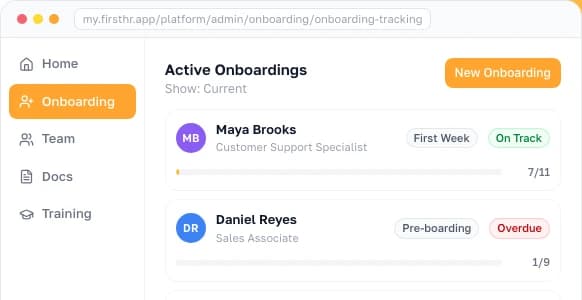
FirstHR holds the half of hybrid that booking tools ignore. The hybrid work policy lives in the handbook with an acknowledgment you can evidence, the equipment agreement gets signed electronically, and a new hire who starts remotely runs the same onboarding sequence as one who starts in the office. Pricing is flat at $98 a month for up to 10 people and $198 for 11 to 50, with larger teams quoted, so there is no per-user arithmetic inside each tier.
The spatial layer comes from the products above: desk maps, room booking, floor plans, presence, and occupancy analytics all sit with the suites and booking platforms. If people are turning up and finding nowhere to sit, one of those products fixes it. If the failure is that half the team has never seen the policy in writing, this is the category that solves it, and a flat-fee HR system covers it without a per-desk or per-user rate.
How many desks you actually need
Fewer than you think, and the gap between headcount and desks is the whole reason this software category exists. Buying before you know your ratio is how companies end up paying per person for desks half of them never use. I have watched a 20-person company buy 20 seats of a booking tool for an office with 9 desks, which is paying for the problem twice.
Turn that into desks. A 25-person hybrid team averaging 2.3 days each produces 57.5 office-days a week, which is 11.5 people in the building on an average day, so 12 desks covers the average. Add about a quarter for the midweek peak and you need 15. The failure case is never the average, it is the Tuesday when everyone shows up at once.
| Team size | Desks at the average | Desks for a midweek peak | What that means for pricing |
|---|---|---|---|
| 10 people | 5 | 6 | Per-user pricing costs double what the desks are worth |
| 25 people | 12 | 15 | A 35-space allowance is already overbuilt |
| 50 people | 23 | 29 | Per-desk pricing comes out slightly ahead at this size |
| Anchor days in use | Peak equals attendance | Peak equals attendance | Fixed days make bookings mostly unnecessary |
The last row matters more than the first three. If you set two fixed anchor days and everyone comes in on them, you do not have an allocation problem, you have a capacity problem, and no software solves that. Booking tools earn their price when attendance is genuinely unpredictable.
What a hybrid stack costs at 25 and 50 people
Between roughly $60 and $250 a month at 25 people for the booking layer, depending entirely on which unit the vendor bills. The table below runs the same scenario through every published model.
| Product and tier | Priced per | 25 people, 12 desks | 50 people, 23 desks | What the rate leaves out |
|---|---|---|---|---|
| Officely Basic | Per user | $63 | $125 | Free to 5 users; runs in Slack, with fewer features in Teams |
| deskbird Business | Per active user, annual | $94 | $188 | Every account not set to inactive counts as active |
| Envoy Reservations | Per bookable resource | $60 | $115 | Excludes an unpublished platform fee |
| Skedda Plus | Per space, 35 included | $249 | $249 | US entry tier; the $99 Starter plan is sold outside the US |
| FirstHR | Flat | $198 | $198 | Covers the HR and policy layer; desk booking comes from a booking tool |
| Microsoft 365 Business Standard | Per user, whole suite | $350 | $700 | Most buyers already pay it; Places finder and explorer included since April 2026 |
| Google Workspace Business Standard | Per user, whole suite | $350 | $700 | Working locations included; admin controls need Business Plus |
| Kadence, Tactic, Robin, OfficeSpace | Quote only | Not published | Not published | Robin states it is designed for 500 employees and above |
Two things stand out. The spread between the cheapest and most expensive published option is about four times at 25 people and half that at 50, because the per-space plan stays flat while per-user and per-desk plans grow with the team. On that arithmetic, Skedda only undercuts deskbird past roughly 65 people and Officely past roughly 100, which is worth knowing before you dismiss a flat rate as expensive.
The other observation is the quote-only row. At these headcounts, four of the best-known names in the category are not expensive, they are unavailable or impractical, and that is the answer a vendor comparison rarely gives you. If your shortlist is all quote-only, you have shortlisted the wrong segment.
Four things no booking tool covers
A desk map records where someone sat, not what you owe them for the day. Four obligations come with a hybrid arrangement, and none of the products above tracks a single one of them.
| Obligation | Why hybrid triggers it | Where it actually lives |
|---|---|---|
| Hours worked away from the office | Non-exempt staff answering messages on a home day are working | Time and attendance records, not a booking log |
| Employment eligibility verification | A hire who starts remotely still needs Form I-9 completed on time | Your onboarding process and E-Verify enrollment |
| Expense reimbursement rules | Several states require paying necessary business expenses at home | Your written policy and payroll process |
| Consistent treatment of remote days | Proximity bias shows up in reviews and promotions, not in bookings | Performance process and manager habits |
The wage rule is the one that surprises founders. The Department of Labor is explicit that work not requested but suffered or permitted is compensable time, which in plain terms means work you allow to happen is work you pay for.
A non-exempt employee clearing messages from the sofa on a work-from-home day has therefore worked, whether or not anyone asked. Hybrid multiplies the chances of that happening and removes the visual cue that used to catch it.
Fairness is the fourth item and the hardest to systematize. In a May 2025 survey, Gallup found hybrid schedules are set by the employee about a third of the time, by a manager or the team a third, and by the employer a third.
The same survey shows why that split matters: 91 percent of employees call the policy fair when their team decides or when they decide themselves, against 73 percent when the employer decides. That is a management decision your booking software will faithfully record and never make for you.
How to choose hybrid work software
Five questions settle this, and the first two remove most of the market before you take a single demo.
Get the order right: write the office attendance policy first, then run whichever tool you pick against a real week before paying, and watch whether people book at all rather than whether the feature list holds up. A desk booking system nobody opens is worse than the group chat message it replaced.
Frequently Asked Questions
What is hybrid work software?
Software that answers two everyday questions for a split team: who will be working where on a given day, and which desk or room each person gets on an office day. It splits into four layers. Presence and work plans, now included in both major email suites (Workspace from Business Standard up). Desk and room booking, sold from $2.50 per user by Officely, $3.75 per active user by deskbird, $5 per resource by Envoy, and $249 a month by Skedda in the US. Communication, bought separately. And the HR layer holding the policy, the signed agreement, and the records.
How much does hybrid work software cost for a small business?
Roughly $60 to $250 a month at 25 people for the booking layer. Officely Basic works out around $63 a month for 25 users, deskbird Business around $94, and Envoy Reservations around $60 for 12 shared desks. Skedda charges for spaces rather than people, and the entry plan sold in the United States is $249 a month with 35 spaces included. Kadence, Tactic, Robin, and OfficeSpace publish nothing at all. If you already pay for Microsoft 365, or Google Workspace from Business Standard up, the presence layer adds nothing.
Is there free hybrid work software?
Three kinds, each with its own limit. Officely is free for 5 users with all features, and deskbird stays free for up to 15 users on its Starter plan; both suit a very small office and end abruptly. Envoy gives away visitor management at 100 entries a month with a 50-person directory, but desk reservations sit on the paid product. The third and best kind is what you already own: Microsoft 365 licenses include Places work plans, and since April 1, 2026, Places finder too, while Google Calendar shares working locations from Business Standard up.
Do I need desk booking software for a small office?
Usually not until desks become scarce. With hybrid attendance averaging 2.3 days a week, a 25-person team needs roughly 12 desks, and if you have more than that nobody is competing for a seat. Booking software earns its price when people arrive and find nowhere to sit, when unused reservations need releasing automatically, or when you need occupancy evidence for a lease decision. Before that, a shared calendar and two fixed anchor days do the same job for nothing.
What is the difference between a hybrid work platform and hybrid workforce solutions?
A hybrid work platform is a product; hybrid workforce solutions is a category label that mixes software, services, and management practice. The first phrase surfaces desk booking and workplace systems, the second surfaces staffing and scheduling for teams that combine office, remote, and field staff. Hybrid work tools is broader still and pulls in chat and video. None of it changes the decision: work out which of the four layers is broken, then shop inside that layer.
Do Microsoft 365 and Google Workspace include hybrid work tools?
Both do. Microsoft Places work plans, workplace presence, and automatic location detection were already core features on any license including the Outlook and Teams calendar, which covers Business Basic, Standard, and Premium. Since April 1, 2026, Places finder and Places explorer are core on those licenses too. Individual desk booking moved to a per-space license rather than Teams Premium. Google Calendar working locations are available on Business Standard and above, with administrator control starting at Business Plus. Check what you own before buying a third product.
What should a hybrid work policy cover before you buy software?
Which days the office expects people, how schedules get set, what the company pays for at home, how hours are recorded for non-exempt staff, and how a change gets requested. Fixed anchor days remove most coordination work before any tool is involved, and schedules set by the team or the employee score far higher on fairness in Gallup data than employer-set ones. Write it down, get it acknowledged, and keep the acknowledgment somewhere retrievable, which is the job of your employee handbook rather than a booking app.
Make HR the easy part of running your business
Onboarding, e-signatures, training and core HR in one place. Up and running in 5 minutes.
- 7-day free trial
- No credit card required
- Cancel anytime