
Employer of Record Colombia: 6 Providers Compared
Hiring in Colombia through an employer of record: prima de servicios, cesantías, social security costs, and six providers compared on published pricing.

Employer of Record Colombia: 6 Providers Compared
What Colombian law adds to a salary before any provider touches the hire, why the arrangement itself is regulated there, and six employer of record providers compared on the prices they publish
The first Colombian offer I priced, I built the model on twelve monthly salaries plus a rounded allowance for payroll tax. Both halves were wrong: Colombian pay carries a statutory service bonus settled in June and December, a savings entitlement that leaves your account every February, and interest on that entitlement paid in cash every January.
This guide covers what Colombian law adds on top of gross salary, the one legal question specific to Colombia that a US buyer should ask early, and six providers compared on published pricing. Every legal and contribution figure below was checked against Colombian government sources in October 2026.
An employer of record handles the mechanics: it employs your hire through its own Colombian entity, affiliates them with the health, pension, and risk carriers, runs local payroll in pesos, and carries the employer obligations, while you keep the work, the salary decision, and the relationship. What it does not do is change the arithmetic underneath, or make the arrangement automatically lawful.
How an employer of record works in Colombia
An employer of record employs your Colombian hire through a Colombian legal entity it already holds, so you can put someone on a compliant local payroll without registering a company in Colombia. You choose the person and the pay; the provider signs the contract and takes on the employer obligations.
The Colombian mechanics run through four carriers rather than one agency. Every employee is affiliated with a health insurer, a pension fund, an occupational risk insurer, and a family compensation fund, and every month those contributions are declared together on a single integrated form. Getting the affiliations filed before the first day is the provider's job, which is why signed paperwork is requested earlier than a US onboarding process would ask for it.
| Function | The provider | You |
|---|---|---|
| Employment contract | Drafts and signs it in Spanish under Colombian law | Agree on the role, the salary, and the contract type |
| Social security affiliations | Files with the health, pension, risk, and compensation carriers | Return signed paperwork before the start date |
| Payroll and withholding | Calculates, pays in pesos, and files the monthly contribution form | Fund each cycle |
| Mandatory extra payments | Pays the prima in June and December and deposits the cesantías | Budget them as pay rather than as a bonus |
| Statutory benefits | Vacation, transport allowance, and work clothing where they are owed | Decide anything above the minimum |
| Day-to-day management | Nothing | Objectives, direction, performance, and promotion |
| Termination | Executes it and calculates the indemnity under Colombian rules | Make the decision and give the provider warning |
The right-hand column is the part vendors underplay. A provider takes on the administration and the employer obligations, not your judgment. You still recruit, still decide, and still own whatever onboarding experience the person actually gets in their first month, five time zones or one away.
Whether the arrangement is legal in Colombia
The model is lawful when the provider genuinely employs your hire through its own Colombian entity on an ordinary employment contract. What Colombian law restricts is labor intermediation, meaning the supply of workers to perform another company's permanent core activities, and that distinction is sharper there than in most markets US founders hire in.
Article 63 of Law 1429 of 2010 prohibits staffing the permanent core activities of a business through intermediation arrangements that erode statutory rights, and it authorizes the labor ministry to fine offenders up to 5,000 monthly minimum wages. At the 2026 figure that ceiling is COP 8.75 billion, roughly US$2.8 million.
Supplying temporary staff is reserved to licensed temporary services companies, and only for narrow situations such as covering leave or a seasonal peak, for six months renewable once.
Article 34 of the Labor Code, rewritten by the 2025 labor reform, adds the practical teeth. Whoever contracts for work or services is jointly liable with the contractor for the wages, benefits, and indemnities owed to that contractor's workers, unless the work is foreign to the ordinary activities of the business.
Joint liability is the mechanism a Colombian claim would travel along, and it is the reason the structure your provider actually uses is worth an early question.
Prima, cesantías, and the payments a US budget forgets
Colombian law layers extra employer payments on top of salary that a US payroll has no line for, and the four accruals among them are worth about 21.8 percent of pay before a single social security contribution is counted. They are entitlements, not bonuses, and they cannot be negotiated away.
| Payment | What it is worth | When it lands |
|---|---|---|
| Prima de servicios | 30 days of salary a year, about 8.33% | Half by June 30, the rest inside the first twenty days of December |
| Cesantías | One month of salary a year, about 8.33% | Deposited into the employee’s chosen fund before February 15 |
| Interest on cesantías | 12% a year on the balance, about 1% of pay | Paid to the employee in January |
| Paid vacation | 15 working days a year, about 4.17% | Earned over a year of service, scheduled by agreement |
| Transport allowance | COP 249,095 a month in 2026 | Owed on pay up to two minimum wages, and it counts in the prima and cesantías base |
| Work clothing and shoes | One set every four months | April 30, August 31, and December 20, on pay up to two minimum wages |
The cesantías rule is the one that catches people. The balance is not yours to hold: under article 99 of Law 50 of 1990 it goes into the fund the employee picks, before February 15, and a late deposit costs one day of salary for every day of delay.
The 2025 labor reform added a monthly option for the cesantías, letting an employer pay 8.33 percent of the base into the fund as it accrues, which smooths the cash flow considerably.
The prima behaves differently again, because it is paid to the employee rather than banked: half by June 30 and the rest in the first twenty days of December. If your provider bills you monthly, you never see the spike. If it bills the accruals as they fall due, June and December are heavy months, and that is worth knowing before the invoice arrives.
What a Colombian hire costs on top of gross
Employer costs add roughly 38 percent to gross pay for a typical Colombian hire, or roughly 52 percent when one tax exemption does not apply. Unlike a US payroll tax, the load arrives as several separate items with different bases, different ceilings, and different due dates. Two of them fund SENA, the national training service, and ICBF, the family welfare institute.
| Employer cost | Rate on monthly pay | Notes |
|---|---|---|
| Pension | 12.00% | The employer covers 75% of the 16% total and the employee pays the rest |
| Health | 8.50% | Waived on pay under ten minimum wages at a corporate employer |
| Occupational risk cover | 0.522% to 6.96% | Set by risk class, and desk work sits at the bottom of the table |
| Family compensation fund | 4.00% | Owed on every employee, with no exemption available |
| SENA and ICBF | 2.00% and 3.00% | Waived on the same terms as the health contribution |
| Prima, cesantías, interest, and vacation | About 21.8% | Accrued monthly, paid out on their own calendar |
| Total employer load | About 38%, or about 52% without the exemption | Before the provider fee and before any currency markup |
That exemption is the single biggest variable in the whole calculation. Article 114-1 of the tax code, added by the 2016 tax reform, relieves companies that file Colombian income tax of the health, SENA, and ICBF contributions for every employee paid less than ten monthly minimum wages, which is COP 17,509,050 a month in 2026.
Most hires a US small business makes in Colombia sit comfortably under that ten-minimum-wage line, so ask your provider to confirm it is applying the relief rather than quoting the gross rates.
Run it on a real number. A salary of COP 6,000,000 a month is about US$1,919 at the official market rate of COP 3,126.08 published for September 5, 2026. Once contributions and accruals are added, that hire costs roughly COP 8,301,000 a month, or about US$2,655. Annually that is close to COP 99.6 million against a headline salary of COP 72 million, and the platform fee sits on top of all of it.
Two things move that dollar figure without anyone renegotiating anything. The exchange rate moves, and the fee is billed in dollars against a peso payroll, so any currency markup applies at every cycle. Comparing providers on the headline fee alone therefore misleads: the fee is a fraction of the story, and the true cost of employing someone is set by Colombian law long before you pick a vendor.
Hours, leave, and ending a contract in Colombia
The Colombian statutory package is a 42-hour standard week, 15 working days of paid vacation a year, a probationary period capped at two months, and no at-will dismissal. None of it is negotiable downward, and no provider can soften it for you.
The working week reached 42 hours on July 15, 2026, the final step of the reduction that Law 2101 of 2021 wrote into the Labor Code, down from 48 hours without any reduction in pay. Hours can be spread over five or six days by agreement, and flexible days of four to nine hours are permitted provided the weekly average holds.
| Term | Colombian position | What a US employer usually expects |
|---|---|---|
| Standard week | 42 hours, the last step of the 2021 hours law | 40 hours a week |
| Probation | Two months maximum, agreed in writing | 90 days |
| Paid vacation | 15 working days a year | 10 to 15 days of paid time off |
| Public holidays | 18 a year, with 10 of them moved to a Monday | 11 federal holidays, not all of them paid |
| Night work | Starts at 7 p.m. and carries a 35% premium | A shift differential, if the company chooses to pay one |
| Rest day and holiday work | 100% premium from July 2027 (90% until then) | Overtime only past 40 hours |
| Dismissal without cause | 30 days of pay for a first year, 20 for each year after | At-will in almost every state |
| Default contract | Indefinite, with fixed terms capped at four years | An at-will offer letter |
Two premiums moved under the 2025 labor reform, and both raise the cost of covering US hours from Bogotá. The first covers night work, which now starts at 7 p.m. rather than 9 p.m. and carries a 35 percent premium.
The second premium covers work on a Sunday, another agreed rest day, or a public holiday, and it is 100 percent from July 1, 2027 (the phase-in sets 90 percent until then). Colombia also observes 18 paid public holidays a year, 10 of which shift to the following Monday.
Termination is arithmetic rather than a conversation. Dismissing an employee paid under ten minimum wages without a proven just cause costs 30 days of salary for a first year of service, plus 20 days for every subsequent year and pro rata for part of one, on top of accrued prima, cesantías, interest, and unused vacation.
Maternity leave runs to 18 weeks and paternity leave to two weeks, both funded through the health system rather than out of your budget, provided contributions are current.
Employer of record providers for Colombia compared
Six providers, compared on the fees they publish rather than the fees a salesperson mentions. All six publish a rate for employment, though for some it is a starting rate rather than a fixed fee.
| Provider | Published employment fee | Contractor fee | Notes |
|---|---|---|---|
| Deel | $599 per employee monthly | $49 per contractor monthly | Publishes its rate; US professional employer organization (PEO) product at $125 per employee monthly |
| Remote | $599 per employee monthly billed annually, $699 month to month | $29 per contractor monthly | Says it owns its legal entities; payroll product at $29 per employee monthly |
| Oyster | $699 per employee monthly | Free for 30 days, then $29 monthly | Annual discount offered; HR expert time included, project-based People Partner Services at $300 an hour |
| Papaya Global | From $499 per employee monthly | From $5 per contractor monthly | Contractor of record priced separately from $199 per contractor monthly |
| Multiplier | From $459 per employee monthly billed annually, $499 month to month | $40 per contractor monthly, billed annually | Growth plan from $519; about 11 percent of countries carry adjusted pricing |
| RemoFirst | From $199 per employee monthly | Free, or $25 on the premium tier | Lowest published fee in this group |
Two patterns show up immediately. The published band runs from $199 to $699 per employee monthly, a spread of $6,000 a year on a single Colombian hire, which is real money at small headcount. And the more useful question in Colombia is not price at all: it is whether the provider will tell you in writing which entity employs your person, and on what legal basis it does so.
The six providers reviewed
Deel publishes its employment rate, something not every provider in the wider category does, and at $599 per employee monthly it sits mid-band in this group. For a US company making a first Colombian hire, the practical draw is that contractor management and employment sit in one account, which fits the common Latin American shape of two contractors in Mexico or Argentina and one employee in Medellín.
What to press on is Colombia specifically. Deel says it owns entities in more than 130 countries, and its own blog lists Colombia among its top countries with Deel-owned entities, but neither its pricing page nor its Colombia hiring page names the Colombian entity.
Which entity signs your hire's contract decides who is accountable if an affiliation is filed late or a dismissal is challenged. Ask Deel for the Colombian contract template too, and read the intellectual property clause, because your hire contracts with the provider and not with you.
Remote states on its own pricing page that it owns its legal entities rather than routing through local partners, and its Colombia country page says the same of Colombia specifically, which buys something concrete. Someone has to sign the contract, file the affiliations, and answer for the arrangement if a court examines it, and a single named entity shortens that chain.
The trade is price on monthly billing. At $699 per employee month to month, Remote ties Oyster for the highest published fee here, roughly $1,200 a year above the $599 tier. On annual billing, Remote itself charges that lower rate.
Remote also publishes a payroll product at $29 per employee monthly for companies that already hold a local entity, which is the product you move to if you eventually incorporate in Colombia.
Papaya Global was founded in 2016 to put finance, HR, payroll, and payments on one platform. That matters more in Colombia than in most markets, because the employer load is not one number: pension, health, occupational risk, the compensation fund, the two payroll levies, and four accruals have different bases and different due dates. Payroll, payments, and gross-to-net reporting in one place earn their keep at budget time.
Papaya also publishes a starting rate of $499 per employee monthly, $2,400 a year per head below the month-to-month rates of Oyster and Remote. Read the words in front of the number: a starting rate is not a Colombian quote, and the contractor products are priced separately, so a mixed team of employees and contractors needs both lines added up before the comparison means anything.
Oyster publishes a rate and gives contractors a free first month before charging $29. Its pricing page states that setup, onboarding, talking to its HR experts, and processing terminations carry no extra charge and sit inside the subscription fee, which suits a founder who wants one Colombian employee without a separate advisory line to negotiate.
What sits outside that fee is the People Partner add-on, a project-based advisory service from senior in-house experts priced at $300 an hour. Oyster also asks for a refundable deposit to open an employment engagement.
Routine termination processing is included, so the add-on is for the harder questions rather than the standard exit. In Colombia the exit is still the moment you want a person rather than a ticket, because the indemnity, the accruals, and the settlement all have to be calculated correctly the first time.
Multiplier publishes its employment rate at $459 per employee monthly on an annual contract and $499 month to month, which on annual billing sits below every published figure above it in this list.
Multiplier's pricing page leads with a no hidden fees claim, and its FAQ says about 11 percent of the countries it supports carry adjusted pricing, so ask whether Colombia is one of them.
The annual contract is the condition attached to the lower rate. Committing to a year is easy to justify for three or four Colombian employees and harder for a single trial hire. That headcount is also roughly where the economics of this whole category start to move.
RemoFirst publishes the lowest fee in this group by a wide margin, starting at $199 per employee monthly, and states that it charges no setup or termination fees and sets no employee minimum. On one Colombian hire that gap is roughly $4,800 a year against the $599 tier and $6,000 against the $699 tier.
The words in front of the number matter here too, because a starting rate is not a Colombian quote, and the vendor says pricing varies by country. Ask for the Colombian figure in writing, ask which entity signs the contract, and ask what deposit applies. A low monthly fee paired with a large deposit is not a low-cost arrangement.
A provider or your own Colombian company
Use a provider while your Colombian headcount is small, and model your own company once it is not. Colombia is unusually easy to incorporate in by regional standards: under Law 1258 of 2008 a simplified stock corporation is created by a private document filed with the chamber of commerce, with no notarial deed and no fixed minimum capital.
| Route | What it takes to start | What it costs to run | When it wins |
|---|---|---|---|
| Employer of record | A contract and usually a deposit, since the provider already holds the entity | $199 to $699 per employee monthly plus the Colombian employer load | One to a handful of people in Colombia |
| Your own Colombian company | A private document filed with the chamber of commerce, plus tax and social security registrations | Accounting, monthly contribution filings, and 35 percent corporate income tax on profit | Sustained headcount in Colombia |
| Independent contractors | A services contract, if the relationship is genuinely independent | Contractor platform fees from free to $49 per person monthly | Genuinely project-based work only |
The contractor row deserves a warning rather than a recommendation. Engaging someone in Colombia on a services contract while directing their hours and methods is the fastest route to a misclassification finding. Colombia polices contribution evasion through the UGPP, a national unit set up for pension and payroll contributions, rather than leaving it to a general tax review. The product you buy does not decide the classification; the relationship does.
One structure worth knowing about for senior hires is the integral salary. Above ten minimum wages, Colombian law allows a written agreement that folds the prima, the cesantías, their interest, and the premiums into a single figure, with vacation the one entitlement that stays separate.
The integral salary floor is ten minimum wages plus a benefits factor of at least 30 percent, so about COP 22.8 million a month in 2026, or roughly US$7,280. An integral salary simplifies the payroll rather than reducing the cost.
What to ask before you sign
Put these five questions to every provider on your shortlist, in writing and before you sign. In Colombia the answers tell you more than the headline fee.
Before you choose
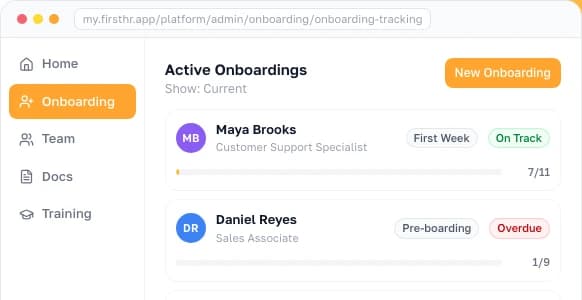
FirstHR covers the part of a Colombian hire that stays with you whichever provider employs the person: the first-week onboarding, the signed documents, the training, and the records. FirstHR is an onboarding and HR platform, not a payroll provider, so the Colombian contract, the peso payroll, and the employer liability come from the providers above.
The provider decision and the HR decision are separate, and people conflate them. Several providers here include onboarding support and HR tools for the people they employ, so a separate layer earns its place when you want the first-week experience, the training the role requires, and employee records in one home across your whole team.
That layer is what we built FirstHR for: onboarding with e-signature on offer letters and acknowledgments, document management, training built from your own files with completion recorded, and employee records, at a flat $98 a month for up to 10 people or $198 for 11 to 50.
Frequently Asked Questions
What is an employer of record in Colombia?
The party named as employer on the Colombian contract, the payslip, and the social security file, while the person works for you in every practical sense. It signs the contract in Spanish, files the affiliations, pays the statutory extras on their calendar, and carries the legal exposure a US company with no Colombian presence cannot carry itself.
How much does an employer of record cost in Colombia?
Fees among the six providers here run from $199 to $699 per employee monthly, and all six publish theirs. Add the Colombian employer load of roughly 38 percent on gross, a deposit in most cases, and any currency markup, since the fee is billed in dollars against a payroll denominated in pesos.
What is the minimum wage in Colombia?
COP 1,750,905 a month for 2026, up 23 percent, with a separate transport allowance of COP 249,095 for employees earning up to two minimum wages. Together they come to COP 2,000,000. Because Colombian law expresses thresholds in minimum wages, that increase also moved the exemption cutoff and the integral salary floor.
What are prima de servicios and cesantías?
Two mandatory payments worth about 16.7 percent of pay between them. The prima is 30 days of salary a year, half by June 30 and half in early December. The cesantías are one month of salary per year of service, deposited into the employee's chosen fund before February 15, with 12 percent annual interest on the balance paid to the employee in January.
What are employer social security contributions in Colombia?
Pension at 12 percent, health at 8.5 percent, occupational risk cover from 0.522 percent to 6.96 percent by risk class, the family compensation fund at 4 percent, and SENA and ICBF at 2 and 3 percent of payroll. Health, SENA, and ICBF fall away for employees paid under ten minimum wages by a corporate employer.
Can you fire an employee in Colombia?
Yes, though never without a number attached, because at-will employment does not exist. Without a proven just cause, ending an indefinite contract costs 30 days of salary for a first year plus 20 days for each year after, for employees under ten minimum wages, on top of accrued prima, cesantías, interest, and unused vacation.
How many hours is a full-time week in Colombia?
Forty-two, reached on July 15, 2026 as the final step of the 2021 reduction from 48 hours, with no cut in pay. Night hours begin at 7 p.m. and carry a 35 percent premium, and work on a rest day or public holiday is paid at a 100 percent surcharge from July 1, 2027 (90 percent in the meantime).
Should I use an employer of record or set up a Colombian company?
A provider first, and a company once the fee per head costs more than running one. A Colombian entity is formed by private document at the chamber of commerce with no minimum capital, but it brings local accounting, monthly filings, corporate income tax at 35 percent, and the administration that comes with all of it.
Make HR the easy part of running your business
Onboarding, e-signatures, training and core HR in one place. Up and running in 5 minutes.
- 7-day free trial
- No credit card required
- Cancel anytime