6 free templates by license level and work type. Download as DOCX or copy-paste.
Plumbing is one of the hardest trades to hire for in America right now. The work is licensed, the labor pool is short, and every journeyman worth hiring is already on someone's payroll, which means your job posting is competing against the job a plumber already has. Most postings lose that competition the same way: a generic title, hidden pay, no mention of the on-call rotation, and requirements copied from a template written for a company ten times your size.
At FirstHR, we build for small businesses that hire without an HR department, and plumbing shops, where the owner writes the posting between service calls, are exactly that. The six templates below cover the real versions of the role: general, residential service, commercial, master, journeyman, and the apprentice posting that opens an entry-level pipeline. Each carries the license, driving, and physical requirements as structured fields. Fill in the brackets, put your real number in, and post.
TL;DR
Six free, ready-to-use plumber job description templates by license level and work type: General, Residential / Service, Commercial, Master, Journeyman, and Apprentice / Helper. Download all six as DOCX files, customize the bracketed fields, and post in minutes. Put the license level in the title, publish the hourly range and the on-call reality, and sell the shop: in a trade this short-staffed, the honest posting wins.
What Does a Plumber Do?
A plumber installs, repairs, and maintains the piping systems that carry water, gas, and waste through homes and buildings: supply lines, fixtures, water heaters, and drainage. The federal occupational data groups plumbers with pipefitters and steamfitters, and describes the shared core of the work as installing and repairing piping fixtures and systems, from determining materials and connecting pipe to pressure-testing for airtight and watertight systems. The O*NET profile for plumbers lists the full task set, from reviewing blueprints and codes to diagnosing failures and directing helpers.
Two structural facts shape any plumber job posting. First, the trade is licensed in nearly every state on an apprentice-journeyman-master ladder, so the license level defines the role more than the duties list does. Second, the work setting splits the job: a residential service plumber diagnosing a leak at a customer's kitchen table and a commercial plumber roughing in a tenant improvement from blueprints hold the same license and live different days. The templates on this page are split along exactly those two lines.
Plumber Duties and Responsibilities
Plumber duties center on installation and repair, diagnosis and inspection, code and safety compliance, and the customer and record-keeping work around the wrench time. The mix shifts by role: service plumbing is heavier on diagnosis and customer communication, commercial work on blueprints and inspections, but the categories hold across the trade. These are the responsibilities grouped the way the templates use them.
Installation & repair
Install and repair pipes, fixtures, and water heaters
Maintain water, gas, and drainage systems
Perform rough-in and finish work on builds and remodels
Diagnosis & inspection
Troubleshoot leaks, clogs, and system failures
Test pressure and inspect completed work
Use cameras and diagnostic tools on drain and sewer work
Code & safety
Work to state and local plumbing code
Prepare work for permits and inspections
Follow OSHA and job site safety practices
Customers & job records
Explain the problem, the fix, and the price clearly
Keep job records, time, and materials accurate
Maintain the truck, tools, and stock
A strong posting picks 8 to 12 specific duties from these categories and grounds them in your job mix: run same-day service calls with upfront pricing, perform backflow testing on commercial accounts, rough in repipes to county code. Vague postings attract vague applicants.
Apprentice vs Journeyman vs Master Plumber: Which Are You Hiring?
The three titles are the state licensing ladder, and the posting should name the rung. Hour requirements and exam details vary by state, but the structure is consistent enough to plan a hire around.
Factor
Apprentice
Journeyman
Master
Experience
Entry level; in training
License exam passed after ~4-5 years
Typically 8-10+ years in the trade
Works
Under direct supervision
Independently on most jobs
Runs jobs and pulls permits
Supervises
No one
Apprentices on their jobs
Journeymen and apprentices
Typical scope
Assists, learns, logs hours
Service and installs start to finish
Bids, planning, code sign-off
License
Registered apprentice (state)
Journeyman license (state exam)
Master license (state exam)
The practical question for a small shop is which rung solves your bottleneck. Too many calls and not enough licensed hands? Journeyman. Nobody to pull permits or price the complex work? Master. Plenty of supervision capacity and a long-term staffing problem? Apprentice, because the registered apprenticeship model lets you build the plumber you cannot hire; the federal apprenticeship system covers how registered programs and hour tracking work.
Which Template Should You Use?
Pick the template that matches the license level and the work type. All six share the same skeleton, summary, duties, requirements, schedule and pay, but the duties and tone shift enough between a kitchen-table service call and a commercial rough-in that the matched version always reads more credibly. Use this guide to choose.
General Plumber
The universal baseline
Install, repair, and maintain systems for a mixed book of work, with license, driving, and physical requirements as fillable fields. Start here if no specific version fits.
Residential / Service Plumber
Customer-facing home service
Service calls in occupied homes: diagnosis at the kitchen table, upfront pricing, on-call rotation stated plainly, and the conduct standards in-home work demands.
Commercial Plumber
Projects and bigger systems
Blueprints and specs, commercial water, waste, and gas systems, backflow testing, trade coordination with GCs, and inspection-ready documentation.
Master Plumber
License holder and crew leader
Pulls permits under the master license, prices the complex jobs, supervises journeymen and apprentices, and serves as the final word on code and quality.
Journeyman Plumber
Licensed and independent
Runs jobs start to finish under their own license, supervises assigned apprentices, and keeps work passing inspection the first time. The core hire for most shops.
Apprentice / Helper
Entry-level, no experience required
The we-train version: registered apprenticeship hours toward the state license, scheduled raises, paid training, and a no-resume-needed application path.
Match the Template to the Bottleneck
The fastest way to choose is by what your shop is short of. Hands on routine work with supervision available? Apprentice. Licensed plumbers to run calls solo? Journeyman, or Residential / Service if the work is in-home. Permits, bids, and crew leadership? Master. Blueprint and buildout work? Commercial. A mixed book of everything? General.
6 Free Plumber Job Description Templates
Download all six as separate Word files in one ZIP, or copy individual templates. Each follows the same structure: company overview, job summary, key responsibilities, required and preferred qualifications, schedule and pay, and how to apply, with the license level, driving record, and physical requirements as structured fields. Fill in the brackets and check your state's licensing terms before posting.
Download All 6 Job Description Templates
General, residential service, commercial, master, journeyman, and apprentice. All as DOCX files in one ZIP.
Template 1: General Plumber
The universal baseline for a mixed book of work: install, repair, and maintain, with license, driving, and physical requirements as fillable fields.
General Plumber Job Description
PLUMBER JOB DESCRIPTION
Company: __
Service area: __
Reports to: [Owner / Service Manager / Lead Plumber]
Employment type: [ ] Full-time [ ] Part-time
Pay range: $_____ to $_____ per hour
ABOUT [COMPANY NAME]
[One or two sentences about your shop: how long you have been in business,
the work you do most, and what it is like to be on your crew.]
JOB SUMMARY
[Company Name] is hiring a Plumber to install, repair, and maintain
plumbing systems for our [residential / commercial / mixed] customers
across [service area]. You will diagnose problems, give customers honest
answers and clear pricing, do clean work that passes inspection, and
represent the company on every job. Company truck, tools policy, and
schedule details below.
KEY RESPONSIBILITIES
•Install, repair, and maintain pipes, fixtures, water heaters,
and drainage systems
•Diagnose leaks, clogs, and system failures and explain the fix
and the price to the customer
•Perform rough-in and finish plumbing on [remodels / new
construction], where assigned
•Work to [state/local] plumbing code and prepare work for
inspection
•Keep accurate job records: work performed, materials used,
time on site
•Maintain truck stock, tools, and equipment in working order
•Follow safety practices on every job site
•Communicate schedule changes and job status with dispatch
•____ + years of plumbing experience in [service / construction]
•Valid driver's license with a clean driving record
•Ability to lift up to ____ lbs, work in crawl spaces and tight
areas, and stand for full shifts
•Professional conduct in customers' homes and businesses
PREFERRED QUALIFICATIONS
•Experience with [tankless water heaters / gas lines / sewer
cameras / your specialty]
•Backflow certification
SCHEDULE, PAY, AND HOW TO APPLY
Schedule: __ (note any on-call rotation)
Pay range: $_____ to $_____ per hour
Perks: __ (company truck, tool allowance,
license renewal paid, boot allowance)
To apply, email __ or call _.
[Company Name] is an equal opportunity employer.
Template 2: Residential / Service Plumber
The customer-facing version: service calls in occupied homes, upfront pricing at the kitchen table, in-home conduct standards, and the on-call rotation stated plainly.
Residential / Service Plumber Job Description
RESIDENTIAL SERVICE PLUMBER JOB DESCRIPTION
Company: __
Service area: __
Reports to: [Owner / Service Manager]
Employment type: [ ] Full-time
Pay range: $_____ to $_____ per hour [+ commission /
performance pay, if applicable]
JOB SUMMARY
[Company Name] is hiring a Residential Service Plumber to run service
calls in customers' homes across [service area]. This is customer-facing
work: you will diagnose problems in occupied houses, present options and
honest pricing at the kitchen table, do clean and respectful work, and
leave every home better than you found it. The plumbing has to be right
and so does the impression.
KEY RESPONSIBILITIES
•Run scheduled and same-day service calls: leaks, clogs, water
heaters, fixtures, toilets, garbage disposals
•Diagnose the problem, explain it in plain language, and present
repair options with upfront pricing
•Complete repairs and installations to code, cleanly, with floor
protection and cleanup on every job
•Respect the customer's home: shoe covers, courtesy, and clear
communication on arrival windows
•Participate in the on-call rotation for emergency calls:
__
•Document jobs, collect payment, and process invoices in
[software/system]
•Restock the truck and report inventory needs
•Flag larger issues (repipes, sewer problems) for estimates
REQUIRED QUALIFICATIONS
•[State] plumbing license at [journeyman / required] level
•____ + years of residential service experience
•Valid driver's license with a clean driving record; company
van provided
•Comfortable presenting prices and getting approval directly
from homeowners
•Ability to lift up to ____ lbs and work in crawl spaces,
attics, and tight quarters
•Background check required (you will work inside customers'
homes; we arrange and pay)
PREFERRED QUALIFICATIONS
•Experience with flat-rate pricing
•Tankless water heater or gas line experience
SCHEDULE, PAY, AND HOW TO APPLY
Schedule: __ (state the on-call reality)
Pay range: $_____ to $_____ per hour [+ incentives]
Perks: __ (take-home van, paid license
renewal, uniforms, no-weekend policy if true)
To apply, email __ or call _.
[Company Name] is an equal opportunity employer.
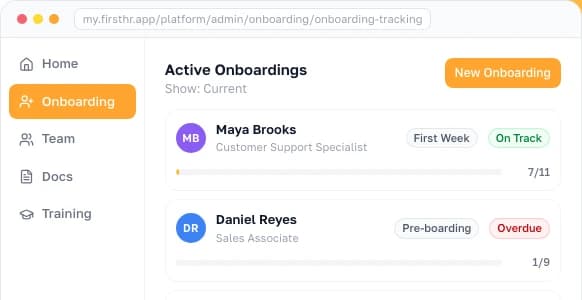
Still Using Spreadsheets for Onboarding?
Automate documents, training assignments, task management, and track onboarding progress in real time.
For projects and bigger systems: blueprints and specs, backflow testing, coordination with GCs and other trades, and inspection-ready documentation.
Commercial Plumber Job Description
COMMERCIAL PLUMBER JOB DESCRIPTION
Company: __
Projects / service area: __
Reports to: [Project Manager / Foreman / Owner]
Employment type: [ ] Full-time
Pay range: $_____ to $_____ per hour
JOB SUMMARY
[Company Name] is hiring a Commercial Plumber for [new construction /
tenant improvement / commercial service] projects across [area]. You
will work from blueprints and specs, install and maintain commercial
systems, coordinate with general contractors and other trades, and keep
your work inspection-ready. This role suits a plumber who likes bigger
systems, reads plans well, and works clean on an active site.
KEY RESPONSIBILITIES
•Read and work from blueprints, specs, and isometric drawings
•Install and repair commercial water, waste, vent, and gas
systems, including [medical gas / grease systems / boilers,
if applicable]
•Perform backflow prevention installation and testing
[certification required or provided]
•Lay out and rough in plumbing for commercial buildouts to
[state/local] code
•Coordinate scheduling and site logistics with GCs,
superintendents, and other trades
•Prepare work for inspections and walk inspectors through it
•Assist with material takeoffs and estimate preparation
•Maintain as-built documentation and daily job logs
•Follow site safety requirements, including trench, confined
space, and lockout/tagout procedures
REQUIRED QUALIFICATIONS
•[State] journeyman or master plumbing license
•____ + years of commercial plumbing experience
•Blueprint and spec reading proficiency
•OSHA ____ [10/30] certification (or willingness to obtain;
we pay)
•Valid driver's license; reliable transportation to job sites
•Ability to lift up to ____ lbs and work from ladders and lifts
PREFERRED QUALIFICATIONS
•Backflow tester certification
•Med gas, boiler, or hydronic experience
SCHEDULE, PAY, AND HOW TO APPLY
Schedule: __
Pay range: $_____ to $_____ per hour
Perks: __ (per diem if applicable, paid
certifications, tool allowance)
To apply, email __ with your license number
and project experience.
[Company Name] is an equal opportunity employer.
Template 4: Master Plumber
The senior trade role: permits under the master license, pricing the complex jobs, supervising journeymen and apprentices, and final say on code and quality.
Master Plumber Job Description
MASTER PLUMBER JOB DESCRIPTION
Company: __
Service area: __
Reports to: [Owner / General Manager]
Employment type: [ ] Full-time
Pay range: $_____ to $_____ per [hour / year]
JOB SUMMARY
[Company Name] is hiring a Master Plumber to lead our field operations:
pull permits under your license, plan and price the complex jobs,
supervise our journeymen and apprentices, and be the final word on code
and quality. This is the senior trade role in the company, with a direct
line to the owner and real influence on how the shop runs.
KEY RESPONSIBILITIES
LICENSE AND CODE AUTHORITY
•Hold the master license the company operates under [if
applicable in your state]; pull and manage permits
•Serve as the final authority on code compliance and quality
before inspection
•Stay current on [state/local] code changes and update crew
practices
JOB PLANNING AND ESTIMATING
•Scope, plan, and price complex jobs: repipes, sewer
replacements, commercial buildouts, custom work
•Prepare estimates and bids; review material takeoffs
•Walk the difficult diagnostics other plumbers escalate
CREW LEADERSHIP
•Supervise and develop ____ journeymen and apprentices
•Run training on code, technique, and safety
•Sign off on apprentice hours for licensing [where applicable]
•Set the standard for customer conduct and job site cleanliness
REQUIRED QUALIFICATIONS
•Active [state] master plumber license in good standing
•____ + years in the trade (typically 8-10+), including
supervisory experience
•Estimating and job-costing experience
•Deep knowledge of [state/local] plumbing code and the permit
process
•Valid driver's license with a clean record
PREFERRED QUALIFICATIONS
•Backflow tester and/or med gas certification
•Experience growing or running a service department
COMPENSATION AND HOW TO APPLY
Pay: $_____ to $_____ per [hour / year]
Perks: __ (truck, phone, license fees paid,
profit share or bonus structure if offered)
To apply, email __ with your license number
and a summary of the largest jobs you have run.
[Company Name] is an equal opportunity employer.
Template 5: Journeyman Plumber
The core hire for most shops: runs jobs start to finish under their own license, mentors assigned apprentices, and keeps work passing inspection the first time.
Journeyman Plumber Job Description
JOURNEYMAN PLUMBER JOB DESCRIPTION
Company: __
Service area: __
Reports to: [Master Plumber / Service Manager / Owner]
Employment type: [ ] Full-time
Pay range: $_____ to $_____ per hour
JOB SUMMARY
[Company Name] is hiring a Journeyman Plumber to run jobs independently:
service calls, installs, and rough-ins completed start to finish under
your own license, with apprentices assigned to you on bigger work. You
get the truck, the schedule, and the trust to handle your route; we get
a licensed plumber whose work passes inspection the first time.
KEY RESPONSIBILITIES
•Complete service, repair, and installation work independently
under your journeyman license
•Diagnose and resolve plumbing issues across [residential /
commercial / mixed] jobs
•Perform rough-in and finish work to [state/local] code
•Supervise and train the apprentice(s) assigned to your jobs;
verify and sign their work
•Communicate options and pricing with customers clearly and
honestly
•Prepare your work for inspection and resolve any corrections
•Keep job documentation, time records, and material usage
accurate in [system]
•Follow OSHA and company safety practices on every site
•Maintain your truck, tools, and stock
REQUIRED QUALIFICATIONS
•Active [state] journeyman plumber license in good standing
•____ + years of experience (typically 4-5+ including
apprenticeship)
•Able to run jobs start to finish without supervision
•Valid driver's license with a clean driving record
•Ability to lift up to ____ lbs and work in crawl spaces,
attics, and trenches
PREFERRED QUALIFICATIONS
•Experience mentoring apprentices
•Gas line, water heater, or drain machine specialty
•Backflow certification
SCHEDULE, PAY, AND HOW TO APPLY
Schedule: __ (state any on-call rotation)
Pay range: $_____ to $_____ per hour
Perks: __ (truck, license renewal paid,
continuing education hours covered, path to master license)
The we-train version: no experience required, registered apprenticeship hours toward the state license, scheduled raises, and a no-resume application path.
Plumber requirements start with the state license at the level the role demands, then the practical gates: a valid driver's license with a clean record since the job comes with a company vehicle, and the physical capability for lifting, crawl spaces, and trenches, stated plainly because they reflect the genuine demands of the work. The SHRM job description tools describe a good job description as a plain-language summary of a position's tasks, duties, and responsibilities, and in a licensed trade, plain language means naming the state, the level, and the certifications instead of asking generically for a licensed plumber. The difference shows in how the bullets are written.
Weak requirement
Strong requirement
Licensed plumber
Active [state] journeyman plumber license in good standing; we pay renewal
Plumbing experience
3+ years of residential service plumbing, running calls start to finish
Good with customers
Explains the problem, the fix, and the price clearly in a customer's home
Valid driver's license
Valid driver's license with a clean record; take-home company van provided
Physically fit
Able to lift up to 75 lbs and work in crawl spaces, attics, and trenches
Two Compliance Notes for the Posting Itself
Plumbers are hourly, overtime-eligible employees in nearly every case: field trade work does not meet the duties tests for white-collar exemption, so classify the role as non-exempt and pay overtime after 40 hours under the Fair Labor Standards Act. And keep every requirement job-related and neutral: the EEOC rules on job advertisements prohibit postings that express preferences based on protected characteristics. Physical requirements are fine when they reflect the actual job; write them as the job's demands, not as a description of the person.
The exempt-or-hourly question trips up more small shops than any licensing rule, especially for working masters with some supervision duties.
How to Write a Plumber Job Description
A strong plumber posting takes about fifteen minutes once you settle the license level, the rate, and the on-call reality. Here is the process the templates are built around.
1
Pick the license level and work type first
General, residential service, commercial, master, journeyman, or apprentice. The level decides everything else, and it belongs in the job title where candidates search for it.
2
Open with the shop, the service area, and the truck
Two or three sentences on the company, the work you actually do, and the vehicle and tool policy. Plumbers evaluate the shop before they evaluate the job.
3
List 8 to 12 concrete duties for your real job mix
Same-day service calls with upfront pricing reads differently than blueprints and backflow testing. Match the bullets to the work and name your systems and specialties.
4
State licensing, driving, and physical requirements plainly
Name the state and license level, require the clean driving record your insurance demands, and list the lifting, crawl space, and trench realities without apology.
5
Publish the hourly range, the on-call rotation, and the perks
The visible number, an honest on-call schedule, paid license renewal, and the take-home truck win licensed plumbers. Hidden details lose them before the first call.
Plumber Salary and the Labor Market
Plumber pay sits comfortably above the national median and climbs the license ladder: apprentices earn while they train with scheduled raises, journeymen hold the middle of the band, and masters, commercial specialists, and overtime-heavy markets fill the top. Set your range from federal data, then adjust for your state and the license level.
Plumber Pay and Demand (BLS, May 2024)
Plumbers, pipefitters, and steamfitters earn a median of $62,970 per year, well above the $49,500 median for all occupations, with the top 10 percent above $105,150. The trade held about 504,500 jobs in 2024, with employment projected to grow 4 percent through 2034 and about 44,000 openings each year (U.S. Bureau of Labor Statistics).
The demand side is the real story for anyone writing a posting: 44,000 openings a year against a licensed workforce that takes four to five years to produce means the shortage compounds, and industry analyses have projected national shortfalls in the hundreds of thousands of plumbers over the coming years. In that market, the posting is a competitive document. Publish the hourly range, name the overtime policy, and price apprentices honestly as an investment: the shop that pays for the license and signs the hours is buying a journeyman at below-market cost, three to five years from now, who already knows the trucks.
Hiring a Plumber for a Small Plumbing Company
Large service companies hire plumbers with recruiters, signing bonuses, and a marketing budget. A small shop has the owner writing the posting between calls, competing for the same short supply of licensed people. Here is how to write the posting for that reality.
Every licensed plumber you want already has a job
The trade is short-staffed nationwide, and a licensed journeyman reading your posting is comparing it against the job they already have plus two other offers. A small shop wins on speed and clarity, not volume: answer applications the same day, interview within 48 hours, publish the hourly range instead of competitive pay, and put the license renewal, truck policy, and on-call reality in the posting itself. The shop that makes a plumber's decision easy gets the plumber; the one that hides the details gets ghosted.
Put the license level in the title, not buried in the requirements
A posting titled just Plumber attracts everyone from career journeymen to people who once fixed their own faucet, and you pay for that vagueness in screening time. Title the posting at the level you are hiring: Journeyman Plumber, Master Plumber, or Apprentice Plumber - No Experience Required, We Train. The title does the first screen for you, the licensing boards' terminology matches what real candidates search, and the apprentice framing in particular opens a pipeline of reliable entry-level people that experienced-only postings never see.
Sell the shop, because the big outfits sell everything else
Large service companies compete with signing bonuses and recruiting teams; a small shop competes with what the big ones cannot offer, but only if the posting says it. Take-home truck, no private-equity sales quotas, an on-call rotation that is actually fair, license fees and continuing education paid, and a real path from apprentice to journeyman to master with the owner signing your hours. Those specifics are the reasons plumbers join five-truck shops, so write them as bullets in the posting rather than hoping candidates assume them.
From Hiring to Onboarding
The job description is step one, and in a licensed trade the steps after acceptance are concrete: verify the plumbing license with the state board, confirm the driving record before handing over a truck, complete the I-9, W-4, and state new hire reporting, and file the certifications, OSHA cards, and license copies where you can find them at renewal time. Then the practical first week: the truck and tool assignment, the pricing and invoicing system, ride-alongs before solo routes for service plumbers, and for apprentices, registering the apprenticeship and starting the hour log their license depends on.
Once you have your offer ready, the offer letter template handles the next step, the employment contract template formalizes terms where a contract is used, and the employee onboarding template structures the first weeks. For the house rules in writing, the HVAC employee handbook template is built for field-service trades and adapts to a plumbing shop with minor edits. FirstHR connects the offer, e-signature paperwork, license and certification storage, and the onboarding workflow in one place, so a small shop can take a plumber from accepted offer to a confident first solo route without an HR department.
Key Takeaways
Plumber is a licensed trade with a three-rung ladder: put the level, apprentice, journeyman, or master, in the job title, because it defines the role more than the duties list does.
Use the version that fits the work: general, residential service, commercial, master, journeyman, or the apprentice posting that opens an entry-level pipeline.
Write duties around your real job mix, kitchen-table pricing reads differently than blueprints and backflow, and state the driving and physical requirements plainly.
Classify the role non-exempt and pay overtime after 40 hours; field trade work does not meet the white-collar exemption tests.
Benchmark pay at the federal median of $62,970 with the top 10 percent above $105,150, publish your hourly range, and sell the shop: truck, paid license renewal, fair on-call.
Onboard with verification first: license check with the state board, driving record before the truck, and apprentice hour tracking registered from day one.
Frequently Asked Questions
What does a plumber do?
A plumber installs, repairs, and maintains the piping systems that carry water, gas, and waste in homes and buildings: fixtures, water heaters, drainage, and supply lines. The daily work combines hands-on installation and repair, diagnosis of leaks, clogs, and system failures, pressure testing and inspection prep, and the customer-facing side of explaining the problem and the price. Plumbers work to state and local plumbing code, and most of the trade operates under a state licensing ladder from registered apprentice to journeyman to master. The work setting shapes the role: residential service plumbers run calls in occupied homes, commercial plumbers work from blueprints on larger systems, which is why this page offers six templates rather than one generic version.
What are the main duties and responsibilities of a plumber?
Plumber duties fall into four areas. Installation and repair: installing and fixing pipes, fixtures, water heaters, and drainage, plus rough-in and finish work on construction and remodels. Diagnosis and inspection: troubleshooting leaks, clogs, and failures, testing pressure, and using cameras and diagnostic tools on drain and sewer work. Code and safety: working to state and local plumbing code, preparing work for permits and inspection, and following OSHA and job site safety practices. Customers and job records: explaining the problem, the fix, and the price clearly, keeping accurate job and material records, and maintaining the truck and tools. A strong posting picks 8 to 12 duties from these areas matched to your actual job mix, since a service plumber's day differs meaningfully from a commercial rough-in crew's.
What is the difference between an apprentice, journeyman, and master plumber?
The three titles are the state licensing ladder. An apprentice is entry level: registered with the state, working under direct supervision while accumulating the documented hours and classroom training the license requires, typically over four to five years. A journeyman has completed the apprenticeship and passed the state exam: licensed to work independently on most jobs and often supervising apprentices, this is the core working level of the trade. A master plumber has additional years of experience and a higher-level state exam: masters can pull permits, supervise journeymen and apprentices, and in many states a business must operate under a master's license. The exact hour requirements and exam structures vary by state, so a job posting should name the specific license level and state rather than asking generically for a licensed plumber.
What should a plumber job description include?
A complete plumber job description includes the title with the license level in it (Journeyman Plumber, not just Plumber), a short company section covering the shop, the service area, and the kind of work you actually do, a job summary of two to three sentences, 8 to 12 specific duties matched to your job mix, requirements stated plainly (state license level, years of experience, a valid driver's license with a clean record, physical requirements like lifting and crawl space work), the schedule including any on-call rotation, a published hourly pay range, the perks that matter in the trade (company truck, paid license renewal, tool or boot allowance), and an equal opportunity statement. The most common gaps are the on-call reality and the pay number; hiding either one costs applications from exactly the experienced plumbers you want.
What requirements and licenses does a plumber need?
Almost every US state licenses plumbers, typically on a three-level ladder: registered apprentice, journeyman (after roughly four to five years of documented hours plus a state exam), and master (additional experience plus a higher exam, with permit-pulling authority). Requirements and titles vary by state, and a handful of states license at the local level instead, so a posting should name the specific state and level. Beyond the license, standard requirements are a high school diploma or GED, a valid driver's license with a clean record since the job involves driving a company vehicle, and the physical capability for the work: lifting, crawl spaces, trenches, and full shifts on your feet. Useful add-ons by role include OSHA 10 or 30, backflow tester certification, and gas line qualifications. For apprentices, no experience is required by definition; reliability and a clean driving record are the real gate.
How much does a plumber make?
Plumbers, pipefitters, and steamfitters earned a median of $62,970 per year in May 2024 federal data, well above the $49,500 median for all occupations, with the top 10 percent earning more than $105,150. Pay scales with the license ladder: apprentices start lower but earn while they train with scheduled raises, journeymen occupy the middle of the band, and masters and experienced commercial or union plumbers fill the top, with location and overtime moving the numbers significantly. The labor market context favors the candidate: employment is projected to grow 4 percent through 2034 with about 44,000 openings each year, and industry analyses have projected shortfalls in the hundreds of thousands of plumbers nationally. For a posting, that means publishing the real hourly range and naming the perks, because plumbers with licenses compare offers side by side.
How do I write a plumber job description for a small plumbing company?
Pick the template matching the license level and work type you are hiring, then do the three things small shops tend to skip. First, put the license level in the title so the posting screens for you and matches what real candidates search. Second, state the unglamorous specifics up front: the on-call rotation, the service area, the physical demands, and the published hourly range, because experienced plumbers skip postings that hide them. Third, sell the shop: take-home truck, paid license renewal and continuing education, a fair on-call schedule, and the apprentice-to-master path with the owner signing the hours. For entry-level hiring, the apprentice template with we-train framing and a no-resume-needed application line opens a pipeline the experienced-only postings never reach. The templates on this page take about fifteen minutes to customize.
What happens after I hire a plumber?
The paperwork and verification start at acceptance: verify the plumbing license with the state board, confirm the driving record if the role includes a company vehicle, complete the I-9, W-4, and state new hire reporting, and document any required certifications like OSHA or backflow in the personnel file. Then the practical first week: the truck and tool assignment, the pricing and invoicing system, ride-alongs before solo routes for service plumbers, and for apprentices, registering the apprenticeship and setting up the hour tracking their license depends on. Trades feel early turnover in lost trucks and lost customers, so a written checklist beats improvising. FirstHR handles the offer letter, e-signature paperwork, license and certification document storage, and the onboarding workflow in one place, built for shops of 5 to 50 that run hiring without an HR department.
Make HR the easy part of running your business
Onboarding, e-signatures, training and core HR in one place. Up and running in 5 minutes.