
Free Project Manager Job Description Templates
Free project manager job description templates for small business: general, construction, IT, marketing, HR, and first-hire. Download as DOCX.

Project Manager Job Description Templates
7 free templates by type. Download as DOCX or copy-paste.
Hiring a project manager (PM) is often the moment a business decides its projects need to actually finish on time. The seven templates below cover the most common versions of the role: general, small business first-PM, construction, IT, marketing, HR, and a signable version. My advice is simple: describe the job you actually have, not a corporate one.
The right project manager brings order to scattered work, keeps budgets and deadlines honest, and frees the owner from chasing every detail. The job description that brings them in does more than list tasks. It signals the level you need, screens for organization and follow-through, and becomes the baseline for the role once you hire.
For a small company, the role tends to be broad and hands-on, more about getting things done than running a formal project management office. At FirstHR, we build for small businesses where the owner writes the posting and the project manager reports straight to them. Each template is ready to use. Fill in the bracketed fields, adjust to match your business, and post.
What Is a Project Manager Job Description?
A project manager job description is a short document that explains the role's purpose, responsibilities, qualifications, and compensation so you can post a job and attract the right candidates. It typically covers a job summary, key responsibilities, required and preferred qualifications, the salary range, and how to apply.
In its job description tools, the Society for Human Resource Management (SHRM) says a job description outlines the tasks, duties, and responsibilities of a position. That standard applies whether you run a large firm or a small business hiring its first PM.
For a project management role specifically, the document does double duty. It attracts applicants, and once someone is hired it becomes the reference point for their responsibilities and goals. Because the title spans everything from a hands-on first hire to an enterprise program lead, the most important job of the description is to make the level and scope unmistakable.
Which Template Should You Use?
Pick the template that matches the role and industry you are filling. The core structure is the same across all seven, but each one emphasizes the responsibilities and language that fit a specific kind of project manager, from a construction PM to an HR project manager. Use this guide to choose.
7 Free Project Manager Job Description Templates
Download all seven at once as separate Word files in one ZIP, or copy individual templates. Each one follows the same structure: job summary, key responsibilities, qualifications, compensation, and how to apply. The signable version adds an acknowledgment line. Fill in the brackets before you post.
Template 1: General Project Manager
The universal, industry-neutral baseline. Covers scope, budget, schedule, team, stakeholders, and risk. Use this if your role does not fit cleanly into a specific industry.
Template 2: Small Business / First-PM
Plain-language version for a company hiring its first project manager. Realistic scope for a small team, reporting to the owner, with a hands-on, multi-hat focus and no enterprise jargon.
Template 3: Construction Project Manager
Trade-specific. Adds permits, subcontractors, OSHA and safety, building codes, and blueprints. For construction and contracting businesses.
Template 4: IT / Technical Project Manager
Technical delivery focused. Covers agile and Scrum, SDLC, cross-functional coordination, vendor management, and technical risk. For software and IT teams.
Template 5: Marketing / Digital Project Manager
Campaign focused. Covers campaign planning, creative coordination, performance tracking, and stakeholder management. For marketing teams and agencies.
Template 6: HR Project Manager
People-project focused. Covers HRIS rollouts, onboarding redesigns, policy and benefits changes, and compliance programs, coordinating across HR, leadership, and vendors. For project managers running HR initiatives.
Template 7: Signable Project Manager (with Acknowledgment)
The same role with an employee acknowledgment and signature line, so the job description becomes a signed record once the new hire starts. Useful for formalizing expectations.
Project Manager Duties and Responsibilities
Project manager duties fall into four categories. A good job description picks the specific duties from each category that apply to your business rather than listing every possible task. These are the responsibilities most often expected of the role.
At a small business, these duties come with more hands-on work and less delegation, since the project manager is often the whole project team.
Roles and Responsibilities by Project Phase
The same duty list reads differently depending on where a project sits. Sorting the responsibilities by phase helps you write a posting that matches your actual work, and it gives the person you hire a clear picture of what they own from kickoff through closeout.
| Phase | What the project manager owns |
|---|---|
| Initiation | Confirms the goal, the budget ceiling, and who signs off, then writes the short brief everyone agrees to |
| Planning | Breaks the work into tasks, sets the schedule, assigns owners, and names the risks before they bite |
| Execution | Runs the team day to day, removes blockers, and keeps the client or the owner informed |
| Monitoring | Tracks budget, schedule, and scope against the plan, and raises variances early rather than at the deadline |
| Closeout | Delivers, gets sign-off, closes out invoices and vendor work, and captures what to do differently next time |
At a small business, one person carries all five phases, so say that plainly in the posting rather than implying a support team. If you want the roles and responsibilities as a standalone PDF to hand to the new hire, open the downloaded Word file, then save it as a PDF from there.
Qualifications, Skills, and Certifications
List the qualifications that actually predict success, not a long wish list. For a project manager, the skills that matter most are organization, communication, and the ability to keep many moving parts on track. These belong in your required list. Certifications such as the PMP (Project Management Professional) and CAPM (Certified Associate in Project Management) can usually be treated as preferred, especially at a small business.
| Qualification | Why it matters | Required or preferred |
|---|---|---|
| Project management experience | Proven delivery is the best predictor | Required |
| Organization and communication | The core of the role | Required |
| Budget and schedule management | Keeping projects on track | Required |
| Project tools (Asana, Jira, etc.) | Day-to-day execution | Preferred (teachable) |
| PMP / CAPM certification | Signals formal training | Preferred |
| Bachelor's degree | Common but often substitutable | Preferred |
For a first PM hire at a small company, prioritize proven organization and follow-through over certifications. A long list of required credentials copied from a corporate template can screen out exactly the resourceful doer a small business needs.
Project Manager vs Coordinator vs Program Manager
A coordinator handles schedules and admin in support of the project manager, a project manager owns each project end to end, and a program manager oversees several related projects. These three titles are often confused, and choosing the wrong one wastes time and sets the wrong pay expectations. This table shows how they differ so you can pick the right level.
| Factor | Project Coordinator | Project Manager | Program Manager |
|---|---|---|---|
| Seniority | Junior, supporting | Mid to senior, owns projects | Senior, strategic |
| Scope | Schedules and admin | Full project lifecycle | Multiple related projects |
| Budget | Rarely | Yes, per project | Across the whole program |
| Accountability | Supports the PM | Project delivery | Program outcomes |
| Best for | Extra support | Most small businesses | Multiple coordinated projects |
Most small businesses need a project manager or, for lighter needs, a coordinator. Use the program manager title only if you genuinely have multiple coordinated projects to oversee, since it carries higher pay expectations.
Senior Project Manager Job Description
A senior project manager job description differs from the standard one in scope rather than in duties. The task list looks similar on paper. What changes is the size of what the person owns, how many projects run at once, and how much of the job is other people.
| What changes | Project Manager | Senior Project Manager |
|---|---|---|
| Projects at once | One or two | Several, often with competing deadlines |
| Budget | Tracks and reports the project budget | Larger budgets, with authority to reallocate |
| People | Coordinates the project team | Mentors coordinators and junior PMs |
| Stakeholders | Team leads and clients | Owners, executives, and key accounts |
| Problems | Escalates the hard ones | Is the escalation point |
| Experience | 3+ years delivering projects | Often 7+ years, with methodology depth |
Senior project manager responsibilities worth naming in the posting: owning several concurrent projects, setting the delivery process rather than following one, negotiating with vendors and contractors, and developing the junior people on the team. This is also the level where a PMP requirement starts to be defensible rather than restrictive.
There is no separate senior template among the seven above, and there does not need to be. Take the general project manager version, raise the experience line, move the certification from preferred to required if the work genuinely demands formal methodology, and add two or three of the duties in this section.
Price a senior role above the median in the Bureau of Labor Statistics (BLS) range below, not at it. The risk to watch is title inflation. Calling a solo, single-project role senior sets a pay expectation you then have to meet, and it makes the posting compete against real senior openings that offer more scope than you have.
How to Write a Project Manager Job Description
A strong project manager job description is quick to write if you follow a clear structure. Here is the process the templates are built around.
Project Manager Salary
Set your salary range using government data as a baseline, then adjust for industry, experience, and location.
Position your range against the role. A first project manager at a small business often starts below the median, while experienced IT and construction project managers sit above it.
BLS data for May 2025 bears this out: construction managers, often called project managers, earned a median of $114,990. O*NET, the Labor Department's occupational database, benchmarks IT project managers against a catch-all computer occupations group with a median of $116,580.
Always publish a range. It is now legally required in many states, and it pays off: in SHRM research (2023), 66 percent of organizations that list pay ranges said doing so raised the quality of their applicants.
Federal wage and hour rules under the Fair Labor Standards Act (FLSA) also apply, so it helps to know the basics in the Department of Labor FLSA standards before you set pay and classify the role.
Hiring Your First PM at a Small Business
Corporate project manager templates assume a project management office, formal methodology, and an HR team to run hiring. A small business has none of that. The role is hands-on, reports straight to the owner, and is often the company's first dedicated PM. Here is how to write it for that reality.
Keep the language neutral and inclusive throughout, since the Equal Employment Opportunity Commission (EEOC) states that it is illegal to publish a job advertisement that shows a preference based on protected characteristics. Once the role is filled, the office manager or owner often coordinates the new hire's first weeks.
From Hiring to Onboarding
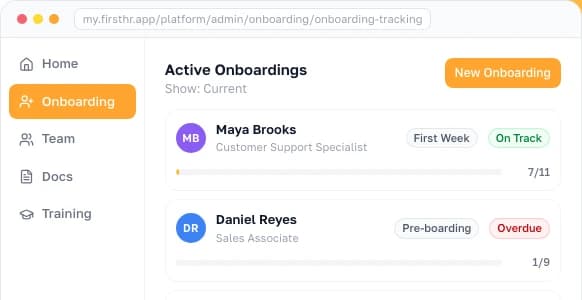
The job description is step one. Once a candidate accepts, the same document becomes the foundation for the offer letter and the onboarding plan. A project manager needs structured onboarding to learn your projects, tools, team, and clients before they can run things effectively.
Give your new project manager clear expectations and access in the first weeks, and consider turning the job description into a signed acknowledgment so the role is formally agreed and stored. FirstHR connects the offer, e-signature, paperwork, and onboarding workflow in one place so a small business can manage the full process from a single system.
Frequently Asked Questions
What does a project manager do?
A project manager plans, runs, and delivers projects on time and within budget. Core responsibilities include defining scope and goals, building schedules, managing budgets, coordinating the team and stakeholders, identifying and managing risks, and reporting on progress from kickoff to completion. The specific focus depends on the industry. A construction project manager handles permits and subcontractors, an IT project manager runs agile delivery, and a marketing project manager coordinates campaigns. In a small business, the role is broader and more hands-on. The constant across all of them is keeping projects organized, on schedule, and moving toward a clear finish.
What should a project manager job description include?
A strong project manager job description includes a short job summary, 8 to 10 specific responsibilities, required and preferred qualifications, the reporting line, a salary range, and how to apply. Responsibilities should be concrete: instead of “manage projects,” write “define scope and timelines, manage the budget, and report weekly on status.” Split the qualifications into two groups, with essentials such as a track record of delivered projects and strong organization in one, and extras such as a PMP certification in the other. For a small business, describe the hands-on, multi-hat nature of the role honestly, since the project manager will likely do the work as well as oversee it.
What does an HR project manager do?
An HR project manager plans and delivers people and HR initiatives the way any project manager runs projects, but focused on HR work. Typical projects include HRIS implementations and system rollouts, onboarding redesigns, policy and handbook updates, benefits changes, and compliance programs. The role coordinates across HR, department heads, leadership, and outside vendors, managing timelines, budgets, change, and risk. It sits at the intersection of project management and HR operations, so the strongest candidates understand both how to run a project and how HR processes like onboarding, HRIS, and compliance actually work. For a small business, this is often a part-time focus of a broader HR or operations role rather than a standalone hire.
What is the difference between a project manager and a project coordinator?
A project manager owns projects end to end: planning, budget, team, risk, and delivery. A project coordinator supports the project manager with scheduling, documentation, and administrative tasks, usually without owning the budget or final accountability. The coordinator is a more junior, supporting role. A program manager sits above the project manager, overseeing multiple related projects and their strategic alignment. For a small business, be honest about which level you need. Many small companies actually need a coordinator or a hands-on first project manager rather than a senior program manager, and matching the title to the real scope sets correct pay expectations.
Do project managers need a PMP certification?
Not always. The PMP (Project Management Professional) is a respected certification that signals formal training, but requiring it narrows your applicant pool and raises the salary you will need to offer. For many roles, especially at small businesses, proven experience delivering projects matters more than a certification. List the PMP or CAPM as a preferred qualification rather than required for most postings. Reserve a certification requirement for senior roles, regulated industries, or companies that specifically need formal methodology. This keeps your pool wide while still attracting candidates who hold the credential.
How much does a project manager make?
A project manager in the U.S. typically earns around $102,000 a year. That is the May 2025 median the Bureau of Labor Statistics reports for project management specialists, the federal occupation closest to the title. The middle 80 percent of that group earns roughly $61,600 to $168,000. Specialty moves the number. BLS puts construction managers, an occupation that includes many construction project managers, at a $114,990 median. The federal O*NET database ties IT project managers to a catch-all computer occupations group whose median is $116,580. First-time or small business project managers often start below the median. Whatever you pay, put a salary range in the posting. Many states now require one in the job ad itself, and SHRM research (2023) found that about two-thirds of employers who list ranges see better-quality applicants. A clear range also screens out candidates whose expectations do not match.
How do I write a project manager job description for a small business?
Write it in plain language and describe the job as it really works on a small team. At a small company, the project manager is hands-on: coordinating the people on a small team, keeping clients in the loop, and often doing the work personally instead of just overseeing it. Leave out enterprise jargon and long lists of certifications. Ask for proven organization, communication, and follow-through, and say plainly that the role reports directly to the owner. The Small Business / First-PM template on this page is built for exactly this situation, so your posting draws a capable doer rather than someone who expects a large project management office.
What happens after I hire a project manager?
After a candidate accepts, the job description becomes the starting point for two documents: the offer letter and the new hire’s onboarding plan. A new project manager cannot run things well until they know your projects, tools, team, and clients, and structured onboarding is how they learn them. Set clear expectations and give them access in the first weeks to help them take ownership faster. Some employers also have the new hire sign the job description as an acknowledgment, so the expectations are formally agreed and kept in the employee record. FirstHR handles the offer letter, document storage, e-signature, and onboarding workflow in one place, so a small business can move a new project manager from hire to fully effective even when the owner is running hiring alone.
Make HR the easy part of running your business
Onboarding, e-signatures, training and core HR in one place. Up and running in 5 minutes.
- 7-day free trial
- No credit card required
- Cancel anytime