
Free Server Job Description Templates
Free server job description templates: casual dining, fine dining, banquet, cocktail, and cafe. Server duties, skills, and responsibilities.

Server Job Description Templates
5 free templates by restaurant type. Download as DOCX or copy-paste.
A server is the face of your restaurant: the person who turns a table of strangers into regulars, keeps the kitchen and the dining room in sync, and carries your hospitality one tray at a time. Below are five ready-to-post templates for the role, each built for a different type of restaurant, and I wrote them for owners and managers who hire between services.
Servers are among the roles restaurants hire most often, because the restaurant and hotel sector posts the highest quit rate of any industry in Bureau of Labor Statistics turnover data for 2025. Every departure puts an owner or general manager (GM) back into hiring mode mid-service. A good server job description is the reusable tool that makes the next hire fast.
At FirstHR, we build for exactly the teams doing this hiring: independent restaurants, cafes, and bars with no HR department. According to the National Restaurant Association, nine in ten restaurants have fewer than fifty employees.
The templates cover casual dining, fine dining, banquet and events, cocktail and bar, and cafe counter-service. Each includes the tip-structure fields plus the certification fields its setting needs, from the food handler card to alcohol service.
What Is a Server Job Description?
A server job description is a document that explains a restaurant server role's duties, skills, schedule, pay structure, and certification requirements so you can post a job and attract reliable servers. It usually opens with a short summary of your restaurant and closes with how to apply.
The job description guide from the Society for Human Resource Management (SHRM) says a job description outlines the tasks, duties, and responsibilities of a position. In a tipped role, that outline must include the money.
One note on the word itself: in hiring, a server description means the restaurant role (the person who waits tables, also called a waiter or waitress), not a computer server. Every template on this page covers that restaurant role, written from the employer's side. The role description shifts with the restaurant type, which is why this page gives you five versions instead of one generic hybrid.
Food Server: One Title, Two Different Jobs
A food server job description can mean either of two roles, and which one you are hiring decides the whole posting. Inside a restaurant, the title is a straight synonym for a server or waiter, tips included. Outside one, it is a separate occupation that serves meals in hotel rooms, hospital rooms, or senior living.
The federal Standard Occupational Classification keeps the two apart: waiters and waitresses form one category, and "Food Servers, Nonrestaurant" form another that covers serving food to people outside a restaurant setting.
In a posting, the practical differences are the money and the clock. Facility food service is usually straight hourly with no tip credit (tips are not counted toward the minimum wage), and it runs on fixed meal-service shifts rather than a dinner rush that ends when the room empties.
If you are hiring for a restaurant, cafe, or bar, use the templates below and title the posting with whichever word your applicants search for. If the role serves meals inside a facility, keep the service duties and cut the tip structure, the section assignment, and the alcohol-service requirements, none of which apply.
Which Template Should You Use?
Pick the template that matches your restaurant type. The server role description changes more across settings than most owners expect: a fine dining server and a cafe server share a title and a work ethic, and almost nothing else about the shift. Use this guide to choose.
5 Free Server Job Description Templates
Download all five at once as separate Word files in one ZIP, or copy individual templates. Each one follows the same structure: restaurant overview, job summary, key responsibilities, skills and qualifications, compensation with the tip structure, and how to apply. Fill in the brackets before you post.
Template 1: Restaurant Server (Casual Dining)
The universal baseline: full table service, POS coordination, side work, and the tip, food handler, and alcohol-age fields built in. Use this for most restaurants.
Template 2: Fine Dining Server
For upscale rooms: wine and pairing knowledge, coursed service, polished standards, and the earnings framing that attracts career servers.
Template 3: Banquet / Event Server
For venues and caterers: synchronized plated service, setup and breakdown, per-event scheduling, and the reliability expectations event work demands.
Template 4: Cocktail / Bar Server
For bars and nightlife: floor drink service, ID checks and responsible-service rules stated up front, late-night pace, and the tip-out structure.
Template 5: Cafe / Counter-Service Server
For cafes and fast-casual hybrids: counter orders, food running, register accuracy, and the morning-rush rhythm of a neighborhood spot.
Server Duties and Responsibilities
Server job duties run from the greeting to the closing side work, and they fall into four groups. A good job description picks 8 to 10 concrete duties for your restaurant type rather than the generic "serve customers."
The duties of a server also change through the day: openers stock stations and set the room, the dinner rush is pure service and coordination, and closers break down, restock, and reconcile. The mix changes by setting too: banquet servers trade section ownership for synchronized timing, cocktail servers add ID checks and intoxication monitoring as non-negotiable duties, and cafe servers blend counter work with food running.
Server vs Host
The two front-of-house roles guests meet first are the server and the host, and small restaurants sometimes blur them in one posting. The short version: the server owns the tables, the host owns the door, and they work as a system.
| Trait | Server | Host |
|---|---|---|
| Takes orders and serves food and drinks at tables | ||
| Greets arrivals and manages the waitlist and seating | ||
| Handles checks and processes payment | ||
| Primary earner of table tips | ||
| Guest-facing role central to the experience |
If your restaurant needs one person doing both, say so explicitly in the posting and pay accordingly, rather than posting a server role and quietly adding door duty. The pay structures differ too: servers typically earn a tipped wage where state law allows, while hosts usually earn straight hourly, sometimes with a tip-pool share depending on house policy and state rules.
Server Skills and Qualifications
Server job description skills come in three layers: the service temperament, the physical basics, and the legal gates. State all three specifically, and for most casual settings keep experience preferred rather than required, since a server with the right attitude trains faster than their resume suggests.
| Weak requirement | Strong requirement |
|---|---|
| Good customer service | Friendly, attentive service that holds up through a Friday rush |
| Able to work hard | Able to stand full shifts and carry loaded trays up to 25 lbs |
| Certified if needed | Food handler card per county rules; we assist new hires in obtaining it |
| Old enough to serve | Minimum age 18 for alcohol service per state law, certification before first shift |
| Experience preferred | Serving or hospitality experience preferred; we train the right attitude |
The legal gates deserve precision because they vary by state and county: the food handler card requirement, the alcohol-service certification, and the minimum age to serve alcohol. Stating them up front, along with whether you help new hires get certified, filters applicants correctly before the interview.
Keep the posting's language neutral and inclusive, too. The Equal Employment Opportunity Commission (EEOC) states that it is illegal for an employer to publish a job advertisement that shows a preference based on protected characteristics such as race, religion, or sex. For recognized occupational tasks to borrow from, the Bureau of Labor Statistics profile of waiters and waitresses lists the standard duties.
How to Write a Server Job Description
A strong server job description takes about 15 minutes with a template, and because servers are among the hires a restaurant repeats most often, the document pays for itself fast. Here is the process the templates are built around.
Server Pay and Tips
Server compensation is a structure, not a number: the hourly base, the tips, and the pooling rules together decide what a server takes home, and experienced servers choose restaurants on the total.
Tipped-wage rules vary sharply by state: some states allow a tip credit against the minimum wage while others require the full minimum before tips, and tip-pooling arrangements carry their own federal rules.
Confirm your state's requirements in the Department of Labor's table of state tipped minimum wages before you post, then publish the structure honestly: base rate, tip arrangement, and the realistic average hourly earnings at your restaurant. The honest number wins against a vague posting every time.
Hiring Servers at a Small Restaurant
Restaurant groups hire servers with recruiting pipelines and HR departments that absorb the churn. An independent restaurant hires the same role with an owner or GM doing it between services, in an industry with some of the highest turnover in the economy. Here is how to write the posting, and run the hire, for that reality.
From Hiring to Onboarding
The job description is step one, and in this industry the step after it matters more than anywhere else. SHRM reports a 2007 study finding that new hires who completed a structured onboarding process were 58 percent more likely to still be at the company three years later. Gallup finds only 12 percent of employees strongly agree their organization does a great job onboarding new employees.
For a server, effective onboarding is concrete: the W-4, I-9, handbook acknowledgment, and certification copies collected before the first shift, then menu training, POS practice, and shadow shifts before solo tables.
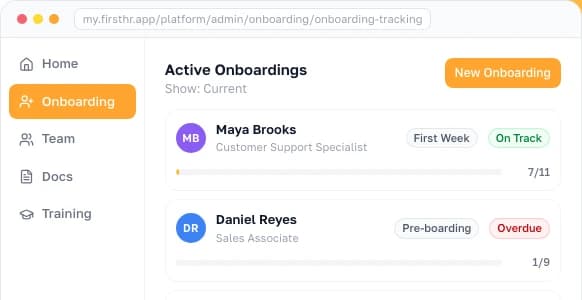
Build that loop once and reuse it for every hire. FirstHR connects the offer letter and handbook acknowledgment with built-in e-signature, document storage including food handler and alcohol-service certification copies, and the onboarding checklist in one place, with training modules for your menu and procedures, so a small restaurant turns one of its most frequent hires into a routine instead of a scramble.
Form I-9 and W-4 go on the new hire's first-day list as tasks, and completed forms are kept in their employee file. The forms themselves are completed outside the platform.
Frequently Asked Questions
What is the job description of a server?
A server takes care of guests through the full dining experience: greeting and seating support, guiding guests through the menu, taking food and drink orders accurately, entering orders into the POS and coordinating timing with the kitchen, serving courses, checking back and refilling proactively, handling allergies and dietary requests, processing payments, and completing opening, running, and closing side work. The restaurant type shapes the rest: fine dining adds wine knowledge and coursed service, banquet work adds synchronized event service, bar serving adds ID checks and responsible alcohol service, and cafe roles blend counter orders with food running. Server and waiter or waitress are the same role under different names.
What are the main server duties and responsibilities?
The main server duties and responsibilities sort into four areas. The first is looking after guests: welcoming the table, explaining the menu, taking each order accurately with every modification, and checking back before anyone has to ask. The second is working with the kitchen: keying orders into the POS without errors, pacing the courses, and passing allergy and dietary notes along with care. The third is the money: bringing the check, taking payment, dividing checks on request, and settling up when the shift ends. The fourth is the section itself: clearing and resetting tables, restocking stations, and finishing the opening and closing side work. In your posting, name 8 to 10 of these for your kind of restaurant instead of a vague line about serving customers.
What is the difference between a server and a host?
A server is responsible for a section of tables, while a host runs the front door. The server takes orders, brings out food and drinks, settles the check, and earns the tips from those tables. The host welcomes arriving guests, keeps the waitlist and reservations moving, spreads seating across sections, and sets the tone of the first impression. Both are front-of-house roles that face guests, and each depends on the other, because even seating from the host is what keeps a server's section under control. The money is structured differently, too: in states that permit it, servers are commonly paid a tipped wage, whereas hosts are generally on a flat hourly rate, and some also get a cut of the tip pool when house policy and state rules allow.
What skills should a server job description require?
Ask for the right temperament, the physical ability the job takes, and the legal requirements that apply, and for most casual restaurants list experience as a plus rather than a must. Temperament means warm, attentive service during a rush, showing up for every scheduled shift including weekends, and getting orders and money right. Physical ability means standing through a whole shift and carrying loaded trays, with the actual weight written in. Legal requirements depend on your state and county, so name them: a food handler card where one is required, plus alcohol-service certification and the minimum age your state sets for serving alcohol. Upscale rooms add wine knowledge, and bars add steady judgment on ID checks. In casual settings, hiring for attitude and training the rest usually works best.
What pay should I list for a server?
List the full structure, not just the base. According to the Bureau of Labor Statistics, waiters and waitresses earned a median of $16.94 an hour in May 2025 with tips counted, and the occupation held about 2.3 million jobs in 2025. Your posting should give the hourly base rate, explain how tips are handled, including any pool or tip-outs, and say what servers at your restaurant typically average per hour once tips are added. Experienced candidates weigh total take-home pay from one restaurant to the next, so a base rate alone tells them little. Tipped-wage rules also differ a lot from state to state: some states require the full minimum wage before tips, while others allow a tip credit. Look up your state in the Department of Labor's state-by-state tipped wage table before the posting goes live.
Why is server turnover so high, and what can a small restaurant do?
The occupation runs on replacement: the Bureau of Labor Statistics expects roughly 423,100 server openings a year nationally through 2035, mostly created when workers leave the role or the workforce, and its turnover survey puts accommodation and food services at the highest quit rate of any industry. A small restaurant cannot opt out of that market, but it can beat the average where it counts: publish the honest earnings picture including tips, keep schedules stable and posted early, run a real first week with menu training and shadow shifts instead of sink-or-swim, and treat servers as professionals. Since many departures happen early, the first weeks are where retention is actually won, and a deliberate onboarding routine is the cheapest fix available.
How do I write a restaurant server job description that attracts good servers?
Open with what good servers compare first: what they will earn, when they will work, and what the place feels like. Give the base rate next to a realistic hourly average with tips, describe the tip pool plainly, and lay out the real schedule, weekends and closing duties included, plus how many tables a server usually covers. Put the legal requirements near the top too, meaning the food handler card and the alcohol-service age and certification your state requires, and say whether you help new hires get certified. Then pick the template that fits your restaurant and write the duties in concrete terms. For casual rooms, keep the must-haves short, since attitude counts for more than a long resume there, and make applying easy, including walking in between services.
What happens after I hire a server?
The signed offer starts a short but unforgiving checklist. Paperwork comes first: the W-4 and I-9, the handbook acknowledgment, and copies of the food handler card and any alcohol-service certification, all in hand before the first shift. Separately, the state new-hire report is due: federal law requires it within 20 days of hire, and some states require it sooner. Training follows: menu knowledge with tastings, POS practice before a live rush, allergy and food-safety basics, and time shadowing a strong server before taking tables alone. In an industry where many new hires leave early, that first week is where retention is won or lost. FirstHR handles the offer letter and handbook acknowledgment with built-in e-signature, stores the certification copies, and runs the onboarding checklist in one place, with training modules for your menu and procedures, so a small restaurant can rerun this hire cleanly every time. The I-9 and W-4 sit on the first-day task list and the finished forms go into the employee file; the forms themselves are filled out outside the platform.
Make HR the easy part of running your business
Onboarding, e-signatures, training and core HR in one place. Up and running in 5 minutes.
- 7-day free trial
- No credit card required
- Cancel anytime