
How to Conduct a Job Interview: The Small Business Owner's Complete Guide
How to conduct a job interview without an HR department. 7-step process, structured questions, scorecard template, and legal compliance.

How to Conduct a Job Interview
The complete guide for small business owners conducting interviews without an HR department
The first job interview I conducted was a disaster, and the seven steps in this guide are what I wish I had followed that day. I sat across from a candidate, asked "so, tell me about yourself," and then spent 45 minutes having a pleasant conversation that told me absolutely nothing about whether this person could do the job. I hired them based on my gut feeling. They lasted two months.
The second interview I conducted was only slightly better. I had a list of questions, but I asked them in a different order for each candidate, added bonus questions for people I liked, and skipped questions for people I had already decided against. I did not take notes. I did not use a scorecard. I made the decision based on who I enjoyed talking to the most, which says very little about how someone will actually do the job.
It took me a dozen hires and several expensive mistakes to learn that conducting a job interview is a skill, not an instinct. The difference between a good interview and a bad one is not talent or experience. It is structure: same questions, same scoring, same process for every candidate.
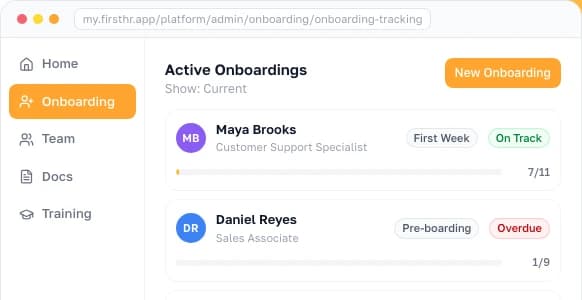
This guide covers the complete process for conducting an interview when you have no HR department, no formal training, and no margin for a bad hire. I built the offer-to-onboarding workflow in FirstHR because the gap between "the interview went great" and "the new hire is actually productive" is where most small businesses lose the investment they made in recruiting.
Why Structured Interviews Matter More for Small Business
A structured interview uses the same questions and the same scoring criteria for every candidate. An unstructured interview is a free-form conversation where the interviewer follows their curiosity, asks different questions to different people, and makes a decision based on overall impression. Most small business owners default to the unstructured approach because it feels natural. It is also significantly worse at predicting job performance.
According to the September 2008 guide to structured interviews from the U.S. Office of Personnel Management (OPM), research consistently indicates that unstructured interviews have little value in predicting job performance: they produce low rating consistency between interviewers and only low to moderate validity. Structured interviews, in OPM's words, have demonstrated a high degree of reliability, validity, and legal defensibility.
Legal defensibility is the part small employers underrate. OPM ties the unstructured interview's exposure to legal challenge directly to its lack of standardization. When every candidate got a different conversation, nothing on paper shows the decision rested on job-related questions.
At an enterprise, a bad hire gets absorbed by the system. At a small business, the same mistake is a crisis that the founder manages personally while the rest of the team picks up the workload. The margin for error is smaller, which makes the interview method more important, not less.
| Interview Type | What It Looks Like | How Well It Predicts Performance | Best For |
|---|---|---|---|
| Unstructured | Free-form conversation, different questions for each candidate, no scoring | Low. OPM: little value in predicting job performance | Casual catch-up coffee, not hiring decisions |
| Semi-structured | Core set of questions with room for follow-ups, informal scoring | Mixed. Rises with the share of the question set that stays fixed | Second-round conversations after structured first round |
| Structured | Same questions, same order, same rubric for every candidate | High. OPM: high reliability, validity, and legal defensibility | First-round interviews, high-stakes hiring |
| Structured + work sample | Structured interview combined with a real or simulated task | High, plus a direct sample of the work itself | Senior roles, technical positions, leadership hires |
Step 1: Prepare Before You Talk to Anyone
Interview preparation takes 30 minutes and determines whether the next 45 minutes produce useful information or wasted time. Most small business owners skip preparation because they believe they can improvise. You can. The question is whether improvisation produces a decision you can defend, or a feeling you cannot explain.
Review the job description (10 minutes)
Read the job description you posted and identify the 3-5 skills or attributes that matter most for success in this role. Not the nice-to-haves. The must-haves. If you could evaluate the candidate on only a handful of things, which would they be? Those become your interview criteria.
Read the resume with purpose (10 minutes)
Do not read the resume to form an opinion. Read it to identify 2-3 specific things you want to explore: a gap in employment, a short tenure at the last job, a claim about managing a team of 15 people, or a specific achievement you want them to walk you through. These become your follow-up questions during the interview.
Prepare 5-7 structured questions (10 minutes)
Write the questions you will ask every candidate. The same questions, in the same order, for every person. This takes less time than you think because most of the questions map directly to the 3-5 criteria you identified from the job description. You are not writing an exam. You are writing a conversation guide that ensures you evaluate every candidate on the same dimensions.
Step 2: Build Your Structured Question Bank
Build your question bank from the two types of questions that dominate effective interviews: behavioral questions (what the candidate did in the past) and situational questions (what they would do in a hypothetical scenario). OPM reports that both formats have proven effective, with behavioral questions showing higher validity where the work is highly complex.
Behavioral questions (tell me about a time when...)
Behavioral questions ask the candidate to describe a specific past experience. The strong ones target specific competencies rather than general performance. "Tell me about a time you went above and beyond" is vague. "Tell me about a time you had to deliver a result with incomplete information and a tight deadline" is specific and reveals how the person handles real-world pressure.
| Competency | Behavioral Question | What a Strong Answer Includes |
|---|---|---|
| Problem-solving | Tell me about a time you identified and fixed a problem nobody asked you to fix. | A specific situation, the root cause they found, what they did, and a measurable result |
| Collaboration | Describe a time you worked with someone whose style was very different from yours. | How they adapted, what compromise looked like, and the outcome for the project |
| Reliability | Tell me about a time you had to choose between competing deadlines. How did you decide what to prioritize? | A framework for prioritization, communication to stakeholders, and the result |
| Adaptability | Describe a time when your role or responsibilities changed significantly. How did you handle the transition? | Specific actions taken to adjust, how quickly they adapted, and what they learned |
| Initiative | Tell me about something you improved at a previous job without being asked to. | A real example with measurable impact, not a hypothetical aspiration |
Situational questions (what would you do if...)
Situational questions present a hypothetical scenario and ask the candidate to walk through their approach. Because they ask what the candidate would do rather than what they have done, they suit roles where candidates lack directly comparable experience. For entry-level hires or career changers, they fill the gap that behavioral questions cannot cover.
| Scenario | Situational Question | What You Are Evaluating |
|---|---|---|
| Customer conflict | A customer calls angry about a mistake we made. They want a refund but our policy does not allow it. What do you do? | Empathy, de-escalation, and judgment about when to follow policy vs when to make an exception |
| Competing priorities | Your manager gives you three tasks due by end of day, but you can only finish two. How do you handle it? | Communication, prioritization framework, and willingness to proactively flag problems |
| Team tension | You notice two teammates are not communicating well and it is affecting a project. What do you do? | Whether they address it directly or avoid it, and how they balance diplomacy with accountability |
| Mistake handling | You realize you sent a report to a client with incorrect numbers. What is your first step? | Speed of response, ownership vs blame-shifting, and whether they think about prevention |
Step 3: Know What You Legally Cannot Ask
Federal laws enforced by the Equal Employment Opportunity Commission (EEOC) prohibit employment decisions based on protected characteristics. Two subjects are off-limits as questions: disability, which employers may not ask about before a conditional job offer, and genetic information, family medical history included.
For race, color, sex, national origin, religion, and age, federal law does not clearly forbid the question itself. Even so, questions that reveal protected information create legal risk, because the EEOC says such inquiries may be used as evidence of an intent to discriminate.
The safest rule is simple: if a question is not directly related to the candidate's ability to perform the job, do not ask it. The table below lists questions to avoid and what to ask instead.
| Category | Do NOT Ask | Ask Instead |
|---|---|---|
| Age | How old are you? When did you graduate? | Are you at least 18? (Only where the job has a legal minimum age, such as hazardous work) |
| Family status | Are you married? Do you have children? Are you pregnant? | Are you available to work the schedule this role requires? |
| Religion | What church do you attend? Do you observe any religious holidays? | This role requires occasional weekend work. Is that something you can accommodate? |
| National origin | Where are you from? What is your native language? | Are you authorized to work in the United States? Do you speak any languages relevant to this role? |
| Disability | Do you have any disabilities? How is your health? | Can you perform the essential functions of this position with or without reasonable accommodation? |
| Arrest record | Have you ever been arrested? | Have you been convicted of a crime relevant to this position? (Check state and local law: some bar this question until after a conditional offer) |
| Salary history | What was your salary at your last job? | What are your compensation expectations for this role? (Several states and cities ban salary history questions) |
| Genetic information | Does anyone in your family have a history of disease? | Never appropriate. Do not ask under any circumstances. |
State and local laws add their own limits. Several states and cities ban salary history questions. California's Labor Commissioner, for example, says an employer generally cannot seek an applicant's salary history but may still ask about salary expectations for the position.
Some states and cities prohibit questions about criminal history on the initial application ("ban-the-box" laws), and some go further: the California Fair Chance Act generally bars employers with 5 or more employees from asking about conviction history before a conditional offer. A few states restrict credit check inquiries. Check your state's labor department for specifics.
Step 4: Run the Interview in 45-50 Minutes
A well-structured first-round interview takes 45 to 50 minutes. Shorter interviews do not provide enough data to make a confident decision. Longer interviews produce diminishing returns and increase the chance of bias (you start over-weighting the last 15 minutes because they are freshest in memory).
How to open the interview
Open by thanking the candidate for their time, offering water or coffee if in-person, and making 2-3 minutes of casual conversation about the weather, their commute, or something else neutral. That small talk has a job: it lowers the candidate's anxiety, so they give authentic answers instead of performing.
After the small talk, explain the structure: "Here is how the next 45 minutes will work. I will start by telling you about the company and the role. Then I will ask you some questions about your experience. After that, you will have time to ask me anything. And I will close by explaining next steps. Sound good?" This gives the candidate a roadmap and reduces the "what is coming next?" anxiety that produces stilted answers.
The 80/20 listening rule
The most common mistake interviewers make is talking too much. The candidate should be speaking 80% of the time. You should be speaking 20%. Your job is to ask questions, listen carefully, take brief notes, and ask follow-ups. If you catch yourself explaining the company culture for 15 minutes, you are giving a presentation, not conducting an interview.
How to close the interview
Always close with specific next steps. "We are interviewing three more candidates this week and plan to make a decision by Friday. You will hear from us either way by end of day Friday." This is professional, creates a deadline for yourself, and respects the candidate's time. "We will be in touch" is not a closing. It is an evasion.
Step 5: Score the Interview Using a Simple Rubric
A scorecard transforms a subjective impression into a comparable data point. Without one, you remember who you liked. With one, you know who demonstrated the competencies the job requires. The difference between these two things is the difference between a hiring decision and a popularity contest.
How to build a scorecard
A scorecard needs three core columns: the competency being evaluated, the question asked, and a 1-5 rating. One means the candidate showed no evidence of the competency. Five means they gave specific examples with measurable results. Keep it to 5 criteria maximum. More than that and you dilute the signal. The sample below adds a fourth column for notes.
| Skill | Question Asked | Rating (1-5) | Notes |
|---|---|---|---|
| Problem-solving | Tell me about a time you solved a problem without clear instructions. | 4 | Described rebuilding inventory process from scratch. Found root cause independently. Clear STAR structure. |
| Communication | Describe a situation where you had to explain something complex to someone non-technical. | 3 | Decent example but stayed abstract. Follow up: ask for a more specific scenario next round. |
| Reliability | How do you handle competing deadlines when you cannot finish everything? | 5 | Excellent. Described prioritization framework they actually use. Gave concrete example with numbers. |
| Culture fit | What kind of work environment brings out your best performance? | 4 | Described preference for autonomy with regular check-ins. Matches our team style well. |
| Role-specific | Walk me through how you would handle [specific scenario relevant to this role]. | 3 | Showed understanding of the basics but missed a key compliance step. Trainable, not a deal-breaker. |
| Overall Score | 19/25 | Advance to reference check. Strong on reliability and problem-solving. Coach on compliance awareness during onboarding. | |
Scoring rules
Complete the scorecard within 30 minutes of the interview ending. Waiting until the end of the day introduces recency bias (you remember the last candidate better than the first). Waiting until tomorrow introduces memory distortion. The 30-minute window is when your observations are most accurate and least influenced by subsequent conversations.
Score each criterion independently. Do not let a strong answer on one question inflate scores on others. If a candidate gave an excellent problem-solving example (5/5) but could not articulate how they work with others (2/5), do not bump collaboration to 4/5 because you liked them overall. Independent scoring per criterion is what makes scorecards more predictive than gut feelings.
| Rating | What It Means | Example Signal |
|---|---|---|
| 1 - No evidence | Candidate could not provide a relevant example or gave a response that was off-topic | Long pause followed by 'I cannot think of a specific example' |
| 2 - Weak evidence | Candidate described a vague or secondhand example without specific details | General statement about team values without personal involvement |
| 3 - Adequate evidence | Candidate gave a relevant example but lacked specifics or measurable results | Described the situation and their role but could not quantify the outcome |
| 4 - Strong evidence | Candidate provided a specific example with clear actions and a positive result | Detailed STAR response with a concrete outcome |
| 5 - Exceptional evidence | Candidate gave multiple specific examples with measurable impact and clear learning | Quantified results, described what they would do differently, showed self-awareness |
Completed scorecards are worth filing, not just filling in. Under the Uniform Guidelines on Employee Selection Procedures (29 C.F.R. Part 1607), which the EEOC adopted in 1978, a selection procedure is any measure used as a basis for an employment decision.
If a selection procedure has the effect of disproportionately excluding people on a protected basis, the employer has to show it is job-related and consistent with business necessity, which in plain terms means it tests for what the job actually requires. Criteria written down before the first interview are far easier to defend on that standard than a recollection written afterward.
Step 6: Make the Decision Within 48 Hours
Speed matters in small business hiring. The best candidates are interviewing at multiple companies. Every day you delay a decision increases the chance they accept another offer. The 48-hour rule forces you to make a decision while your assessment is fresh and before you lose the candidate to a faster competitor.
How to compare candidates
Compare scorecard totals, not impressions. If Candidate A scored 22/25 and Candidate B scored 18/25, the decision is straightforward. If they are close (within 2-3 points), look at which criteria each candidate was strongest on and match that to the role's most critical requirements. A customer service hire who scored 5/5 on communication and 3/5 on problem-solving may be a better fit than one who scored 4/5 on both.
Conduct reference checks before extending the offer
Reference checks happen after the final interview and before the offer. Not after the offer. A verbal offer followed by a reference-based withdrawal creates legal risk and reputational damage. Call three references (at least one direct supervisor), ask structured questions, and document the responses.
Notify all candidates
Every candidate who interviewed deserves a response, including those you did not select. A brief email is sufficient: "Thank you for taking the time to interview for [role]. We have decided to move forward with another candidate. We appreciate your interest in [company name]." This takes 2 minutes per candidate and protects your employer brand. Small business owners often skip this because they are busy. The candidates notice.
Step 7: From Offer to Day 1 (The Step Nobody Covers)
Every interview guide ends at Step 6: make the decision, send the offer. But the interview process is not complete when the offer is signed. It is complete when the new hire is productive.
The stretch between an accepted offer and a productive employee is wider than most first-time hiring managers plan for. According to Gallup (2019), most people need 12 or more months to get up to speed in most jobs, and onboarding should be a year-long process, not a 30-day one. The person who ran the interview, the hiring manager, owns that transition.
This is where structured hiring pays its biggest dividend: everything you learned in the interview and the reference checks shapes how you onboard this specific person. A candidate who demonstrated strong independence needs less hand-holding in Week 1. A candidate who struggled with a role-specific scenario needs targeted training in that area during the first 30 days.
The interview doubles as the first data-collection step in a successful onboarding process. The timeline below covers its opening stretch, from the day the offer is accepted to the first formal review.
| When | What to Do | Why It Matters |
|---|---|---|
| Day of acceptance | Send a personal welcome email from the hiring manager (not a template) | Sets the tone: this is a team that communicates and values people |
| Within 48 hours | Send pre-boarding paperwork: I-9, W-4, direct deposit, handbook acknowledgment | Legal compliance starts before Day 1. Late I-9 completion carries penalties. |
| 1 week before start | Confirm start date, share first-week schedule, introduce the buddy or mentor | Eliminates first-day anxiety. The candidate has already mentally joined the team. |
| Day 1 | Run orientation: compliance forms, team introductions, role expectations | First impressions determine whether the new hire commits or starts looking elsewhere |
| End of Week 1 | First 1-on-1: how is it going, what questions do you have, what do you need | Catches confusion and misalignment before they become patterns |
| Day 30 | Formal review against the goals set during onboarding | Confirms the hiring decision was right and course-corrects if needed |
One deadline on that list is not yours to move. The employee signs Section 1 of Form I-9 no later than their first day of work for pay, and you complete Section 2 within three business days of the date employment begins, per U.S. Citizenship and Immigration Services.
A Monday start puts the Section 2 deadline on Thursday, which is why the paperwork goes out as soon as the offer is accepted rather than on Day 1.
Interview Formats Compared: Which One to Use When
The right interview format depends on the role, your team size, and how many rounds you plan to conduct. The table below compares five common formats and where each one fits.
| Format | Structure | Duration | Best For | Not Ideal For |
|---|---|---|---|---|
| One-on-one (structured) | Hiring manager asks all questions, scores independently | 45-50 min | Most roles, first-round interviews, small teams | Senior/exec roles where multiple perspectives are needed |
| Panel interview | 2-3 interviewers ask questions from a shared question set | 60-75 min | Roles that interact with multiple teams, leadership hires | Entry-level roles (overkill, intimidates candidates) |
| Working interview / work sample | Candidate completes a real or simulated task | 60-90 min | Technical roles, creative positions, roles where output quality matters | Roles where output is hard to evaluate in isolation |
| Phone screen | Brief call to verify basics before investing in a full interview | 15-20 min | High-volume roles, initial filter before in-person rounds | Final decision. Never hire based on a phone screen alone. |
| Group interview | Multiple candidates interviewed simultaneously | 45-60 min | Seasonal retail, hospitality, high-volume roles | Knowledge work, office roles, anything requiring individual assessment |
For most small business hires, a structured one-on-one interview in the first round followed by a shorter second conversation (30 minutes, focused on fit and logistics) is sufficient. Save panel interviews for roles that interact with multiple teams. Save work samples for roles where output quality is critical and hard to assess through questions alone.
Running an in-person interview
An in-person interview needs about 15 minutes of setup that a video call does not. Book a room with a door, tell the team you are unavailable, put your phone face down, and print the question set and the scorecard so you are not typing while the candidate is talking.
Decide in advance who greets the candidate and where they wait, because the interview effectively starts at the front door. Offer water, keep the room comfortable, and put a clock where you can both see it. Walk the candidate out yourself at the end rather than pointing at the exit.
How to Conduct a Remote Interview
Remote interviews follow the same structure as in-person interviews with a few adjustments for the video format. The questions, scoring, and process are identical; only the logistics and the candidate's comfort level change.
| In-Person | Remote Adjustment | Why It Matters |
|---|---|---|
| Greet at reception, walk to interview room | Send video link 24 hours in advance, confirm it works 5 minutes before start | Technical issues waste the first 10 minutes and fluster the candidate |
| Offer water or coffee | Ask 'are you comfortable, do you need a minute before we start?' | Acknowledges the awkwardness of talking to a screen |
| Read body language naturally | Focus on voice tone, pacing, and facial expressions. Do not penalize for eye contact (they are looking at the screen, not the camera) | Video distorts non-verbal cues. Over-indexing on them leads to bad assessments |
| Share documents by hand | Use screen share for job descriptions or scorecards | Keeps both parties literally on the same page |
| Walk them out personally | Stay on the call for 30 seconds after the formal close | Abrupt disconnects feel impersonal. A brief 'thanks again, really enjoyed talking with you' makes a difference |
One additional rule for remote interviews: record them (with the candidate's consent) if you plan to involve other team members in the decision. A 45-minute recording is more useful than a second-round interview that asks the same questions because the original interviewer forgot half the conversation.
Panel Interviews for Small Teams
Panel interviews involve two or three interviewers asking questions from a shared set. They are useful when the new hire will work across multiple teams and each team lead needs to assess fit. They are counterproductive when used for entry-level roles where a single interviewer can evaluate all relevant criteria.
How to run a panel interview
Assign each interviewer 2-3 questions from the shared set. One person leads the interview (opens, closes, manages time). Each panelist scores independently on their assigned criteria. Debrief after the candidate leaves, not during the interview. Never let one panelist's body language influence the others' assessment in real time.
When panel interviews go wrong
The most common failure mode: three interviewers asking the same questions because nobody coordinated beforehand. The candidate answers "tell me about your biggest challenge" three times and wonders whether this team communicates at all.
The fix is simple: pre-assign questions, brief the panel for 5 minutes before the candidate arrives, and debrief for 10 minutes after they leave. Those 15 minutes of coordination make the difference between a panel interview that adds value and one that wastes everyone's time.
The Complete Interview Checklist
Use this checklist for every interview. Print it, keep it with your question set and scorecard, and check off each item. Structure is what separates a hiring process from a guessing game.
Common Mistakes When Conducting Interviews
After conducting dozens of interviews and coaching other founders through their first hires, I see the same eight mistakes come up again and again. Each one lowers the quality of the hiring decision, and each one is fixable with preparation.
The pattern behind all eight mistakes: treating the interview as a conversation instead of an assessment. A great conversation produces a friend. A great assessment produces a good hire. They are not the same thing.
How to Be a Good Interviewer
A good interviewer asks every candidate the same job-related questions, listens far more than they talk, writes down evidence instead of impressions, and scores each criterion before comparing anyone. Everything else is style. Those four habits are what separate an interview that predicts performance from one that predicts very little.
Listening well depends on a habit most managers have to build deliberately: silence. When a candidate finishes an answer, wait three seconds before you move on. The second half of an answer, the part that arrives after the pause, is usually the specific part. Filling the gap yourself is the fastest way to lose it.
The other habit worth building on purpose is keeping the assessment separate from the sales pitch. A hiring manager is doing two jobs in one meeting: evaluating the candidate and giving the candidate a reason to say yes. Keep the pitch in the company overview and the close, not spread through the questions, where it turns answers into agreement.
If more than one person at your company interviews, these habits have to be shared or the scores are not comparable across interviewers. The guide to training hiring managers covers calibration, shadowing, and a short curriculum for getting a first-time interviewer ready.
Start your next hire with one change: write the questions and the scorecard before you meet the first candidate. Everything else in this guide gets easier once both are on paper.
Frequently Asked Questions
What are the 7 steps of conducting an interview?
The 7 steps are: (1) Prepare by reviewing the job description and resume, (2) Build 5-7 structured questions based on the role requirements, (3) Know what you legally cannot ask and which questions about EEOC protected categories still carry legal risk, (4) Run the interview in 45-50 minutes following a consistent structure, (5) Score the interview using a 1-5 rubric on each criterion, (6) Make the hiring decision within 48 hours while the conversation is fresh, and (7) Transition from offer to onboarding by preparing the offer letter, collecting compliance paperwork, and setting up the first 30 days.
How do you start an interview as the interviewer?
Open with a warm welcome and 2-3 minutes of relaxed conversation so the candidate's nerves can settle. Next, lay out the plan for the meeting: how long it will run, which topics you will cover, and at what point they get to put their own questions to you. Knowing the shape of the conversation in advance lets the candidate focus on giving good answers instead of guessing what comes next.
What questions should I ask when conducting a job interview?
Lead with behavioral questions, the kind that start with 'tell me about a time when...', because they draw out evidence of what the candidate has actually done. Save situational 'what would you do if...' questions for candidates who lack directly comparable experience. Focus on 5-7 questions tied to the core competencies of the role. Include at least one question about problem-solving, one about working with others, one about handling pressure or deadlines, and one role-specific scenario. Ask every candidate the same questions to keep comparisons fair.
What is the STAR method of interviewing?
STAR stands for Situation, Task, Action, Result, and it is the framework for evaluating a behavioral answer rather than for asking the question. During an interview, use it as a follow-up prompt when an answer is vague. Writing questions that produce STAR-shaped answers, probing for a missing component, and scoring answers consistently across interviewers are covered in our dedicated STAR method guide.
What should an interviewer avoid asking?
Avoid questions about age, race, religion, national origin, disability, pregnancy, marital status, sexual orientation, gender identity, or genetic information. Two of these are off-limits under federal law: genetic information, which includes family medical history, and disability, until you have made a conditional job offer. The rest invite trouble because, according to the EEOC, asking them may be used as evidence of discriminatory intent. Skip arrest records as well; conviction questions may be permissible, depending on state and local law and on how the offense relates to the job. Where a state or local law bans it, leave salary history alone. The rule for every question: if it is not directly related to the candidate's ability to perform the job, do not ask it.
What is the difference between structured and unstructured interviews?
A structured interview follows a fixed plan and an unstructured one does not. In a structured interview, every candidate answers the same questions, written in advance, and every answer is rated against the same criteria. An unstructured interview has no script, so each candidate gets a different conversation. The U.S. Office of Personnel Management, in its guidance on federal hiring, rates the structured format high on consistency between raters, on accuracy, and on surviving a legal challenge. It finds the unstructured format a poor predictor of job performance and, because it is so subjective, an invitation to legal challenges. When a small business makes a high-stakes hire on limited information, structure is what lets you compare candidates at all.
How long should a job interview last?
Plan on 45-50 minutes for a standard first-round interview. That breaks down into 5 minutes of introductions, 5 minutes on the company and the role, 25 minutes of structured questions, 10 minutes for the candidate's own questions, and 5 minutes to close. Past the 60-minute mark, each extra minute tells you less and gives bias more room to work: a candidate you warmed to at minute 15 spends the next 45 minutes being confirmed rather than assessed. Panel interviews are the exception and can run 60-75 minutes, since several interviewers split the questions.
How many interviews should a small business conduct before hiring?
Two rounds cover most roles at a small business. The first is the structured interview itself, 45-50 minutes long and scored on your rubric. The second is a 30-minute follow-up on fit and logistics. Senior and leadership hires justify a third round built around a work sample or a presentation. Beyond three rounds for a non-executive role, extra interviews signal indecision rather than thoroughness, and you risk losing candidates to competitors who move faster.
Should I take notes during an interview?
Yes. Tell the candidate at the start that you will be jotting down notes so you remember their answers accurately. Keep them brief: observations, not a transcript. Capture the examples they give, any numbers or results they mention, and whatever stands out for better or worse. Then turn the notes into scorecard ratings within 30 minutes after the candidate leaves, while the details are still sharp.
What happens after the interview?
Fill in your scorecard within 30 minutes of the interview, set the scores side by side with those of the other candidates for the role, and reach a decision inside 48 hours. Check references on your top choice before you prepare the offer letter. Let every candidate know the outcome, the ones you turned down included. Once your chosen candidate accepts, move straight into pre-boarding: send the welcome email, collect the compliance paperwork, and set up the schedule for the first week.
Make HR the easy part of running your business
Onboarding, e-signatures, training and core HR in one place. Up and running in 5 minutes.
- 7-day free trial
- No credit card required
- Cancel anytime