
Reference Checks: A Small Business Hiring Guide
How to conduct reference checks at a small business. 15 questions to ask, a 7-step process, legal rules, and how references connect to onboarding.

Reference Checks
How to check references when you have no HR department
The first time I skipped a reference check, it cost me six months. Here is what happened, and the process I wish I had followed instead, laid out so you can run it yourself before your next offer.
The candidate interviewed brilliantly. Articulate, experienced, confident. I was excited to make the offer and did not want to slow down the process with phone calls. Three months later, the person I hired could not do the job at the level they described. Six months later, they were gone, and I was restarting the search from scratch.
When I finally called the references I should have called before hiring, two out of three told me exactly what I would have needed to hear: the candidate was a strong presenter but struggled with follow-through and deadlines. Thirty minutes of phone calls would have saved me six months and roughly $30,000 in wasted salary, lost productivity, and rehiring costs.
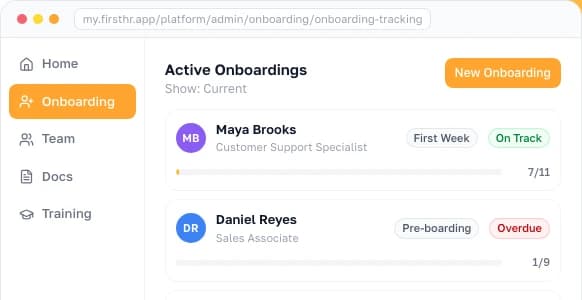
This guide covers what a reference check actually is, the four types of reference verification, a step-by-step process for running one without an HR department, 15 specific questions to ask, and the legal rules you need to follow. It also covers the part most reference check guides miss entirely: how to use what you learn from references to build a better onboarding plan. I built the hiring-to-onboarding workflow in FirstHR specifically for small businesses where one person handles everything from the signed offer to Day 90.
What Is a Reference Check?
A reference check is a structured conversation with someone who has direct professional experience working with a job candidate. The goal is to verify the candidate's claims about their experience and performance, and to learn things the interview could not reveal: how they handle pressure, how they interact with colleagues over time, and whether their self-assessment matches how others perceive them.
The U.S. Office of Personnel Management identifies reference checking as a validated assessment method that predicts job performance better than years of education or job experience alone (OPM). Despite this, many small businesses skip the calls entirely or treat them as a formality.
The usual reason for skipping the calls is speed: the founder wants to close the hire and move on. But reference checks take 30-45 minutes total and can prevent a mistake that takes months to correct.
Types of Reference Checks
The term "reference check" gets used loosely for four different things: professional references, employment verification, character references, and background checks. Knowing the differences keeps you from doing the wrong type of check or skipping an important step.
For most small business hires, professional references are the priority. Employment verification confirms facts but does not tell you how well the person performed. Character references are subjective and difficult to evaluate. Background checks are important for certain roles but are a separate process governed by the Fair Credit Reporting Act (FCRA) and typically handled by third-party screening companies.
Why Reference Checks Matter More for Small Businesses
Reference checks are proportionally more valuable at small scale because every hiring decision has outsized impact. When you only make 5-10 hires per year, each one represents a significant percentage of your workforce. Getting one wrong is not a statistical inevitability. It is a preventable event.
At an enterprise, a bad hire is absorbed by the system. Other people cover the gaps. HR manages the performance improvement plan. The team adjusts. At a small business, a bad hire is a crisis. The founder is personally managing the fallout, the team is overloaded, and the business loses momentum.
| Company Size | Impact of One Bad Hire | Time to Recover | Reference Check Value |
|---|---|---|---|
| Founding team | A double-digit share of the workforce affected, founder directly managing fallout | Longest | Critical: no buffer for hiring mistakes |
| Small business | A visible share of one team, which absorbs part of the impact while productivity drops | Long | High: limited margin for error |
| Mid-size | A few percent of the workforce, department handles most of the impact | Shorter | Important: but systems absorb more shock |
| Enterprise | A fraction of a percent, HR and management handle the process | Shortest | Standard: part of structured hiring process |
The math is simple. Three phone calls take 30-45 minutes total. A hire that fails costs you the search, the salary you already paid, and months of recovery time. The return on 45 minutes of reference checking is among the highest of any hiring activity.
Early departures are common enough to plan around. Work Institute reports that more than one third of newly hired employees quit within their first year. It lists the common reasons as unclear job expectations, insufficient onboarding, lack of support from leadership, and mismatched role fit (Work Institute). Mismatched role fit is exactly what a reference call surfaces.
The 7-Step Reference Check Process
Most guides describe reference checking as "call three people and ask some questions." That is technically correct, but it misses the structure that makes reference checks actually useful: seven steps that start with written consent and end with an onboarding plan. Here is the step-by-step process that works for small businesses without an HR team.
Step 7, connecting references to onboarding, is the step that keeps working after the offer is signed. Reference checks are usually treated as the final gate before the offer, but they are also the first input into the onboarding plan.
If you learn that your new hire needs more structure than average, you build more check-ins into their first 30 days. If you learn they ramp up quickly, you accelerate the training timeline. Reference insights turn a generic onboarding plan into a personalized one.
Should You Use a Reference Checking Service?
For most small businesses, the answer is no, and the reason is not the fee. You are the person who will manage this hire, so you are the person who should hear the pause before the answer. A reference checking service earns its money at volume, across time zones, or when the hiring manager will never get around to making the calls.
Automated reference checking makes a different trade. The software emails each reference a structured questionnaire, collects the answers, and scores them next to the other references for the same candidate. It solves the scheduling problem and produces comparable data. It also loses the hesitation, the sideways answer, and the follow-up question you would have asked next.
One rule matters more than the choice itself. When a third party runs the check for you, the result is what the Fair Credit Reporting Act calls an investigative consumer report: a report built from interviews with people who know the candidate.
An investigative consumer report comes with its own paperwork: a stand-alone written disclosure, written authorization from the candidate, written notice of the report no later than three days after you request it, and an adverse action process if you decline to hire. Calls you place yourself carry none of that.
15 Reference Check Questions to Ask
The quality of a reference check depends entirely on the quality of the questions. Yes/no questions produce useless answers. Open-ended, behavioral questions produce insights. Treat the list below as a bank rather than a script: pick the questions that fit the role, then put that same set to every reference to keep the process consistent and comparable across candidates.
| Category | Question | What It Reveals |
|---|---|---|
| Verification | Can you confirm the candidate's job title and dates of employment? | Catches resume inflation: exaggerated titles, extended dates |
| Verification | What was your working relationship with the candidate? | Establishes credibility of the reference and context for their observations |
| Performance | What were the candidate's primary responsibilities? | Validates that the candidate actually did what they claimed in the interview |
| Performance | How would you describe the quality of their work? | Open-ended assessment that forces specifics rather than generic praise |
| Performance | Can you describe a time when the candidate exceeded expectations? | Tests whether the reference can provide a concrete example vs vague praise |
| Work style | How did the candidate handle feedback or criticism? | Predicts how they will respond during onboarding check-ins and performance reviews |
| Work style | How did they perform under pressure or tight deadlines? | Reveals stress behavior that interviews rarely surface |
| Work style | How would you describe their communication style? | Predicts team dynamics and whether their style matches your team |
| Reliability | Were there any issues with attendance, punctuality, or reliability? | Identifies patterns that affect daily operations at a small business |
| Reliability | Did the candidate require more supervision than typical, or were they self-directed? | Predicts management load, critical for founders who manage while doing everything else |
| Growth | What areas would you suggest the candidate focus on for professional development? | Diplomatically asks about weaknesses. References are more honest with this framing |
| Growth | How did the candidate contribute to team dynamics? | Reveals interpersonal behavior over time, not just interview performance |
| Departure | Why did the candidate leave your organization? | Validates the candidate's stated reason and reveals potential red flags |
| Rehire | Would you rehire this person? | The most revealing question. Hesitation or qualifiers tell you more than a direct no |
| Onboarding | What advice would you give their next manager for setting them up for success? | Directly informs your onboarding plan and management approach |
The last question is the most underrated. By framing it as advice for the next manager, you give the reference permission to share constructive feedback without feeling like they are criticizing someone. The answers go straight into your onboarding planning.
Put the questions on one page with room to write beside each, and fill it in while the call is happening rather than afterward. That is the difference between a set of impressions and a record you can compare across three references and across two candidates.
Sample Reference Questions and Answers
Reading the answer matters as much as asking the question. The examples below pair a plausible reply with what it should tell you. The pattern across them is consistent: a specific event with an outcome describes the work, while a run of adjectives usually describes the reference.
| Question | What you hear back | How to read it |
|---|---|---|
| Would you rehire this person? | 'Yes. I tried to, twice.' | Strong. Enthusiasm with an action behind it. Nothing here needs a follow-up. |
| Would you rehire this person? | 'That would depend on the role.' | Follow up in the moment. Ask which role, and which one not. The qualifier is the answer, and the detail behind it is what you called for. |
| How did they perform under a tight deadline? | 'We shipped two days late because a vendor missed, and she rebuilt the plan in an afternoon.' | Strong. A specific event with a decision inside it. This reference watched the work closely enough to describe it. |
| How did they perform under a tight deadline? | 'He was always very professional.' | Thin. Professional describes conduct, not performance under pressure. Ask about the last deadline that slipped and what he did about it. |
| What should they focus on developing? | 'She writes better than she presents, and she knows it. She asked me to run practice sessions with her.' | Useful and usable. A real gap plus evidence of effort against it. Put presentation reps into the first 90 days. |
| What should they focus on developing? | 'Honestly, nothing comes to mind.' | Incomplete. Everyone has something. Reframe the question as advice for the next manager and ask it again. |
| Why did the candidate leave? | 'I would rather let them tell you that.' | Note it, do not push. Ask the candidate the same question and compare the two answers. A polite decline is usually company policy, not a warning. |
One vague answer is a busy person on a bad day. The same vague answer from two references, on the same question, is a pattern worth a third call. Ask the follow-up while you still have them on the line, because a reference who has already hung up rarely picks up twice.
Legal Rules and Compliance
Reference checking is less regulated than background checks, but there are rules you need to follow. Getting them wrong exposes you to liability, especially if you use reference information to make a discriminatory hiring decision.
What You Can Ask
You can ask any question that is directly related to the candidate's job performance, work history, and professional behavior. This includes responsibilities, performance quality, reason for leaving, attendance, work style, and whether the reference would rehire the candidate. Stick to job-related inquiries and you are on solid legal ground.
What You Cannot Ask
The same protected categories that apply to interviews apply to reference checks. Do not ask about age, race, religion, national origin, disability, pregnancy, marital status, sexual orientation, or genetic information. Do not ask whether the candidate filed workers compensation claims or took FMLA leave (Family and Medical Leave Act). If a reference volunteers protected information, do not record it or factor it into your decision.
Federal disability law, the Americans with Disabilities Act (ADA), covers the reference call directly. According to Equal Employment Opportunity Commission (EEOC) guidance on the ADA, an employer may not ask a third party, former employers included, any question it could not ask the applicant directly. Before an offer, workers compensation history is one of those questions, so it stays off the reference call too.
Consent and Documentation
Always obtain written consent from the candidate before contacting references. This is standard practice and protects you from claims of unauthorized contact. If you decide not to hire based partly on reference information, document the job-related reasons for your decision.
Retention is a rule rather than a preference. Under 29 CFR 1602.14, covered employers keep every personnel and employment record for one year from the date the record was made or the personnel action was taken, whichever is later. A reference check note filed with the candidate record is one of those records.
Can Employers Call Previous Employers Without Permission?
In most cases, yes. No federal law requires a candidate to authorize a call you place yourself to a former employer, and the FCRA rules above apply only when a third party runs the check for you. Written consent is still the right practice, for three reasons that have nothing to do with the statute.
It tells the candidate which employers you plan to call, so nobody is caught out. It gives a reference a reason to pick up an unknown number. And it keeps you clear of the one call that does real damage: a current employer who did not know their employee was looking. Never contact a current employer without explicit written permission naming that employer.
Calling someone the candidate did not list is a separate question. It is generally lawful, and it is how you get past a reference list assembled to say pleasant things. Say in the consent form that you may contact other former colleagues, though: a check the candidate only hears about afterward feels like going behind their back.
Is It Illegal to Give a Bad Reference?
No. Giving a bad reference is not illegal in itself. That matters on both sides of the call: when you are the employer checking a candidate, and when your own phone rings about someone you let go. Defamation requires a false statement of fact, so an accurate account of what happened is not defamation, however unflattering it is.
The other limit is motive. According to the EEOC, it is illegal to give a negative or false reference, or to refuse to give one, because of race, color, religion, sex, national origin, age (40 or older), disability, or genetic information. Retaliating against someone who complained about discrimination is illegal too.
The practical rule when you are the one answering is to say what is documented. Dates, title, and performance you can point to in a review or a written warning are defensible. A characterization you never wrote down at the time is not. In most states, references given in good faith, positive or not, are protected from defamation claims by what the law calls qualified privilege.
The same caution is the honest explanation for the dates-and-title-only policies you keep running into. They are usually a company decision to avoid the argument, not a legal requirement, which is worth knowing when a former employer tells you their hands are tied.
State-Specific Considerations
Some states have specific laws regarding employer references. Many states offer qualified immunity to employers who provide honest references in good faith, protecting them from defamation lawsuits. A 2001 study in the Cornell Journal of Law and Public Policy described these job reference immunity statutes as prevalent.
A few states restrict what information former employers can disclose. Connecticut is one: without written authorization from the employee, an employer there may release nothing from the personnel file beyond dates of employment, title or position, and wage or salary (Conn. Gen. Stat. 31-128f).
Check with the labor department in your state for the specifics. The U.S. Department of Labor publishes a directory of every state labor office, with contact details for each one (DOL State Labor Offices). The HR laws guide covers the federal framework.
Connecting Reference Checks to Onboarding
A reference check pays off twice: once in the hiring decision, and again in how you onboard the person you hire. Most guides treat reference checks as the last step of hiring. In practice, they are the first step of onboarding, because the information you gather directly shapes how you set up the new hire for success.
| What the Reference Said | What It Means for Onboarding | Action to Take |
|---|---|---|
| 'She needs clear expectations upfront' | The new hire performs best with structure | Write detailed 30-day goals and review them on Day 1. Schedule daily check-ins in Week 1. |
| 'He ramped up faster than anyone I have managed' | The new hire will get bored with a slow start | Accelerate the training timeline. Assign real work in Week 1 instead of shadowing for two weeks. |
| 'She was great independently but sometimes missed team updates' | Communication gaps may appear in group settings | Add the new hire to all relevant team channels on Day 1. Include them in standups from Week 1. |
| 'He needed more feedback than most to stay on track' | The new hire benefits from frequent check-ins | Schedule twice-weekly 1:1s for the first month instead of weekly. |
| 'She left because she felt her contributions were not recognized' | Recognition matters more to this person than average | Acknowledge early wins publicly. Include recognition in 30-day review. |
| Hesitation on the rehire question | There may be a performance or behavior concern not explicitly stated | Watch for the pattern the reference hinted at. Set clear performance criteria early. |
Here is that handoff as a form, so the summary gets written every time instead of only when someone remembers. It is short on purpose: themes rather than transcripts, and no way for a manager to trace a sentence back to the person who said it.
Common Mistakes When Checking References
Six mistakes come up repeatedly at small businesses conducting reference checks for the first time. All of them reduce the value of the reference check or create unnecessary legal risk.
The pattern behind most of these mistakes is treating reference checks as a compliance checkbox rather than an investigation.
The founder who calls three people, asks whether the candidate was any good, and moves on has technically conducted a reference check. The founder who asks specific behavioral questions, listens for what is not said, and feeds the insights into onboarding has conducted a reference check that actually protects the business.
Frequently Asked Questions
What is a reference check?
A reference check is a short phone conversation with a person who has worked alongside a job candidate, usually a former supervisor, a colleague, or someone who reported to them. It lets you confirm the work history the candidate described, hear how they actually performed, and spot concerns while you can still act on them, before the hiring decision is made. Each call usually runs 10-15 minutes, and all of them should be finished before you extend a job offer.
How many references should I check?
Three references is the standard for most roles: at least one former direct supervisor, one peer or colleague, and one additional contact. For senior or leadership roles, consider checking four to five references, including a former direct report. For entry-level roles where candidates have limited work history, two professional references plus one character reference is acceptable.
What is the difference between a reference check and a background check?
A reference check is a conversation with someone who knows the candidate professionally, focused on performance and work style. A background check is a formal screening, run by a third-party company, that verifies identity, criminal history, education credentials, and sometimes credit history. Background checks come under the Fair Credit Reporting Act (FCRA) and require written candidate consent. Reference calls you make yourself fall outside the FCRA. Once a third-party service phones the references for you, though, a Federal Trade Commission (FTC) staff opinion treats the result as an investigative consumer report, meaning a report built from interviews about the candidate. The background-check consent and disclosure rules then apply, plus a written notice within three days of the request. Either way, get the candidate's written authorization first.
When should I check references in the hiring process?
The right moment is after the final interview round and before any job offer goes out. Checking at that point keeps you from committing to a candidate on incomplete information. Calling references after a verbal offer gets the order backwards: if what you hear makes you withdraw the offer, the withdrawal itself creates legal risk. The sequence that works is final interview, reference checks, offer decision, and then the formal offer letter.
Can a former employer give a bad reference?
Yes. A former employer may share negative information about a past employee as long as it is true and related to the job. What it may not do is give a negative reference because of a protected trait such as race, sex, age, or disability, or in retaliation for a discrimination complaint. Plenty of companies will only confirm dates of employment and job title, but that limit is usually the company's own policy choice rather than something the law demands. Most states also shield a former employer from defamation claims over an honest reference given in good faith, a protection called qualified privilege. Many states have reference immunity statutes that add to that protection.
Do I need the candidate's permission to check references?
Not always as a matter of law, but you should get written consent every time, before the first call goes out. Most employers build a reference check authorization into the job application, or have the candidate sign a separate form during the interview process. Consent on paper protects you against potential claims, and it is a professional courtesy to the candidate, particularly one who has not yet told their current employer about the job search.
What questions are illegal to ask during a reference check?
Any question you could not lawfully ask the candidate in an interview is off limits with a reference, too. Disability is the clearest case. The Equal Employment Opportunity Commission (EEOC), in its guidance on the Americans with Disabilities Act (ADA), treats a question put to a former employer the same as one put to the applicant, so disability and workers compensation questions are out before an offer. The Genetic Information Nondiscrimination Act separately bars requesting genetic information. Federal law does not expressly forbid questions about age, race, religion, national origin, pregnancy, marital status, or sexual orientation, but the EEOC says such questions can be used as evidence of intent to discriminate, so leave them out. The same goes for leave under the Family and Medical Leave Act (FMLA): never ask whether the candidate took it. Keep to job-related ground: performance, responsibilities, work style, and the reason for leaving. If a reference brings up anything protected without being asked, keep it out of your notes and your hiring decision.
How do reference checks connect to onboarding?
Reference calls give you the raw material for a new hire's onboarding plan. When a former manager says the candidate needs more structure than most, schedule extra check-ins during their first 30 days. When a reference describes a quick learner who gets restless without a challenge, move them through training faster than your default schedule. When someone mentions a skill the candidate struggled with, put that skill into the training plan from the start. Used this way, what you heard before the offer turns a one-size-fits-all onboarding program into one built around the person you actually hired.
What if a reference will not respond?
Non-responsive references are common. Try calling twice at different times of day and sending one follow-up email. If a reference still does not respond after three attempts, ask the candidate for an alternative contact. If multiple references are unresponsive, treat that as a signal worth noting in its own right: when a candidate's former supervisors all seem to avoid talking about them, their silence may be telling you something important.
Should small businesses check references for every hire?
Yes. A small business has less room for error than a large company, because each person makes up a bigger slice of the team. On a small team, one bad hire can be a double-digit percentage of your whole headcount. Checking three references at 10-15 minutes per call comes to 30-45 minutes of work. SHRM's 2025 benchmarking survey put the average cost per hire for a nonexecutive role at $5,475, and that figure is recruiting spend alone, before any of the disruption a wrong hire creates. Next to that, the time you spend on references is small.
Make HR the easy part of running your business
Onboarding, e-signatures, training and core HR in one place. Up and running in 5 minutes.
- 7-day free trial
- No credit card required
- Cancel anytime