
Service Advisor Job Description Template
Free service advisor job description templates for auto shops and dealerships: standard, independent, senior, and entry-level. Download as DOCX.

The service advisor is the face of any auto shop or dealership service department, the person who turns a worried customer and a technician's findings into an approved repair and a satisfied customer. It is part customer service, part sales, and part coordination, and the role looks different at a franchise dealership than at a family-owned independent shop.
Most templates online give you one generic version, which leaves a small shop with a posting that misses what actually defines the job. The five templates below cover the role by business type and level: standard, dealership, independent shop, senior, and entry-level writer. Fill in the brackets and post.
At FirstHR, we build for small businesses that hire without an HR department, and auto shops are a textbook case: the industry is highly fragmented, most shops are small, and the owner or service manager writes the posting and runs the whole hire.
- Sign the offer letter
- Sign the employee handbook
- Workplace Safety course
What Does a Service Advisor Do?
A service advisor is the link between customers and technicians, greeting customers, writing up repair orders, explaining recommended work and pricing, keeping customers updated, and making sure they leave satisfied. The job blends customer service, selling, and coordination between the counter and the shop floor.
There is no separate federal occupation for service advisors. The closest match in federal data is automotive service technicians and mechanics, though the advisor role is customer-facing rather than hands-on repair.
For the employer writing the posting, the daily work depends on the business. A dealership advisor handles warranty work and customer satisfaction (CSI) targets; an independent shop advisor works across all makes and builds relationships; a senior advisor mentors the team. The five templates here split by business type and level, so the summary and duties match the actual role.
Service Advisor Duties and Responsibilities
Service advisor duties center on customer-facing work, repair orders, sales and revenue, and coordination. The business shifts the emphasis (warranty and CSI at a dealership, relationships and repair-order growth at an independent shop), but these four categories hold across nearly every advisor role. These are the duties grouped the way the templates use them.
A strong posting grounds these in your specifics: the business type, the pay plan, the systems you use, and who the advisor reports to.
Which Template Should You Use?
Pick the template by your business type and the level you need. All five share the same skeleton, but each emphasizes the duties, pay structure, and qualifications that fit a specific kind of service advisor role. Use this guide to choose.
5 Free Service Advisor Job Description Templates
Download all five as separate Word files in one ZIP, or copy individual templates. Each follows the same structure: job summary, key responsibilities, required and preferred qualifications, and compensation and how to apply, with an equal opportunity statement included. Fill in the brackets before you post.
Template 1: Standard Service Advisor
The universal, brand-agnostic version. Greet customers, write repair orders, explain work and pricing, and keep customers happy. Start here and adapt to your business.
Template 2: Auto Dealership Service Advisor
For franchise dealership service departments. Adds warranty processing, manufacturer work, CSI score targets, flat-rate commission, and the dealer management system.


Template 3: Independent Auto Repair Shop Service Advisor
For independent multi-bay repair shops. Adds mixed makes and models, shop management software, relationship-driven sales, and average-repair-order growth. The SMB sweet spot.
Template 4: Senior / Lead Service Advisor
For an experienced advisor who mentors the team and owns service KPIs while still carrying customers. A senior role, not a manager position, for shops scaling up.
Template 5: Entry-Level Service Writer
For a first front-desk hire. Focused on writing repair orders, data entry, and status updates, with training provided. A path into the full service advisor role.
What to Include in a Service Advisor JD
Every strong service advisor job description shares the same core sections (summary, responsibilities, qualifications, pay, and how to apply), with concrete duties rather than generic ones. The templates above are built around them, but it helps to see the difference between vague and specific wording.
| Weak bullet | Strong bullet |
|---|---|
| Help customers | Greet customers and write up accurate repair orders |
| Explain repairs | Translate technician findings into clear customer language |
| Sell services | Present estimates and grow average repair order honestly |
| Use the computer | Manage repair orders in shop or dealer management software |
| Hit goals | Meet CSI and hours-per-RO targets |
Specific, concrete duties attract candidates who understand the work and signal a serious employer. Keep the language neutral and inclusive too, since the Equal Employment Opportunity Commission (EEOC) prohibits job advertisements that show a preference based on protected characteristics. For a fuller framework, the Society for Human Resource Management (SHRM) guide to writing a job description covers the standard sections.
Service Advisor vs Service Writer
The titles overlap, and many shops use them interchangeably, but when a shop distinguishes them, the service writer is the narrower, more entry-level role. The advisor owns the full customer experience and the sales side; the writer focuses on the administrative side of the counter.
| Aspect | Service Writer | Service Advisor |
|---|---|---|
| Focus | Repair orders and data entry | Full customer experience and sales |
| Experience | Entry-level, training provided | Experienced, customer-facing |
| Sales role | Limited | Presents work, grows repair order |
| Pay | Hourly, small bonus | Base plus commission |
In practice, the writer role is often a first step into becoming an advisor. For hiring, decide whether you need the full advisor or an entry-level writer who will grow into it, since that changes the experience you require and the pay you offer. The templates above include both.
Certifications and Training
Service advisors do not need a license, but a recognized certification and some training are worth knowing about and listing where they fit. The main credential is the ASE C1, from the National Institute for Automotive Service Excellence (ASE).
List the ASE C1 as preferred rather than required for most roles, since strong customer service skills often matter more than a certificate, especially for entry-level writers. Depending on the work, some shops also value Environmental Protection Agency (EPA) Section 609 certification for servicing vehicle air-conditioning systems, and dealerships often require manufacturer-specific training for your brand.
How to Write a Service Advisor Job Description
A strong service advisor posting takes about fifteen minutes once you settle the business type, the responsibilities, the pay structure, and the qualifications. Here is the process the templates are built around.
Service Advisor Pay and Commission
Service advisor pay is usually a base plus commission, so total pay varies widely by shop, performance, and location. There is no dedicated federal wage figure for service advisors, so the closest automotive occupation in federal data serves only as a rough benchmark, not a target.
Most advisors earn a base plus commission on the labor and parts they write, with dealerships adding CSI and performance bonuses and independent shops tying pay to average repair order. The table below shows the typical structure by role.
| Role | Typical pay structure | Notes |
|---|---|---|
| Service writer | Hourly + small bonus | Entry-level, lower end |
| Independent shop advisor | Base + commission | Often tied to repair order |
| Dealership advisor | Base + flat-rate commission | Plus CSI and performance bonuses |
| Senior / lead advisor | Base + commission + bonuses | Highest, with KPI ownership |
For setting pay, look at what comparable shops in your area offer for the role and experience, build an honest base-plus-commission plan, and state the structure clearly in the posting, since advisors compare pay plans closely and the upside is part of the draw.
Overtime rules also depend on the kind of shop where the advisor works. In Encino Motorcars v. Navarro (2018), the U.S. Supreme Court held that dealership service advisors are exempt from federal overtime pay under section 13(b)(10)(A) of the Fair Labor Standards Act (FLSA), the exemption for salesmen primarily engaged in selling or servicing automobiles.
That exemption covers only overtime pay, and only at an establishment primarily engaged in selling vehicles. An independent repair shop cannot rely on it, and the federal minimum wage still applies.
State overtime law can be stricter than the federal rule, so the Dealership template marks the role overtime-exempt with a state check. The Standard and Senior templates default to non-exempt and add the dealership exemption in a bracket, and the Independent Shop and Service Writer templates stay non-exempt.
Hiring a Service Advisor for a Small Shop
A large dealer group hires advisors through a recruiting team and a standard pay plan. A small shop or single-store dealer makes the same hire directly, usually the owner or service manager, and often more than once. Here is how to do it well.
After You Hire: Onboarding a Service Advisor
Service advisor onboarding at a small shop is about getting the new hire productive at the counter quickly: comfortable with your systems, your process, and your customers. The basics come first: the offer with the pay plan spelled out, the I-9, tax forms, and state new-hire reporting, plus any commission acknowledgment or handbook.
Role-specific onboarding comes next: a login and walkthrough of your shop or dealer management system, your customer-greeting and write-up process, your service menu and pricing, and any manufacturer or customer-service training.
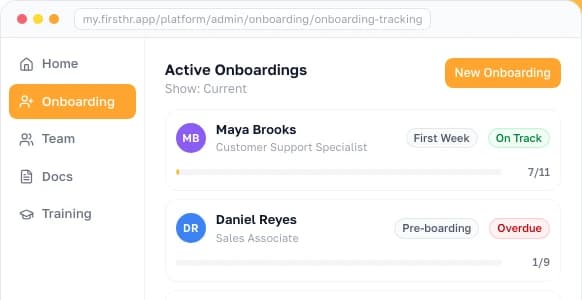
FirstHR fits this directly: e-signature for the offer, commission acknowledgment, and handbook, document management for ASE certifications, driver's license, and any state or EPA credentials with expiration dates on file, training assignments with completion records for your systems and processes, an HRIS with an org chart placing the advisor in your service department, and a self-service portal where the advisor can see their information, all built for shops without an HR department, which helps when you hire for the counter more than once. Applicant tracking is coming soon to FirstHR; today the platform handles onboarding and document tracking once the candidate signs.
Your next step is simple: pick the template that fits your shop, fill in the brackets, spell out the pay plan, and have the offer and first-week plan ready before you post.

Frequently Asked Questions
What does a service advisor do?
A service advisor is the person at the service counter who connects customers with the technicians working on their vehicles. The advisor greets customers, listens to their concerns, writes the repair order, turns the technicians’ findings into plain language, presents estimates and recommended services, keeps customers posted during the repair, and handles pickup and payment. Done well, the job protects both sides: customers understand and approve the work, and the shop captures what that work is worth. It combines customer service, selling, and coordination, and the emphasis depends on the setting. At a dealership the focus is warranty and manufacturer requirements, at an independent shop it is working across all makes and building long-term relationships, and a senior advisor also mentors the team.
What is the difference between a service advisor and a service writer?
Many shops use the two titles interchangeably, but where they are separated, a service writer is the narrower, entry-level role built around counter administration, while a service advisor owns the customer relationship and the sales. The writer writes up repair orders, enters customer information, and relays parts and status updates. The advisor does all of that and also presents recommended work, builds relationships, upsells appropriately, and carries the customer experience, often with service revenue targets. The writer position is frequently the first rung toward advisor, because it teaches the counter before the full responsibilities arrive. When you hire, first decide between a full advisor and an entry-level writer who can grow into the role, because that choice sets the experience you ask for and the pay you put in the posting. The templates on this page cover both.
What should a service advisor job description include?
A strong service advisor job description has a clear job summary, the pay structure, key responsibilities, qualifications split into required and preferred, and a simple way to apply, all written for your specific business. Because dealerships, independent shops, senior roles, and entry-level writer roles differ so much, the most important step is matching the template to your business and describing the real work: warranty processing and customer satisfaction (CSI) targets at a dealership, or relationship-building and growth in average repair order at an independent shop. Be specific about pay, since a base plus commission is the usual deal for advisors and a vague compensation line costs you good applicants. For most roles, treat the C1 service consultant certification from the National Institute for Automotive Service Excellence (ASE) as a preference, not a requirement, add an equal opportunity statement, and finish with one clear way to apply. Every template on this page targets one business type or level, so the posting fits the actual job.
How much does a service advisor make?
There is no official federal pay figure for service advisors because they are not a separate occupation, and typical pay combines a base with commission, so it swings with the shop, the advisor’s results, and the local market. As a rough benchmark, the Bureau of Labor Statistics (May 2025) reports a median annual wage of $50,620 for automotive service technicians and mechanics, the nearest automotive occupation in federal data. Commission earned on the work an advisor writes up can push total pay well above or below that number. Dealership plans often combine flat-rate commission with customer satisfaction (CSI) and performance bonuses, while independent shops commonly tie commission to the average repair order. To set pay for your own opening, check what comparable local shops offer for the same experience level, design an honest base-plus-commission plan you can sustain, and write the full structure into the posting. Candidates weigh pay plans carefully, so a clear upside helps you attract strong people.
Does a service advisor need ASE certification?
No, ASE certification is not legally required to work as a service advisor, but it is a recognized credential worth listing as preferred. ASE is the National Institute for Automotive Service Excellence, and the credential that fits this job is its C1 Automobile Service Consultant certification. The exam is voluntary and has 50 scored questions on sales skills, shop operations, vehicle systems knowledge, communications, and customer and internal relations. To become certified, an advisor must pass it and also have two years of work experience as a service consultant, and the certification lapses after five years unless they pass the recertification test. For most hires, especially entry-level writers and many independent shop roles, strong customer service skills and the right attitude matter more than a certificate, so ask for the C1 as a preference to avoid screening out good candidates. For senior advisor roles you can reasonably weight it more heavily. Some shops also look for Environmental Protection Agency (EPA) Section 609 certification, which covers servicing vehicle air-conditioning systems, when the work calls for it.
What happens after I hire a service advisor?
Once the candidate says yes, onboarding begins, and for a service advisor the goal is a productive person at the counter as soon as possible. Start with the offer and paperwork: an offer letter that spells out base pay, commission, and bonuses, the I-9, tax forms, state new-hire reporting, and any commission acknowledgment or handbook. Then move to onboarding specific to the job, such as system access and a walkthrough of your dealer or shop management software, how your shop greets customers and writes up orders, the services you offer and what they cost, plus any manufacturer or customer-service training. FirstHR fits this directly: e-signature for the offer, commission acknowledgment, and handbook, document management for ASE certifications, driver's license, and any state or EPA credentials, each stored with its expiration date, training assignments with completion records for your systems and processes, an HRIS with an org chart placing the advisor in your service department, and a self-service portal where they can see their information. Applicant tracking is coming soon to FirstHR; today the platform handles onboarding and document tracking once the candidate signs, which helps when you hire for the counter more than once.
Make HR the easy part of running your business
Onboarding, e-signatures, training and core HR in one place. Up and running in 5 minutes.
- 7-day free trial
- No credit card required
- Cancel anytime