
Free Warehouse Associate Job Description Templates
Free warehouse associate job description templates: general, entry-level, forklift, shipping and receiving, part-time, and lead. Download as DOCX.

A warehouse associate keeps your operation moving: receiving stock, picking and packing orders, loading trucks, and keeping inventory accurate. For a small warehouse, an e-commerce business, or a distribution operation, it is often the role you hire most and the one that turns over fastest. I would not write this posting from scratch, and with the six templates below, you do not have to.
The job description that brings applicants in does more than list tasks. It sets clear expectations on shift, pay, and physical demands, screens for reliable people, and becomes the baseline for the role once you hire.
At FirstHR, we build for small businesses that hire lean and fast, where the owner or supervisor writes the posting and onboards the new hire themselves. The templates cover the most common versions of the role: general, entry-level, forklift operator, shipping and receiving, part-time, and lead. Each is ready to use. Fill in the bracketed fields, adjust to match your operation, and post.
- Sign the offer letter
- Sign the employee handbook
- Workplace Safety course
Which Template Should You Use?
Pick the template that matches the role you are filling. The core structure is the same across all six, but each one emphasizes the responsibilities, requirements, and language that fit a specific kind of warehouse role. Use this guide to choose.
6 Free Warehouse Associate Job Description Templates
Download all six as separate Word files in one ZIP, or copy individual templates. Each one covers the job summary, responsibilities, qualifications, physical requirements, and how to apply, and the General template adds a company overview. Fill in the brackets before you post.
Template 1: General Warehouse Associate
The universal, all-purpose baseline. Covers receiving, picking, packing, shipping, inventory, and basic equipment, plus physical requirements and an equal employment opportunity (EEO) statement. Use this if you want a solid starting point for almost any warehouse role.
Template 2: Entry-Level Warehouse Associate
For hiring without experience. Minimal requirements, on-the-job training, and an emphasis on reliability and willingness to learn. Use this when you are happy to train the right person rather than require prior warehouse work.


Template 3: Forklift Operator / Warehouse Associate
For warehouses with powered equipment. Adds forklift operation, pre-shift inspections, OSHA-safe operation, certification, and the 18-and-over requirement. Use this when equipment operation is part of the role.
Template 4: Shipping & Receiving Associate
For dock and inbound-outbound work. Adds verifying shipments, bills of lading, manifests, carrier coordination, cycle counts, and FIFO rotation. Use this for a role focused on shipping and receiving accuracy.
Template 5: Part-Time / Seasonal Warehouse Associate
For peak seasons and e-commerce spikes. Flexible shifts, short-term framing, quick onboarding, and a shorter list of requirements. Use this to staff up fast for a busy period.
Template 6: Senior / Lead Warehouse Associate
For an experienced associate stepping into leadership. Adds training new hires, monitoring productivity and safety, and 2 or more years of experience. Use this when the role includes leading others on the floor.
What Is a Warehouse Associate?
A warehouse associate is a hands-on worker who moves, stores, and ships products and keeps a warehouse running. The role centers on receiving stock, picking and packing orders, loading and unloading trucks, and maintaining accurate inventory in a clean, safe environment. The Bureau of Labor Statistics (BLS) groups most of this work under hand laborers and material movers, who manually move freight, stock, or other materials.
The title goes by several names. Warehouse worker, material handler, stock clerk, and order picker all describe similar work, and many postings use the terms interchangeably. The scope varies by operation: some associates specialize in shipping and receiving or forklift operation, while in a small warehouse one associate does it all. That is why the job description should describe the actual duties for your operation rather than copy a generic list.
Key Responsibilities of a Warehouse Associate
Warehouse associate responsibilities fall into four broad areas. A good job description picks the specific duties from each area that apply to your operation rather than listing every possible task. These are the responsibilities most often expected of the role.
For a specialized role, this list shifts toward the relevant area, such as dock work for shipping and receiving or equipment operation for a forklift role.
What to Include in a Warehouse Associate Job Description
Every strong warehouse associate job description includes the same core sections: a job summary, the key responsibilities, qualifications, physical requirements, pay, and how to apply, often after a short company overview. The templates above are built around those core sections. Within those sections, concrete duties beat generic ones, and the table below shows the difference in wording.
| Weak bullet | Strong bullet |
|---|---|
| Move boxes | Pick, pack, and prepare 100+ orders per shift for shipment |
| Use equipment | Operate a pallet jack to load and unload delivery trucks |
| Handle inventory | Perform daily cycle counts and report discrepancies |
| Receive stock | Verify incoming shipments against purchase orders and packing slips |
| Be physically able | Lift up to 50 lbs repeatedly and stand for the full shift |
Specific, measurable duties attract candidates who can actually do the work and signal a serious employer. Keep the language neutral and inclusive too: federal law prohibits job advertisements that show a preference based on protected characteristics, as the Equal Employment Opportunity Commission explains.
Physical Requirements and the ADA
Warehouse work is physical, and the job description should state the physical requirements clearly. List lifting limits, standing time, and the work environment as essential functions, meaning the core duties of the job. That sets honest expectations for applicants and has a legal benefit under the Americans with Disabilities Act (ADA).
Write physical requirements as specific, job-related facts, such as the ability to lift a stated weight repeatedly and stand for the full shift. If the role involves a forklift, the OSHA powered industrial truck standard requires the employer to train, evaluate, and certify each operator. Separately, federal child labor rules bar anyone under 18 from operating a forklift outside agriculture.
Warehouse Associate Pay
Warehouse associates are typically paid hourly. Set your range using government data as a baseline, then adjust for shift, experience, location, and whether the role requires equipment operation.
Always publish a pay range. A growing number of states require one, and employers report that it pays off. The Society for Human Resource Management found in SHRM research (2023) that 70 percent of organizations that list pay ranges said more people applied, and 66 percent said applicant quality improved.
Because warehouse roles are usually hourly and non-exempt, federal overtime rules under the Fair Labor Standards Act (FLSA) apply. It helps to know the basics in the Department of Labor FLSA standards before you set pay and classify the role.
How to Write a Warehouse Associate Job Description
A strong warehouse associate job description comes together quickly if you follow a clear structure. Here is the process the templates are built around.
Common Mistakes to Avoid
A few mistakes show up again and again in warehouse job postings and quietly cost you good applicants. Each one takes only a few minutes to fix.
| Mistake | Why it hurts | Fix |
|---|---|---|
| Vague duties | Candidates cannot tell what the job involves | List specific, daily tasks |
| No physical requirements | Mismatched applicants apply and quit fast | State lifting and standing clearly |
| No pay range | Fewer and less qualified applicants | Add an hourly range |
| No shift or schedule | Wastes time on availability mismatches | State the shift and days |
| Over-requiring experience | Shrinks the pool for a trainable role | Keep must-haves short |
Most of these fixes come down to specificity. A clear, honest posting that states the duties, pay, shift, and physical demands attracts people who fit and repels those who do not, which is exactly what you want before you spend time screening.
Hiring a Warehouse Associate for a Small Business
Large warehouses have recruiters, dedicated trainers, and high-volume hiring systems. A small warehouse or e-commerce business does not. The owner or a supervisor writes the posting, screens applicants, and onboards the new hire, often while running everything else. Here is how to write the posting for that reality.
From Hiring to Onboarding
The job description is step one. Once a candidate accepts, the same document becomes the foundation for the offer and the onboarding plan. Warehouse roles turn over quickly, so good onboarding has an outsized payoff: a structured first day and clear training reduce the early quits that make this role expensive to fill.
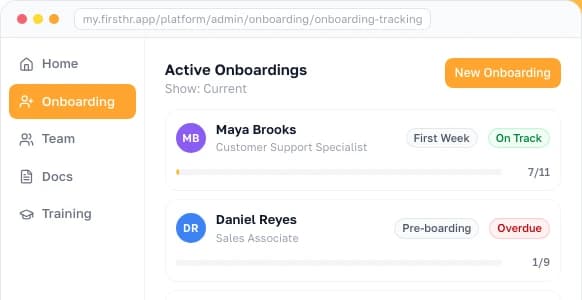
Good onboarding is what turns a new warehouse associate into a productive team member and keeps them past the first weeks. Once you have your offer ready, the offer letter template handles the next step, and an onboarding template gives the associate a structured start. FirstHR connects the offer, paperwork, and onboarding workflow in one place so a small business can manage the full process from one system.

Frequently Asked Questions
What does a warehouse associate do?
A warehouse associate handles the flow of products through your warehouse: receiving and storing incoming goods, picking and packing orders, and shipping them out, while keeping inventory counts accurate and the floor organized and safe. On a typical shift, that can mean checking in deliveries, getting orders ready to ship, loading and unloading trucks, running basic equipment such as pallet jacks, counting stock, and following safety procedures. How the work divides up depends on your operation. One associate may work the dock on shipping and receiving, another may drive a forklift, and a third may do a little of everything. In a small warehouse, one person often covers the whole range, so your posting should list the duties your operation really needs.
What are the responsibilities of a warehouse associate?
The core responsibilities fall into four areas. Receiving and storage: processing incoming stock, inspecting deliveries, and storing products correctly. Picking and shipping: picking and packing orders accurately, preparing shipments, and loading and unloading trucks. Inventory and equipment: performing counts, operating pallet jacks or forklifts, and reporting discrepancies. Safety and housekeeping: following safety protocols and keeping the warehouse clean and organized. A strong job description lists the specific responsibilities for your operation rather than a generic catch-all. The templates in this article give you a starting point to customize for your warehouse.
What is the difference between a warehouse associate and a warehouse worker?
In practice, warehouse associate and warehouse worker usually mean the same role, and the titles are often used interchangeably in job postings. Both cover receiving, picking, packing, shipping, and general warehouse duties. Associate can signal a customer-facing or team-oriented framing, while worker is more generic. Related titles like material handler, stock clerk, and order picker describe more specific versions of the same general work. When you post, use the title your candidates are most likely to search for, and describe the actual duties clearly so the title does not matter much.
What skills does a warehouse associate need?
The most important qualities are reliability, attention to detail, and physical stamina, since the work is hands-on and accuracy matters. Useful skills include the ability to follow instructions and safety procedures, basic math for counting and inventory, teamwork, and comfort with scanners or warehouse systems. For specialized roles, forklift certification or shipping and receiving experience is valuable. For entry-level hires, you can prioritize reliability and willingness to learn over experience: the Bureau of Labor Statistics notes that hand laborers and material movers typically learn through on-the-job training lasting a month or less. Keep the must-have requirements short so you do not shrink your applicant pool unnecessarily.
How much does a warehouse associate make?
Most warehouse associates are paid by the hour. For a baseline, use the U.S. Bureau of Labor Statistics (BLS) figures for hand laborers and material movers, the group that covers most warehouse associate work: in May 2025, half of them earned more than $38,220 a year, roughly $18.38 an hour. The bottom tenth made less than $30,190, and the top tenth more than $52,340. Forklift drivers earn more, with BLS putting the median for industrial truck and tractor operators at $22.32 an hour. Your own rate will move with location, shift, experience, and any equipment the job involves, and a lead associate who trains others and runs the floor needs a bigger budget. Put a pay range in every posting: a growing list of states requires one, and most employers that list ranges told researchers at the Society for Human Resource Management (SHRM) that it brought in more applicants.
Do I need to require a forklift certification?
Only if the role involves operating a forklift or other powered industrial truck. Under the OSHA forklift standard, the employer must certify that each operator has been trained and evaluated on the types of trucks they will drive, and federal child labor rules keep workers under 18 off forklifts in nonagricultural jobs. If the role includes forklift work, ask for prior forklift training or certification, or state that the associate must be willing to complete your training (you certify each operator yourself), and require the person to be at least 18. If the role does not involve powered equipment, do not list forklift certification as a requirement, since it will narrow your applicant pool unnecessarily. If the job includes operating powered equipment, start from the Forklift Operator template.
What happens after I hire a warehouse associate?
You move on to the offer and onboarding, and the job description you wrote becomes the starting point for both. People leave warehouse jobs quickly, so the first days matter: a planned first day and clear training mean fewer new associates quit early. Put the offer in writing, gather the signed paperwork, run safety and equipment training, and show the associate how your operation works before they take on tasks alone. Expectations you set early pay off quickly in a role with this much turnover. FirstHR handles the offer letter, document storage, and onboarding workflow in one place, so a small business can move a new warehouse associate from hire to productive with minimal overhead.
Make HR the easy part of running your business
Onboarding, e-signatures, training and core HR in one place. Up and running in 5 minutes.
- 7-day free trial
- No credit card required
- Cancel anytime