
Employment Status: Types and What Each Changes
Employment status for US employers: the types you actually use, what each one changes for payroll taxes, benefits and overtime, and how to record it.

Employment Status
What the term means for a US employer, the statuses a small business actually uses, and what each one changes for taxes, benefits and legal coverage
The first time a lender asked me to confirm an employee's employment status, I opened three systems and got three answers. The offer letter said full time. The payroll register said salaried. The benefits file said eligible as of the first of the month. None of those was what the form was asking for.
Employment status is one of those phrases that means something slightly different to everyone who asks for it. A payroll provider means one thing by it. The IRS means another. A benefits broker means a third. Most handbooks use the term repeatedly without ever defining it, which is how a company ends up with four true answers and no single correct one.
This is the explanation I wanted back then: what employment status actually is for a US employer, the statuses a small business genuinely uses, and what each one changes in taxes, benefits and legal coverage.
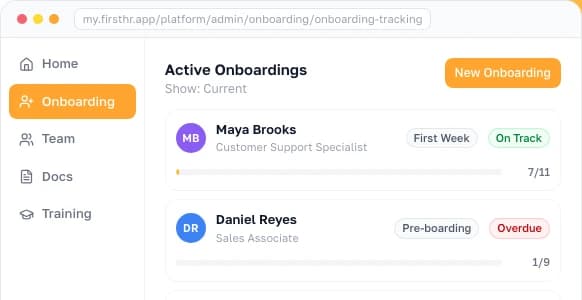
We structured the employee record inside FirstHR around these fields because collecting them at hire is most of the work, and reconstructing them a year later is most of the pain.
What Employment Status Means for an Employer
Employment status is the classification that describes how a person is attached to your business and which employment rules follow from that attachment. It is not a job title, a pay grade or a seniority level. It answers a legal question: what does this business owe this person, and under which laws.
No single federal statute defines employment status and hands you the list. Each agency defines the part it cares about. The IRS decides who belongs on a payroll. The Department of Labor decides who gets overtime. Your state unemployment agency decides who is covered for benefits. The health coverage rules decide who counts as full time for a coverage obligation.
That fragmentation is why one worker can be a W-2 employee for the IRS, nonexempt for overtime, full time under your handbook and not full time for health coverage measurement, all at once, with nothing wrong anywhere. The categories were written by different authors for different purposes and were never meant to line up.
The Four Questions That Set Employment Status
Employment status is four independent answers rather than one label. Payroll relationship, expected hours, expected duration and overtime exemption are each decided by a different rule, and changing one of them does not automatically change the others.
The order matters more than it looks. A wrong answer to question one produces a tax assessment. Questions two and three are mostly your own policy. Question four is a legal test again, with back overtime pay behind a wrong answer, and small businesses most often answer it by guessing from the pay method.
Write all four into the offer letter and the employee record on day one. Almost every status mess I have untangled started the same way: a company recorded one field, assumed the rest, and then had to reconstruct them from memory when a claim, an audit or a verification request arrived.
Employment Status Types at a Glance
Small businesses use eight employment statuses in practice. Five of them describe W-2 employees of your business and differ only in hours and expected duration. Two describe someone whose paycheck comes from elsewhere, or from no employer at all. The eighth is a title rather than a status.
| Status | Who the legal employer is | Year-end form | What the status actually changes |
|---|---|---|---|
| Full-time employee | Your business | Form W-2 | Nothing about tax treatment. It changes benefit eligibility under your own plan terms and your health coverage math once you are a large employer |
| Part-time employee | Your business | Form W-2 | The same withholding and employer taxes at a smaller scale. Benefit eligibility depends entirely on how each plan document defines an eligible employee |
| Temporary or fixed-term employee | Your business | Form W-2 | Your staffing plan and your unemployment cost. Every payroll, wage and hour obligation is identical to a permanent employee for the weeks worked |
| Seasonal employee | Your business | Form W-2 | The same as temporary, with the added wrinkle that recurring seasonal work gets special treatment in the health coverage headcount rules |
| On-call or per diem employee | Your business | Form W-2 | Scheduling only. Hours still accrue toward benefit eligibility measurements, which is where irregular schedules quietly create obligations |
| Staffing agency placement | The staffing agency | The agency issues it | You pay an invoice rather than run payroll. Directing the work day to day can still pull you back in as a joint employer |
| Independent contractor | Nobody. They are self-employed | Form 1099-NEC | Everything. No withholding, no employer payroll tax, no unemployment or workers’ compensation coverage, and only a few employment statutes reaching them through you |
| Intern | Usually your business | Form W-2 when paid | The title, not the status. A paid intern at a for-profit company is normally an ordinary employee with an ordinary employment status |
Only two lines in that table are legal categories with tests behind them: the contractor line and the agency line. The rest are labels you define. That freedom is useful, because your handbook can say what full time means at your company, but it is also why people assume the labels carry protections they do not carry.
Full-Time and Part-Time: You Set the Line, With Two Exceptions
There is no federal hour count that makes an employee full time. The Department of Labor states that the Fair Labor Standards Act does not define full-time employment or part-time employment, which leaves the threshold to the employer and to any applicable agreement. Whatever your handbook says is the operative definition for your company.
Two things override that freedom. The first is the health coverage rule for larger employers. The IRS defines a full-time employee for employer shared responsibility purposes as someone employed on average at least 30 hours of service per week, or 130 hours of service per month.
That definition applies once you are an applicable large employer, which the IRS sets at an average of at least 50 full-time employees including full-time equivalents during the prior calendar year. Below that count the rule does not bind you, but the arithmetic is worth running early because full-time equivalents are counted, not headcount.
The second override is your own plan documents. A health plan, a retirement plan and a paid time off policy each carry their own definition of an eligible employee, and those definitions are rarely the same number. Retirement plans carry one rule worth knowing before you set an hours line.
Under the long-term part-time employee rule in section 401(k) of the Internal Revenue Code, a plan has to let a part-time employee defer pay into it once they complete two consecutive 12-month periods credited with at least 500 hours of service in each. The two-period standard applies for plan years beginning after December 31, 2024.
Hours also drive benefit questions that owners underestimate. Whether part-time employees get benefits is answered by your plan documents rather than by the label, and the same is true for retirement plan participation.
Temporary, Seasonal and Fixed-Term Status
A temporary employee is a W-2 employee with a planned end date. The end date changes your headcount plan and your unemployment experience, and it changes nothing at all about the payroll and wage obligations you carry while the person is working.
Minimum wage applies. Overtime applies unless the role is exempt. Federal and state unemployment tax applies, and workers' compensation applies on the same terms as for your permanent staff.
The paperwork and handbook promises apply as well. Form I-9, which confirms the person is authorized to work in the US, and the state new hire report are both required. The person is entitled to whatever your handbook promises to employees generally, unless the handbook says otherwise in writing.
Seasonal work is temporary work that recurs with a season, and the distinction earns its keep in one specific place: the health coverage headcount rules treat certain seasonal workers differently when you are working out whether you are a large employer.
Fixed-term employment is the label that causes the most trouble in an offer letter. Writing a specific end date can read as a promise of employment through that date, which cuts against the at-will relationship you probably intend. State the expected duration and keep the at-will language in the same document.
The last trap is the assignment that quietly becomes permanent. Someone hired for eight weeks who is still there in month nine has usually crossed a benefit eligibility measurement without anyone noticing.
Exempt and Nonexempt Is a Separate Status Field
Exempt and nonexempt answers one question: does federal minimum wage and overtime law cover this role. It is decided by duties and salary together, not by hours worked, job title, or a salary by itself.
Three tests have to be satisfied together for the standard white-collar exemptions. The employee must be paid on a salary basis, must be paid at least the salary level, and must actually perform exempt duties.
According to the Department of Labor fact sheet on the white-collar exemptions, the salary level is $684 per week, the highly compensated employee threshold is total annual compensation of $107,432 or more, and computer employees can alternatively be paid $27.63 an hour.
Two combinations surprise owners. Salaried nonexempt is real and common: paying a salary does not buy an exemption, and an employee who fails the duties test earns overtime no matter how the pay is delivered.
Part-time exempt is also possible, but as the Department of Labor confirms, the salary level is not prorated, so a half-time employee still needs the full weekly figure to stay exempt.
Several states set a higher salary level than the federal one, and where they differ the higher figure applies. Work through exempt versus nonexempt classification before you write the number into an offer letter, because reclassifying later means recalculating overtime for the period you got it wrong.
Where Contractors, Agency Workers and Interns Sit
An independent contractor has no employment status with your business, because there is no employment relationship to classify. They are a vendor you pay against an invoice, they carry their own tax and insurance, and most employment statutes do not reach them through you.
Contractor status looks cheap, which is why the label gets abused and why agencies test it rather than accept it. The IRS applies a common law control test across behavioral control, financial control and the type of relationship, and several states apply a stricter ABC test that presumes employee status unless the business proves three conditions.
The reporting is different too. A contractor receives a Form 1099-NEC rather than a Form W-2, and the IRS instructions for that form set the reporting threshold at $2,000 for payments made after December 31, 2025. That replaces the $600 figure that section 6041 of the tax code had carried since 1954.
A worker placed by a staffing firm is an employee, just not yours. The firm runs payroll, issues the year-end form and carries the unemployment and workers' compensation obligations. Your exposure starts when you direct the day-to-day work closely enough that a joint employment analysis can treat you as an employer too.
Interns are the category people get wrong in the friendliest way. A paid intern at a for-profit company is normally an ordinary employee whose title says intern, with the same withholding, the same wage floor and the same paperwork as anyone else.
Unpaid internships at for-profit employers are the narrower case. The Department of Labor applies a seven-factor primary beneficiary test to decide whether the intern is really an employee, and it is worth reading in full before you rely on it.
What Each Status Changes for Taxes and Benefits
Employment status changes three buckets: what you withhold and remit, what the person can enroll in, and which laws reach them. The payroll relationship drives nearly all of it. Hours and duration mostly move the benefits column.
| Obligation | Any W-2 employee, at any hour count | Independent contractor |
|---|---|---|
| Federal income tax withholding | Yes, per the employee’s Form W-4 | None. They pay estimated tax quarterly |
| Social Security tax | 6.2 percent from you and 6.2 percent from the worker, on wages up to $192,300 for 2027 ($184,500 for 2026) | The worker pays the full 12.4 percent as part of self-employment tax |
| Medicare tax | 1.45 percent from each side on all wages, plus 0.9 percent withheld from the worker above $200,000 | The worker pays the full 2.9 percent, plus the additional rate |
| Federal unemployment tax | 6.0 percent on the first $7,000 of wages, a net 0.6 percent with the full state credit | None |
| State unemployment tax | Yes, at your experience rate and state wage base | None, and the worker cannot claim benefits against you |
| Workers’ compensation coverage | Required from the first employee in many states and above a small-employer threshold in others; Texas and South Dakota leave it optional | Their own policy, or none at all |
| Minimum wage and overtime | Yes, unless the role passes the exemption tests | No |
| Group health plan eligibility | Per plan terms, with the waiting period capped at 90 days | Not eligible through you |
| Retirement plan eligibility | Per plan terms, including the long-term part-time rule | Not eligible through you |
| Year-end form | Form W-2 | Form 1099-NEC once payments reach $2,000 in the calendar year |
Two rows deserve a second read. The health plan row reflects a federal ceiling: a group health plan may not impose a waiting period longer than 90 days, so coverage has to be effective by the 91st day, counting the day the employee meets the plan's substantive eligibility conditions as day 1.
The Social Security row is where the cost comparison between an employee and a contractor usually goes wrong. The employer half of that tax is money you never pay on an invoice, which is why a legitimate contractor bills more per hour than an equivalent employee earns. Compare loaded cost against the full billing rate, never against the base wage.
The wage base itself moves every year. The Social Security Administration publishes the new figure annually, and each employer applies the cap to the wages it pays rather than to everything the worker earned that year. Hiring someone who already hit the base at another job therefore does not reduce what you owe on the wages you pay.
One scope note, because this topic sits next to payroll and people ask: FirstHR is an onboarding and HR platform, not a payroll provider. What we hold is the status record itself and the onboarding steps attached to it: the information a payroll system runs on, not a replacement for one.
Where Employment Status Lives in Your Records
Employment status is written down in at least six places, and the failure mode is not that any one of them is wrong. It is that they disagree with each other and nobody notices until an outside party compares two of them.
Pick one of those six as the source of truth and make every other copy derive from it. For most small companies that is the employee record in the HR system, because it is the only place all four status fields sit together and the only one a manager will actually open.
This pays off most with a new hire. Capture hours, expected duration and exempt classification in the same flow that collects the tax forms and the signed offer letter, and the status record is complete before day one instead of being assembled later from three inboxes.
The outbound side matters just as much. An employment verification letter and an unemployment claim response both state a status under your name, and both get compared against your personnel file if anything is contested.
Active, On Leave and Terminated: The Other Status Field
Most HR systems carry a second field also called status, and it tracks the state of the relationship rather than its classification: active, on leave, suspended, terminated, rehired. It is a different question from full time or exempt, and conflating the two is a common source of reporting errors.
Keep them separate on purpose. An employee on a leave of absence is still a full-time nonexempt employee whose relationship state is on leave, and their benefit continuation rights depend on the leave, not on a change of classification. At termination the relationship state changes while the classification simply stops applying.
How to Change Someone's Employment Status
Changing employment status is a small project with four moving parts: the written notice, the payroll change, the benefits consequence and the record. Skip any one of them and the change is only half made, which is worse than not making it. Six steps get all four done in the right order.
Two transitions carry more weight than the rest. Part time to full time usually triggers a benefits waiting period and a real cost increase, so budget it before you promise it. Nonexempt to exempt requires a fresh duties analysis rather than a pay method change, and it is the reclassification most likely to be challenged later.
Moving a contractor onto payroll is a different animal again, because it is a first-time hire in the eyes of every federal and state clock.
The Employment Status Mistakes I See Most
Using a 1099 to make a small hire simpler is the expensive one. Reduced hours never create contractor status, because the control test asks the same questions at ten hours a week as at forty. A former employee brought back part time on an invoice, doing the same work for the same manager, is the exact fact pattern misclassification audits are built to catch.
Treating full time as a legal category is the common one. It is a policy label at most companies, so promising benefits by hour count alone, without checking what each plan document defines as an eligible employee, is how a company ends up owing coverage it never priced.
Calling someone exempt because they are salaried is the frequent one. Pay method is one of three tests and cannot carry the other two on its own. If the duties do not fit an exemption, the person earns overtime regardless of what the offer letter says.
Writing a hard end date into an offer letter without at-will language is the quiet one. A stated term can be read as a promise of employment through that date, which is the opposite of what most owners intend when they hire someone temporarily.
Letting the systems drift is the boring one, and it causes the most day-to-day trouble. A status changed in the HR system but not in payroll, or in payroll but not in the benefits file, produces a wrong paycheck or a wrong verification letter.
That ten-minute pass catches a wrong classification. The sheet below catches the last mistake on this list instead, the one where every classification is right and the copies simply disagree. Its first tab takes one status field at a time and sets what the offer letter, the HR record, the payroll register, the benefit plan file and your last outbound letter each say about it side by side, so a mismatch surfaces as a row rather than as a surprise on a verification form. The second is the change log: one line per status change, with a date column for the written notice, the payroll push, the benefits re-run and the employee record, because a change is only half made until all four carry a date.
| A | B | C | D | E | F | G | H | I | J | K | |
|---|---|---|---|---|---|---|---|---|---|---|---|
| 1 | Employee name | Status field being checked | What the signed offer letter says | What the HR record says | What the payroll register says | What the benefit plan file says | What we last stated in an outbound letter | Do they agree? (yes or no) | Which copy we corrected, and to what | Corrected on | Corrected by |
| 2 | Example: R. Diaz | Weekly hours | 32 hours, stated in the letter | 32 hours, part time | Hourly, no scheduled hours held | Eligible, plan line is 30 hours | Verification letter said full time | No | HR record and future letters say 32 hours | 2026-09-14 | N. Owner |
| 3 | Example: T. Okafor | Exempt or nonexempt | Exempt, salaried | Exempt | Salary, no overtime treatment | Not used for eligibility | Not stated | Yes | None needed this round | 2026-09-14 | N. Owner |
| 4 | |||||||||||
| 5 | |||||||||||
| 6 | |||||||||||
| 7 | |||||||||||
| 8 | |||||||||||
| 9 | |||||||||||
| 10 | |||||||||||
| 11 | |||||||||||
| 12 | One row per person per status field | Read every other record against the signed offer letter, then correct the copies rather than the source |
Frequently Asked Questions
What does employment status mean?
Employment status records the legal shape of a working relationship: who the employer is, and which employment rules therefore reach the person. It sits apart from job title, pay grade and seniority, because those describe the role rather than the relationship. For a US employer it is really four separate answers rather than one label: whether the person is on your payroll as a W-2 employee, how many hours the job is, how long the job is expected to last, and whether federal overtime law covers the role. Each of those four is set by a different rule. Two of them are yours to define in policy, and two of them are decided by law and tested by an agency if anyone ever asks. Recording all four at hire is what keeps the answer consistent later.
What are the types of employment status?
Eight labels cover nearly every small company: full time, part time, temporary or fixed term, seasonal, on call, staffing agency placement, independent contractor and intern. The first five all describe W-2 employees of your business, separated only by definitions you write yourself. A staffing agency placement is an employee of the agency rather than of you, so the agency runs payroll and issues the year-end form. An independent contractor is not an employee at all and therefore has no employment status with your business. A paid intern is normally an ordinary employee whose title happens to say intern. Only two of the eight are legal categories with tests behind them; the rest are labels for scheduling and planning.
Who decides whether an employee is full time or part time?
You do, in almost every case. The Fair Labor Standards Act carries no definition of either term, as the Department of Labor confirms, so whatever number your handbook names is the operative one. Two things override that choice. Once you average at least 50 full-time employees including full-time equivalents over the prior year, the health coverage rules define a full-time employee as someone averaging at least 30 hours of service per week or 130 hours per month, and that definition governs your coverage obligation regardless of what your handbook says. Your benefit plan documents can also set their own eligibility line. The practical fix is to write one number into the handbook and then check each plan document against it rather than assuming they agree.
Does employment status change how much payroll tax I withhold?
The payroll relationship changes it completely; the hours do not. Every W-2 employee triggers the same withholding and employer tax obligations at any hour count: federal income tax per Form W-4, Social Security at 6.2 percent from each side up to the annual wage base, Medicare at 1.45 percent from each side with no ceiling, federal and state unemployment tax, and workers’ compensation coverage wherever your state requires it. A ten-hour-a-week employee is the same tax setup as a forty-hour employee, just with smaller numbers. An independent contractor is a different arrangement entirely: no withholding, no employer payroll tax, and a Form 1099-NEC at year end instead of a Form W-2 once payments cross the reporting threshold.
Is exempt or nonexempt part of employment status?
Yes, and it is a separate field from hours and duration. The exempt or nonexempt field settles one question: whether federal minimum wage and overtime law covers the role. For the standard white-collar exemptions, three conditions must all hold. The person is paid on a salary basis, earns at least the federal salary level of $684 per week, and actually performs exempt executive, administrative, professional, or computer duties. There are carve-outs: computer employees can instead be paid hourly at $27.63 or more, and outside sales employees face no salary requirement at all. Paying a salary by itself does not create exempt status, which is why plenty of salaried employees are still nonexempt. A part-timer can hold exempt status, but the weekly figure never shrinks with the schedule, so someone working half a week must still clear the same amount in full.
Are independent contractors an employment status?
No. A contractor sits outside the status framework entirely, because the arrangement creates no employment relationship to begin with. You buy a service against an invoice, the person handles their own tax, their own insurance and their own schedule, and most employment protections do not travel to them through your business. The label is tempting because it looks cheaper on paper, so agencies check the facts instead of taking it at face value. The IRS weighs behavioral control, financial control and the type of relationship under its common law test. Several states go further with an ABC test, which starts from the presumption that the worker is an employee until the business proves three conditions. Substance decides the question, not the wording of the contract.
How do I change an employee from part time to full time?
Handle it as a short sequence rather than a field edit, because four systems have to end up saying the same thing. Put the change in writing with an effective date, a new pay rate and the exempt or nonexempt classification that applies at the new schedule. Send the change to payroll ahead of the first affected pay period, because an edit that stops at the HR record produces a wrong paycheck on the very next cycle. Run benefits eligibility next, since a higher hour count can start a waiting period or open enrollment, and group health coverage has to start within 90 days of the person meeting the plan’s eligibility conditions. Then update the employee record so the system, the payroll register and the signed letter all agree.
Make HR the easy part of running your business
Onboarding, e-signatures, training and core HR in one place. Up and running in 5 minutes.
- 7-day free trial
- No credit card required
- Cancel anytime