
Soft Skills Training: A Guide for Growing Businesses
How to train employees on soft skills without an HR department. 6 essential skills, a 90-day training plan, and methods that work for growing teams.

Soft Skills Training
How to build communication, teamwork, and problem-solving on your team
I hired a developer who was technically brilliant and interpersonally destructive. His code was flawless. His communication was a disaster. He sent one-word replies to client questions. He interrupted colleagues in meetings. He treated code reviews as personal criticism competitions. Within four months, two team members had asked to be moved off his projects and one had started looking for other jobs.
The technical skills were never the problem. The soft skills were the entire problem. And the mistake was mine: I assumed that hiring someone technically competent meant they would naturally know how to communicate, collaborate, and handle conflict. They did not. Nobody had ever trained them on those skills, and I did not either because I did not have a framework for doing it.
This guide is that framework: soft skills training for growing businesses with no HR department and no training budget. It covers what soft skills actually are, the six that matter most, why they matter more at a small company, how to train them through everyday work, how to build them into onboarding, and how to tell whether the training is working.
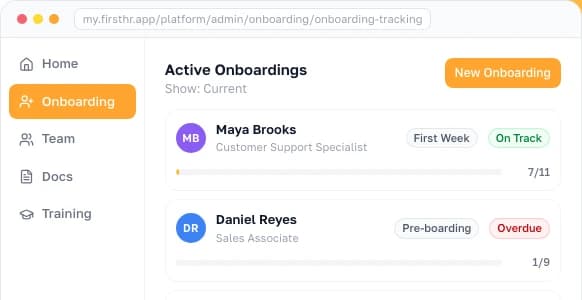
I built training modules into FirstHR so that soft skills development becomes part of the onboarding workflow rather than an afterthought that only surfaces during performance problems.
What Is Soft Skills Training?
Soft skills training is the structured development of interpersonal and behavioral skills that determine how effectively an employee works with other people. While hard skills training teaches someone to do a specific task (operate a CRM, write code, process an invoice), soft skills training teaches them how to communicate clearly, collaborate productively, resolve disagreements, and adapt to changing circumstances.
The distinction matters for training because the two are taught in completely different ways. Hard skills transfer through documentation, courses, and demonstrations. Soft skills need practice in real situations, feedback on actual behavior, and people nearby who model them well. A manager who watches a new hire handle a customer conversation and then gives specific feedback teaches more than a video course on "effective communication."
Why Soft Skills Matter More at Small Companies
At an enterprise employer, one person with poor communication skills is a localized problem. Their manager notices, HR gets involved, the issue is managed inside one team. At a small company the same person is a company-wide problem. Everyone works together. Everyone notices. Every bad interaction reaches team dynamics, client relationships, and the founder's sanity.
Three structural factors make soft skills disproportionately important at growing businesses.
Every Employee Is Visible
At a small company, there is no place to hide. Most of the team sees every email, every meeting contribution, and every client interaction. An employee who communicates poorly is not a private problem for their supervisor to manage. They become a team-wide friction point that drags on collaboration, morale, and output across the entire organization.
Roles Are Less Defined
At enterprise employers, people operate within clearly defined roles with structured handoffs. At growing companies, everyone handles tasks outside their job description. The developer takes a customer call. The operations manager writes a proposal. The salesperson helps with onboarding.
Every one of these cross-functional moments requires soft skills that the employee's primary role may not demand. That turns adaptability, communication, and teamwork into survival skills for the organizational ambiguity that comes with growth, rather than nice-to-have extras.
Early Turnover Starts with Friction
According to research reported by SHRM (2017), up to 20% of all employee turnover happens within the first 45 days of employment. At a small company, a good share of that early exit traces to interpersonal friction rather than skill: the new hire who cannot collaborate, the manager who cannot give constructive feedback, the colleague who creates conflict instead of resolving it.
Those are the friction points soft skills training during onboarding is aimed at. Address them in the first six weeks and they stay small. Leave them and they harden into the reasons someone gives notice.
| Scenario | Without Soft Skills Training | With Soft Skills Training |
|---|---|---|
| New hire sends confusing emails to clients | Client complains, manager intervenes reactively, damage already done | Week 1: communication standards defined. Week 2: manager reviews first client emails, gives feedback before they are sent |
| Two team members disagree on an approach | Conflict festers for weeks, both parties avoid each other, productivity drops | Conflict resolution framework taught in Month 1, manager facilitates first resolution as a learning moment |
| Employee misses a deadline without warning | Surprise missed deadline, scramble to recover, trust damaged | Time management expectations set during onboarding, check-in cadence catches slippage early |
| New hire struggles to adapt to ambiguous role | Frustration builds, employee disengages, quits within 90 days | Adaptability discussed during onboarding, expectations for role fluidity set explicitly |
6 Essential Soft Skills to Train
Every business needs employees who can communicate, collaborate, solve problems, manage time, resolve conflict, and adapt to change. These six skills cover the interpersonal foundation that every other training builds on.
Order matters, and communication comes first because every other soft skill depends on it. You cannot collaborate without communicating. You cannot resolve conflicts without articulating your perspective. You cannot manage time effectively without setting and communicating expectations. Start with communication and build the others on top.
Soft Skills vs Hard Skills: Different Training, Different Methods
Understanding the difference between soft and hard skills determines how you train each one. The methods that work for hard skills (documentation, courses, demonstrations) fall short for soft skills, and the last three rows of the table show why: how each is measured, how long it takes, and who delivers it.
| Dimension | Hard Skills | Soft Skills |
|---|---|---|
| What they are | Technical, measurable abilities specific to a job | Interpersonal behaviors that apply across all jobs |
| Examples | CRM operation, Python coding, financial modeling, equipment repair | Communication, teamwork, problem-solving, adaptability |
| How they are learned | Courses, documentation, practice, certifications | Observation, practice in real situations, feedback, role-modeling |
| How they are measured | Tests, certifications, task completion quality | Behavioral observation, peer feedback, self-assessment |
| Training timeline | Days to weeks for basic proficiency | Months of consistent practice and feedback |
| Who delivers training | Subject matter expert or online course | Manager and colleagues through daily interaction |
Soft skills are developed through real work, not through courses. A two-hour online module about effective communication teaches concepts. Writing the email, having the manager read it before it goes out, and hearing exactly what to change teaches the behavior. Soft skills training is coaching, not instruction.
The timeline in that table is the reason. A 2012 review in the British Journal of General Practice reports a habit-formation study in which automaticity in a new daily behavior plateaued on average around 66 days. Put simply, a new daily habit took about that long to run on autopilot, with wide variation between people and behaviors. A single workshop cannot span that. A weekly check-in can.
How to Train Soft Skills Without an HR Department
Soft skills training at growing businesses does not require workshops, courses, or a training budget. It requires three things: defined standards, real-work practice, and consistent feedback.
Step 1: Define What Good Looks Like
Write down the specific behaviors you expect for each soft skill. Not "be a good communicator" but "reply to internal messages within 4 hours, lead emails with the ask or the update before the context, and confirm understanding at the end of every meeting." Specific standards are trainable. Vague expectations are not. Share these standards with every new hire during their first week.
Filling this in takes about an hour, and it is the hour the rest of the training depends on. Keep its "Using this in a check-in" section open during check-ins, because a standard nobody ever references stops being a standard within a month.
Step 2: Use Real Work as the Training Ground
The most effective soft skills training method is structured practice in real situations. Give the new hire a small shared task with one colleague in Week 2, then a collaborative project in Days 31-60 that requires working with two or three colleagues. Role-play a difficult customer conversation before they handle one for real. Have them present a project update to the team in Month 3. Each of these is a training exercise disguised as actual work. The skills develop through doing, not through watching.
Step 3: Build Feedback into Your Check-in Cadence
Soft skills feedback works best when it is specific, timely, and part of a regular rhythm. Put one observation about an interpersonal skill into at least one check-in every week of the first 90 days, whether that is one of the short daily check-ins of Month 1 or the weekly check-ins the plan below settles into by Month 3: "Your summary email after the client call was clear and saved the team twenty minutes of follow-up questions" or "In the meeting yesterday, I noticed you jumped in before Sarah finished her point. Try pausing for a beat before responding."
Frequency does more work here than eloquence. Gallup (2022) finds employees are 3.6 times more likely to strongly agree they are motivated to do outstanding work when their manager gives feedback daily rather than annually, and that 80% of employees who received meaningful feedback in the past week are fully engaged. A weekly cadence is the realistic floor.
Leadership Soft Skills Training for Managers
Managers need a different set of skills from everyone else, and the gap shows up fastest in the person you just promoted for being good at the work. Delegating, giving feedback that lands, running a decision to a conclusion, and holding a difficult conversation are the four skills that separate a strong individual contributor from a manager people stay for.
The cost of skipping this lands on the team, not the manager. In a 2023 survey of 2,066 employees reported by SHRM, 34% of people with a negative manager experience wanted to leave the organization and 41% reported being stressed or anxious about coming to work.
Train them the same way you train everyone else: define the behavior, then practice on real work. Have a new manager draft a piece of feedback before delivering it and read it through with them. Sit in on their first two check-ins and debrief afterward. Leadership training for managers covers the wider structure.
Soft Skills Training Topics and Modules
The training topics worth adding after the core six are critical thinking, accountability, business acumen, innovation, resilience, and customer service skills. Interpersonal skills training is the umbrella name a catalog will use for the whole group, and each one runs in-house for far less than the catalog price.
The table covers those six, plus problem solving, which already sits in the core set but gets sold as a separate module often enough to be worth a line.
| Training topic | What it means on a small team | How to run it as a module |
|---|---|---|
| Critical thinking | Judging whether a vendor claim, a customer story, or your own assumption holds up before you act on it | Ask for the reasoning before you hear the recommendation, and make that the normal order in every meeting |
| Accountability | Owning a commitment through to the end, including saying early and plainly when it is going to slip | Give every commitment a name and a date in one shared place, then review the misses in a weekly check-in without blame |
| Business acumen | Understanding how the company makes money and how one particular role moves that number | Walk a new hire through a real invoice, the costs behind it, and the margin left over, inside their first month |
| Innovation | Proposing and testing better ways to do the work, which is process improvement rather than product invention | Give one hour a month to a documented irritation in the process and let whoever raised it run the fix |
| Resilience | Recovering from a lost deal, a bad review, or a project that failed, without disengaging from the next one | Debrief failures on the same cadence as wins, and separate the quality of the decision from the quality of the outcome |
| Customer service skills | Staying clear and calm with a frustrated customer, and knowing the point at which to escalate | Role-play the three complaints you actually get, then listen to a real recording together and mark the moment it turned |
| Problem solving | One of the core six, kept here because catalogs price it as its own module | Hand over a real problem with your solution withheld, then review the reasoning rather than the answer |
Two rules for sequencing. Run one of these at a time, because a team working on four things is working on none. And pick the one attached to a problem you can already name, since a topic chosen from a catalog rather than from an observed gap is the module people quietly skip.
Critical Thinking Training for Employees
Critical thinking training teaches people to separate what they know from what they are assuming before they act. In a small business it earns its place in three spots: a vendor pitch nobody checks, a customer complaint taken at face value, and a plan built on a number somebody half remembered.
The exercise is cheap. Take a real decision you have not made yet, ask everyone to write down the one assumption they would test first and how they would test it, then run the cheapest of those tests before you commit. Do that four or five times and people start doing it unprompted.
When a Soft Skills Course or Program Is Worth Buying
Buy a course when the skill carries a body of technique that nobody in the building has, and train in-house for everything else. Presentation delivery, structured negotiation, and formal coaching qualifications are the usual cases. Communication, accountability, and time management almost never are.
Bought training comes in three formats. A subscription library costs least per head and gets used least. A live workshop builds a shared vocabulary in a day and fades without follow-up. A coach working with two or three managers costs the most per person and shifts behavior most reliably.
Corporate soft skills training bought as a one-off workshop with no manager follow-up wastes the most money of any option here. Whatever you buy, what makes it stick is what makes the free version stick: somebody watches the behavior at work afterward and says something specific about it. Even the best soft skills training program lives or dies in the two weeks that follow it.
Why Soft Skills Training Should Start on Day 1 of Onboarding
Soft skills training should start during onboarding, alongside compliance and role-specific training, for three reasons. Most companies get the sequence backwards and treat it as something that happens after the technical training is done.
First, new hires are in learning mode during onboarding. They are actively adapting to a new environment, meeting new people, and absorbing new information, which makes this the moment of highest receptivity to behavioral change. By Month 6, habits are established and changing them requires significantly more effort.
Second, soft skills problems that go unaddressed during onboarding become normalized. If nobody tells the new hire in Week 1 that one-word email replies are unacceptable, by Week 8 they believe those replies are fine, because nobody said otherwise.
Third, the onboarding period is full of natural soft skills training opportunities: team introductions (communication), group projects (collaboration), first-day jitters (adaptability), and the inevitable confusion of being new (asking for help). These situations become training moments if you treat them intentionally.
90-Day Soft Skills Training Plan
This plan embeds soft skills training into the natural onboarding timeline. Each phase builds on the previous one, progressively increasing the new hire's interpersonal independence.
The buddy in the first phase is the cheapest item on the list and the one I would cut last. Microsoft's own onboarding research, published in Harvard Business Review in 2019, found new hires with an onboarding buddy were 23% more satisfied with their onboarding after the first week and 36% more satisfied at 90 days than those without one.
The 90-day review is the formal transition point. By Day 90, the new hire should be communicating effectively, collaborating without handholding, and handling minor conflicts independently. If they are not, the review is where you create a specific development plan for the gaps that remain.
Measuring Soft Skills Progress
Measuring soft skills is harder than measuring hard skills because there is no certification exam or error count. Harder is not impossible, though. Four approaches give you enough data to assess progress and identify development needs.
| Method | How It Works | When to Use |
|---|---|---|
| Behavioral observation | Manager notes specific examples of communication, collaboration, and conflict handling during regular work | Continuously, logged in a check-in at least once a week |
| Peer feedback (informal) | Ask 2-3 colleagues: 'How is it going working with the new hire? Any communication or collaboration observations?' | Day 30 and Day 60 |
| Self-assessment | New hire rates their own soft skills on a 1-5 scale across the six core areas | Day 30, 60, and 90 |
| Gap analysis | Compare self-assessment to manager assessment. The gap reveals blind spots | Day 60 and Day 90 |
The gap analysis is the most useful of the four because it surfaces misalignment between how the employee perceives their skills and how others experience them. An employee who rates their communication at 5 while their manager rates it at 3 has a blind spot that coaching can address.
Agreement tells you something too. An employee whose self-assessment matches the manager's assessment has accurate self-awareness, which is itself a soft skill worth recognizing.
Common Mistakes in Soft Skills Training
Five mistakes appear consistently when growing businesses attempt soft skills training. Each one undermines the training before it has a chance to work.
Most of these mistakes share one fix: the three steps above, started in the new hire's first week. If you want a single next step, fill in the communication section of the standards sheet this week and bring one specific observation to your next check-in.
Frequently Asked Questions
What is soft skills training?
Soft skills training is a planned effort to build the interpersonal and behavioral side of someone's work: how they talk to people, cooperate with them, and handle friction on the job. It targets six areas: communication, teamwork, problem solving, time management, conflict resolution, and adaptability. Hard skills training, by contrast, teaches a specific technical ability, such as running a piece of software or writing code. Because the behaviors soft skills training builds show up in every job, it is relevant to every role and every industry.
What are the most important soft skills to train?
Six soft skills carry most of the weight in a growing business: communication, teamwork, problem solving, time management, conflict resolution, and adaptability. In practice, communication means writing clearly, listening properly, and getting ideas across. Teamwork means working well with people in other roles and with other styles. Problem solving means spotting and fixing issues on your own. Time management means setting priorities and hitting deadlines. Conflict resolution means raising disagreements openly and professionally. Adaptability means coping when priorities shift or the path is unclear. Train communication first: the other five all run through it, so a weakness there shows up as a weakness in each of them.
Can soft skills be taught or are they natural?
They can be taught. Soft skills are habits of behavior rather than fixed parts of someone's personality, and habits respond to instruction, practice, and feedback. Communication gets better when someone is shown what good looks like and then practices it. Conflict resolution gets better with a simple framework and role-play. Time management gets better with tools and someone holding the employee accountable. Some people start from a stronger baseline, yet everyone improves with deliberate training and steady feedback. Treating soft skills as inborn is the main reason most companies never put money into training them.
When should soft skills training start?
Start on Day 1 of onboarding rather than months later, after a problem has already surfaced. In their first weeks, new hires are adjusting to a new workplace, new people, and new routines all at once, which makes them unusually open to picking up new habits. A practical sequence: set communication expectations in Week 1, hand out a small shared task in Week 2 and a cross-functional project in the second month, and keep specific feedback on behavior coming at least once a week for the whole first 90 days. Leave soft skills until the first performance review and the bad habits will already have set.
How do you train soft skills without an HR department?
Three methods that require no HR expertise or budget. First, define standards: write down what good communication, teamwork, and problem-solving look like at your company. Second, use real work as training: assign collaborative projects, role-play difficult scenarios, and debrief after challenging situations. Third, build feedback into check-ins: weekly specific observations about interpersonal skills during your regular manager check-ins. No courses, no LMS, no training department required.
How do you measure soft skills?
Measure soft skills by observing behavior over time rather than by testing. Four signals are worth tracking: how often the employee communicates on their own initiative instead of waiting to be asked, how they deal with disagreements (avoiding them, escalating them, or settling them directly), what colleagues say about them during collaborative projects, and how their own ratings compare with the manager's. Have the new hire rate themselves at 30, 60, and 90 days, then set those scores against the manager's view at 60 and 90. The difference between the two ratings is often the most useful guide for development planning.
What is the difference between soft skills and hard skills?
Hard skills are the technical abilities a particular job calls for, such as coding in Python, operating a CNC machine, or building a financial model. People pick them up through formal education or practice, and you can check them objectively: someone either can write code or cannot. Soft skills are the interpersonal habits that every job depends on, including communication, teamwork, and adaptability. They are harder to measure, yet they often decide whether a person succeeds or fails in a role, particularly at a small company where everyone works side by side.
How much does soft skills training cost?
Less than most owners assume, because the methods that work are mostly free. Defining behavioral standards, mentoring, role-playing, and specific feedback during check-ins cover the bulk of soft skills development and cost only the manager's attention. An HR platform with training modules adds structure and a record of who completed what, which for FirstHR is flat, predictable pricing rather than a per-course charge. A bought workshop or an external coach is worth paying for where the skill carries technique nobody in the building has, such as presentation delivery or structured negotiation. For foundational communication and time management, it is rarely money well spent.
Make HR the easy part of running your business
Onboarding, e-signatures, training and core HR in one place. Up and running in 5 minutes.
- 7-day free trial
- No credit card required
- Cancel anytime