
Employer of Record Sweden: 6 Providers Compared
Hiring in Sweden through an employer of record: 31.42 percent employer contributions, collective agreements, vacation pay, and six providers compared.

Employer of Record Sweden: 6 Providers Compared
What Swedish law settles before any provider touches the hire, what a Stockholm salary really costs once contributions and an occupational pension land, and six employer of record providers compared on the prices they publish
The first Swedish offer I worked on fell apart on a single question from the candidate: what pension are you putting me on? This guide is built so you have an answer ready. It covers the rules Swedish law and collective agreements set for a hire, what that hire costs on top of gross pay, and six providers compared on the prices they publish.
I had budgeted the salary, added what I thought was a generous allowance for payroll tax, and had no answer at all. She was polite about it. She also knew exactly what her last employer had paid, to the tenth of a percent.
That is Sweden in one exchange. The headline contribution rate is easy to find and easy to budget. The part that decides whether an offer is competitive sits in a collective agreement that neither of you negotiated, and a US founder usually does not know it exists until a candidate asks.
An employer of record takes the mechanical half of that problem away. The provider employs your hire through a Swedish entity, registers with the tax agency, runs payroll in kronor, and carries the employer obligations, while you keep the work and the relationship. The arithmetic underneath stays yours to understand. Every legal and contribution figure below was checked against Swedish government sources in October 2026.
How an employer of record works in Sweden
An employer of record employs your Swedish hire through a Swedish entity it already holds or a partner holds for it, so you can put someone on a compliant local payroll without registering a company in Sweden. You choose the person and set the pay; the provider signs the contract and absorbs the employer obligations.
Swedish payroll runs on a strict monthly rhythm. The employer deducts preliminary tax from every salary payment and files a return that names each employee individually, with the filing and the payment both falling due in the month after the pay run. It is a small discipline, but it is the reason providers want signed paperwork before a cycle opens rather than halfway through it.
| Function | The provider | You |
|---|---|---|
| Employment contract | Drafts and signs it under Swedish law | Set the role, the start date, and the salary |
| Tax registration and filing | Registers with the Swedish Tax Agency and files monthly | Return signed paperwork in time |
| Payroll and preliminary tax | Calculates, pays in kronor, and remits the month after | Fund each cycle |
| Employer contributions | Declares and pays 31.42 percent on pay and benefits | Budget it alongside the salary decision |
| Collective agreement | Applies the agreement its Swedish entity is bound by | Confirm which one, and what it adds to the cost |
| Pension and insurance | Places the premiums the agreement requires | Decide anything above the agreed minimum |
| Day-to-day management | Nothing | Objectives, direction, performance, and promotion |
| Termination | Executes it on Swedish grounds, notice, and process rules | Make the decision and give the provider warning |
The right-hand column is where vendor marketing goes quiet. A provider absorbs the filings and the legal exposure, not the judgment. You still choose the person, set the work, and own whatever onboarding experience actually lands in their first week.
Collective agreements decide what your contract does not
Sweden has no statutory minimum wage and no government pay table to look up. Pay floors, occupational pension, insurance, and often terms above the statutory minimum come from the collective agreement that binds the employing entity, and around 90 percent of Swedish employees work at a covered workplace.
That coverage figure comes from the National Mediation Office, the government agency that monitors wage formation, which sets out the mechanics in its 2020 report on collective agreements and minimum wages. Coverage is broad, but of the roughly 700 agreements in force, fewer than 250 specify minimum wage levels at all. Pay is negotiated individually at the point of engagement.
That combination catches US employers twice. There is no legal floor to check, so a thin offer is not unlawful, only unlikely to be accepted. And there is no grading table to hide behind either, so the number you name is the number you negotiated, exactly as it would be at home.
What the agreement does fix is the expensive part sitting around the salary. Occupational pension is the clearest example. Under ITP 1, the white-collar plan administered by Collectum, the employer pays 4.5 percent of monthly salary up to SEK 52,125 and 30 percent of the portion above that, up to SEK 208,500. Those thresholds track 7.5 and 30 income base amounts, and the government fixed the income base amount at SEK 83,400 for 2026.
What a Swedish hire costs on top of gross
Employer contributions are 31.42 percent of cash pay and taxable benefits, with no ceiling at any salary level. That single rate carries pension, sickness insurance, parental insurance, and unemployment, which makes Sweden simpler to model than most of Europe until the occupational pension and its own tax arrive.
The Swedish Tax Agency publishes the breakdown, and the largest line inside it funds nothing specific. Old-age pension takes 10.21 percent, sickness insurance 3.55 percent, the labor market contribution 2.64 percent, parental insurance 2.00 percent, survivor pension 0.30 percent, and work injury 0.10 percent. The remaining 12.62 percent is a general payroll tax that simply goes to the state.
| Employer cost | Rate on gross pay | Notes |
|---|---|---|
| Employer contributions | 31.42% | Pension 10.21%, sickness 3.55%, labor market 2.64%, parental 2.00%, survivor 0.30%, work injury 0.10%, general payroll tax 12.62% |
| Employees who have turned 67 | 10.21% | Only the old-age pension component, for those already 67 when the year began |
| Employees born 2003 to 2007 | 20.81% | On the first SEK 25,000 a month, from 1 April 2026 to 30 September 2027 |
| Occupational pension under ITP 1 | 4.5% and 30% | 4.5% up to SEK 52,125 a month and 30% above it, where an agreement applies |
| Special payroll tax on pension | 24.26% | Charged on the pension premium itself rather than on salary |
| Vacation supplement | 0.43% per vacation day | About 0.9% of annual salary across 25 days for monthly-paid staff |
| Total employer load | About 38% | Before the provider fee and before any currency markup |
Put numbers on it. A salary of SEK 50,000 a month is SEK 600,000 of annual gross. The vacation supplement adds about SEK 5,375, contributions at 31.42 percent add roughly SEK 190,200, an ITP 1 premium at 4.5 percent adds SEK 27,000, and the special payroll tax on that premium adds about SEK 6,550. Employment cost lands near SEK 829,000 a year, roughly 38 percent above gross, before the provider charges anything at all.
A platform fee of $599 a month adds a further $7,188 a year. Fees like that are quoted in dollars while the payroll is paid in kronor, so the currency markup is a real line rather than a rounding error.
A shortlist built on headline fees misleads: the fee is a small share of the total, and the true cost of employing someone is set by Swedish law and the applicable agreement long before you pick a vendor.
Vacation pay is its own calculation
Swedish employees get 25 vacation days a year under the Annual Leave Act, and the pay that goes with those days is calculated separately rather than folded into salary. Which of two methods applies depends on how the person is paid.
The leave year runs from 1 April to 31 March, and the twelve months before it are the qualifying year that earns the paid days.
Someone who starts after 31 August is entitled to only five days in that first leave year. A new hire's first-year days off are also normally unpaid, because the act attaches pay to vacation days only where vacation pay has already been earned.
| Rule | What the Annual Leave Act says | What it means for your budget |
|---|---|---|
| Paid vacation days | 25 a year | Five weeks, and a floor that many agreements improve on |
| Leave year | 1 April to 31 March | Paid days are earned in the twelve months before it |
| Late start | 5 days if employment begins after 31 August | First-year days off carry pay only if vacation pay was already earned |
| Monthly-paid vacation pay | Salary, plus 0.43% of monthly pay per day | About 10.75% of one month’s salary across 25 days |
| Variable pay | 12% of pay earned in the qualifying year | Applies to commission, shift pay, and hourly work |
| Summer block | At least four consecutive weeks in June to August | Arrange cover before you promise a summer deadline |
| Saved days | Days above 20 can be saved for five years | A liability that sits on the books until it is taken |
For a monthly-paid employee the same-pay rule applies: salary continues through the holiday, plus a supplement of 0.43 percent of monthly salary for every paid vacation day. Where pay varies, the percentage rule applies instead, and vacation pay is 12 percent of what the person earned during the qualifying year. Collective agreements frequently raise both figures, which is another reason the agreement question comes before the salary question.
The Annual Leave Act also requires leave to be scheduled so the employee gets at least four consecutive weeks off across June, July, and August unless something else is agreed. Treat that as a planning constraint rather than a cultural quirk. Swedish summers empty out, and a US manager who books a launch for mid-July has planned it without the team.
Notice, probation, and sick pay in Sweden
Sweden has no at-will employment. A dismissal needs objective grounds, either redundancy or something specific to the person, and employer notice runs from one month to six depending on how long the employee has been with you.
The Employment Protection Act sets the ladder: one month as the minimum for both sides, then two months after two years of service, three after four, four after six, five after eight, and six after ten. The employee keeps full pay and benefits through the notice period even when there is no work to give them, which is what turns a Swedish exit into a figure you can calculate rather than a risk you carry.
Probation is the flexible part, and by European standards it is generous. A probationary employment can run up to six months, either side can end it without giving a reason, and the employer owes two weeks of warning before doing so. Let the six months lapse in silence and the employment converts to a permanent one automatically, which is the single most common Swedish paperwork mistake I see US companies make.
| Term | Swedish position | What a US employer usually expects |
|---|---|---|
| At-will employment | Does not exist | The default in almost every state |
| Grounds for dismissal | Objective grounds: redundancy, or reasons relating to the person | No reason required |
| Employer notice | 1 month, rising with service to 6 months | 2 weeks as a courtesy |
| Probation | Up to 6 months, ended with 2 weeks of warning | 90 days |
| Fixed-term contracts | Convert to permanent after 12 months in five years | Renewed at will |
| Normal working time | Ordinary hours capped at 40 a week by statute | 40 hours a week before overtime |
| Employer sick pay | Up to 14 days at 80 percent of lost wages | Company policy, or nothing |
| Parental leave | 480 days per child, paid by the state | Up to 12 weeks unpaid where federal leave law applies |
Two further rules catch US employers. A general fixed-term contract converts to a permanent one once the person has held it for more than twelve months within a five-year period. And in a redundancy, selection follows length of service within each unit. Since the reform that took effect in 2022, though, any employer may exempt up to three employees it considers particularly important, whatever the number of selection groups.
Sick pay is the running cost that surprises people. Försäkringskassan, the Swedish Social Insurance Agency, states that the employer pays sick pay for the first 14 days, less a waiting-day deduction equal to 20 percent of an average week of sick pay. The Sick Pay Act sets that pay at 80 percent of the wages the employee loses.
After day 14 the state takes over, and the employee claims sickness benefit from the agency instead. Parental leave costs you nothing directly either, since the 480 days of parental benefit per child are paid by the agency, although collective agreements commonly add an employer top-up.
The holiday calendar reads oddly to an American eye. The Public Holidays Act names 13 holidays on top of ordinary Sundays, but Easter Sunday and Whit Sunday fall on a Sunday by definition, and Midsummer Day and All Saints' Day always land on a Saturday.
The days that genuinely empty an office, Midsummer Eve, Christmas Eve, and New Year's Eve, are not public holidays at all. They count as Sundays under the Annual Leave Act, and almost every workplace treats them as time off.
Employer of record providers for Sweden compared
Six providers, compared on the rates they publish rather than the rate a salesperson mentions on a call. All six publish both an employment fee and a contractor fee, which makes this an unusually easy category to line up on list price.
| Provider | Published employment fee | Contractor fee | Notes |
|---|---|---|---|
| Deel | $599 per employee monthly | $49 per contractor monthly | Publishes its rate; US professional employer organization (PEO) product at $125 per employee monthly |
| Remote | $599 on annual billing, $699 month to month | $29 per contractor monthly | States that it owns all of its legal entities |
| Oyster | $699 per employee monthly | Free for 30 days, then $29 per contractor monthly | Annual discounts offered; project-based HR advisory at $300 an hour |
| Multiplier | From $459 per employee monthly | $40 per contractor monthly | Three tiers; $459 on an annual contract and $499 on a monthly one |
| Papaya Global | From $499 per employee monthly | From $5 per contractor monthly | Contractor of record priced separately, from $199 per contractor monthly |
| RemoFirst | From $199 per employee monthly | Free, or $25 on the premium tier | Lowest published fee here; says it works through in-country partners |
Two patterns show up immediately. The published band runs from $199 to $699 per employee monthly, a spread of $6,000 a year on a single Swedish hire. And not one of these pricing pages says whether its Swedish entity is bound by a collective agreement, which is the question that decides what the hire actually costs once the fee is paid.
The six providers reviewed
Deel publishes its employment rate at $599 per employee monthly, $100 below the $699 charged by Oyster and by Remote month to month. What makes it the sensible default for a first Swedish hire is coverage of the shape most small companies are actually in: a designer invoicing from Berlin, an engineer employed in Stockholm, and contractor management sitting in the same account rather than in a second vendor relationship.
Press on Sweden specifically. The pricing page says nothing about whether the Swedish entity is bound by a collective agreement, and that answer decides whether an occupational pension premium sits inside your quote or outside it. Ask for the Swedish contract template as well, and read the intellectual property assignment, because your hire contracts with the provider rather than with you.
Remote states on its pricing page that it directly owns all of its legal entities and never relies on third parties to employ workers. That is the vendor's own claim rather than a verified fact, but if it holds for Sweden it buys something concrete: one named party to run the monthly filing, place the pension, and answer for a decision if the tax agency or a union asks a question.
The trade is price, unless you commit for a year. Month to month, Remote charges $699 per employee, the top of the published range and roughly $1,200 a year above the $599 tier on a single hire. Annual billing brings it down to that same $599.
Remote also publishes a payroll product at $29 per employee monthly for companies that already hold a local entity, which is the product you move to if you eventually register in Sweden yourself.
Oyster publishes a rate, gives contractors a free first 30 days before charging $29, and states that setup, onboarding, talking to its HR experts, and processing terminations are all included in the fee. That suits a founder who wants one Swedish employee and no standing relationship to manage, and its buying flow is the most straightforward of the six.
The hourly advisory rate tells you where the model draws its line. Oyster's project-based HR advisory, People Partner Services, costs $300 an hour on top of the support the fee already includes. That is fine while everything is routine, and expensive at the one moment it is not.
A Swedish dismissal is where that line matters. It comes with a stated ground, a union consultation, and a notice ladder, so ask in advance which side of the line it falls on.
Multiplier publishes a starting rate of $459 per employee monthly on an annual contract, rising to $499 if you pay month to month, which undercuts every established platform above it. It sells in three tiers, so the entry figure buys the smallest one, and the Growth tier above it runs $519 on an annual contract.
The question to settle is what Sweden costs on the tier you would actually buy. Providers price by country, and a starting rate is an entry point rather than a quote, so ask for the Swedish figure in writing alongside the deposit and the currency markup. Sweden is a well-served market with clear statutory rules and one national contribution rate, which makes a competitive quote more plausible here than in a jurisdiction with sector pay grids.
Papaya Global was founded in 2016 to put finance, HR, payroll, and payments on one platform, and it publishes a starting employment rate of $499 per employee monthly. The product line is unusually granular: employment, contractor of record, plain contractor payments, and managed payroll each carry their own price, so you buy the piece you need rather than a bundle.
Reporting depth is the real argument for it, and in Sweden there is a specific thing to report on. Contributions, the pension premium, and the special payroll tax charged on that premium are three separate bases, so ask whether its reports keep them apart. A finance lead needs that split when the Swedish figure moves. One employee in Gothenburg does not. Several countries and a quarterly variance conversation do.
RemoFirst publishes the lowest fee in this group by a wide margin, starting at $199 per employee monthly, and states that it charges no setup or hidden fees and sets no minimum headcount. On one Swedish hire that gap is roughly $4,800 a year against the $599 tier and $6,000 against the $699 tier, which is real money at small headcount.
It is also the one provider here that says plainly it works exclusively through vetted in-country partners rather than holding entities of its own. That is a legitimate model and an honest trade at this price, but it lengthens the chain: ask who the Swedish partner is, whether that entity holds a collective agreement, and what the deposit comes to.
A small monthly fee attached to a large deposit is not a cheap arrangement, only a differently expensive one.
A provider, direct registration, or your own Swedish company
Sweden gives you a middle option most countries do not, between using a provider and forming your own aktiebolag (AB), the Swedish limited company. A foreign company with no permanent establishment here, meaning no taxable business presence, can register directly with the Swedish Tax Agency as an employer.
For a company registered that way, employer contributions then run at 18.80 percent instead of 31.42 percent, because the general payroll tax does not apply to it. The gap is worth doing the arithmetic on. On a salary of SEK 600,000, the difference between 31.42 and 18.80 percent is roughly SEK 76,000 a year, which is more than most providers charge for the entire service.
There is also a social security agreement route under which the employee declares and pays the contributions, though the tax agency is explicit that you still deduct preliminary tax and that it may come back to you if the employee does not pay.
| Route | What it takes to start | What it costs to run | When it wins |
|---|---|---|---|
| Employer of record | A contract and a deposit; the provider already holds the entity | Published fees of $199 to $699 per employee monthly, plus the Swedish employer load | A first hire, or a handful of people |
| Direct registration as a foreign employer | Registration with the Swedish Tax Agency and a monthly filing routine | Contributions at 18.80 percent instead of 31.42, plus running payroll yourself | A stable hire, and someone who can own the filings |
| Your own Swedish AB | SEK 25,000 of share capital and a company registration | Swedish accounting, payroll, an annual report, and 20.6 percent corporate income tax on profit | Sustained headcount in Sweden |
| Independent contractors | A contract, if the relationship is genuinely independent | Contractor platform fees from free to $49 per person monthly | Genuinely project-based work only |
What direct registration does not remove is the employer role itself. You sign the contract, you carry the Employment Protection Act exposure, you settle the collective agreement question, and someone in your company runs a Swedish filing every month. It suits a company with one trusted long-term hire and a bookkeeper who can absorb the routine. It rarely suits a first hire made in a hurry.
The contractor row carries a warning rather than a recommendation. Engaging someone in Sweden as a contractor while directing their hours and their methods is the fastest route to a misclassification finding, because what decides the question is how the work is actually controlled rather than what the agreement is called.
One question belongs with your tax adviser rather than with any vendor. A person working from home in Sweden can create a permanent establishment for your US company, depending on what they do and how they do it. That determination decides whether the 18.80 percent rate applies at all. It is a question about your business, not about the provider you pick.
What to ask before you sign
Before you choose
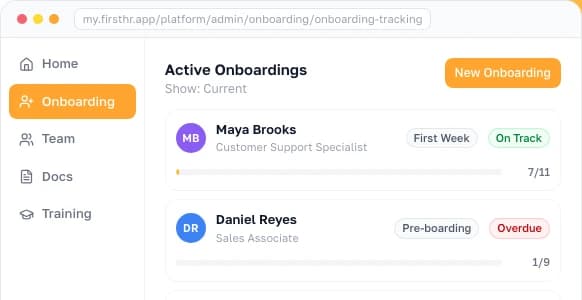
FirstHR covers the HR layer around a Swedish hire: FirstHR is an onboarding and HR platform, not a payroll provider. The Swedish entity, the Tax Agency registration, payroll in kronor, and the collective agreement question come from the providers above, so if you need someone on a Swedish payroll next month, shortlist from them.
Two separate decisions get conflated in one purchase. A provider settles the legal employment question. It does not decide what the first week looks like, where the signed documents live, whether the required training was completed, or whether employee records can be found a year later.
None of that changes when you are hiring across borders rather than at home.
That layer stays yours whichever route you take, and it is what we built FirstHR for: onboarding with e-signature, document management, training with completion tracking, and an employee record that holds together for a small business without a dedicated HR person, at a flat $98 a month for up to 10 people or $198 for 11 to 50.
Frequently Asked Questions
What is an employer of record in Sweden?
The company named as employer on the Swedish contract, the payslip, and the monthly tax filing, while the person works for you in every practical sense. It signs the contract under Swedish law, registers with the tax agency, remits preliminary tax and contributions, and carries the legal exposure so that a US company with no Swedish presence does not have to.
How much does an employer of record cost in Sweden?
The six providers reviewed here publish rates between $199 and $699 per employee monthly. Add the Swedish employer load of roughly 38 percent on gross once contributions, the vacation supplement, an occupational pension, and the special payroll tax on that pension are counted. Then allow for a deposit that varies by provider and a currency markup, since the fees are quoted in dollars against a payroll paid in kronor.
Does Sweden have a minimum wage?
No statutory floor exists, and in many industries there is no published grid either. The National Mediation Office reported in 2020 that fewer than 250 of roughly 700 collective agreements set minimum wage levels, and that pay is negotiated individually at the point of hire. What the agreement fixes instead is the pension premium, the insurance package, and often benefits above the statutory minimum.
What are employer social security contributions in Sweden?
One rate covers almost everything: 31.42 percent for employees born in 1959 or later, charged on the whole salary with nothing capped. Inside it are old-age pension at 10.21 percent, sickness insurance at 3.55 percent, a labor market contribution of 2.64 percent, parental insurance at 2.00 percent, survivor pension at 0.30 percent, work injury at 0.10 percent, and a general payroll tax of 12.62 percent.
How much annual leave and vacation pay do employees in Sweden get?
Five weeks, or 25 days, and the pay attached to those days is worked out on its own footing. Monthly-paid employees keep their salary through the holiday and receive a supplement of 0.43 percent of monthly pay per day, while variable pay is settled at 12 percent of qualifying-year earnings. Leave must include at least four consecutive weeks between June and August unless something else is agreed.
How much notice do I have to give an employee in Sweden?
One month at the minimum, rising to six once the person has ten years of service behind them, with two, three, four, and five months at the two, four, six, and eight-year marks. Notice is only part of it: the dismissal itself needs an objective ground, and the employee keeps full pay and benefits throughout the period even if you have no work to give them.
Can a US company employ someone in Sweden without an entity or an employer of record?
Yes. A foreign company with no permanent establishment in Sweden can register directly with the Swedish Tax Agency as an employer, and contributions then run at 18.80 percent rather than 31.42 percent. The saving is real, but you take on the employer role, the statutory exposure, and a monthly Swedish filing that somebody in your company has to own.
Should I use an employer of record or set up a Swedish company?
A provider first, and a company once the fee per head costs more than the overhead of running one. A Swedish AB needs SEK 25,000 of share capital and pays 20.6 percent corporate income tax on profit, but it also needs local accounting, monthly filings, an annual report, and ongoing administration, against a fee that scales with every head you add.
Make HR the easy part of running your business
Onboarding, e-signatures, training and core HR in one place. Up and running in 5 minutes.
- 7-day free trial
- No credit card required
- Cancel anytime