
Free Director of Operations Job Description
Free director of operations job description templates: standard, small business, manufacturing, and nonprofit versions. Download all as DOCX.

Director of operations is the hire a small business makes when the founder finally admits that running the company day to day has become a full-time job, and that it should not be theirs. It is also one of the most expensive postings the company has written so far, which makes the generic templates a real liability.
Generic templates describe a corporate maintainer stepping into existing departments and dashboards, while the actual opening at a small company is a builder taking operations off a founder's plate and constructing the processes that do not exist yet.
At FirstHR, we build for small businesses that hire without an HR department, and this posting is the moment many of them professionalize. My advice to any founder making this hire is to write the posting around what you are handing over, not around the title.
The five templates below cover the real versions of the role: the full standard, the small business first-ops-hire that no job board offers, manufacturing, nonprofit, and a concise Operations Director version for fast job-board posting. Fill in the bracketed fields, settle the title question, and post.
- Sign the offer letter
- Sign the employee handbook
- Workplace Safety course
What a Director of Operations Job Description Should Include
A director of operations job description needs five sections: a reporting line, a two-to-three-sentence job summary defining the operational mandate, 6 to 10 concrete responsibilities, qualifications split into required and preferred, and a salary range with application instructions.
According to the Society for Human Resource Management (SHRM) job description guide, a job description outlines the tasks, duties, and responsibilities of a position and gives both employees and managers a clear reference for gauging performance and clarifying expectations. For a senior role, that clarity has measurable stakes.
The section small companies most often skip is the reporting line, and it is the one senior candidates read first: reporting to a founder with no chief operating officer (COO) above is a different job than reporting into an executive layer, and the posting should say which one this is.
Director of Operations Key Responsibilities
Director of operations responsibilities fall into four areas: operational strategy and process, people and cross-functional coordination, metrics (key performance indicators, or KPIs) and budget ownership, and risk with compliance. The setting shifts the weights (manufacturing adds production planning and safety, nonprofit adds grant and board support), but the categories hold. These are the responsibilities grouped the way the templates use them.
A strong posting frames these as accountabilities with numbers attached: own the $2M operating budget, take on-time delivery from 88 to 95 percent, build the purchasing process from scratch. Activity language such as oversee, support, and assist attracts candidates who describe work; outcome language attracts candidates who did it.
Director of Operations vs COO vs Operations Manager
Three titles, three altitudes, and posting the wrong one is the most common mistake in this hire. The comparison decides both the candidate pool and the price. The pricing row compares each title with the Bureau of Labor Statistics (BLS) median pay for general and operations managers (May 2025).
| Factor | Operations Manager | Director of Operations | COO |
|---|---|---|---|
| Altitude | Runs a specific operation | Owns the operations function | Co-owns company strategy |
| Reports to | Director / GM / Owner | CEO / COO / Founder | CEO |
| Manages | Front-line staff | Managers and functions | Executives and functions |
| Core mandate | Execute within processes | Build and own the operating system | Translate strategy company-wide |
| Typical pricing | Below the $105,770 median | Around and above the median | Executive-level |
The practical test is what the hire will own: running the existing operation well is the operations manager posting, and a true executive seat that co-pilots the company is the COO posting.
The director role sits between them: senior enough to decide how the operation should run, focused enough to stay accountable for it. At a small company the boundaries blur, which is an argument for naming the actual scope in the posting rather than leaning on the title to carry it.
Which Template Should You Use?
Pick the template by company shape. The responsibility core is shared across all five, but the scope, reporting line, and requirements differ enough that the matched version reads more credibly to senior candidates. Use this guide to choose.
5 Free Director of Operations Job Description Templates
Download all five as separate Word files in one ZIP, or copy individual templates. Each follows the same core structure: job summary, key responsibilities, qualifications, and compensation with how to apply. Four of the five also ask applicants to send one specific example of their work with their resume. Fill in the brackets and name the real scope before you post.
Template 1: Standard Director of Operations
The full version for an established company: operational strategy, KPI and budget ownership, team leadership, cross-functional coordination, and vendor management.


Template 2: Small Business / First Ops Hire
The version no job board offers: founder-reporting, processes built from scratch, the unowned hats named explicitly, and skills-first requirements without a mandatory MBA.
Template 3: Manufacturing / Production Director of Operations
For plants and production floors: production planning, inventory, quality systems, OSHA safety, multi-shift supervision, and ERP/MRP fluency as a fillable field.
Template 4: Nonprofit Director of Operations
For mission-driven organizations: finance operations, HR and payroll oversight, grant budget support, board materials, and facilities, reporting to the Executive Director.
Template 5: Operations Director (Concise Job-Board Version)
The short version under the alternate title: a tight summary, eight bullets, qualifications, and the salary line, built for fast posting.
Director of Operations Qualifications to Include
Director-level qualifications should be evidence-weighted: the role has no license and no mandatory credential, and the O*NET profile for general and operations managers shows varied entry paths. Operational vocabulary is easy to perform in an interview; operational results are hard to fake on paper.
| Weak requirement | Strong requirement |
|---|---|
| 10+ years of operations experience | Owned operational outcomes and a budget; tell us about one improvement, with the numbers |
| Strong leadership skills | Has managed managers, or built a team from the first hire up |
| Process improvement mindset | Found a bottleneck, fixed it, and can show the before-and-after metric |
| MBA required | Degree or MBA preferred; demonstrated results weigh more |
| Excellent communication | Reports operational performance to leadership in business terms, monthly and honestly |
Keep the must-haves to demonstrated ownership, team leadership, and analytical comfort, with industry experience and degrees under preferred. Keep the language neutral and job-related too: the U.S. Equal Employment Opportunity Commission (EEOC) prohibits job advertisements that show a preference based on protected characteristics such as race, sex, or age.
How to Write a Director of Operations Job Description
A strong director of operations posting takes about 20 minutes once the level question is settled, and the level question is the whole game. Here is the process the templates are built around.
Director of Operations Salary
Price this role from the federal benchmark, then adjust hard for company size and industry, because the spread on this title is among the widest of any senior role.
The spread is the lesson: small businesses and nonprofits routinely fill the role below the median, manufacturing and scale push it well above, and the same title can price at double depending on the company behind it.
A small business that cannot match corporate pay should publish its honest range and sell what corporate cannot: founder access, whole-company scope, the autonomy to build rather than maintain, and visible impact. Director-level candidates skip postings without a number, so the range goes in regardless.
Hiring a Director of Operations Without an HR Department
Large corporations hire this role with compensation bands, leveling frameworks, and executive recruiters. A small business owner is usually writing the posting alone, for a role senior to any they have hired before. Here is how to write it for that reality.
From Hiring to Onboarding
The job description is step one, and for this hire the onboarding is a transfer of ownership, not an orientation. The founder hands over the operation deliberately and in writing: the budget, the vendor relationships, the process knowledge that has lived in one head, with introductions to every team lead and key vendor in the first two weeks.
The onboarding arc that works is 30-60-90: the new director assesses the operation by day 30, proposes the operating plan by day 60, and owns the numbers by day 90. Senior hires fail differently than junior ones, quietly and expensively, so the structured handoff matters.
Once you have your offer ready, the offer letter generator drafts it in minutes, and the employment contract template attaches the job description as the formal scope where a contract is used.
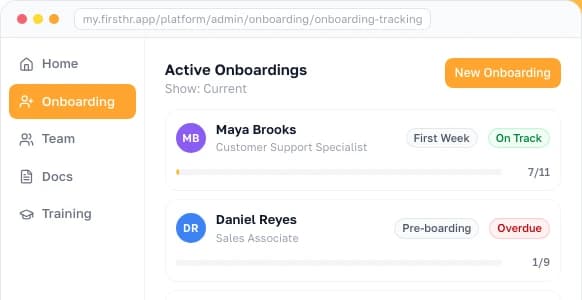
For a hire who leads others, the manager onboarding template structures the first weeks. FirstHR connects the offer, e-signature paperwork, org chart placement, and the onboarding workflow in one place, so a small business can take an ops director from accepted offer to owning the operation without an HR department.

Frequently Asked Questions
What does a director of operations do?
A director of operations owns how a company runs day to day: translating company goals into operating plans, leading the operations team, managing the operating budget, defining and tracking the operational KPIs, coordinating across departments, driving process improvement, and managing key vendor relationships. The role is accountable for operational performance rather than operational activity; success is measured in throughput, cost, quality, and reliability, not in meetings held. Reporting lines vary by company size: at mid-size companies the role typically reports to the CEO or COO, while at a small business the director of operations is often the first dedicated operations leader and reports directly to the founder, with a broader generalist scope.
What should a director of operations job description include?
A solid posting has five parts. First, a reporting line that says who the role answers to (the CEO, COO, founder, or Executive Director) and which teams it leads. Second, a short job summary, two to three sentences, that states the operational mandate. Third, 6 to 10 concrete responsibilities covering strategy, KPIs, budget, team leadership, cross-functional coordination, and process improvement. Fourth, qualifications split into required and preferred, weighted toward proven operational results over degrees. Fifth, the pay range and how to apply, ideally asking candidates to describe an improvement they personally owned and the numbers behind it. Finish with an equal opportunity statement, and for manufacturing or nonprofit settings add the compliance and scope sections that the matching template on this page already carries.
What is the difference between a director of operations and a COO?
Scope and seat. A COO is a C-suite executive who co-owns company strategy with the CEO and typically oversees multiple functions, of which operations is one; a director of operations is a senior leader who owns the operations function specifically and executes within the strategy set above them. In practice the line blurs at small companies, where one person may carry either title for similar work, but the posting choice matters: the COO title attracts candidates expecting an executive seat, equity conversations, and strategy ownership, while director of operations attracts execution-focused operators. If the role you are scoping co-pilots the company, post the COO version; if it runs the operation, post this one.
What is the difference between a director of operations and an operations manager?
Altitude. An operations manager runs a specific operation day to day, a location, a shift, a function, executing within established processes and managing front-line staff. A director of operations sits a level above: setting the operational strategy, owning the budget, managing the managers, and being accountable for cross-functional performance. The practical test for a small business is what the hire will own: if the job is running the existing operation well, post the operations manager role, which also prices meaningfully lower; if the job is deciding how the operation should run, building processes, and owning company-level operational results, it is the director role. Title inflation in either direction produces mismatched candidates.
Is operations director the same as director of operations?
Yes, the titles describe the same role, and search engines, job boards, and candidates treat them interchangeably; which one a company uses is convention rather than substance. For posting purposes it occasionally matters tactically: some job boards and candidate searches favor one phrasing, so using the title your local market searches for can affect visibility. The concise template on this page is written under the Operations Director title for exactly that use, and the content of the role (operational strategy, team leadership, budget, KPIs, and process improvement) is identical either way. Whichever title you choose, spell out the scope in the job summary so candidates judge the job by its duties rather than its label.
How much does a director of operations make?
The nearest federal occupation is general and operations managers, and the Bureau of Labor Statistics puts their median pay at $105,770 a year in its May 2025 survey. Pay ranges unusually widely around that midpoint, from under $50,090 for the bottom tenth of earners to over $253,390 for the top tenth, a gap driven largely by company size and industry. Small businesses and nonprofits commonly fill the role in the range below the median, manufacturing and larger companies above it, and the title at scale climbs toward executive pay. Publish your honest range; director-level candidates benchmark carefully, and a small company that cannot match corporate pay should sell scope, autonomy, and founder access, which corporate cannot match either.
Does a small business need a director of operations?
The signal is founder bandwidth. When the owner of a small company spends most of the week running day-to-day operations (scheduling, vendors, firefighting, the budget spreadsheet) instead of working on customers, product, and direction, the company has outgrown improvised operations and the first ops hire pays for itself. Below that point, an operations manager or a strong office manager usually covers the need at lower cost. The first-ops-hire version of the role differs from the corporate one: founder-reporting, generalist scope including unowned functions like HR basics and facilities, and a builder mandate, which is why this page includes a dedicated small business template rather than assuming the corporate shape.
What happens after I hire a director of operations?
After the offer is accepted, the job description carries forward into the offer letter and the onboarding plan. This hire needs more than a standard orientation, because the real job is taking over the operation. Start with a written handoff from the founder covering the budget, the vendor relationships, and the knowledge that so far lives only in the founder's head. Arrange meetings with each team lead and the main vendors during the first two weeks. Then run a 30-60-90 day arc: the new director spends the first 30 days assessing how the operation really runs, presents an operating plan by day 60, and is accountable for the numbers by day 90. FirstHR handles the offer letter, e-signature paperwork, org chart placement, and the onboarding workflow in one place, so a small business can take an ops director from accepted offer to owning the operation without an HR department.
Make HR the easy part of running your business
Onboarding, e-signatures, training and core HR in one place. Up and running in 5 minutes.
- 7-day free trial
- No credit card required
- Cancel anytime