
Free Operations Manager Job Description Templates
Free operations manager job description templates for small business: standard, small business, remote, industry, and director. Download as DOCX.

Operations Manager Job Description Templates
5 free templates by type. Download as DOCX or copy-paste.
An operations manager is often the hire that turns a busy small business into a well-run one. Below are free templates for the role and practical guidance on filling them in. My advice to any owner making this hire: take the job description seriously, because it sets the scope, screens for the right experience, and becomes the baseline for the role once you hire.
In a small company, the role is broad. An operations manager takes the day-to-day off the owner's plate, builds the systems that let the company scale, and keeps teams, vendors, and processes moving. Facilities, admin, and sometimes light people work fall to the same person.
At FirstHR, we build for small businesses that hire lean, where the owner writes the posting between running everything else. The five templates below cover the most common versions of the role: standard, small business, remote, industry-specific, and director. Each is ready to use. Fill in the bracketed fields, adjust to match your business, and post.
Which Template Should You Use?
Pick the template that matches the role and level you are filling. The core structure is the same across all five, but each one emphasizes the responsibilities, scope, and language that fit a specific kind of operations role. Use this guide to choose.
5 Free Operations Manager Job Description Templates
Download all five at once as separate Word files in one ZIP, or copy individual templates. Each one covers the same essentials: a role summary, key responsibilities, qualifications, compensation, and how to apply. Fill in the brackets before you post.
Template 1: Standard Operations Manager
The universal, all-purpose baseline. Covers summary, responsibilities, qualifications, skills, salary, and an EEO statement. Use this if you want a solid starting point you can adapt to almost any operations role.
Template 2: Small Business / First Operations Hire
Written for owner-led small businesses. This version describes the multi-function reality of a small business operations manager: operations plus facilities, vendors, admin, and light people tasks, reporting directly to the owner. Ideal for your first dedicated ops hire.
Template 3: Remote Operations Manager
For distributed teams. This template adds the remote essentials: remote scope, the tool stack, async communication expectations, time-zone overlap, and required setup. Use it for any fully remote operations hire.
Template 4: Industry-Specific (Retail / Logistics / Manufacturing)
For operational roles tied to a physical operation. Covers inventory, shift management, throughput targets, supply chain, and safety standards like OSHA or HACCP. Adapt the bracketed industry fields to your setting.
Template 5: Director of Operations / Senior
For hiring above the manager level. A strategic scope covering operational strategy, P&L, multi-department oversight, and leading other managers. Use this when you are hiring an operations leader, not an individual contributor.
What Is an Operations Manager?
An operations manager oversees the day-to-day activities that keep a business running efficiently. The core job is managing processes, coordinating teams, allocating resources, and maintaining quality so the company meets its goals. The exact responsibilities vary widely by company size, and fitting them to your company is the single most important thing to get right in the job description.
At a large company, the role is specialized and sits within a defined operations department. At a small business, the operations manager is a generalist who covers a broad range of work and reports straight to the owner. A posting copied from a large company will describe a role you are not actually hiring for.
Operations Manager Duties and Responsibilities
Operations manager duties fall into four broad areas. A good job description picks the specific duties from each area that apply to your business and level rather than listing every possible task. These are the responsibilities most often expected of the role.
At a small business, this list usually expands to include facilities and basic admin as well, since the operations manager is often the only operational role.
What to Include in an Operations Manager Job Description
Every strong operations manager job description includes the same core sections: the title and reporting line, a short summary, the main duties, must-have and nice-to-have qualifications, key skills, the pay range and benefits, and the equal opportunity statement. The templates above are built around them, but it helps to know how to make the duties concrete rather than generic.
| Weak bullet | Strong bullet |
|---|---|
| Oversee operations | Run daily operations and keep work on schedule across teams |
| Improve processes | Document and improve operational processes to remove bottlenecks |
| Manage budgets | Own the operational budget and track costs against targets |
| Work with vendors | Manage vendor relationships, contracts, and service levels |
| Track performance | Set and report on operational KPIs each month |
Specific, measurable duties attract candidates who can actually do the work and signal a serious employer. Keep the language neutral and inclusive too, since the Equal Employment Opportunity Commission (EEOC) prohibits job advertisements that show a preference based on protected characteristics.
Operations Manager vs Operational Manager vs Director
Operations manager and operational manager usually mean the same role, while a director of operations sits above both. The titles are easy to confuse, and getting the distinction right helps you set the correct scope, level, and pay. This table shows how they compare.
| Responsibility | Ops Manager | Director of Ops |
|---|---|---|
| Runs daily operations | ||
| Documents and improves processes | ||
| Owns operational strategy | ||
| Owns the P&L | ||
| Leads other managers | ||
| Oversees multiple departments |
Operations manager is the standard US term; operational manager is a variant of the same title. The director role is strategic and leads managers, while the operations manager executes and improves daily operations. Match the title and template to the actual scope, since labeling a role above or below its real level attracts the wrong candidates and sets incorrect pay expectations.
Business Operations Manager: Where the Emphasis Moves
A business operations manager job description covers the same ground as the standard one, with the weight shifted from physical operations to how the company itself runs: systems, data, spend, and the handoffs between teams. The title turns up most in software, agencies, and professional services, where there is nothing to store or ship.
| Emphasis | Operations manager | Business operations |
|---|---|---|
| Daily focus | Keeping delivery, service, or production on schedule | Keeping the systems and handoffs between teams working |
| Data | Tracks operational metrics and reports them | Builds the reporting, then uses it to pick what to fix next |
| Tools | Runs the tools the business already has | Owns the software stack and leads the switch when one stops fitting |
| Projects | Improves processes that already exist | Runs cross-functional work such as a pricing change or a new billing flow |
| Vendors | Manages suppliers and service levels | Manages contracts, renewals, and spend across the whole stack |
| Typical setting | Retail, logistics, manufacturing, field service | Software, agencies, professional services |
Start from the Standard template and swap the responsibilities section for the right-hand column, then keep whichever title your candidates actually search for. If you run a warehouse or a floor, the industry-specific template is still the closer fit, even when the internal title says business operations.
Operations Manager Salary
Set your salary range using government data as a baseline, then adjust for scope, experience, and location. Pay varies widely, because the title covers everything from a small business generalist to a senior leader at a large company.
For a small business operations manager, expect to sit below the median; for a director of operations, above it. Federal wage and hour rules also apply when you set pay and classify the role, so read the Department of Labor's overview of the Fair Labor Standards Act before you finalize the offer.
Pay Transparency Rules
Fourteen states and the District of Columbia now require employers to include a salary range in job postings, and Delaware joins them on September 26, 2027. Nevada requires the range to be shared once an applicant has interviewed, and Rhode Island requires it on request. This directly affects how you write the compensation section of your operations manager posting.
Even where it is not required, publishing a range is good practice. According to 2023 research from the Society for Human Resource Management (SHRM), 70 percent of organizations that list pay ranges in job postings say more people apply, and 66 percent say applicant quality has improved. A stronger applicant pool matters most for a small business doing its own hiring.
How to Write an Operations Manager Job Description
A strong operations manager job description is quick to write if you follow a clear structure. Here is the process the templates are built around.
Hiring an Operations Manager for a Small Business
Corporate operations manager templates assume dedicated departments, enterprise systems, and a layer of leadership above the role. A small business has none of that, so its operations manager reports straight to the owner and often handles facilities, vendors, and admin on top of operations.
Getting this hire right matters, because the cost of a poor hiring decision includes filling the seat a second time. According to an estimate reported by SHRM (2017), recruiting, hiring, and onboarding a new employee can cost as much as $240,000. Here is how to write the posting for a small business.
From Hiring to Onboarding
The job description is step one. Once a candidate accepts, the same document becomes the foundation for the offer letter and the onboarding plan. An operations manager touches many parts of the business, so good onboarding pays off fast: they need access to your systems, documentation, and key relationships early to become effective.
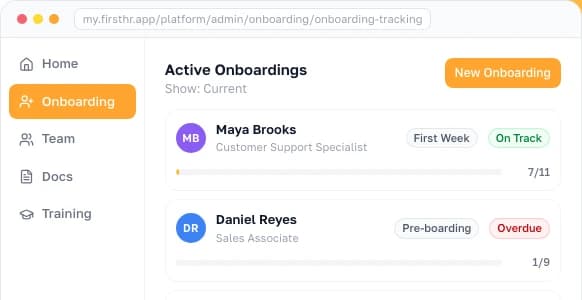
Good onboarding is what turns a new operations manager into a productive leader and keeps them past the first year. FirstHR connects the offer, paperwork, and onboarding workflow in one place so a small business can manage the full process from one system.
Frequently Asked Questions
What does an operations manager do in a small business?
In a small business, an operations manager keeps daily operations running and often wears several hats. The heart of the job is overseeing processes, coordinating teams, managing resources, and improving how work gets done. Beyond that core, the role usually stretches to cover facilities, vendor management, basic admin, and sometimes light people tasks such as supporting hiring and onboarding. Unlike a large company, a small one has no layer of dedicated departments, so the operations manager stays hands-on and reports directly to the owner. Because the mix differs from one business to the next, write the job description around the work your company actually needs done, not a corporate version of the role.
What should an operations manager job description include?
A strong operations manager job description includes nine core sections: a clear job title, a short job summary, the reporting line, key responsibilities, required and preferred qualifications, key skills, a salary range, benefits, and an equal opportunity statement. Responsibilities should be concrete, such as “document and improve operational processes” or “manage vendors and budgets,” rather than vague phrases. For a small business, describe the multi-function reality honestly and set a realistic salary. Keeping the must-have qualifications focused draws a wider pool of applicants, while a clear salary range attracts more qualified candidates and meets disclosure rules in many states.
What is the difference between an operations manager, an operational manager, and a director of operations?
Operations manager and operational manager are usually two names for the same job; a director of operations ranks above both. The standard US title, and the one federal occupational data uses, is operations manager, and operational manager is a variant of it. Either way, the person runs day-to-day operations. The director works at the strategic level: setting operational strategy, owning the P&L, overseeing several teams or departments, and often managing other managers. The operations manager, by contrast, keeps daily operations running and makes them better. Pick the title that fits the real scope and pay level. For a manager-level hire, start with the standard or small business template; for a strategic leadership hire, use the director template.
What salary should I list for an operations manager?
Start from federal wage data, then adjust for the role's scope, the experience you need, and your location. The Bureau of Labor Statistics Occupational Employment and Wage Statistics survey (May 2025) puts the median annual wage for general and operations managers at $105,770; the bottom 10 percent earn less than $50,090 and the top 10 percent more than $253,390. The spread is wide because the same title is used both for generalists at small companies and for senior leaders at large ones. Plan for a small business operations manager to land below the median and a director of operations above it. Publish the pay as a range: a range draws more qualified applicants, and many states now require one.
Do I have to include a salary range in the job posting?
In a growing number of states, yes. Fourteen states and the District of Columbia make employers put a salary range in the job posting itself, and on September 26, 2027, Delaware joins them. Two more states require disclosure in other ways: Nevada after an interview, and Rhode Island on request. The details, such as which employers are covered, any employee-count threshold, and the penalties, differ by state and shift over time. A remote job that could be done from a covered state often falls under that state's law as well. Where no law applies, a range is still worth posting: in SHRM research (2023), nearly two-thirds of organizations that list pay ranges said the quality of their applicants went up. Look up the current state and local rules before each posting.
What is the difference between an operations manager and an office manager?
An office manager keeps the office and administrative functions running: supplies, scheduling, facilities, and front-office tasks. An operations manager has a broader, more strategic scope: running and improving the processes that drive the whole business, coordinating teams, managing vendors and budgets, and tracking performance. In a very small company, one person sometimes covers both, but the operations role is generally larger and higher-paid. The pay gap shows in Bureau of Labor Statistics data for May 2025: a median of $105,770 a year for general and operations managers, against $69,500 for first-line supervisors of office and administrative support workers. That second occupation is where O*NET files the office manager title. If the role you are filling is mostly administrative, the office manager job description is a better fit; if it is about running and improving operations across the business, use an operations manager template.
What do I do after the candidate accepts?
Turn the job description into a formal offer and an onboarding plan. The offer letter should spell out the title, salary, start date, and at-will terms; after that, collect the signed paperwork and begin onboarding. Because an operations manager works across so much of the business, a quick start matters: set them up early with system access, documentation, and introductions to key contacts, and agree on clear 30-60-90 day expectations. FirstHR sends the offer letter for e-signature, keeps signed and uploaded documents in the new hire's file, and runs the onboarding workflow in one place, so a small business can move a new operations manager from hire to fully effective with minimal overhead.
Make HR the easy part of running your business
Onboarding, e-signatures, training and core HR in one place. Up and running in 5 minutes.
- 7-day free trial
- No credit card required
- Cancel anytime