
FirstHR

Free Forklift Operator Job Description Templates

Free forklift operator job description templates: standard, small business, warehouse, OSHA-certified, and multi-equipment. Download as DOCX.

Nick Anisimov

Nick Anisimov

FirstHR Founder

Hiring
16 min

Forklift Operator Job Description Templates

5 free templates with OSHA certification language built in. Download as DOCX or copy-paste.

Forklift operator is the hire where the job description doubles as a compliance document. OSHA's powered industrial truck standard applies to every employer whose people operate a forklift, a twelve-person supply yard with one propane truck owes the same training, evaluation, and record-keeping as a national distribution center, and the generic templates get the central requirement wrong: they demand a valid forklift license, which does not exist, when the rule is that the employer certifies the operator on its own equipment before solo operation.

At FirstHR, we build for small businesses that hire without an HR department, and small warehouses, local distributors, and supply houses are exactly that: the owner or operations manager writes the posting, runs the training, and keeps the certification records. The five templates below cover the real versions of the role, standard, small business, warehouse and distribution, OSHA-compliance-first, and multi-equipment, each with the certification language written correctly and the operational fields, shift, equipment type, lifting requirement, built in. Fill in the brackets and post. For the general principles behind any posting, the guide to writing a job description covers the fundamentals.

TL;DR
Five free, ready-to-use forklift operator job description templates: Standard, Small Business / No HR, Warehouse / Distribution, Certified / OSHA-Compliant, and Multi-Equipment. Download as DOCX, customize the bracketed fields, and post in minutes. Write the certification requirement the way OSHA 29 CFR 1910.178 actually works: the employer trains, evaluates, and certifies before solo operation, keeps the record, and re-evaluates at least every three years. There is no universal forklift license.

What Does a Forklift Operator Do?

A forklift operator uses powered industrial trucks to load, unload, move, and stack materials in warehouses, distribution centers, yards, and manufacturing plants: trailer work at the dock, put-away into racking, order pulling and staging, and the steady movement of product between receiving, storage, and shipping. The O*NET profile for industrial truck and tractor operators frames the core tasks: operating trucks and tractors to move materials around facilities, inspecting equipment, and recording the movement of the materials they handle.

For the employer writing the posting, the useful frame is that the seat time is wrapped in obligations: a documented pre-shift inspection every shift, hard rules on speed, pedestrians, and load capacity, and in modern warehouses a systems layer of RF scanning and inventory accuracy that matters as much as machine control. The title is interchangeable with forklift driver and lift truck operator, the candidates are the same pool, and if the day at your operation is more hand work than seat time, the warehouse associate templates or the material handler templates may name the actual center of the job better.

Forklift Operator Duties and Responsibilities

Forklift operator duties and responsibilities center on material movement, the safety and inspection discipline that surrounds every hour on the truck, the inventory and documentation work that keeps the warehouse accurate, and the equipment care and general teamwork that keep a facility running. The setting shifts the weights, a distribution center day is dock turns and WMS transactions while a small supply house day is truck unloading and order staging, but the categories hold. These are the duties grouped the way the templates use them.

Operation & material movement
Load, unload, move, and stack materials and pallets
Load and unload trailers at the dock on schedule
Move product between receiving, storage, and shipping
Safety & inspections
Complete a documented pre-shift inspection, every shift
Follow speed limits, pedestrian rules, and capacity limits
Report damage, near misses, and hazards the same day
Inventory & documentation
Scan moves with RF equipment and keep WMS locations accurate
Verify loads and counts against orders
Perform cycle counts and rotate stock FIFO
Equipment care & teamwork
Refuel or recharge and report maintenance needs
Tag out defective equipment immediately
Switch to general warehouse work during non-forklift time

A strong posting picks 8 to 12 of these and grounds them in the operation with the specifics attached: unload up to ____ trailers per shift within dock turn targets, put away product in racking to ____ feet, scan every move in the WMS, complete the documented pre-shift inspection before first use. Operators screen postings on the operational facts, the equipment by type, the shift, the lifting requirement, the conditions, before any prose about culture, which makes precision in the duties section a recruiting advantage. For a structured way to scope any role before posting, the guide to defining job responsibilities walks through the process.

Which Template Should You Use?

Pick the template by operation. The safety and certification core runs through all five, but the systems work, the equipment mix, and the honest shape of the day differ enough that the matched version always reads more credibly to experienced operators. Use this guide to choose.

Standard Forklift Operator
The general-purpose base
The default version: loading, moving, and stacking with pre-shift inspections, OSHA certification language written correctly, and the general warehouse overlap as a fill-in field.
Small Business / No HR
Owner-led operations
The honest small-company version: a stated forklift-to-hand-work split, we-provide certification language, and a direct apply process without an applicant portal.
Warehouse / Distribution
DCs and fulfillment
The systems version: RF scanning, WMS transactions, cycle counts, FIFO rotation, dock turn-time targets, and shift structure for multi-door operations.
Certified / OSHA-Compliant
Compliance-first employers
Built around 29 CFR 1910.178: the certification program spelled out in the posting, refresher triggers, three-year re-evaluation, and the record-keeping fields.
Multi-Equipment Operator
Mixed fleets
Checkbox equipment list across truck classes, sit-down, stand-up, reach truck, order picker, with type-specific certification stated per machine and elevated-work requirements.
Match the Template to the Operation
A general warehouse or yard with one main truck: Standard. An owner-run distributor or supply house where the operator also picks and receives: Small Business. A multi-door DC with RF scanning and WMS work: Warehouse / Distribution. A compliance-sensitive operation that wants the OSHA program in the posting: Certified. A mixed fleet with reach trucks and order pickers: Multi-Equipment, with type-specific certification stated per machine.

5 Free Forklift Operator Job Description Templates

Download all five as a single Word document or copy individual templates. Each follows the same structure: company overview, job summary, key responsibilities, required qualifications, compensation, and how to apply, with the OSHA certification language written correctly, we train, evaluate, and certify before solo operation, and the equipment type, shift, and lifting requirement carried as fill-in fields rather than left vague. Fill in the brackets and post.

Download All 5 Job Description Templates
Standard, small business, warehouse and distribution, OSHA-compliant, and multi-equipment. All in one DOCX.

Template 1: Standard Forklift Operator

The general-purpose base: loading, moving, and stacking with documented pre-shift inspections, correct OSHA certification language, and the general warehouse overlap as a structured field.

Standard Forklift Operator Job Description
FORKLIFT OPERATOR JOB DESCRIPTION
Company: __
Location: __
Reports to: [Warehouse Manager / Operations Manager]
Employment type: [ ] Full-time [ ] Part-time
Shift: [ ] Day [ ] Evening [ ] Overnight [ ] Weekend rotation
Pay range: $_____ to $_____ per hour

ABOUT [COMPANY NAME]

[One or two sentences about your company, what you move or make, and
the team the new operator will join.]

JOB SUMMARY

[Company Name] is hiring a Forklift Operator to load, unload, move,
and stack materials safely and accurately in our [warehouse / yard /
production facility]. You will operate a [forklift type:
__], complete documented pre-shift inspections, and
keep product moving while keeping people safe. We train, evaluate,
and certify operators on our equipment per OSHA requirements.

KEY RESPONSIBILITIES

Operate a forklift to load, unload, move, and stack materials
and palletized product
Complete a documented pre-shift equipment inspection before
every shift
Load and unload trailers at the dock safely and on schedule
Move product between receiving, storage, staging, and shipping
Verify loads and counts against orders; report discrepancies
Follow site speed limits, pedestrian right-of-way rules, and
load capacity limits at all times
Report equipment damage, near misses, and hazards the same day
Keep aisles, docks, and staging areas clear and organized
Assist with general warehouse duties during non-forklift time:
__

REQUIRED QUALIFICATIONS

High school diploma or GED [required / preferred]
Forklift operator training and certification per OSHA
29 CFR 1910.178, completed before solo operation (we provide
training and evaluation on our equipment)
____ year(s) of forklift operating experience [type:
__], or willingness to be trained
Able to lift up to ____ pounds and stay on your feet for a
full shift
Reliable attendance; the dock schedule depends on it
[Background check / drug screening per company policy: ____]

COMPENSATION AND HOW TO APPLY

Pay range: $_____ to $_____ per hour
[Shift differential: _ / overtime policy: __]
Benefits: __
To apply, email __ or stop by
__ by _.
[Company Name] is an equal opportunity employer.

Template 2: Small Business Forklift Operator (No HR Department)

The honest owner-led version: a stated forklift-to-hand-work split, we-provide certification language for candidates without prior training, and a direct apply process.

Small Business Forklift Operator Job Description (No HR Department)
FORKLIFT OPERATOR JOB DESCRIPTION - SMALL BUSINESS
Business: __
Location: __
Reports to: [Owner / Operations Manager]
Employment type: [ ] Full-time [ ] Part-time
Pay range: $_____ to $_____ per hour

JOB SUMMARY

[Business Name] is a ____-person [distributor / supplier /
manufacturer / warehouse] hiring our [first / next] Forklift
Operator. This is the honest version of the job at a small company:
roughly ____% of the day on the forklift, loading and unloading
trucks and moving stock, and ____% general warehouse work, picking
orders, staging deliveries, and keeping the place organized. You
will work directly with [the owner / our small crew], and your work
is never anonymous here. No forklift certification yet? We provide
OSHA-required training and certify you on our equipment.

KEY RESPONSIBILITIES

Load and unload delivery trucks and customer vehicles with
the forklift
Move, stack, and rotate stock in the [warehouse / yard]
Complete the pre-shift forklift inspection checklist, every
shift, no exceptions
Pick, stage, and wrap orders for delivery or pickup
Receive shipments: count, check for damage, put away
Keep aisles, racks, and the dock area clean and safe
Help customers at the [counter / dock] when needed:
__
Flag low stock, damaged product, and equipment issues to
[the owner / manager] directly

REQUIRED QUALIFICATIONS

Forklift certification per OSHA 1910.178 before operating solo;
we provide the training and evaluation
Prior forklift or warehouse experience [preferred / not
required, we will train the right person]
Able to lift up to ____ pounds repeatedly through a shift
Dependable: a ____-person team feels every absence
Comfortable switching between forklift work and hand work
without being asked

COMPENSATION AND HOW TO APPLY

Pay range: $_____ to $_____ per hour
Schedule: ______ (no overnight shifts: _)
Benefits: __
To apply, email __ or come by
__ and ask for _.
[Business Name] is an equal opportunity employer.
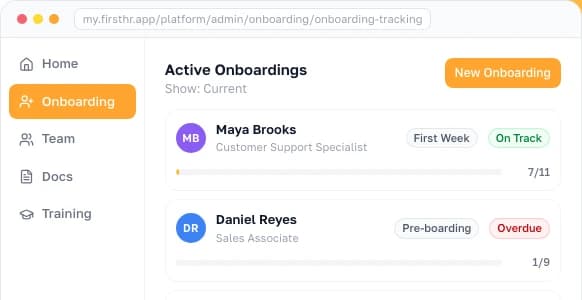
Still Using Spreadsheets for Onboarding?
Automate documents, training assignments, task management, and track onboarding progress in real time.
See How It Works

Template 3: Warehouse / Distribution Center Forklift Operator

The systems version: RF scanning, WMS accuracy, cycle counts, FIFO rotation, dock turn-time targets, and shift structure for multi-door operations.

Warehouse / Distribution Center Forklift Operator Job Description
WAREHOUSE FORKLIFT OPERATOR JOB DESCRIPTION
Facility: __
Location: __
Reports to: [Warehouse Supervisor / Shift Lead]
Employment type: [ ] Full-time [ ] Part-time
Shift: [1st / 2nd / 3rd: __]
Pay range: $_____ to $_____ per hour

JOB SUMMARY

[Facility Name] is hiring a Warehouse Forklift Operator for our
[distribution center / fulfillment warehouse] with ____ dock doors
and ____ SKUs. The role combines forklift operation with the
systems side of modern warehousing: RF scanning, [WMS:
__] transactions, cycle counts, and FIFO rotation.
Accuracy on the screen matters as much as control on the seat.

KEY RESPONSIBILITIES

Operate [sit-down / stand-up: ________________] forklifts to
receive, put away, replenish, and ship product
Scan every move with the RF scanner; keep [WMS] locations
accurate in real time
Load and unload trailers within dock turn-time targets
Pull and stage orders by wave or route schedule
Perform cycle counts and report variances same day
Rotate stock FIFO; flag short-dated and damaged product
Complete documented pre-shift inspections and report defects
before operating
Follow pedestrian aisles, horn protocols, speed limits, and
rack load capacities at all times
Support [pick / pack / load: ________________] functions during
peak periods

REQUIRED QUALIFICATIONS

Forklift certification per OSHA 29 CFR 1910.178; we evaluate
and certify on our equipment before solo operation
____ year(s) of warehouse forklift experience
RF scanner and WMS experience [system: ________________]
preferred
Able to lift up to ____ pounds and work in [ambient / cooler /
freezer: __] conditions
Reliable attendance on a fixed shift schedule
PREFERRED QUALIFICATIONS
Reach truck or order picker experience
Cycle count or inventory control experience

COMPENSATION AND HOW TO APPLY

Pay range: $_____ to $_____ per hour
[Shift differential: _ / weekend premium: _]
Benefits: __
To apply, email __ by _.
[Facility Name] is an equal opportunity employer.

Template 4: Certified Forklift Operator (OSHA-Compliant)

Compliance-first: the certification program spelled out inside the posting, type-specific training, refresher triggers, the three-year re-evaluation, and the record-keeping fields per 29 CFR 1910.178.

Certified Forklift Operator Job Description (OSHA-Compliant)
CERTIFIED FORKLIFT OPERATOR JOB DESCRIPTION (OSHA 29 CFR 1910.178)
Company: __
Location: __
Reports to: __
Employment type: [ ] Full-time [ ] Part-time
Pay range: $_____ to $_____ per hour

JOB SUMMARY

[Company Name] is hiring a Certified Forklift Operator for a role
where compliance is part of the job description, not a footnote.
You will operate [equipment types: __] under our
OSHA-compliant powered industrial truck program: documented
training, hands-on evaluation, recorded certification, and
re-evaluation at least every three years. Operators here are
certified, not just experienced.

KEY RESPONSIBILITIES

Operate powered industrial trucks only as trained, evaluated,
and certified per OSHA 29 CFR 1910.178
Complete and sign documented pre-shift inspections; remove
defective equipment from service immediately
Load, unload, move, and stack materials within rated capacity
and load center limits
Handle [hazardous materials / special loads: ________________]
per site procedures
Follow site traffic plan: speed limits, pedestrian zones, horn
points, and dock procedures
Participate in refresher training after any accident, near
miss, observed unsafe operation, equipment change, or workplace
change
Complete scheduled re-evaluation at least once every three
years and keep certification current
Report incidents, near misses, and hazards the same shift

OUR CERTIFICATION PROGRAM (WHAT WE PROVIDE)

Formal instruction plus practical, hands-on training on our
equipment and in our workplace conditions
Evaluation of operator performance before solo operation
A certification record kept on file with: operator name,
training date, evaluation date, and the identity of the
trainer/evaluator
Re-evaluation at least every three years; refresher training
when triggered
Training is type-specific: certification on one truck class
does not transfer automatically to another

REQUIRED QUALIFICATIONS

Prior forklift certification and ____ year(s) experience on
[equipment type: __] preferred; final
certification is completed on our equipment regardless
Able to lift up to ____ pounds and work a full shift on
your feet
Clean safety record; commitment to inspection and reporting
discipline
[Hazmat handling / special endorsement needs: ________________]

COMPENSATION AND HOW TO APPLY

Pay range: $_____ to $_____ per hour
[Certification premium: _]
Benefits: __
To apply, email __ with your training and
certification history by _.
[Company Name] is an equal opportunity employer.

Template 5: Multi-Equipment Forklift Operator

For mixed fleets: a checkbox equipment list across truck classes, per-machine certification stated explicitly, narrow-aisle and elevated-work requirements, and cold storage fields.

Multi-Equipment Forklift Operator Job Description
MULTI-EQUIPMENT FORKLIFT OPERATOR JOB DESCRIPTION
Facility: __
Location: __
Reports to: [Warehouse Manager / Operations Supervisor]
Employment type: [ ] Full-time [ ] Part-time
Pay range: $_____ to $_____ per hour

JOB SUMMARY

[Facility Name] is hiring a Forklift Operator who can run more than
one machine. Our operation uses several classes of powered
industrial trucks, and the strongest operators move between them as
the day requires. Certification is per equipment type: we train and
evaluate you separately on each truck you will operate.

EQUIPMENT YOU WILL OPERATE (check all that apply)

[ ] Sit-down counterbalance forklift (propane / electric / diesel)
[ ] Stand-up / electric rider forklift
[ ] Reach truck (narrow-aisle racking)
[ ] Order picker / cherry picker (elevated work, harness required)
[ ] Electric pallet jack / walkie rider
[ ] Other: __

KEY RESPONSIBILITIES

Operate each assigned truck class only after type-specific
training, evaluation, and certification per OSHA 1910.178
Complete a documented pre-shift inspection on every machine
before first use
Move product between dock, bulk storage, racking, and pick
areas using the right machine for the task
Work narrow aisles with the reach truck within rack and aisle
clearances
Perform elevated picking from the order picker with harness
and lanyard, per fall protection procedures
[Work in cold storage / freezer zones: ________________]
Switch between equipment and hand work as the schedule
requires
Report defects per machine and tag out faulty equipment
immediately

REQUIRED QUALIFICATIONS

Certification per OSHA 1910.178 on at least [one / two] of the
equipment classes above; we provide type-specific training and
certification for the rest
____ year(s) of multi-equipment warehouse experience preferred
Comfortable working at height on the order picker [max height:
____ feet]
Able to lift up to ____ pounds and work [ambient / cold
storage] conditions
Attention to detail across different control layouts; the
machines do not forgive autopilot

COMPENSATION AND HOW TO APPLY

Pay range: $_____ to $_____ per hour
[Per-equipment premium: _ / cold storage premium: _]
Benefits: __
To apply, email __ listing the equipment you
have operated by _.
[Facility Name] is an equal opportunity employer.
Companies Using FirstHR Onboard 3x Faster
Join hundreds of small businesses who transformed their new hire experience.
See It in Action

Forklift Certification and OSHA Requirements (29 CFR 1910.178)

Forklift hiring runs on one federal standard, and the posting should reflect how it actually works. Under OSHA 29 CFR 1910.178, the employer, not a state agency and not a card-issuing website, trains, evaluates, and certifies each operator before solo operation. The training must combine formal instruction with practical, hands-on exercises, must cover both truck-related topics and your workplace-specific conditions, and is type-specific: certification on a sit-down counterbalance truck does not transfer automatically to a reach truck or an order picker. OSHA's powered industrial truck training eTool walks through the required program elements in plain language, and federal law sets the operator minimum age at 18.

The Two Lines Small Employers Miss
The standard is specific about records and recurrence. On records, 1910.178(l)(6): "The certification shall include the name of the operator, the date of the training, the date of the evaluation, and the identity of the person(s) performing the training or evaluation." On recurrence, 1910.178(l)(4)(iii): "An evaluation of each powered industrial truck operator's performance shall be conducted at least once every three years." Refresher training is also triggered by an accident or near miss, observed unsafe operation, assignment to a different truck type, or changed workplace conditions. These obligations apply to every employer with even one forklift.

The hiring implication is direct: an experienced operator from another warehouse still gets trained and evaluated on your equipment and your conditions before operating unsupervised, so the posting should request the candidate's training history while stating that final certification happens in-house. And the language throughout should stay job-related and neutral, physical requirements stated plainly in pounds and hours, since the EEOC prohibits job advertisements that show a preference based on protected characteristics.

Forklift Types and Equipment Variations

One title covers a family of machines, and because OSHA certification is type-specific, the posting should name the trucks the hire will actually run. This is the equipment map most warehouse postings draw from.

Equipment typeWhere it is usedWhat to state in the posting
Sit-down counterbalanceGeneral warehouse, docks, yardsThe default; most candidates trained here; fuel type (propane, electric, diesel)
Stand-up / electric riderHigh-turnover dock and staging workFrequent on-off operation; different controls; certify separately
Reach truckNarrow-aisle rackingAisle widths, rack heights, and narrow-aisle experience preferred
Order picker (cherry picker)Case picking at heightOperator works elevated; harness and fall protection required
Electric pallet jack / walkieStaging and trailer loadingOften the entry rung; still a powered industrial truck under OSHA

The qualifications section follows the same precision rule. Weak requirements invite weak applications; strong requirements are checkable and state the OSHA logic correctly. If your operation also runs production machinery beyond powered industrial trucks, the machine operator templates cover those seats, including a forklift-combo version.

Weak requirementStrong requirement
Valid forklift license requiredCertification per OSHA 1910.178 before solo operation; we provide training and evaluation on our equipment
Forklift experience2+ years operating sit-down counterbalance forklifts in a warehouse setting; reach truck experience a plus
Able to do physical workAble to lift up to 50 pounds repeatedly and stay on your feet for a full shift
Safety-mindedClean safety record; completes documented pre-shift inspections and reports hazards the same day
Flexible team playerComfortable switching between forklift operation and general warehouse work, roughly a 60/40 split

How to Write a Forklift Operator Job Description

A strong forklift operator posting takes about 20 minutes once the equipment list and the shift are settled. The SHRM job description tools describe a good job description as a plain-language summary of a position's tasks, duties, and responsibilities, and for a forklift role the plain language doubles as a safety document: the duties and limits you write are the scope your operator works to. Here is the process the templates are built around. If this is among your first hires, the small business hiring guide covers the steps around the posting itself.

1
Choose the template for your operation
Standard, small business, warehouse and distribution, OSHA-compliance-first, or multi-equipment. The setting decides the duties, the systems work, and the candidates.
2
Write the certification language correctly
Certification per OSHA 29 CFR 1910.178 before solo operation, with the company providing training and evaluation. There is no universal forklift license, so do not require one.
3
List 8 to 12 duties with the equipment named
Pre-shift inspections, trailer loading, put-away and replenishment, RF scanning and WMS accuracy, cycle counts, and the truck classes stated by type.
4
Name the real shape of the role at your size
At a small operation the forklift is part of the job, not all of it. State the forklift-to-hand-work split honestly; it filters for candidates who want the variety.
5
Publish pay, shift, and physical requirements honestly
The hourly range, the actual schedule, the lifting requirement in pounds, the working conditions, and any certification training or premium the company provides.

Forklift Operator Salary

Forklift operator pay sits in a fairly narrow national band, and the variables that move it, equipment skill, shift, and conditions, are all things the posting can state directly.

The Federal Benchmark (BLS, May 2024)
Material moving machine operators, the federal group that includes forklift operators, earn a median of about $46,620 per year, roughly $22.41 per hour, across about 867,700 jobs nationally. Employment is projected to grow about 1 percent through 2034, slower than average, but turnover keeps hiring steady at roughly 83,200 openings each year (U.S. Bureau of Labor Statistics).

Within the band, distribution centers and overnight shifts pay above small local operations, cold storage and freezer work commands a premium, and multi-equipment operators who run reach trucks and order pickers earn above single-machine operators. A small business competing against the big DCs should publish the honest hourly range and compete on what they cannot offer: a predictable daytime schedule, no mandatory weekend rotations, paid OSHA certification for candidates without prior training, and a crew small enough that the work is never anonymous.

Hiring a Forklift Operator Without an HR Department

Large distribution networks hire forklift operators with recruiters, safety departments, and training teams. At a small warehouse, supply house, or local distributor, the owner or operations manager does all of it, including the OSHA program. Here is how to write the posting for that reality.

OSHA does not scale down: one forklift carries the same obligations as a hundred
The powered industrial truck standard, 29 CFR 1910.178, applies to every employer whose employees operate a forklift, regardless of company size. A twelve-person building supply yard with a single propane truck owes the same compliance as a national distribution center: formal instruction plus hands-on training, an evaluation before solo operation, a written certification record, refresher training when triggered, and a re-evaluation at least every three years. There is no small-business exemption and no grace period, and the operator cannot bring compliance with them from a previous job, because the training must cover your equipment and your workplace conditions. The posting participates in this directly: write the certification requirement as something the company provides and documents, request prior training history at the application stage, and treat the first days of employment as the compliance window they legally are. Owners who put the program in the posting signal a professionally run operation, and experienced operators read it exactly that way.
There is no universal forklift license, so do not require one
Postings written from generic templates routinely require a valid forklift license, and the requirement misunderstands the rule: OSHA certification is issued by the employer, is specific to the equipment type and the workplace, and does not transfer automatically between jobs the way a driver's license does. What an experienced candidate actually carries is a training history, prior formal instruction, hands-on experience by truck class, and certification records from previous employers, all of which are worth requesting, none of which replace your own evaluation. The strong posting states it plainly: certification per OSHA 1910.178 completed before solo operation, we provide the training and evaluation on our equipment, prior experience on the relevant truck class preferred. Written that way, the requirement stops filtering out good candidates who know the rule, stops attracting card-mill certificates that mean nothing on your dock, and starts the employment relationship with the compliance sequence already understood by both sides.
At a small operation the forklift is part of the job, not all of it, so state the split
Big-facility templates describe an operator who spends the whole shift on the seat. At a small distributor or supply house, the same person picks orders by hand, stages deliveries, receives shipments, helps a customer at the counter, and sweeps the dock at close, and a posting that hides that mix produces a frustrated hire within the first month. Name the split honestly with a rough percentage, sixty percent forklift, forty percent general warehouse is a common honest answer, and frame it accurately: variety is what working at a company small enough to know every customer looks like, and plenty of operators prefer it to eight hours of repetitive pallet moves. The honesty also protects the certification logic, because an operator who spends most of the day off the truck still needs the full OSHA program for the time on it, and the posting that names both halves of the job sets that expectation before day one instead of during a disagreement in week three.

From Hiring to Onboarding

The job description is step one, and in forklift hiring the steps after it are documented or they did not happen: formal instruction plus hands-on training on your equipment and your workplace conditions, an evaluation of the operator's performance, and the certification record filed, name, training date, evaluation date, trainer identity, all before the first unsupervised shift. Then the recurring layer someone has to own: pre-shift inspections every shift, refresher training when triggered, and the three-year re-evaluation on a calendar that does not depend on anyone's memory. Alongside it runs standard employment onboarding, the offer, Form I-9 within the first days along with the rest of the new hire paperwork, and the safety orientation and site traffic plan walked on foot, the sequence the manufacturing onboarding guide structures for industrial settings.

Once you have your offer ready, the offer letter template handles the next step, the new hire training template structures the certification and safety sequence, and the onboarding playbook ties the whole first-90-days process together. FirstHR connects the offer, e-signature paperwork, certification document storage with expiration tracking for the three-year re-evaluation, training checklists, and the onboarding workflow in one place, so a small warehouse can take a forklift operator from accepted offer to a documented, certified first solo shift without an HR department.

Key Takeaways
Pick the template for your operation: standard, small business with the honest work split, warehouse and distribution with the WMS layer, OSHA-compliance-first, or multi-equipment with per-machine certification.
Write the certification requirement the way the rule works: there is no universal forklift license; under OSHA 29 CFR 1910.178 the employer trains, evaluates, and certifies on its own equipment before solo operation.
OSHA does not scale down: one forklift at a twelve-person yard carries the same training, record-keeping, refresher, and three-year re-evaluation obligations as a national distribution center.
Name the equipment by type in the posting, because certification is type-specific: a sit-down counterbalance certificate does not transfer automatically to a reach truck or order picker.
State the operational facts operators screen on: hourly range, the actual shift, lifting requirement in pounds, working conditions, and the forklift-to-hand-work split at a small operation.
Benchmark pay at the federal median of about $22.41 per hour and compete on what big DCs cannot offer: daytime schedules, paid certification training, and a crew where the work is never anonymous.

Frequently Asked Questions

What does a forklift operator do?

A forklift operator uses powered industrial trucks to load, unload, move, and stack materials in warehouses, distribution centers, yards, manufacturing plants, and construction sites. The core day is material movement: unloading trailers at the dock, putting stock away in racking, pulling and staging orders, and keeping product flowing between receiving, storage, and shipping. Around the seat time sit the obligations that define the role: a documented pre-shift equipment inspection every shift, strict adherence to speed limits, pedestrian rules, and load capacity limits, and same-day reporting of damage, near misses, and hazards. In modern warehouses the job also includes the systems layer, RF scanning, warehouse management system transactions, cycle counts, and FIFO rotation, and at small companies it overlaps with general warehouse work like hand picking and receiving, which is why this page offers separate templates by setting rather than one generic version.

What are the main forklift operator duties to list in a posting?

Forklift operator duties fall into four groups. Operation and material movement: loading, unloading, moving, and stacking materials and pallets, trailer work at the dock, and product moves between receiving, storage, staging, and shipping. Safety and inspections: a documented pre-shift inspection before every shift, compliance with site speed limits, pedestrian right-of-way rules, and rated load capacities, and same-day reporting of damage and near misses. Inventory and documentation: RF scanning, keeping warehouse management system locations accurate, verifying loads against orders, cycle counts, and FIFO stock rotation. Equipment care and teamwork: refueling or recharging, tagging out defective machines immediately, and switching to general warehouse work during non-forklift time. A strong posting lists 8 to 12 of these matched to the setting and names the equipment, because a narrow-aisle reach truck day and a dock-loading counterbalance day are different jobs under one title.

Is a forklift driver job description different from a forklift operator job description?

No. Forklift driver, forklift operator, and lift truck operator name the same role, and employers and job boards use the phrasings interchangeably for the same posting. OSHA's own terminology is powered industrial truck operator, which covers the whole equipment family: sit-down counterbalance forklifts, stand-up riders, reach trucks, order pickers, and motorized pallet jacks. The practical advice for an employer is to title the posting with the term local candidates actually search, forklift operator is the most common, and to name the specific equipment in the body, because the title is generic but the certification is not: OSHA training and evaluation are type-specific, and an operator certified on a sit-down counterbalance truck is not automatically certified on a reach truck. The templates on this page work under any of the title variants.

Does a forklift operator need a license or certification?

Certification yes, license no, and the difference matters in the posting. There is no government-issued universal forklift license. Under OSHA 29 CFR 1910.178, the employer certifies the operator: formal instruction plus practical hands-on training, an evaluation of the operator's performance in the workplace, and a written certification record, all completed before the employee operates solo. The certification is specific to the equipment type and to your workplace, which means even an experienced operator hired from another warehouse must be trained and evaluated on your trucks and your conditions before operating unsupervised. A posting that requires a valid forklift license misstates the rule and attracts card-mill certificates; the correct language is certification per OSHA 1910.178 completed before solo operation, with the employer providing training and evaluation, and prior experience on the relevant truck class listed as preferred.

What are the OSHA requirements for forklift operators?

OSHA's powered industrial truck standard, 29 CFR 1910.178, sets the full sequence. Training must combine formal instruction with practical, hands-on exercises and must cover both truck-related topics and workplace-specific conditions. The employer must evaluate the operator's performance before solo operation and must keep a certification record containing the operator's name, the training date, the evaluation date, and the identity of the person who performed the training or evaluation. Refresher training is required after an accident or near miss, after observed unsafe operation, when the operator is assigned a different truck type, or when workplace conditions change. And an evaluation of each operator's performance must be conducted at least once every three years. Operators must also be at least 18 years old under federal law, and daily pre-shift equipment inspections are required. These obligations apply to every employer regardless of size.

How much does a forklift operator make?

Federal data groups forklift operators under material moving machine operators, who earned a median of about $46,620 per year, roughly $22.41 per hour, as of May 2024, with about 867,700 jobs nationally. Employment is projected to grow about 1 percent through 2034, slower than average, but turnover keeps demand steady: roughly 83,200 openings are projected each year, mostly replacing workers who change occupations or leave the labor force. Within the band, pay moves with setting and skill: distribution centers and third-shift work typically pay above small local operations, cold storage and freezer work commands a premium, multi-equipment operators who run reach trucks and order pickers earn above single-machine operators, and certified candidates with clean safety records command more than the entry rate everywhere. A small business competing for operators should publish the honest hourly range, the real shift schedule, and any certification training it provides.

How do I write a forklift operator job description for a small business without HR?

Pick the small business template, then get three things right. First, write the certification language correctly: certification per OSHA 1910.178 before solo operation, with the company providing training and evaluation on its own equipment, because there is no universal forklift license and requiring one filters out candidates who know the rule. Second, state the honest shape of the job: at a small distributor or supply house the operator spends part of the day on the truck and part on general warehouse work, picking, receiving, staging, sometimes the counter, and naming the rough split up front filters for people who want the variety. Third, publish the operational facts candidates screen on: the hourly range, the actual shift, the equipment by type, the lifting requirement in pounds, and the physical conditions, ambient, cooler, or freezer. The templates on this page carry all three as structured fields, and the compliance program belongs in the posting as a we-provide item.

What happens after I hire a forklift operator?

The OSHA sequence runs from acceptance to the first solo shift, and it is documented or it did not happen: formal instruction plus hands-on training on your equipment and your workplace conditions, an evaluation of the operator's performance, and a certification record filed with the operator's name, training date, evaluation date, and the trainer's identity, all before unsupervised operation. Then the recurring layer: pre-shift inspections every shift, refresher training when triggered by an accident, near miss, unsafe operation, new equipment, or changed conditions, and a re-evaluation at least every three years on a calendar someone actually owns. Alongside it runs standard employment onboarding: the offer, Form I-9 and tax paperwork in the first days, safety orientation, and the site traffic plan walked through on foot. FirstHR handles the offer letter, e-signature paperwork, certification document storage with renewal tracking, training checklists, and the onboarding workflow in one place, built for warehouses and small businesses without an HR department.

Ready to transform your onboarding?

7-day free trial No credit card required
Start Your Free Trial