
Free Product Manager Job Description Templates
Free product manager job description templates: standard, startup first PM, senior, associate, and technical. Download as DOCX and customize.

Product Manager Job Description Templates
5 free templates by level. Download as DOCX or copy-paste.
A product manager (PM) decides what to build and why, then rallies engineering, design, and go-to-market teams to ship it. The five templates below cover the most common versions of the role by level and type: standard, startup first PM, senior, associate, and technical.
The right template matters because a PM is one of the highest-leverage hires a growing software company makes, and one of the hardest to scope: the role looks completely different at a small startup than at a large product org. The job description you write sets the level, the scope, and the expectations, and in a competitive market it doubles as a recruiting pitch.
At FirstHR, we build software for growing companies, so we know the product role from the inside. Each template is ready to use. Fill in the bracketed fields, adjust to match your company and stage, and post.
Which Template Should You Use?
Pick the template that matches the level and type of product manager you need. The core structure is the same across all five, but each one emphasizes the scope, seniority, and language that fit a specific kind of PM role. Use this guide to choose.
5 Free Product Manager Job Description Templates
Download all five as separate Word files in one ZIP, or copy individual templates. Each one covers the job summary, key responsibilities, qualifications, compensation, and how to apply. The Standard template also adds a company overview. Fill in the brackets before you post.
Template 1: Product Manager (Standard)
The all-purpose version for any company hiring a PM. Owns strategy, roadmap, and execution across engineering, design, and go-to-market, with a balanced set of requirements. Start here if the role fits a general product management position.
Template 2: Startup Product Manager (First PM Hire)
For a startup or growing company hiring its first PM. A hands-on generalist who builds process from scratch, works directly with the founder, and ships fast amid ambiguity. Use this when there is no existing product team to slot into.
Template 3: Senior Product Manager
For an experienced PM leading a major product area. Owns business outcomes, drives complex cross-functional work, and mentors other product managers. Use this for a senior role that operates with autonomy and influence.
Template 4: Associate / Junior Product Manager
For an early-career hire growing into a full PM role. Supports the backlog, requirements, and data analysis under a senior PM's guidance. Use this when you want to develop product talent rather than hire senior.
Template 5: Technical Product Manager
For technically complex products like APIs, platforms, and developer tools. Works deeply with engineering on architecture and trade-offs and translates technical capability into customer value. Use this when the role requires an engineering foundation.
What Is a Product Manager?
A product manager (PM) is the person who decides what a product should do and why, then works with engineering, design, and go-to-market teams to make it happen. The role sits at the intersection of business, technology, and user experience: a PM identifies customer needs and business goals, defines what success looks like, and aligns a team to build toward it.
Most PMs lead through influence rather than authority, since they typically do not manage the engineers and designers they work with. Harvard Business School senior lecturer Julia Austin rejects the "CEO of the product" label for this reason, writing in Harvard Business Review (2017). Citing Martin Eriksson, she notes that PMs lack direct authority over most of what a product needs to succeed.
The role varies enormously by company and level. A first PM at a startup is a scrappy generalist doing everything from research to launch. A senior PM at a larger company focuses on strategy for a major area, and a technical PM goes deep with engineering. That is why the job description should describe the role at your stage and level rather than copy a generic one.
Software Product Manager vs Technical Product Manager
A software product manager is a product manager whose product happens to be software. The title names an industry rather than a separate discipline, so the posting looks like the Standard or Startup template. Reserve the Technical PM template for products that are themselves technical: APIs, platforms, infrastructure, and developer tools.
What makes a posting read as software-specific is detail rather than the title. Name the product and its stage, say how large the engineering team is, describe the release rhythm the PM will work in, and state whether they own one feature area or the whole product.
Product Manager Responsibilities and Duties
Product manager responsibilities fall into four broad areas. A strong job description selects the specific duties from each area that apply to your role and level rather than listing every possible task. These are the responsibilities most often expected of the role.
For a first PM at a startup, all four areas land on one person. For a senior PM, the weight shifts toward strategy, and for a technical PM, toward deep execution with engineering.
What to Include in a Product Manager Job Description
Every strong product manager job description includes the same core sections: a short summary of your company and the role, key responsibilities, required and preferred qualifications, compensation, how to apply, and an equal opportunity statement. The templates above are built around them; the Standard one gives the company summary a section of its own. Write the responsibilities as concrete duties rather than buzzwords. The table shows the difference between vague and specific wording.
| Weak bullet | Strong bullet |
|---|---|
| Own the product | Define and own the product strategy and roadmap |
| Be data-driven | Define success metrics and analyze product data to guide decisions |
| Work with teams | Partner with engineering and design to ship features |
| Understand customers | Conduct user research and turn insights into priorities |
| Drive results | Own a measurable business outcome for your product area |
Specific, outcome-focused responsibilities attract candidates who understand the role and signal a serious employer. Keep the language neutral and inclusive too, since the Equal Employment Opportunity Commission (EEOC) prohibits job advertisements that show a preference based on protected characteristics. For a fuller framework, the SHRM guide to writing a job description covers the standard sections.
Requirements and Skills
Unlike licensed roles, product management has no required degree or certification, so the requirements section is about experience, skills, and fit for the level. Set the bar to match the role: a first or associate PM should not face the same requirements as a senior one.
Across all levels, the constants are product sense, the ability to prioritize with incomplete information, and strong communication, since PMs lead through influence. Most PM roles are salaried and exempt from overtime under the Fair Labor Standards Act, so review the Department of Labor FLSA classification rules when you set pay.
When to Hire Your First PM
There is no fixed rule, but most companies hire their first product manager once product decisions become a bottleneck the founder can no longer manage alone. That often happens as a real engineering team takes shape, though product-led startups sometimes hire much earlier.
| Signal | What it means |
|---|---|
| Engineers wait on product decisions | The founder is the bottleneck for what to build next |
| The roadmap no longer fits in your head | Prioritization needs a dedicated owner |
| Customer feedback is piling up unstructured | Someone needs to synthesize it into decisions |
| Competing priorities with no clear owner | Trade-offs need a single accountable person |
If several of these are true, it is time. For a broader view of building out your team and the steps around any hire, the U.S. Small Business Administration guide to hiring and managing employees is a useful starting point, and the small business hiring guide covers the practical steps.
Product Manager Salary
For product manager pay, marketing managers are the closest federal benchmark. According to the Bureau of Labor Statistics (BLS) Occupational Employment and Wage Statistics survey (May 2025), that group earned a median of $166,790 a year, and its middle half earned between $123,020 and $216,410.
The marketing manager figure is a proxy, because BLS has no separate product manager occupation. O*NET, the Department of Labor occupation database, lists product manager among the job titles reported by marketing managers. Actual PM pay varies widely around the benchmark, so set your range carefully against current market data for your specific situation rather than a single national figure.
Always publish a salary range, and include equity if you offer it. Product managers are in demand and evaluate compensation closely, so a clear, competitive range plus meaningful equity helps your posting compete. Pay transparency in job postings is also required in a growing number of states.
How to Write a Product Manager Job Description
A strong product manager job description is quick to write if you follow a clear structure. Here is the process the templates are built around.
Hiring a Product Manager for a Growing Company
A large company hires a PM into an established product org with clear lanes, career ladders, and process. A growing company or startup has none of that yet. The founder or an early leader writes the posting, and the new PM may be the first and only one, building product practice from scratch. Here is how to write the posting for that reality.
From Hiring to Onboarding
The job description is step one. Once a candidate accepts, the same document becomes the basis for the offer and onboarding. A PM's first weeks are about absorbing context that lives in founders' and teammates' heads, so a structured onboarding pays off fast for an influence-based role.
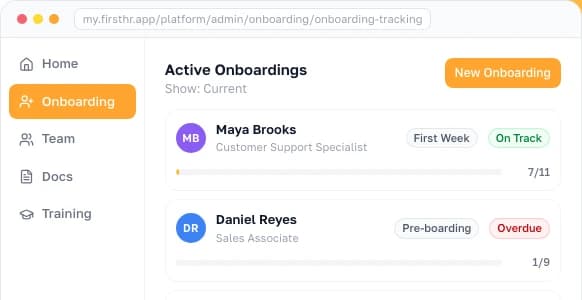
Set up the onboarding before the new PM's first day, so their first weeks go into learning the product and the team rather than waiting on access and paperwork. FirstHR connects the offer, paperwork, and onboarding workflow in one place so a growing company can manage the full process from one system.
Frequently Asked Questions
What does a product manager do?
A product manager sets the direction for a product, deciding which problems it should solve and why, and then gets the teams that build, market, and sell it to deliver. The job blends three views: what the business needs, what the technology allows, and what users want. In a typical week, a PM owns the strategy and roadmap, talks with customers about their needs, decides what gets built next, writes specs and user stories, and works side by side with engineering and design to ship. They also set the metrics that define success, dig into product data, and plan launches with marketing, sales, and support. In most companies a PM has no direct reports, so they get things done through influence, keeping every team pointed at the same product vision and outcomes.
What are the responsibilities of a product manager?
A product manager's responsibilities fall into four areas. Strategy and roadmap: defining the product direction, prioritizing features, and owning success metrics. Discovery and research: talking to customers, running user research, and turning insights into decisions. Execution and delivery: writing specs and user stories, managing the backlog, and working with engineering and design to ship. Launch and measurement: coordinating go-to-market, analyzing product data, and communicating progress to stakeholders. The balance shifts by level and company. A first PM at a startup does all of this hands-on, while a senior PM focuses more on strategy and a technical PM goes deeper with engineering.
What skills does a product manager need?
The core skills are strong product sense, analytical ability, and communication. A PM needs to understand customers deeply, make good prioritization decisions with incomplete information, and align cross-functional teams without direct authority. Useful hard skills include data analysis, writing clear specs and user stories, and enough technical fluency to work effectively with engineers, which matters most for a technical PM. Soft skills are just as important: empathy, influence, and the ability to communicate a vision. For a first PM at a startup, scrappiness and comfort with ambiguity matter more than polished process experience. Match the skills you require to the level and type of PM you are hiring.
What is a software product manager?
A software product manager owns a software product, which makes it the same job as product management anywhere else, applied to an application, a SaaS tool, or a mobile app. Companies use the phrase mainly to tell candidates what industry they are joining. The work is the general role: customer discovery, roadmap ownership, prioritization calls, written requirements, and steady partnership with engineering and design. For most postings the Standard template is the right starting point, with the Startup version fitting a young company making its first product hire. Go with the Technical version only when the thing being managed is infrastructure, an interface other developers build against, or tooling for engineers, since that work rewards a background in engineering. Then make the posting concrete, because candidates in software judge a role by what you say about the product, the team around it, and how often you ship.
What is the difference between a product manager and a project manager?
A product manager decides what to build and why, owning the product's strategy, roadmap, and outcomes. A project manager focuses on how and when, coordinating timelines, resources, and execution to deliver a defined scope on schedule. The product manager is accountable for whether the product succeeds in the market; the project manager is accountable for delivering the work on time and on budget. The two roles often work together, and in small companies one person sometimes covers both. They require different skills and different job descriptions, so be clear about which one you are hiring before you write the posting.
When should a company hire its first product manager?
The usual moment is when the founder can no longer run the product alone, which for most companies comes once a meaningful engineering team is already in place. Typical warning signs include engineers stuck waiting for product decisions, a roadmap too big to hold in the founder's head, a growing pile of customer feedback that nobody has time to sort and rank, and priorities that compete because no one owns the trade-offs. No hard rule applies, and some product-led startups hire a PM very early. The real test is whether product decisions have turned into a bottleneck. If they have, a first PM, hired with the Startup template, pays for themselves quickly.
How much does a product manager make?
The nearest federal benchmark is $166,790 a year, the May 2025 median wage that the Bureau of Labor Statistics (BLS) reports for marketing managers. BLS does not track product managers as an occupation of their own, and O*NET, the Labor Department's occupation database, files the product manager title under marketing managers, so read that number as a reference point, not a price tag. Real offers move with seniority, location, company stage, and equity, with associate PMs at the low end and senior PMs at the top. Geography makes a big difference: in the same BLS data, the marketing manager median was $103,280 in Jackson, Mississippi, against $231,370 in the San Jose metro area. Equity is often a meaningful part of the package, especially at startups. Before you pick a number, look at current market data for your city, your stage, and the level you need, and always put a salary range in the posting. A transparent range draws more qualified applicants, and a growing list of states makes it mandatory.
What happens after I hire a product manager?
Once a PM says yes, use the job description as the starting point for both the offer letter and the onboarding plan. The first few weeks set the tone for the whole role: a new PM has to learn the product, get to know the engineering and design teams, understand your customers, and pick up the history and reasoning that nobody has written down. Build a structured plan that covers product knowledge, tools, key relationships, and clear priorities for the first 90 days, so they are ready to make real product decisions early. Gather the signed paperwork, set up their access, and add the role to your company records. Because product managers lead through influence, a strong start pays off more here than in most roles. FirstHR handles the offer, document storage, and onboarding workflow in one place.
Make HR the easy part of running your business
Onboarding, e-signatures, training and core HR in one place. Up and running in 5 minutes.
- 7-day free trial
- No credit card required
- Cancel anytime