
Recruitment and Retention Strategies in Healthcare for Small Practices
Recruitment and retention strategies for small healthcare practices: what works with no HR department, by care setting.

Recruitment and Retention in Healthcare
Strategies that work for a small practice, when the owner or office manager is also the HR department
I build HR software for small teams, and the person who ends up running hiring is usually the owner or the office manager, between patients. This guide is for that person: how a small healthcare practice recruits and keeps clinical staff when it cannot match a health system on pay.
Most advice about recruitment and retention in healthcare is written for organizations with a chief nursing officer, a talent acquisition team, and a workforce planning function. It talks about pipeline partnerships with universities, employer brand campaigns, and predictive analytics on flight risk.
If you run a small dental practice, a clinic, or a home care agency where you are also the scheduler, none of that is actionable. You are competing for the same clinical staff as the health system twenty minutes away, without their pay bands, their tuition assistance, or their recruiting department. And you are doing it while seeing patients.
The guide covers what changes by care setting, the advantages a small practice genuinely has and how to use them, retention levers sorted by what they cost, the healthcare-specific compliance that general hiring guides miss, and a checklist you can work through. The strategies assume no HR department, because most practices this size do not have one.
The Short Answer
The recruitment and retention strategies that work at a small healthcare practice are different from the ones that work at a hospital: compete on decision speed rather than pay, recruit through current staff referrals before job boards, and state the actual schedule and pay range in the posting.
Next, treat schedule predictability as a priority, hold a short monthly one-on-one with every person, fund one certification per person per year, and structure the first 90 days with scheduled check-ins. Larger employers cannot easily match any of those, because their constraint is process and yours is budget.
The sections below expand each one, with the differences by care setting and the compliance requirements specific to hiring clinical staff.
Why Small Practices Need a Different Playbook
The standard healthcare workforce playbook assumes scale. Build a pipeline with local nursing programs, run an employer brand campaign, invest in a career ladder with defined bands, deploy engagement surveys, act on the analytics. Every one of those requires either a dedicated person or a budget line that a small clinic does not have.
Meanwhile the pressure is arguably worse at small scale. When one of twelve people leaves, you lose eight percent of your capacity immediately and the remaining eleven absorb it. There is no float pool, no per diem bench, no internal transfer to backfill from.
One resignation creates the conditions for the next one, which is the mechanism by which small practices lose three people in a quarter after two stable years.
There is one more difference that matters. At a large employer, HR owns this. At your practice, the person responsible is you or your office manager, doing it between patients, on top of a full job.
Limited time shapes which strategies are realistic. Anything requiring sustained weekly effort will not survive a busy month, so the strategies below are built around actions that are either one-time or take a few hours a month at most.
Healthcare Hiring Trends That Shape a Small Practice
The healthcare hiring trends that matter at this scale are demographic rather than cyclical. The Bureau of Labor Statistics projects healthcare occupations to grow much faster than the average for all occupations from 2025 to 2035, with about 1.9 million openings a year once replacement needs are counted.
Two consequences follow for a practice your size. Experienced clinical staff will keep having real options within a short drive, so a competing offer from a system is a permanent condition rather than a bad quarter. And the supply you can influence is the one coming out of local training programs, which is why a standing relationship with one beats any single posting.
What Turnover Actually Costs You
Replacing someone in a clinical role commonly costs between half and twice the position's annual salary, and most owners underestimate it because the largest components are not invoiced. Work out your own number before deciding what retention is worth spending.
| Cost Component | Typical Range | Why It Gets Missed |
|---|---|---|
| Advertising and job board spend | $200 to $1,000 per search | The only line that appears on a statement, which is why it is often mistaken for the total. |
| Owner or manager time | 15 to 30 hours per hire | Screening, interviewing, and reference calls, at the opportunity cost of clinical or management time. |
| Temporary or agency coverage | $0 to $10,000+ | Highly variable. Agency clinical coverage is expensive, and going without it costs differently. |
| Overtime absorbed by remaining staff | Often several thousand dollars | Rarely attributed to the departure that caused it, which is why the connection is missed. |
| Onboarding and training time | 40 to 120 hours of existing staff time | Someone experienced is training instead of working. This is the largest hidden component. |
| Productivity gap | Several months to full productivity | A new medical assistant or hygienist is not at full pace for months, and the gap is real revenue. |
| Knock-on turnover | Difficult to quantify, frequently the largest | The strain of being short-staffed produces the next resignation. This is where a single departure becomes a pattern. |
Gallup reports the same range, one-half to two times annual salary, for replacement cost across the economy, and calls it a conservative estimate.
Market data from hospitals shows what larger employers face. A 2026 national retention survey covering 527 hospitals in 40 states put the average cost of replacing one staff registered nurse at roughly $60,000, with staff RN turnover at 17.6 percent. Your dollar figure will be lower, but losing one of twelve people hurts more than losing one of twelve hundred.
What Changes by Care Setting
Healthcare is not one labor market. A dental practice, a home care agency, and a physical therapy clinic compete for different people against different alternatives, and the strategy that works in one setting can be irrelevant in another.
The pattern across settings: the hardest role to fill is rarely the most senior one. It is the role where demand is highest relative to supply and where the work is portable between employers. Hygienists, medical assistants, and caregivers can change employers without changing anything else about their lives, which is what makes those roles hard to hold.
The Advantages You Actually Have
Small practices tend to recruit apologetically, as though the only relevant comparison is the health system's pay scale. That framing loses candidates who would have chosen you, because the things you can offer are real and structurally unavailable to a large employer.
The critical part is the second half of each: how to actually use it. Advantages that are true but never stated do not influence anyone's decision.
Put the schedule in the posting. Describe the actual breadth of the role. Say that the owner works alongside the team. Candidates comparing your posting against a health system's generic listing will notice, and the ones who care about those things are precisely the ones who will stay.
Recruitment Strategies That Work at Small Scale
Channel selection matters more at small volume than at large, because you cannot afford to screen a hundred applications for one role. The goal is fewer, better-matched candidates rather than maximum reach.
| Channel | Cost | Typical Quality | When to Use It |
|---|---|---|---|
| Current staff referrals | $250 to $1,000 bonus | Highest of any channel | Always first. Your staff know what the job involves and will not refer someone who cannot do it. |
| Local training programs and community colleges | Free to low | High for entry and mid-level clinical | Ongoing relationship. Programs producing MAs, dental assistants, and therapy assistants want placement partners. |
| Profession-specific job boards | $50 to $400 per posting | Good, narrow pool | For licensed roles where the candidate pool is defined by credential. |
| General job boards | $100 to $500 sponsored | Variable, high volume | Front desk, billing, and administrative roles where the pool is broad. |
| Local profession groups on social media | Free | Variable but often good | Regional groups for hygienists, MAs, and therapists are active and candidates trust peer recommendations. |
| Returning former employees | Free | Very high | Keep in touch with anyone who left on good terms. Returning staff need almost no ramp time. |
| Recruiters and staffing agencies | 20 to 25 percent of first-year pay | High but expensive | Senior clinical roles only. The fee rarely pays back on a support-staff hire. |
Referrals deserve the emphasis. At a small practice, a referral from a hygienist or a medical assistant carries information no interview produces: they know the pace, the patient mix, and the personalities, and they are staking their own standing on the recommendation. Make the bonus real and pay it promptly, and split it so half arrives at hire and half at ninety days.
How to Recruit Caregivers for a Home Care Agency
Caregiver hiring is a volume problem rather than a search problem, and the real competition is jobs outside healthcare. The Bureau of Labor Statistics projects 18 percent growth for home health and personal care aides from 2025 to 2035, with roughly 760,500 openings a year.
What turns an applicant into someone who is still there in month six is guaranteed hours, a client geography that does not cost an hour of unpaid driving, and a start date inside a week. Say all three on the first phone call. Agencies that offer only the fast start fill the shift and lose the person by month two.
Recruiting Nurses When You Hire One at a Time
A clinic adding a single RN or licensed practical nurse (LPN) is not running a nursing pipeline, so hospital tactics do not transfer. Nurses evaluate a small employer on three questions: how many patients they are responsible for at once, how much charting follows them home, and who they report to on a difficult day.
Answer all three in the posting and again in the interview, with numbers instead of adjectives. Then use the channels that reach them: the state nursing association board, the alumni list of the nearest nursing program, and the clinical staff you already employ, who know which of their former colleagues is unhappy.
Writing a Posting That Reaches Clinical Staff
Clinical staff read job postings differently than most candidates, because they have specific questions that determine whether the job is viable for their life. A posting that answers those questions gets applications from people who have already decided the job could work. One that does not gets applications from everyone and from nobody who matters.
The healthcare-specific addition is that credential and licensure requirements should be stated precisely, since ambiguity there produces applications from people who are not eligible and wastes screening time on both sides.
Healthcare Recruitment Marketing on a Practice Budget
Healthcare recruitment marketing at this size is not a campaign. It is making sure a clinician who hears your name can find out in under a minute what working there is like. A short careers page on your own site does most of that work: current photos, the size of the team, and how long the people on it have been there.
The rest is showing up where clinical staff already gather. Regional profession groups, the alumni pages of nearby training programs, and your own patient-facing channels all reach people who live within commuting distance. One honest post from a current employee outperforms a paid ad, because it answers the question a posting cannot.
Moving Fast Enough to Win
Speed is the advantage most small practices fail to use. A health system can take weeks to route an offer through approvals, and you can decide today. In a market where a good hygienist or medical assistant is talking to two or three employers simultaneously, that difference decides who gets them.
Total elapsed time: three to five weeks from posting to accepted offer.
Retention Levers Sorted by What They Cost
Most retention advice assumes a budget. This is organized the other way, starting with what costs nothing, because that is where practices under financial pressure have to begin and because the free levers address the complaints people actually have.
The order matters. Practices that skip the first tier and go straight to a pay increase often find that turnover continues, because the pay was not the problem. Someone leaving over a schedule that changes with a day's notice will leave a slightly better-paid job with the same schedule. Fix the operational issues first, then spend money on the things money actually solves.
The First 90 Days Decide Retention
Healthcare turnover is front-loaded. Research reported by SHRM shows that up to 20 percent of all employee turnover happens within the first 45 days, and Work Institute reports that more than a third of new hires quit inside their first year.
The 2026 national hospital retention survey shows the same pattern: 29.5 percent of hospital new hires left within a year, and first-year turnover outpaced every other tenure group. In a clinical role the first weeks are also public, because a new person is learning in front of patients and colleagues from day one.
The failure mode at small practices is predictable: the new hire arrives, someone shows them where things are, and then everyone returns to seeing patients. The new person spends three weeks piecing together how the practice works from fragments, concludes it is disorganized, and starts wondering whether they made a mistake.
| Phase | What Should Happen | The Common Failure |
|---|---|---|
| Before day one | Credentials verified, systems access created, schedule confirmed, first-week plan written | Everything left to day one, so the first morning is spent on setup instead of orientation. |
| Week 1 | Shadowing, systems training, introduction to every team member, daily 10-minute check-in | Thrown into a full patient load on day two because the practice is short-staffed. |
| Days 1 to 30 | Working with support available, knows who to ask, understands the patient population | Nobody has time to answer questions, so the new hire stops asking and starts guessing. |
| Days 31 to 60 | Operating largely independently, contributing to flow, raising issues | No feedback given, so small habits become entrenched and are harder to correct later. |
| Days 61 to 90 | Full pace, formal review, discussion of what comes next | The 90-day mark passes unmarked, and the person never learns whether they are doing well. |
Book the day 7, 30, 60, and 90 check-ins before the person starts. Fifteen minutes each. Booking them is the highest-return half-hour of calendar work a practice owner can do, because the questions that get answered in week two are the ones that otherwise become a resignation in month four.
Scheduling Is a Retention Strategy
At a small healthcare practice, scheduling is not an administrative function. Scheduling conflicts rank among the most common reasons clinical staff resign, ahead of salary in national hospital retention data. It is also the area where owners most often fail to see the connection between a decision and a resignation three months later.
The mechanism is straightforward. Clinical staff arrange childcare, second jobs, school, and family obligations around a schedule. When the schedule changes with short notice, everything else in the person's life has to change with it, repeatedly.
The cost is invisible to the person making the change and enormous to the person absorbing it. Enough of it and someone takes a job paying the same money at a practice that publishes two weeks ahead.
Healthcare Talent Management at Practice Scale
Healthcare talent management is the whole employment loop rather than the hiring half: attract, onboard, develop, and keep the people you already have. At a hospital each of those has a department and a budget behind it. At a small practice it is a handful of habits, and the one most owners skip is development.
The general version of talent management assumes an apparatus you do not have, so the table below translates each stage.
| Stage | What a Health System Does | What a Small Practice Does Instead |
|---|---|---|
| Workforce planning | Annual headcount modeling by department, with a per diem float pool to absorb gaps | Knowing which single vacancy would stop the practice, and who could cover it for two weeks |
| Attraction | Employer brand campaigns and system-wide job board contracts | A posting that states the schedule, pay range, and patient volume, plus a referral bonus that gets paid |
| Onboarding | Centralized orientation cohorts and a formal preceptor program | A written first-week plan, and the day 7, 30, 60, and 90 check-ins booked before the start date |
| Development | Tuition assistance, clinical ladders, and internal transfer options | One funded certification a year, the added scope it unlocks, and a stated pay step |
| Performance | An annual review cycle running in an HR system | A fifteen-minute monthly one-on-one and a written review at 90 days |
| Retention and succession | Engagement surveys and flight-risk analytics | Stay interviews twice a year and a cross-trained backup for every single-person function |
Clinical staff leave small practices for systems partly because a system can show them a next step. You can show one too, and it costs less than matching the pay. Name the certification you will fund, the added scope it unlocks, and the pay step that follows, then put those three lines in writing where the whole team can read them.
The other half is knowing who covers what before you have to find out. Most practices have one person who understands billing, one who owns the schedule, and no second person for either. Cross-train a backup for every single-person function while everyone is still employed, because the alternative is finding the gap during a resignation.
Compliance Specific to Healthcare Hiring
Healthcare employers carry obligations beyond standard employment paperwork, and small practices are more exposed because the requirements are usually managed informally by whoever has time. Six areas cause most of the problems.
Two of those have a rule behind them worth reading once. 45 CFR 164.530(b) requires HIPAA privacy training for every workforce member and documentation that it happened, and the Office of Inspector General at the federal Department of Health and Human Services publishes the exclusion list and tells employers to check it routinely, not once at hire.
None of these are complicated individually. The failure is almost always that nothing is systematized: license expiry dates live in someone's memory, exclusion checks happen when someone remembers, and privacy training is verbal. Write the sequence down once for your setting, then run it the same way for every hire.
State requirements vary considerably by care setting, particularly around immunization records and background screening for roles with patient contact.
The Recruitment and Retention Checklist
Everything above as a working document. Copy it or download it and work through the sections in order.
Section 1 is the one to do first even if you skip everything else. Owners who have not calculated their turnover cost consistently underinvest in retention, because the expense is spread across categories that never appear together on any statement.
What to Measure
Four numbers are enough at this scale. More than that and the measuring becomes a task nobody does.
| Metric | How to Calculate | What Good Looks Like | What It Tells You |
|---|---|---|---|
| Annual turnover rate | Departures in 12 months divided by average headcount | Below the norm for your setting; home care and long-term care run far higher than clinic settings | The headline number, but too slow to act on alone at small headcount. |
| 90-day retention | Hires still employed at 90 days divided by total hires | Above 90 percent | The most actionable number. Failures here are onboarding and expectation-setting problems, both of which you control. |
| Days from posting to accepted offer | Calendar days across the full process | Under 35 days | Directly measures whether you are using your speed advantage or losing candidates to deliberation. |
| Referral share of hires | Hires from staff referrals divided by total hires | 30 percent or more | A referral rate near zero usually means either the bonus is not real or current staff would not recommend the job. |
The last one is worth reading carefully. Staff referral rate is a retention metric disguised as a recruitment metric. People do not refer their friends to a job they are unhappy in, so a referral rate that falls to zero is an early signal about the working environment, months before it shows up in turnover.
Common Mistakes
| Mistake | Why It Happens | The Fix |
|---|---|---|
| Competing with hospitals on salary alone | Pay is the visible difference, so it looks like the whole problem | Compete on speed, schedule, and scope, and state those explicitly in recruiting. You will lose a salary contest and win a fit contest. |
| Waiting to see if a better candidate applies | The stakes of a wrong hire feel high at small headcount | Decide within 48 hours. The candidate you are deliberating over is talking to two other employers this week. |
| Treating scheduling as administration | It is urgent daily work, so it never gets examined strategically | Publish two weeks out and count how often it changes. This is a retention decision, not a logistics task. |
| Raising pay before fixing operations | Money feels like the direct answer to a resignation | Someone leaving over the schedule will leave a better-paid job with the same schedule. Fix the operational cause first. |
| No structure in the first 90 days | The practice is short-staffed, which is why you hired | Book the day 7, 30, 60, and 90 check-ins before the start date. Early departures are the most preventable kind. |
| Relying on the same reliable people for coverage | They say yes, which makes it easy | Track who covers what. The most dependable person is the one you are most likely to lose, and their departure is the most damaging. |
| Verbal credential and compliance tracking | It works until it does not | Record license expiry dates with reminders and run exclusion checks on a schedule. Memory is not a compliance system. |
| Only asking why people leave | Exit interviews are a standard practice | Ask why people stay, twice a year, while they are still there. Exit interviews document problems you can no longer fix. |
Recruitment and retention at a small practice are the same activity. The conditions that make people stay are the conditions that make the job easy to describe honestly in a posting. A practice with a stable schedule, a competent supervisor, and a functioning first ninety days does not have a recruitment problem, because the people already there refer their friends.
If you change only two things, publish the schedule two weeks ahead and book the day 7, 30, 60, and 90 check-ins for your next hire before they start.
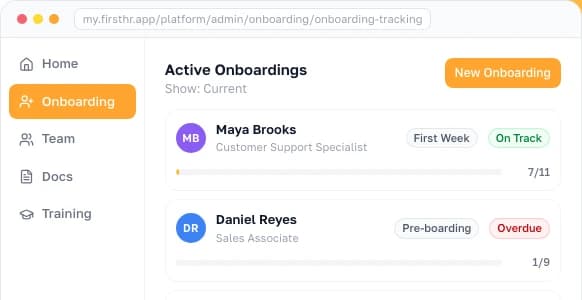
The administrative half of this is where a practice without an HR department loses the most time. FirstHR handles the sequence around the hire: offer letters with e-signature, onboarding task workflows with deadlines, and document storage that records an expiry date for each license and certification. Its onboarding plans can be extended into structured first-90-day plans, and every record sits in one employee file.
Frequently Asked Questions
What are the best recruitment and retention strategies in healthcare?
Start with speed: decide within 48 hours of the final interview and call with the offer the same day, while a larger employer's offer can take weeks to clear approvals. Pay a real bonus for staff referrals, and post the real schedule and pay range up front so candidates can self-select. Keep the schedule stable, since an unpredictable schedule drives more resignations than pay does. Meet with each person for a short one-on-one every month, fund one certification or continuing education course for each person every year, and plan the first 90 days deliberately, because most healthcare turnover happens early rather than late.
Why is retention so difficult in healthcare right now?
Three structural forces overlap. The federal Health Resources and Services Administration projects national shortages of registered nurses, licensed practical nurses, and dental hygienists, so experienced people have real alternatives within commuting distance. Large health systems recruit continuously with tuition support, internal advancement, and sign-on bonuses that a small practice cannot match on paper. And several roles, particularly medical assistants and caregivers, sit in a pay band that overlaps with retail, logistics, and warehouse work that is physically easier and has no licensing requirement. Small practices compete on different terms rather than on the same ones.
How much does it cost to replace a healthcare employee?
Gallup puts the cost of replacing an employee at one-half to two times the position's annual salary, a range it calls conservative. Clinical roles land in that range once you count advertising, the owner's time spent interviewing, temporary coverage, onboarding, and the productivity gap while the new person learns. National hospital survey data puts the average cost of replacing a single registered nurse at about $60,000. At a small practice the dollar figure is lower but the operational impact is worse, because there is no float pool and the remaining staff absorb the gap directly, which is how one resignation turns into two.
How can a small practice compete with hospitals on pay?
Usually it cannot, and trying to compete purely on salary is the wrong strategy. What a small practice can offer that a system structurally cannot: a decision made in 48 hours instead of several weeks, a schedule built around an individual rather than a staffing model, broader clinical scope, direct access to the owner, and continuity with the same patients over years. These matter enormously to a specific group of candidates. The job is to name those advantages explicitly in recruiting so the right people self-select rather than assuming they are obvious.
What is the most common reason healthcare staff leave a small practice?
Schedule chaos and feeling unable to do the job properly, more often than pay. Staff who are called in on days off, told about schedule changes with a day's notice, or asked to run a clinic that is chronically one person short will leave for a job paying the same amount. The pay complaint is often what gets said in the exit conversation because it is easier to say than the real reason. Stay interviews with current staff surface the actual issues while there is still time to address them.
Where should a small practice advertise for clinical staff?
In order of return: current staff referrals with a real bonus, local training programs and community colleges that produce medical assistants, dental assistants, and therapy assistants, profession-specific job boards run by state associations, general job boards for front-desk and administrative roles, and local social media groups for the profession. Recruiters make sense only for senior clinical roles where the search is genuinely hard, because a fee of 20 percent or more of first-year salary rarely pays back for a support-staff hire.
How long should hiring take at a small medical practice?
Plan for three to five weeks between posting the job and getting an accepted offer, and treat faster as a competitive advantage rather than a corner cut. The single biggest source of lost candidates at small practices is not sourcing, it is the gap between the final interview and the offer. Clinical staff in demand often hold two or three conversations at once, and a week of internal deliberation is enough to lose someone. Decide within 48 hours of the final interview and send the written offer the same day you call.
Do small healthcare practices need to offer health insurance to retain staff?
Below 50 full-time equivalent employees there is generally no federal requirement to offer coverage, but for clinical staff it is close to a practical necessity. People who work in healthcare are unusually aware of what medical care costs and of what a plan actually covers. A plan with a deductible so high that nobody can afford to use it does not function as a retention tool and can damage credibility. If budget is tight, a smaller contribution toward a genuinely usable plan usually retains better than a larger plan nobody uses.
What healthcare-specific compliance applies when hiring clinical staff?
Beyond standard employment paperwork, healthcare employers typically need to verify professional licenses directly with the issuing state board rather than accepting a copy, check federal exclusion lists before hiring and periodically after for anyone whose work touches federally funded care, document patient privacy training soon after each person joins, collect immunization or health screening records as required by the state and setting, and apply background screening consistently across everyone in the same role. Requirements vary by state and setting, so put your own list on paper once and reuse it for each hire.
How do I keep staff when I cannot raise pay this year?
Focus on the levers that cost little and address the actual complaints. Publish the schedule two weeks out and stop changing it. Hold a fifteen-minute monthly conversation with each person. Fix the one operational problem everyone mentions, because the failure to fix a known annoyance reads as proof that nobody is listening. Cover a certification or license renewal. Buy the equipment that makes the work less frustrating. None of these replace competitive pay indefinitely, but they address the reasons people give privately for leaving, which are usually not compensation.
Make HR the easy part of running your business
Onboarding, e-signatures, training and core HR in one place. Up and running in 5 minutes.
- 7-day free trial
- No credit card required
- Cancel anytime