
What Is Knowledge Management? Definition, Types, Process, and Tools
What is knowledge management? Definition, 4 types of knowledge, the KM process, tools, and how to prevent knowledge loss at your business.

What Is Knowledge Management?
Definition, types, process, and tools for managing organizational knowledge
At one of my early startups, our best engineer left on a Friday. By Monday, the rest of the team realized that half the deployment process lived entirely in his head. Nobody had written it down. Nobody had been trained on it. The documentation he did leave behind was six months out of date.
We spent the next three weeks reverse-engineering what he had been doing for three years, and we still missed things that only surfaced when a deployment broke two months later. That experience cost us roughly 200 hours of engineering time and one client relationship. It was also entirely preventable.
Preventing it would not have taken expensive software or a formal knowledge management program, just a basic system that kept critical knowledge documented, shared, and updated. That is what knowledge management actually is at its core: making sure your organization's knowledge does not depend on any single person's presence.
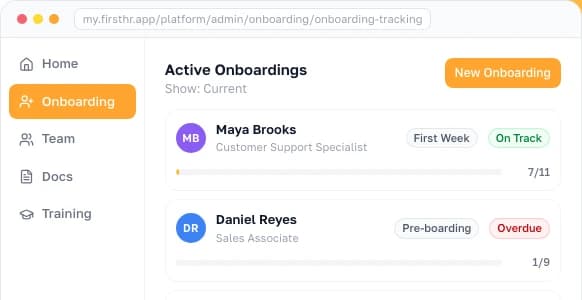
This guide covers what knowledge management means, why it matters more for growing businesses than most people realize, the four types of organizational knowledge, the process for managing them, the tools available at every scale, and how knowledge management connects to employee onboarding. I built document management and training modules into FirstHR specifically because knowledge transfer during onboarding is the most critical moment in any company's knowledge management lifecycle, and it deserves a system rather than improvisation.
What Is Knowledge Management?
Knowledge management is the systematic process of identifying, capturing, organizing, sharing, and applying an organization's collective knowledge. It encompasses the strategies, processes, and tools that ensure the right knowledge reaches the right people at the right time, enabling better decisions, reducing duplicated effort, and preventing critical knowledge from being lost when employees leave.
The concept has roots in management theory, notably Peter Drucker's writing on knowledge workers, but it became a formal discipline in the 1990s when Ikujiro Nonaka and Hirotaka Takeuchi published their book The Knowledge-Creating Company and researchers like Thomas Davenport began defining frameworks for organizational knowledge.
The International Organization for Standardization published ISO 30401:2018, the first international standard for knowledge management systems, which provides requirements and guidelines applicable to organizations of any size.
In practice, knowledge management answers a deceptively simple question: how do you make sure what one person knows is available to everyone who needs it? In the smallest companies, daily conversation handles it. As a small business grows, gaps start appearing, and by mid-size, without deliberate knowledge management, teams routinely duplicate work, new hires ramp up slowly, and departing employees take irreplaceable knowledge with them.
Why Knowledge Management Matters
Knowledge management matters for one structural reason: as organizations grow, the share of the company's total knowledge that any single person holds falls fast. In a team small enough to sit in one room, everyone is close enough to most of it that conversation is a working system.
Once a team outgrows that room, each person holds a fraction, and nobody can say what the fractions leave uncovered. Without systems to bridge that gap, individual knowledge silos create inefficiency, errors, and fragility.
Departures turn that gap into an emergency. The Bureau of Labor Statistics counted 5.1 million total separations across the US economy in July 2026 alone, 3.1 million of them voluntary quits. Each one is employee turnover with a handover attached. The replacement then inherits the same gap from the other side: new hires who cannot find the information they need feel unsupported and disengaged.
| Impact Area | Without KM | With KM |
|---|---|---|
| New hire productivity | Slow ramp that depends on who has time to explain things | Faster ramp through documented processes and structured training |
| Employee departure | Critical knowledge lost; team scrambles to reconstruct | Knowledge documented; transition is inconvenient but not catastrophic |
| Repeated questions | Same questions answered verbally, repeatedly, by the same person | Answers documented once, accessible to everyone |
| Process consistency | Each person does it differently based on who trained them | Documented standard operating procedures (SOPs) ensure consistent execution regardless of who does it |
| Decision quality | Decisions made without context from past experiences | Decision logs and lessons learned inform current choices |
| Training cost | Every new hire requires live, 1-on-1 training from scratch | Training materials exist; live time spent on context and questions, not basics |
4 Types of Organizational Knowledge
Organizational knowledge comes in four types (tacit, explicit, implicit, and embedded), and each one calls for a different management approach. Trying to manage tacit knowledge with a wiki is as ineffective as trying to manage explicit knowledge through mentoring. The type determines the method.
The most important distinction is between tacit and explicit knowledge. Explicit knowledge is manageable through documentation and systems. Tacit knowledge requires human interaction: mentoring, coaching, shadowing, and structured conversations. Most KM failures happen when organizations treat all knowledge as explicit and ignore tacit knowledge.
| Characteristic | Tacit Knowledge | Explicit Knowledge |
|---|---|---|
| Where it lives | In people's heads, built through experience | In documents, databases, and systems |
| How it transfers | Observation, mentoring, conversation, practice | Reading, training, self-study |
| How to capture it | Recorded walkthroughs, interviews, decision logs, debriefs | SOPs, manuals, checklists, policies, training materials |
| Example | Knowing when a client meeting is going badly from body language | The 12-step process for onboarding a new client |
| Risk when someone leaves | Knowledge disappears entirely | Knowledge remains in documentation |
| Management approach | Buddy programs, mentoring, job shadowing, coaching | Document management, knowledge bases, training modules |
A seminal Harvard Business Review article by Hansen, Nohria, and Tierney found that successful companies choose a primary KM strategy aligned with how their knowledge works. Companies relying on standardized processes focus on codifying explicit knowledge. Companies relying on custom expertise focus on connecting people who hold tacit knowledge.
The Knowledge Management Process: 6 Steps
The knowledge management process runs in six steps: identify, capture, organize, share, apply, and update. Knowledge management is not a tool you install but a cycle, and the steps look the same in practice whether you run them through enterprise software or a shared Google Drive.
The cycle is continuous because organizations generate new knowledge constantly. A KM process that captures knowledge once and never updates it produces documentation that becomes progressively less useful. The quarterly review in Step 6 closes the loop.
Two KM Strategies: Codification vs Personalization
Every organization leans on one of two primary strategies for managing knowledge: codification (people-to-documents) or personalization (people-to-people). Knowing which one fits your business keeps you from investing in the wrong approach.
Codification: People-to-Documents
Codification extracts knowledge from the people who hold it, documents it in a reusable format, and stores it where others can access it on their own. Once documented, the knowledge no longer depends on any individual. Codification works best when your business relies on repeatable, standardized processes.
Personalization: People-to-People
Personalization keeps knowledge in people and focuses on connecting knowledge holders with knowledge seekers through mentor relationships, expert directories, communities of practice, and structured shadowing. Personalization works best when your business relies on creative, customized problem-solving where the knowledge is too complex or context-dependent to codify.
| Factor | Codification (People-to-Documents) | Personalization (People-to-People) |
|---|---|---|
| Primary medium | SOPs, wikis, training materials, databases | Mentoring, coaching, expert consultation, shadowing |
| Best for | Repeatable processes, standardized products, compliance | Creative problem-solving, complex expertise, custom services |
| Scale | Scales infinitely once documented | Scales with expert availability |
| Risk | Documentation becomes outdated if not maintained | Knowledge lost when experts leave |
| Small business example | SOP for processing a new client order | Senior developer pair-programming with junior on complex feature |
Most small businesses need codification as their primary strategy because their challenges are mainly operational. Personalization supplements codification for tacit knowledge that cannot be documented.
Knowledge Management Frameworks
Two frameworks dominate knowledge management theory: the SECI model and the DIKW pyramid. You do not need to implement either formally. SECI explains why documents alone never finish the job, and DIKW explains why a folder full of information is not yet knowledge.
The SECI Model (Nonaka and Takeuchi)
The SECI model is named for four processes (socialization, externalization, combination, and internalization) that move knowledge back and forth between its tacit and explicit forms.
| Process | From | To | How It Works | Small Business Example |
|---|---|---|---|---|
| Socialization | Tacit | Tacit | Learning through shared experience and practice | New hire shadows senior team member on client calls for two weeks |
| Externalization | Tacit | Explicit | Articulating tacit knowledge into documents | Senior sales rep records a video walkthrough of how they qualify leads |
| Combination | Explicit | Explicit | Organizing and connecting documented knowledge | Combining product docs, sales playbook, and FAQ into structured training |
| Internalization | Explicit | Tacit | Learning by doing, converting docs into expertise | New hire follows the documented sales process for 30 days until it becomes instinct |
The practical takeaway: documentation alone (Externalization + Combination) is only half the knowledge management cycle. Without Socialization (mentoring, shadowing) and Internalization (practice, application), documented knowledge never becomes operational expertise.
The DIKW Pyramid (Data to Wisdom)
The DIKW pyramid shows the level knowledge management works toward: knowledge, which sits above raw data and organized information and below the judgment the model calls wisdom. Each of its four levels adds something to the one beneath it: first context, then experience, then judgment.
| Level | Definition | Example |
|---|---|---|
| Data | Raw facts without context | Customer support received 147 tickets last Tuesday |
| Information | Data organized with context | Ticket volume was 40% above average, driven by a billing outage |
| Knowledge | Information combined with experience to enable action | When billing outages happen, proactively email affected customers within 2 hours |
| Wisdom | Knowledge applied with judgment across situations | Knowing which problems require proactive communication vs silent resolution |
Most KM tools manage information. True knowledge management requires converting information into actionable knowledge and eventually wisdom. This conversion happens through training, coaching, and experience.
Knowledge Management Examples
Knowledge management in business rarely looks like a knowledge management project. It looks like one specific answer, written down once by the person who knew it, stored where the work happens, and used by somebody else two months later. Here is what that looks like function by function at a small company.
| Function | The knowledge at risk | How it gets captured | What changes |
|---|---|---|---|
| Sales | How a senior rep qualifies a lead and handles the objections that kill deals | Recorded call walkthrough plus a one-page qualification guide | New reps apply the same criteria instead of inventing their own |
| Customer support | The answers to the twenty questions behind most tickets | A macro library and one help article per question | Response times drop and answers stop varying by agent |
| Operations | The month-end sequence and which figures are reconciled by hand | A dated SOP, tested by someone who did not write it | The close survives the owner being on vacation |
| HR | Policy answers, onboarding steps, and how past employee cases were decided | A policy library, an onboarding workflow, and a decision log | Managers stop asking the same policy question every quarter |
| Finance and admin | Vendor history, approval routes, and renewal dates | A vendor sheet with contacts, terms, and the reasoning behind each contract | Contracts stop renewing by accident |
| Field and shop floor | Equipment quirks, safe workarounds, and setup times | Short recorded clips and a printed checklist at the machine | Fewer errors on the shifts the experienced operator does not work |
Every example follows the same shape: a repeated answer becomes a document, the document sits where the task happens, and a second person verifies it by following it. The application of knowledge management is that loop, not the tool it runs on. Six well-tested documents on a shared drive beat two hundred nobody has checked.
Knowledge Management and Employee Onboarding
Onboarding is the highest-stakes knowledge management event in any organization. In 30 to 90 days, a new hire needs to absorb months or years of accumulated knowledge: how the company operates, what the products do, how internal tools work, who to ask about what, and the unwritten rules.
| Transfer Method | How It Works | Effectiveness | Risk |
|---|---|---|---|
| Verbal pass-through | Founder tells new hire everything over 2-3 days | Moderate short-term, poor long-term | Re-explained for every hire; inconsistent |
| Documented self-study | New hire reads SOPs and training docs independently | Good for explicit knowledge; poor for tacit | Misunderstandings go undetected |
| Structured onboarding | Documented training + assigned tasks + mentoring + check-ins | High for both explicit and tacit knowledge | Requires upfront investment in documentation |
The structured approach is where KM and onboarding intersect most productively. Documentation handles the "what" and "how." Human interaction handles the "why" and "when."
There is also a virtuous cycle: every new hire who goes through onboarding identifies gaps in documentation. "The SOP says to use Tool X, but we switched to Tool Y three months ago." These observations improve the knowledge base for the next hire.
Knowledge Management in HR
HR knowledge management covers two jobs at once. The first is the knowledge the HR function owns itself: policies, the handbook, onboarding steps, training records, job descriptions, and the reasoning behind past employee decisions. The second is running the system every other team stores its knowledge in, because at a small company nobody else owns that.
The HR half is the easiest place to start, because the material is already written and rarely organized. Pull the policies and onboarding documents into one structure with an owner and a review date, and the rest of the company has a working example to copy. Document management and a shared knowledge base are where that begins.
Tribal Knowledge: The Hidden Risk
Tribal knowledge is the informal, undocumented information that employees accumulate through experience and share verbally. Every organization has it: the office manager who knows that the accounting software crashes if you enter more than 50 line items at once, or the sales rep who knows that Client X prefers email over phone.
The risk is that tribal knowledge often represents the most critical operational knowledge a business has, stored exclusively in people's heads.
| Tribal Knowledge Type | Example | What Happens When the Person Leaves |
|---|---|---|
| Process shortcuts | The fastest way to get a PO approved is to CC the CFO's assistant | New employees follow the official (slower) process |
| Client preferences | Client Y always wants the executive summary on a separate page | New account manager delivers standard format; client is dissatisfied |
| System workarounds | The CRM export only works if you select 'All Fields' | New user spends hours debugging a broken export |
| Historical context | We tried that approach with Vendor Z and it failed due to API limitations | Team re-proposes the same approach, wasting weeks |
| Relationship knowledge | The best vendor contact for urgent requests is Maria in Portland | Team uses the support line and waits 48 hours instead of 2 |
The "bus factor" is the informal metric for tribal knowledge risk: how many key people could leave before operations are significantly disrupted. If the answer is one, you have a critical knowledge management problem.
Knowledge Retention Strategies
Knowledge retention is the deliberate work of keeping critical knowledge inside the business when the person holding it changes role, takes leave, or resigns. It is knowledge management pointed at one failure mode: a departure that takes operating capability with it. Six strategies cover almost every case.
| Strategy | What it retains | When to start | Effort |
|---|---|---|---|
| Written SOPs and checklists | Explicit, repeatable process knowledge | Before anyone announces a departure | Low, but ongoing |
| Cross-training a backup | The ability to do the task, not just a description of it | As soon as a critical task has one owner | Medium |
| Recorded walkthroughs | The steps people skip when they write instructions | When a process resists documentation | Low |
| Job shadowing and mentoring | Judgment, context, and the reasons behind decisions | Weeks or months before a handover | High |
| Decision logs | Why a choice was made and what was rejected | At the moment of the decision | Low |
| Structured offboarding handover | Open threads, relationships, and unwritten context | The day notice is given | Medium |
The order you use them in matters more than the list itself. A backup who has actually done the task retains more than any document, so cross-training outranks writing wherever one person owns something critical. Documentation still comes first for volume, because it is the only strategy that scales without spending a second person's time.
The worst moment to start is the exit interview. Two weeks of notice is enough to record walkthroughs and hand over open threads, not to rebuild three years of context. Capture happens while people are still in the job, which makes offboarding the last step of knowledge retention rather than the first.
Learning Retention: Why Training Alone Does Not Stick
Knowledge retention keeps knowledge in the company. Learning retention is the narrower question of how much of it stays in one person's head after a training session, and the honest answer is less than whoever ran the session assumes. People forget procedures they perform rarely, however well the training went.
The fix is not more training. It is putting the documented version within reach at the moment of use so recall is never the point of failure: a checklist at the workstation, a short refresher when the process changes, and real practice soon after the session. Just-in-time training and a searchable knowledge base do more here than a longer course.
Knowledge Management Tools and Systems
Knowledge management tools range from a shared folder with naming conventions to enterprise platforms sold on annual contracts with an implementation project attached. The six categories below cover what is actually on the market. Most small companies need exactly one of them, and which one depends on where the work already happens.
How a Knowledge Management System Works
A knowledge management system (KMS) works in four moves: content goes in, structure makes it findable, retrieval puts it in front of the person doing the work, and a maintenance cycle keeps it true. Software handles the middle two well and the outer two badly, which is exactly where most systems fail.
In practice: somebody writes or records the answer and files it under an agreed name and tag. Search and permissions decide who can reach it. The employee pulls it up at the moment of the task rather than reading it in advance. Then a named owner reviews it on a schedule and fixes or retires whatever has gone stale.
Nothing in that sequence requires a dedicated platform. A shared drive with naming conventions, an owner per folder, and a quarterly review is a knowledge management system. The tool changes how fast retrieval feels. It does not change whether anyone captures or maintains anything, and that is the part that decides whether the system survives its first year.
Matching Tools to Company Size
| Company Size | Recommended Approach | Tools | How It Is Priced |
|---|---|---|---|
| Solo owner and first hires | Shared drive with clear folder structure | Google Drive or Dropbox + Google Sheets | Free tier, or storage you already pay for |
| Small business | Lightweight wiki or HR platform with document management | Notion, Slite, or HR platform with training modules | Per user per month for a wiki, or one subscription for the HR platform |
| Growing small business | Dedicated knowledge base + onboarding platform | Guru, Tettra, or Confluence + HR/onboarding tool | Per user per month for the knowledge base, plus the onboarding tool |
| Mid-size company | Knowledge base + LMS or integrated HR platform | Confluence + LMS, or full HRIS (human resources information system) with training and KM | Per user per month across two or more tools |
| Enterprise | Enterprise KM platform or suite | Confluence, SharePoint, Guru Enterprise, or dedicated KMS | Usually quoted through sales, on an annual contract |
For a small business, the most practical approach is often an HR platform that combines onboarding, document management, and training modules rather than a standalone knowledge management tool.
Knowledge Management for Small Businesses
Small businesses face fundamentally different knowledge management challenges and need a different approach: the founder and the team document as part of their regular work, in a shared folder or a lightweight wiki. Most KM content is written for enterprises with dedicated KM teams and significant technology budgets, so here is how each enterprise practice translates.
| Enterprise KM | Small Business KM |
|---|---|
| Dedicated KM team with defined roles | Founder + team members document as part of regular work |
| Enterprise wiki with governance and taxonomy | Shared folder with clear naming conventions, or lightweight wiki |
| Formal knowledge audits and gap analyses | Ask new hires what was missing from their training |
| Change management program to drive adoption | Lead by example: founder documents their own processes first |
| KPI dashboards tracking content usage | Simple check: are people finding answers without asking me? |
| Platform licensing plus implementation services on an annual contract | Free tools or one monthly subscription |
The Minimum Viable Knowledge System
If you are starting from zero, five elements create a functional knowledge management system in under a week. First, document your top 10 processes: the tasks that happen most frequently and involve more than three steps. Second, create a new hire knowledge packet with everything a new person needs in their first week.
The remaining three elements make the system last. Establish a decision log for important business decisions, assign process owners for each major area, and connect documentation to onboarding so every new hire both consumes and improves it.
Which processes belong in that top ten is not a matter of taste. The ones worth writing first are the ones a single person is currently holding, and the fastest way to find them is the bus-factor question from the tribal knowledge section: what stops if this person is out for two weeks?
The workbook below starts there. Its first tab ranks what only one person knows. The second turns each of those into a capture task with a method, an owner, and a date. The third records what every new hire says they had to work out alone. The document inventory and the repeat-question log belong to the knowledge base instead.
| A | B | C | D | E | F | G | H | |
|---|---|---|---|---|---|---|---|---|
| 1 | Person or role | What only they know | Where it shows up (process, client, system) | What stops if they are out for two weeks | How many other people could do it | Knowledge type (tacit / implicit / embedded) | Risk | Capture priority |
| 2 | SAMPLE Ops lead | The month-end close sequence, and which figures are reconciled by hand | Finance, monthly | Close slips past the 5th and nobody knows which numbers were manual | 0 | Implicit | High | 1 |
| 3 | SAMPLE Founder | Which vendor contact answers urgent requests, and the history behind each contract | Vendor management | Urgent requests go to the support queue and wait 48 hours | 0 | Tacit | High | 2 |
| 4 | ||||||||
| 5 | ||||||||
| 6 | ||||||||
| 7 | ||||||||
| 8 | ||||||||
| 9 | ||||||||
| 10 | ||||||||
| 11 | ||||||||
| 12 | Rule | A zero in the 'how many other people' column is the whole point of the exercise. Sort by it | ||||||
| 13 | Rule | Implicit knowledge can be written down this quarter. Tacit knowledge needs shadowing or a recorded walkthrough, not a document |
KM vs Knowledge Base vs Wiki vs Intranet: What Is the Difference?
The key distinction: knowledge management is the strategy. Everything else is a tool or component. You can have a comprehensive wiki and still have poor knowledge management if nobody uses it, nobody updates it, and new hires do not know it exists.
| Term | What It Is | Scope | Example |
|---|---|---|---|
| Knowledge Management | A strategy and process for managing organizational knowledge | Tools, processes, culture, and people | The company's overall approach to capturing and sharing knowledge |
| Knowledge Base | A centralized, searchable collection of documented knowledge | A specific tool or system | A collection of articles answering common questions |
| Wiki | A collaborative, editable collection of documents | A specific tool or system | Confluence or Notion pages that anyone can edit |
| Intranet | An internal website for company information | A broader platform that may include KM features | SharePoint site with news, policies, and document libraries |
| KMS | The technology layer that supports KM processes | The toolset used for KM | Guru, Bloomfire, or wiki + document management + search |
How to Start a Knowledge Management Initiative
Start a knowledge management initiative small and grow it in stages. KM initiatives fail most often because they start too big: buying an enterprise platform, planning a comprehensive taxonomy, or attempting to document everything at once.
Begin with the most painful knowledge gap (Day 1): identify the person whose departure would cause the most disruption and list the knowledge only they hold. Then document the top 10 questions (Days 2-5) by tracking what gets asked most frequently and writing clear answers. Pick one tool (Day 5): the simplest system that stores searchable text documents.
The next three steps turn those documents into a habit. Assign knowledge owners (Week 2), so each domain has one person ensuring documentation stays current. Connect the knowledge base to onboarding (Week 3), so new hires work through it and flag gaps. Then establish a review cadence (Month 2+): quarterly reviews where owners verify accuracy.
Building a Knowledge Sharing Culture
A knowledge sharing culture is what gets documentation written when nobody is watching, and it comes from what leaders do rather than what they announce. If the founder answers the same question privately for the fifth time instead of writing it down, the team learns that documenting is optional and the wiki stays empty.
Three habits move it. Document in the open, where the team sees the work happening. Treat a question asked twice as a gap in the knowledge base rather than an interruption. Credit the people who write things down in the same breath as the people who ship. Mandates without those signals produce compliance, not sharing.
Who Runs Knowledge Management
At a large company a knowledge management team owns this: a program lead, content managers, and subject matter experts who supply and approve material. A small business has no such team and does not need one. It needs the same jobs distributed: one sponsor, one owner per knowledge domain, and the people doing the work writing it up.
The sponsor is usually the founder, and the job is protecting the time rather than producing the content. Domain owners do not write everything either; they are accountable for whether their area is accurate, and they are the ones who close the quarterly review. Naming them is the difference between a system and a folder.
Measuring Knowledge Management Effectiveness
The simplest measure of knowledge management is whether people find answers without asking someone. If they do, the system is working. The six metrics below add detail, from how fast new hires become independent to how quickly the team recovers after a departure.
| Metric | What It Measures | Good Signal | Warning Signal |
|---|---|---|---|
| Time to productivity for new hires | How quickly new employees become independent | Decreasing with each new hire | Staying the same despite documented training |
| Repeat question frequency | How often the same questions are asked | Decreasing (answers are findable) | Same questions asked repeatedly |
| Knowledge base usage | Whether documented knowledge is accessed | Consistent, growing usage | Content exists but nobody accesses it |
| Documentation currency | % of documents updated within 6 months | 75%+ updated | Less than 50% reviewed |
| Onboarding feedback scores | New hire satisfaction with information accessibility | Improving over time | Consistent complaints about missing information |
| Knowledge recovery time | How long the team takes to fill gaps after a departure | Measured in days | Extended disruption after each departure |
AI and the Future of Knowledge Management
AI is changing knowledge management in three practical ways.
AI-Powered Search Across Systems
Traditional KM requires employees to know where information is stored. AI-powered search eliminates this requirement by searching across documents, chat history, email, and wikis simultaneously. For organizations with knowledge scattered across many tools, that is a big change. For a small business with one or two systems, it matters less.
Generative AI for Knowledge Capture
The biggest barrier to KM is documentation time. Generative AI reduces that time by drafting content from existing materials: turning meeting notes into process documents, converting recorded walkthroughs into step-by-step guides, and generating FAQ content from support ticket histories.
AI Assistants for Knowledge Retrieval
AI assistants trained on a company's knowledge base answer employee questions by synthesizing information from multiple documents. Instead of searching a 10-page SOP, an employee asks the assistant and receives a direct answer with a citation.
Common Knowledge Management Mistakes
Six mistakes appear consistently across organizations implementing KM for the first time. All stem from treating KM as a technology project rather than a people and process challenge.
If you do one thing after reading this, ask the bus-factor question about each person on your team: what stops if they are out for two weeks? Start capturing what the person with the longest answer knows. Every other part of knowledge management, from tools to review cycles, builds on that first step.
Frequently Asked Questions
What does knowledge management mean?
Knowledge management means running a deliberate system for finding out what your organization knows, getting that know-how out of individual heads, storing it where others can find it, and making sure it actually gets used and kept current. The payoff is practical: people get answers when they need them, nobody redoes work that already exists, knowledge does not walk out the door when an employee leaves, and new hires reach full speed sooner. It covers explicit knowledge, meaning written processes, SOPs, and training materials, as well as tacit knowledge, the expertise, judgment, and context that live in people's heads.
What are the 4 types of knowledge management?
The four types of organizational knowledge are tacit (unwritten expertise and intuition that is difficult to articulate), explicit (documented knowledge like SOPs, manuals, and policies), implicit (knowledge that can be documented but has not been yet), and embedded (knowledge built into processes, systems, and organizational structures). Effective knowledge management addresses all four types, though most programs start with converting implicit knowledge to explicit through documentation.
What is the difference between knowledge management and information management?
Information management focuses on storing, organizing, and retrieving data and documents. Knowledge management goes further by connecting information to context, making it actionable, and ensuring it transfers between people. Information management asks 'where is the file?' Knowledge management asks 'does the person who needs this know it exists, understand it, and use it to make better decisions?' Information management is a component of knowledge management, not a synonym for it.
Do small businesses need knowledge management?
Every business with more than one employee manages knowledge, whether intentionally or not. The question is whether knowledge transfer happens through deliberate systems (documented processes, structured onboarding, searchable knowledge bases) or through ad hoc methods (asking the person who knows, hoping someone remembers, re-learning from mistakes). Small businesses do not need enterprise KM software, but they do need documented processes for repeatable tasks, structured onboarding that transfers critical knowledge to new hires, and systems that prevent knowledge from walking out the door when someone leaves.
What is the difference between tacit and explicit knowledge?
Explicit knowledge can be written down, stored, and shared through documents: a recipe, a standard operating procedure, a policy manual. Tacit knowledge is personal, experiential, and difficult to articulate: knowing when bread dough has been kneaded enough, sensing when a sales prospect is ready to close, or intuiting that a particular approach will not work based on past experience. The central challenge of knowledge management is finding ways to transfer tacit knowledge, which typically happens through mentoring, shadowing, coaching, and structured conversations rather than through documents.
What is a knowledge management system?
A knowledge management system (KMS) is the combination of technology, processes, and practices an organization uses to manage its knowledge. It can be as simple as a shared Google Drive with a clear folder structure and naming conventions, or as complex as an enterprise platform with AI-powered search, content creation workflows, and analytics. The system includes the tools (wiki, knowledge base, document management), the processes (how knowledge is captured and updated), and the culture (whether employees actually contribute to and use the system).
What is the SECI model?
The SECI model, developed by Ikujiro Nonaka and Hirotaka Takeuchi, describes how knowledge transforms between tacit and explicit forms through four processes: Socialization (tacit to tacit, through shared experience like shadowing or mentoring), Externalization (tacit to explicit, through articulating knowledge into documents or models), Combination (explicit to explicit, through organizing and connecting documented knowledge), and Internalization (explicit to tacit, through learning by doing). The model explains why documentation alone is not sufficient for knowledge management.
How does knowledge management relate to onboarding?
Onboarding is where knowledge management is under the most pressure. In their first 30 to 90 days, a new employee has to take in knowledge the company built up over months or years: how operations run, what the products do, which internal tools to use, whom to go to with which question, and the unwritten norms behind the official process. When that transfer runs on documented training materials, SOPs, and an assigned mentor instead of on whoever happens to be free, onboarding becomes knowledge management focused on one new person.
What is the ISO 30401 standard for knowledge management?
ISO 30401:2018 is the international standard for knowledge management systems. It provides requirements and guidelines for establishing, implementing, maintaining, and improving KM within organizations. The standard defines knowledge management principles, emphasizes that KM must be aligned with organizational objectives, and requires organizations to determine what knowledge is needed and how to manage it. While applicable to organizations of any size, its formal requirements are most relevant to mid-size and large organizations.
How is AI changing knowledge management?
AI is reshaping knowledge management through better search, faster documentation, and assistants that answer questions directly. Search built on AI looks through several systems at once, so an employee no longer needs to know which folder or app holds the answer. Generative AI turns material that already exists into first drafts of documentation, which cuts the time that capturing knowledge takes. AI assistants connected to a knowledge base reply to employee questions by pulling from several documents, acting like a subject matter expert who is always on call. For a small business, the most practical use is having AI draft SOPs and training materials from existing documentation.
Make HR the easy part of running your business
Onboarding, e-signatures, training and core HR in one place. Up and running in 5 minutes.
- 7-day free trial
- No credit card required
- Cancel anytime