
Free Bank Teller Job Description Templates
Free bank teller job description templates: community bank, credit union, head teller, universal banker, and senior teller. BSA/AML duties included.

Bank Teller Job Description Templates
5 free templates for banks and credit unions. Download as DOCX or copy-paste.
Bank teller hiring belongs mostly to community banks and credit unions now: the megabanks are automating the line, while small institutions keep human tellers because personal service is the product they sell. That makes the posting an odd fit for the generic templates, which are written for a role the big banks are phasing out and skip the things that define teller work at a small institution: the compliance expectations regulators audit, the bondability standard, the member-versus-customer language, and the promotion path that keeps good people.
At FirstHR, we build for small organizations that hire without an HR department, and a community bank with twelve employees is exactly that, with a federal compliance program on top. The five templates below cover the real versions of the role: community bank teller, credit union teller, head teller, universal banker, and senior teller. Each carries the CTR awareness, suspicious-activity escalation, dual control, and BSA/AML training expectations as plain-language bullets. Fill in the brackets and post.
What Does a Bank Teller Do?
A bank teller processes routine customer transactions at a bank or credit union: deposits, withdrawals, check cashing, loan payments, and transfers, with cash handling and end-of-shift drawer balancing as the accuracy backbone. The O*NET profile for tellers frames the core: receiving and paying out money, keeping records of money and negotiable instruments in transactions, and the verification work around them. Teller, bank teller, and member service representative (the credit union phrasing) describe the same line work, and a posting benefits from matching the language to the institution.
The defining structure of the role at a small institution is that the transaction work carries two more jobs inside it: the teller is the front line of the compliance program, the first set of eyes on cash thresholds, identity, and unusual activity, and the front line of the relationship, the person customers and members see most. Both belong in the posting.
Bank Teller Responsibilities
Bank teller responsibilities center on accurate transaction processing and cash handling, compliance and security duties, customer service with referrals, and the accuracy and recordkeeping that audits sample. The institution type shifts the emphasis, a credit union leans on member relationships while a head teller role leans on vault and supervision, but the categories hold. These are the duties grouped the way the templates use them.
A strong posting picks 8 to 12 of these and grounds them in the role: balance the drawer to a near-zero difference record, recognize transactions requiring a Currency Transaction Report and follow bank procedures, refer members to lending for the products their accounts suggest they need. The referral expectation deserves honesty in particular: if the role carries referral goals, the posting should say so and the pay should reflect it, because candidates who discover quotas in week two leave.
Which Template Should You Use?
Pick the template by institution and level. The compliance core, CTR awareness, escalation, dual control, BSA/AML training, runs through all five, but the language, the scope, and the candidates differ enough that the matched version always reads more credibly. Use this guide to choose.
5 Free Bank Teller Job Description Templates
Download all five as separate Word files in one ZIP, or copy individual templates. Each follows the same structure: institution overview, job summary, key responsibilities, required and preferred qualifications, compensation, and how to apply, with the CTR awareness, suspicious-activity escalation, dual control, bondability, and BSA/AML training expectations as plain-language bullets. Fill in the brackets and align the compliance language with your own policies before posting.
Template 1: Community Bank Teller
The flagship for small banks without an HR department: entry-level transactions, customer service, and the compliance expectations written in plain language a first-time teller can understand.
Template 2: Credit Union Teller / Member Service Representative
The same core with credit union language throughout: members instead of customers, share drafts, field of membership, and the owner-member service style that defines the institution.
Template 3: Head Teller / Teller Supervisor
The operational backbone of the branch: team supervision, vault ownership with dual control, surprise cash counts, approval limits, new-teller training, and first-escalation duties.
Template 4: Universal Banker / Teller-Hybrid
The role the branch of the future runs on: teller transactions when the line is busy, account opening and digital banking help at the desk, and referrals as a core duty with incentives stated.
Template 5: Senior Teller
The experienced anchor of the line: elevated approval limits, complex transactions, mentoring newer tellers, vault backup, and referral goals, the step toward head teller or universal banker.
BSA/AML Duties to Include in a Teller Job Description
The teller line is where a bank's compliance program meets the public, and the job description should say so in plain language, because generic follow-all-regulations bullets hide the real job from candidates and from new hires. The legal floor: federal law requires institutions to maintain a BSA/AML compliance program that includes an ongoing employee training program, the Bank Secrecy Act framework FinCEN administers, and examiner guidance in the FFIEC BSA/AML examination manual expects training to cover appropriate personnel, those whose duties require knowledge of the BSA, a category tellers nearly always fall into.
In a posting, that translates into a handful of concrete bullets rather than legal citations: recognizing cash transactions over $10,000 that require a Currency Transaction Report and following bank procedures, escalating unusual or suspicious activity to the BSA Officer or manager per policy, verifying identity and endorsements on every transaction, following dual control and security procedures, and completing required compliance training on schedule, including BSA/AML training. Every template on this page carries that set, phrased as institution procedure, and the same expectations become the first module of onboarding once the hire is made, with completion documented, because examiners review training records.
Bank Teller Qualifications to Include
Teller qualifications are trust-anchored rather than credential-anchored: the role is genuinely entry-level, but it handles cash under a fidelity bond, which makes the background and bondability standard the real gate, and precision in the posting does the screening a missing HR department cannot.
| Weak requirement | Strong requirement |
|---|---|
| Banking experience required | Cash handling or customer service experience; we train promising people from retail and hospitality |
| Handle money | Process transactions accurately and balance your drawer to a near-zero difference record |
| Follow regulations | Recognize CTR thresholds (cash over $10,000), escalate suspicious activity per policy, follow dual control |
| Trustworthy | Able to pass a background check and meet the institution's bondability requirements |
| Good with people | Friendly, accurate service that makes customers bank here instead of at the big bank down the street |
Keep the must-have list short and the preferred list honest: requiring prior banking experience for an entry-level line role shrinks the pool the community institutions have always trained from, and the posting language throughout should stay neutral and job-related, since the EEOC prohibits job advertisements that show a preference based on protected characteristics.
How to Write a Bank Teller Job Description
A strong teller posting takes about 20 minutes once the institution type is settled, because the type decides the language, the scope, and the candidates. The SHRM job description tools describe a good job description as a plain-language summary of a position's tasks, duties, and responsibilities, and at a regulated institution the plain language has to carry the compliance expectations too. Here is the process the templates are built around.
Bank Teller Salary
Teller pay sits at the entry level of financial services, and the employment data carries a recruiting lesson worth reading honestly: the occupation is shrinking nationally even as replacement hiring continues, which changes how a small institution should pitch the job.
Role moves pay within the band: senior tellers price above the line for elevated limits and mentoring, head tellers carry a supervisory premium, and universal bankers typically earn more than classic tellers because the role adds platform work and referrals, often with incentives. The decline projection is the community institution's pitch, not its problem: the big banks are cutting the human line, which means the candidates who want relationship banking work are looking exactly where small institutions are hiring, and the posting that offers a stable schedule, a named promotion path from teller to senior to head teller or universal banker, and a branch where the manager knows your name wins against an hourly rate alone.
Hiring a Teller Without an HR Department
Megabanks hire tellers with recruiting teams, training academies, and compliance departments. A community bank or credit union with a dozen employees does it with the branch manager, under the same federal compliance expectations, in an occupation the headlines say is disappearing. Here is how to write the posting for that reality.
From Hiring to Onboarding
The job description is step one, and teller onboarding is compliance-first to a degree most small employers never see: complete the background check and bondability verification, collect the signed offer and new hire paperwork, and schedule BSA/AML training as part of the first days with completion documented, because examiners review training records, not intentions. The role-specific expectations regulators audit make a structured compliance training sequence the spine of the plan. Then the practical layer: the teller platform and core system, cash handling and balancing procedures, dual control rules, security and robbery procedures walked seriously, the escalation path with actual names, and supervised drawer time with an experienced teller before solo balancing, even for experienced hires, because every institution's procedures differ.
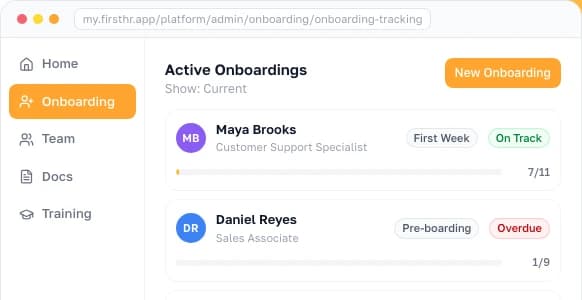
Once you have your offer ready, the offer letter template handles the next step, the employment contract template attaches the job description as the formal scope where a contract is used, and the training plan template structures the compliance and procedures sequence week by week. FirstHR connects the offer, e-signature paperwork, document storage, training assignment with completion tracking, and the onboarding workflow in one place, so a community bank or credit union can take a teller from accepted offer to a balanced solo drawer without an HR department.
Frequently Asked Questions
What does a bank teller do?
A bank teller processes routine customer transactions at a bank or credit union branch: deposits, withdrawals, check cashing, loan payments, and transfers, counting and verifying cash and balancing the drawer at the end of every shift. Around the transactions sit the parts that make the role more than cashiering: verifying customer identity on every transaction, recognizing cash transactions that cross the $10,000 Currency Transaction Report threshold, escalating unusual or suspicious activity per bank policy, detecting counterfeit currency, following dual control and security procedures, and referring customers to bankers for accounts and loans. At a community bank or credit union, the teller is also the face of the institution, the person customers and members interact with most, which is why service quality belongs in the posting alongside accuracy.
What are the main bank teller responsibilities to list in a posting?
Bank teller responsibilities fall into four groups. Transactions and cash: processing deposits, withdrawals, check cashing, loan payments, and transfers, handling cash accurately, and balancing the drawer every shift. Compliance and security: verifying identity and endorsements, recognizing Currency Transaction Report thresholds for cash over $10,000, escalating suspicious activity per policy, and following dual control, security, and robbery procedures. Customers and referrals: friendly, accurate service, resolving simple account issues, and referring customers to bankers for products. Accuracy and records: counterfeit detection, confidentiality of customer information, and completing required compliance training including BSA/AML on schedule. A strong posting lists 8 to 12 of these matched to the institution type, since a credit union member service role and a head teller role are different jobs under one title.
What qualifications does a bank teller need?
Bank teller is a genuine entry-level role: the standard requirements are a high school diploma or equivalent, cash handling or customer service experience, accuracy and attention to detail, a friendly professional manner, and basic computer skills, with the bank training the rest on the job. The requirements that function like credentials in this field are different: the ability to pass a background check and meet the institution's bondability standard, since tellers handle cash under a fidelity bond, and the trustworthiness that implies. Community banks and credit unions have always hired promising people from retail and hospitality and trained them, which is why the strongest postings keep the must-have list short, accuracy, service instincts, background check, and put prior banking experience in the preferred list rather than the required one.
Do bank tellers need BSA/AML training?
In practice, yes. Federal law requires every bank and credit union to maintain a BSA/AML compliance program that includes an ongoing employee training program, and regulator examination guidance expects that training to cover appropriate personnel, those whose duties require knowledge of the Bank Secrecy Act. Tellers nearly always fall into that category, because the teller line is where the BSA becomes practical: cash transactions that cross the $10,000 Currency Transaction Report threshold, identity verification, structuring patterns, and the unusual activity that suspicious activity reporting depends on all surface there first. For a small institution, that means a new teller goes into BSA/AML training as part of onboarding, the training is documented because examiners check documentation, and the job description should say compliance training is part of the job, which the templates on this page do.
What is the difference between a bank teller and a universal banker?
A bank teller works the transaction line: deposits, withdrawals, payments, cash handling, and drawer balancing, referring customers to bankers when they need accounts or loans. A universal banker is the hybrid role many institutions are moving to: part teller, part platform banker, processing transactions when the line is busy and opening accounts, servicing requests, and helping customers with digital banking at the desk the rest of the time. The industry context matters for hiring: federal projections show classic teller employment declining 13 percent through 2034 as transactions move to digital channels, while the universal banker model is what many branches are converting teller seats into. For a small institution deciding which posting to write, the question is honest scope: if the person will open accounts and make referrals as a core duty rather than an occasional favor, post the universal banker version and pay for it.
How much does a bank teller make?
Tellers earn a median of about $39,340 per year, roughly $18.91 per hour, as of May 2024 federal data, with entry-level positions typically starting lower and senior, head teller, and universal banker roles pricing above the line for the added limits, supervision, or platform duties. The employment context belongs in a small institution's pay thinking: the role held about 347,400 jobs in 2024 and is projected to decline 13 percent through 2034, but about 29,800 openings still appear each year, mostly replacing people who leave, which means hiring competition is real even in a shrinking occupation. Community banks and credit unions compete best by publishing an honest hourly range and pairing it with what the big banks cut first: stable schedules, a real promotion path from teller to senior to head teller or universal banker, and a branch culture where the institution knows your name.
How do I write a teller job description for a community bank or credit union without an HR department?
Pick the matching template, community bank or credit union, then handle the three things small institutions tend to miss. First, write the compliance expectations in plain language: recognizing Currency Transaction Report thresholds, escalating suspicious activity per policy, dual control and security procedures, and completing BSA/AML training on schedule, because regulators expect role-appropriate training and experienced candidates respect postings that know it. Second, name the practical requirements honestly: the background check and bondability standard, the Saturday rotation, the teller platform, and the real promotion path. Third, keep the must-have list short, accuracy, service instincts, and trustworthiness, with banking experience as preferred, because community institutions have always trained good people from retail and hospitality, and the posting should keep that pipeline open. Use member language throughout for a credit union: members, not customers, and share drafts where they apply.
What happens after I hire a bank teller?
The compliance sequence runs first and it is heavier than most small employers expect: complete the background check and bondability verification, collect the signed offer letter and new hire paperwork, and put BSA/AML training on the onboarding plan from day one with completion documented, because examiners review training records, not intentions. Then the practical layer: the teller platform and core system, cash handling and balancing procedures, dual control rules, security and robbery procedures walked seriously, the escalation path for suspicious activity with actual names, and supervised drawer time with an experienced teller before solo balancing, even for experienced hires, because every institution's procedures differ. Annual compliance refreshers go on a tracking calendar. FirstHR handles the offer letter, e-signature paperwork, document storage, training assignment and completion tracking, and the onboarding workflow in one place, built for institutions without an HR department.
Make HR the easy part of running your business
Onboarding, e-signatures, training and core HR in one place. Up and running in 5 minutes.
- 7-day free trial
- No credit card required
- Cancel anytime