
Free Busser Job Description Templates
Free busser job description templates: casual, fine dining, bar, food runner, catering, and teen. Tip pooling and youth-labor notes built in. DOCX.

Most small restaurants copy their busser job description from a template written for any employer, and that template misses what actually matters when you hire bus staff. The six templates below cover the role by venue: casual, fine dining, bar, food runner combo, catering, and entry-level teen.
At FirstHR, we build for small businesses that hire without an HR department, and an independent restaurant hiring a busser is a textbook case: turnover is constant, the role is entry-level and high-volume, and the posting carries tip and youth-labor stakes a generic template ignores.
A busser posting has to get two things right: the tip-pool disclosure that keeps your pay offer compliant, and the youth-labor rules that apply because so many bussers are teenagers. The role also looks different in a fine-dining room than at a bar or a catering event, so pick the version that fits your venue, fill in the brackets, and post.
- Sign the offer letter
- Sign the employee handbook
- Workplace Safety course
What Is a Busser?
A busser keeps the dining room running by clearing, cleaning, and resetting tables, supporting servers, refilling water, and keeping service areas clean and stocked. The federal classification for the job is dining room and cafeteria attendants and bartender helpers.
O*NET, a Labor Department database, lists busser, busboy, bus person, and server assistant among the sample titles for that classification, which is why the federal data covers all of them together. Busser and busboy mean the same job; busser is the gender-neutral term that has largely replaced busboy, and it is the one to use in a posting.
Beyond the shared core duties, the work shifts by venue, which is why one generic template rarely fits. The six templates on this page split by venue so the summary and duties match the actual job, from a casual diner to a fine-dining room to a catering event.
Busser Duties and Responsibilities
Busser duties and responsibilities center on four areas: tables and resets, server and guest support, cleanliness and sanitation, and side work and service flow. The venue shifts the emphasis (crumb service and stemware for fine dining, glassware and restocking for a bar, running food for a combo role), but these four categories hold across nearly every busser job. Here they are, grouped the way the templates use them.
A strong posting grounds these in your specifics: the venue, the pace, the physical demands, and who the role reports to.
Busser vs Server vs Food Runner vs Barback
A busser turns tables and backs up the servers, a server takes orders and manages the guest, a food runner carries finished dishes from the kitchen, and a barback restocks and supports the bar. These four front-of-house roles overlap and get confused often, so naming the right one keeps your posting accurate and decides which template you need.
| Role | Primary focus | Tipped |
|---|---|---|
| Busser | Clears, cleans, and resets tables; supports servers | Yes, usually via tip pool |
| Server | Takes orders, serves, manages the guest and payment | Yes, directly and via pool |
| Food Runner | Delivers completed dishes from the kitchen to tables | Often, via tip pool |
| Barback | Restocks and supports the bar; clears bar tables | Yes, usually via bar tip pool |
In small restaurants these roles blend, which is why the busser and food runner combo is common.


Which Template Should You Use?
Pick the template by your venue. All six share the same skeleton, but each one emphasizes the duties, pay structure, and requirements that fit a specific kind of busser. Use this guide to choose.
6 Free Busser Job Description Templates
Download all six as separate Word files in one ZIP, or copy individual templates. Each follows the same structure: job summary, key responsibilities, qualifications, and compensation and how to apply. Fill in the brackets and confirm your tip and youth-labor rules before you post.
Template 1: Standard / Casual Restaurant Busser
The base version for any casual restaurant: clearing and resetting tables, supporting servers, refills, and sanitation. Start here if no specialized version fits.
Template 2: Fine Dining Busser / Server Assistant
The server-assistant version: polished table maintenance, crumb service, stemware handling, and refined resets, usually with one to two years of experience preferred.
Template 3: Bar Busser / Barback
The bar version: glassware, restocking, bartender support, and bar-area sanitation in a fast, high-volume alcohol-service environment, with age requirements built in.
Template 4: Busser / Food Runner (Combo)
The combo version: running food from the kitchen plus bussing tables, with expo communication. Common in smaller restaurants where roles overlap.
Template 5: Catering / Banquet Busser
The event version: setup and breakdown, table maintenance during service, and off-site logistics, often event-based, seasonal, and on evenings and weekends.
Template 6: Entry-Level / Teen Busser (Youth-Labor Compliant)
The youth-labor-compliant version: a no-experience first job with FLSA scheduling limits and permitted-task notes built in for hiring 14 to 17 year olds.
Skills and Qualifications to Include
Busser qualifications are mostly about reliability, speed, and physical capability rather than formal credentials. Keep the requirements concrete, and separate the must-haves from the nice-to-haves.
| Weak requirement | Strong requirement |
|---|---|
| Hard worker | Reliable and punctual across nights and weekends |
| Fast | Keeps up and resets tables quickly during a rush |
| Physically able | Stands for long shifts and lifts up to 25-50 lbs |
| Team player | Communicates clearly with servers and the kitchen |
| Some certs | Food handler card where required by your state |
Most busser roles need no prior experience, so hire for reliability and attitude and train the rest. Keep the language neutral and job-related, since the Equal Employment Opportunity Commission (EEOC) prohibits job advertisements that show a preference based on protected characteristics.
The Society for Human Resource Management (SHRM) offers a fuller framework: its job description guide suggests interviewing current employees about the knowledge, skills, physical requirements, and experience the role needs.
Busser Pay and Tips
Bussers are paid an hourly base plus tips, almost always through a tip pool, so total pay is the base rate plus the tip share. Federal wage data gives a benchmark for that total because it counts tips, while the tip share itself depends on your venue and volume.
Hourly base rates vary widely by region and local tipped-wage rules, and in a busy room tips can add substantially to the total. For a small restaurant, set an honest hourly base, disclose how the tip pool works in the posting, and check your state's tipped-wage and minimum-wage rules. Candidates compare total expected earnings, so be clear about both halves of the pay.
Hiring a Busser: Compliance
Two compliance points apply to almost every busser hire: tip pooling and, when the candidate is a teenager, youth-labor law. Teen candidates are common: the Bureau of Labor Statistics reports that food and beverage serving jobs, the group that includes bussers, employ more 16- to 19-year-olds than any other occupation. Both points belong in the posting and the offer.
On tips, bussers are customarily tipped employees who can share in a traditional tip pool. Department of Labor guidance on tipped employees names bussers alongside servers and service bartenders among the occupations that can share a traditional pool when the employer takes a tip credit (pays a lower cash wage and counts tips toward the rest of the minimum wage).
If you pay the full minimum wage without taking a tip credit, the pool can also include back-of-house staff, but managers and owners can never share in employee tips under any circumstances. Disclose the arrangement in the posting so the pay offer is clear and compliant.
How to Write a Busser Job Description
A strong busser posting takes about ten minutes once you settle the venue, the duties, the pay and tips, and the schedule. Here is the process the templates are built around.
Hiring a Busser for a Small Restaurant
A large restaurant group hires bussers through a recruiting process and a standard pay grid. In an independent restaurant, the owner or a manager usually makes the same hire directly, and does it constantly because restaurant turnover is high. Each posting also has to get the tip and youth-labor details right, so here is how to do it well.
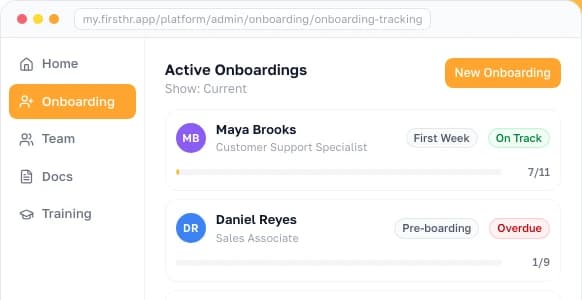
After You Hire: Onboarding a Busser
Busser onboarding has to be fast, because restaurant turnover means you will run the process again soon, and the slow part is the paperwork, not the interview.
The paperwork basics come first: the offer with the hourly rate and tip arrangement stated, the I-9 completed within three business days, tax forms, state new-hire reporting, and any required food handler card. Then a quick orientation on sanitation, service flow, and your point-of-sale (POS) or expo system gets the new busser onto the floor.
FirstHR fits this directly: e-signature for the offer letter, document management for food handler cards and certifications, training assignments with completion records for food-safety and service orientation, and an HR information system (HRIS) with employee profiles for your team. That setup helps when you rehire for the same role often.
Form I-9 and the W-4 go on the new hire's first-day list as tasks, and the completed forms are kept in their employee file; the forms themselves are completed outside the platform. Applicant tracking is coming soon to FirstHR; today the platform handles onboarding and document tracking once the candidate signs.

Frequently Asked Questions
What does a busser do?
A busser turns tables over and backs up the floor: wiping down, clearing, and resetting each table between parties, supporting the servers, topping off water and condiments, hauling dishes to the dish area, and keeping the service areas tidy and stocked. Bussers, sometimes called bus staff or dining room attendants, help the floor turn tables quickly and keep service flowing so guests have a smooth experience. The exact duties shift by venue: a fine-dining busser provides crumb service and handles stemware, a bar busser restocks glassware and supports bartenders, and a combined busser and food runner also delivers dishes from the kitchen. In every version it is a fast-paced, on-your-feet entry-level role and a common first job in restaurants.
Is a busser the same as a busboy?
Yes. The two words name one job, and busser is the gender-neutral version that has mostly taken the place of busboy. Federal occupational data counts both, together with related titles such as bus person and server assistant, in one category: dining room and cafeteria attendants and bartender helpers. For your job title and posting, busser is the current, more inclusive choice, and anyone who knows the older word will still recognize the role. Nothing about the work changes with the name: the person clears and resets tables, backs up the servers, and keeps the dining room tidy and stocked.
What is the difference between a busser, a server, and a food runner?
They are three separate front-of-house jobs. The busser handles table turnover and dining-room cleanliness, wiping down, clearing, and resetting tables between guests and backing up the servers. The server owns the guest relationship for a section: taking orders, bringing food and drinks, and handling payment. The food runner carries finished plates from the kitchen to the right tables and checks timing with the expo station and the cooks. Small restaurants often blend these jobs, and a combined busser and food runner position is a common result. Name the actual role in your posting so candidates know whether they will mainly turn tables, manage guests, or run food, because the skills and pay are different.
How much should I pay a busser?
Plan on an hourly wage plus tips; in most restaurants the tips come through a tip pool, so a busser's pay is the base rate and the pool share combined. For a national benchmark, the Bureau of Labor Statistics puts the May 2025 median for dining room and cafeteria attendants and bartender helpers, the federal occupation that covers bussers, at $16.34 an hour. Because the survey treats tips as part of wages, that median describes base pay and tips together rather than the base on its own. Real pay swings with your region, your type of venue, and local tipped-wage law. Choose an honest base rate, explain the tip arrangement in the posting, and confirm what your state requires for tipped and minimum wages. Spell out the likely total as well, because candidates weigh the whole package rather than the hourly base by itself.
Can a teenager work as a busser?
Yes. Bussing ranks among the most common first jobs for teenagers, but federal and state youth-labor rules decide when and how teens can work. Under the federal Fair Labor Standards Act (FLSA), 14 and 15 year olds may work in a restaurant outside school hours, capped at three hours on a school day, eighteen hours in a school week, eight hours on a non-school day, and forty hours in a non-school week. Their shifts have to fall between 7 a.m. and 7 p.m., and the evening cutoff moves to 9 p.m. from June 1 through Labor Day. Bussing tables is allowed at that age, but operating power-driven food slicers, grinders, processors, and mixers is not, and nobody under 18 may run a baler or compactor. Many states go further than the federal rules, and when a state rule is more protective, that is the one you follow. Since child-labor penalties are significant, start from a youth-labor-compliant job description and build the scheduling limits in from the first shift.
Do bussers get tips?
Yes. Bussers count as customarily and regularly tipped employees, and most of them receive their tips through a pool. Under federal rules, a traditional pool can include bussers alongside servers and bartenders. An employer that pays the full minimum wage and takes no tip credit may also bring back-of-house workers, such as cooks and dishwashers, into the pool. Owners and managers are the fixed exception: they can never take a share of employee tips. Because tip arrangements carry legal requirements, a busser job description should spell out the pay structure, meaning the hourly base plus the pool share, so the offer reads clearly and stays compliant. Being open about it also shows candidates what they can realistically earn.
What should a busser job description include?
A strong busser job description includes a clear job summary, key responsibilities, skills and qualifications, the physical requirements, and the pay structure including how tips work, all written for your specific venue. Because the role differs across casual, fine dining, bar, and catering settings, the most useful step is to match the posting to your restaurant type. State the real physical demands like standing for long shifts and lifting, since these are legitimate job requirements. Include the schedule, an honest hourly base with tip disclosure, and a simple way to apply. If you hire teens, add the youth-labor scheduling limits. The templates on this page are each written for a specific venue so the duties and requirements match the actual job.
What happens after I hire a busser?
Onboarding starts as soon as a candidate says yes, and in a restaurant it has to move quickly because turnover never lets up. Paperwork comes first: an offer letter that states the hourly rate and the tip arrangement, Form I-9 finished within three business days, the tax forms, your state's new-hire report, and a food handler card wherever one is required. Before the first shift, a short orientation should cover sanitation, how service flows, and your point-of-sale or expo system. FirstHR covers the steps once the offer is made: the offer letter is signed electronically, food handler cards and certifications live in document management, food-safety and service orientation can be assigned as training with completion records, and every hire gets an employee profile in the HRIS, which helps when you rehire for the same role often. The I-9 and W-4 show up as tasks on the new hire's first-day list, and once they are filled out elsewhere, the finished forms are stored with the employee record. Applicant tracking is coming soon to FirstHR; today the platform handles onboarding and document tracking once the candidate signs.
Make HR the easy part of running your business
Onboarding, e-signatures, training and core HR in one place. Up and running in 5 minutes.
- 7-day free trial
- No credit card required
- Cancel anytime