
Restaurant Hiring Tips for Independent Operators
Restaurant hiring tips for independent operators: where to find staff, how to run a paid trial shift, interview questions, and compliance.

Restaurant Hiring Tips
A practical guide for independent operators who are also the HR department
Most advice about restaurant hiring is written for someone who does not exist in your world. It assumes a recruiting coordinator, an applicant tracking system, a talent pipeline, and a corporate office that approves headcount. You have a walk-in that needs fixing, a line cook who just told you he is moving to Denver, and a Saturday coming.
The gap between that advice and your reality is not about scale. It is about who does the work. In a chain, hiring is somebody's job. In your restaurant it is the thing you do between the delivery and the dinner rush, which means the advice that matters is the advice that fits in the gaps of an already full day.
So this guide is written for that. Independent operator, one location or two, no HR department, and you are the owner, the general manager, and the person who has to complete the I-9. What follows is the practical version: where people actually come from, how to screen without wasting shifts, how to run a trial that tells you something, the compliance items that catch restaurants specifically, and how to keep the people you hire long enough to stop doing this every month. I built FirstHR for businesses in exactly this position.
Why This Is Genuinely Hard
It helps to know that the difficulty is structural rather than something you are doing wrong. Restaurants operate in the highest-churn labor market in the country, and no amount of good management makes that disappear entirely.
The demand side is also tight. According to the National Restaurant Association's 2026 State of the Restaurant Industry report, industry employment is projected to reach 15.8 million jobs, with operators forecast to add about 100,000 positions. Hiring on that scale is happening while operators report difficulty finding experienced managers and chefs specifically. You are competing for the same people as everyone else on your street.
What this adds up to: hiring is not an occasional interruption to running your restaurant. It is a recurring operational function, and treating it as one, with a repeatable process rather than an improvisation each time, is most of the advantage available to you.
What the Restaurant Labor Shortage Looks Like Now
The restaurant labor shortage has narrowed rather than ended. Applications for host, busser, and dishwasher roles generally arrive. What stays scarce is anyone with kitchen experience, anyone who can run a shift, and almost any role in a market where a new opening has just absorbed the available people.
Two forces keep it that way. The workforce skews young, and the National Restaurant Association points to the shrinking 16-to-24-year-old population as a long-term constraint on industry labor supply. The quit rate does the rest: you are rarely hiring for a role once, so a gap that looks small in any given month reopens two or three times a year.
For an independent operator, the useful read is that this is a planning problem before it is a pay problem. The restaurants that feel the shortage least are usually the ones hiring on a schedule and keeping a short list of people worth calling, not the ones paying the most per hour.
What Turnover Actually Costs You
Thousands of dollars per hourly departure, and most of it never appears as a line item. According to Gallup, the cost of replacing one employee runs from one-half to two times that person's annual pay, which Gallup itself calls a conservative estimate.
The closest hospitality-specific measurement is older and narrower. Cornell University's Center for Hospitality Research recorded an average of $5,864 per departure across a convenience sample of twelve hotel properties, in a 2006 study, with individual cases running from $2,604 to $14,019.
Neither figure is a current restaurant number, and no survey publishes one. What both agree on is the shape of the bill, which is the part that actually transfers to your operation.
| Where the money goes | Share of the total | What that looks like in a restaurant |
|---|---|---|
| Lost productivity | 52 percent | The last two weeks of someone who has already left in their head, the shifts you run short, and the months before the replacement works at full speed |
| Recruiting | 20 percent | Job postings, your own hours reading applications, phone screens, and the interviews nobody shows up for |
| Orientation and training | 14 percent | Trial shift wages, plus the hours your best server spends training instead of serving |
| Selection | 11 percent | Interviews, reference calls, and decision time that comes out of your own week rather than anyone else |
| Pre-departure | 3 percent | The notice period, the exit conversation, and the schedule you rebuild around the gap |
Those shares come from the Cornell study, and the top row is the one worth sitting with. More than half the cost is output you never got, which is exactly why the number stays invisible: nobody sends you an invoice for a section that ran slow for six weeks.
Four hourly departures in a year is unremarkable in this industry, and multiplied out it costs about what a decent piece of kitchen equipment costs. Spending two hours building a better hiring and onboarding process is one of the highest-return uses of time available to an independent operator, and it competes against nothing on your calendar because it never feels urgent.
Start Earlier Than Feels Necessary
The single most common structural mistake is reactive hiring: starting the search when someone gives notice. By then you are short-staffed for the entire duration of the process, which pushes you toward hiring whoever is available rather than whoever is good.
Count backward and the sixty-to-ninety-day window stops sounding excessive. Sourcing and posting takes two to three weeks to produce a real pool. Interviewing and trials take another one to two. Anyone currently employed owes their restaurant two weeks. Training before they are actually useful on a busy shift is at least another week. That is six to eight weeks minimum, and it assumes nothing goes wrong.
For seasonal operations this is the whole game. If your July is triple your March, you are hiring in May, and the operators who staff up comfortably are the ones who started before the people they wanted had already taken jobs elsewhere.
Writing a Job Post That Actually Works
Nearly every restaurant job post is the same document: a duties list, a line about being a team player, and a request for two years of experience. Candidates scrolling a job board see fifteen of these and cannot distinguish them, so they apply to all fifteen and take whoever calls first.
The way to stand out is not creative writing. It is answering the questions candidates actually have and that almost nobody addresses.
| What candidates want to know | What most posts say | What to say instead |
|---|---|---|
| What will I actually take home? | Competitive pay | Base rate plus a realistic tip range from your actual recent numbers, stated as a range |
| What is the schedule really like? | Flexible scheduling | How many shifts, which days, how far ahead the schedule posts, and how time-off requests work |
| What is it like to work here? | Fast-paced environment | How big the team is, how long people have stayed, who they would report to, whether the kitchen is calm or loud |
| Is there anywhere to go from here? | Growth opportunity | A specific example: our current kitchen manager started on the line two years ago |
| What do I get besides wages? | Nothing, usually | Shift meal, any paid time off, schedule stability, anything else real |
Two additional points. Post the pay range. In a growing number of states you are required to, and even where you are not, posts without pay get materially fewer applications because candidates assume the worst. And keep the requirements honest: asking for two years of experience for a busser eliminates good candidates for no reason and is one of the most common self-inflicted wounds in restaurant hiring.
Where to Actually Find People
Posting everywhere produces volume, and volume is a burden when you are screening between services. Pick two or three channels that work in your market and run them properly.
| Channel | Works best for | What to know |
|---|---|---|
| Referrals from current staff | Every role, especially back of house | Lower quit rates than comparable hires from other channels, and it costs nothing. Requires asking specifically and repeatedly rather than once |
| Job boards | Front of house and entry-level kitchen | High volume, variable quality. Pick the one restaurant workers in your market actually use rather than posting to all of them |
| Sign in the window | Front of house, dishwashers, bussers | Still works, particularly for people who live nearby. Costs nothing and reaches people who are not actively searching online |
| Culinary schools and programs | Line cooks, prep, junior kitchen roles | Requires building a relationship with one instructor, which takes one conversation and pays off for years |
| Your own social accounts | Front of house | Your regulars already follow you and some of them want a job or know someone who does |
| Other restaurants | Experienced staff across roles | Poaching is normal in this industry. Be decent about it, since the operator you take someone from will do the same to you |
For most independent restaurants, referrals plus one well-chosen board covers the large majority of hires. Culinary schools become worth the effort if you consistently need kitchen staff, and the relationship is easier to build than operators expect, because instructors want placements for their students.
One more channel worth naming: people who worked for you before. Rehires arrive knowing your menu, your systems, and your team, and the industry moves people around enough that a former server who left for a chain eighteen months ago may be very open to a call. Keep a short list.
Hiring Ideas That Reach People Who Are Not Job Hunting
Some of the best restaurant hires are not reading job boards at all, so the ideas that work are the ones that reach people where they already are. Put a line on the check presenter and the table tents saying you are hiring, with a number to text. Your regulars already like the place, and several of them know someone who would fit.
An open hiring afternoon is the other idea worth trying. Pick two slow hours, say in advance that anyone can walk in and talk, and decide the same day for the roles you can decide on. Tell your suppliers and the businesses on your block as well, since delivery drivers and neighboring owners hear who is unhappy long before you do.
What makes any of this work is being specific about what you are offering. Someone who was not looking will not dig for details, so the pay range, the shift pattern, the meal, and how quickly you decide belong in the first sentence you say to them, not in a follow-up conversation that never happens.
Referrals Are Your Best Channel
Referred hires quit less, and that is measured rather than folklore. Research published in The Quarterly Journal of Economics (2015), covering nine large firms across call centers, trucking, and technology, found referred workers 10 to 30 percent less likely to quit than comparable non-referred hires.
None of those are restaurants, and the mechanism is the part that transfers anyway. Your existing staff will not refer someone who will embarrass them, and the referred person arrives with a friend already inside, which is most of what makes a first week survivable in a kitchen.
What most operators get wrong is treating it as passive. Mentioning once at a pre-shift that you are hiring is not a referral program. What works is asking specific people specifically: you worked at that place on Fifth, is there anyone there who should be here instead. That question produces names. A general announcement produces nodding.
Make it worth their while with a bonus that pays out in two parts, some at hire and the rest at ninety days. Two-part payment aligns the referrer with the person actually working out, and it costs you nothing if the hire does not last. Even a modest amount signals that you mean it.
One caution the vendors selling referral software never mention. The EEOC warns in its guidance on race and color discrimination that word-of-mouth recruiting inside a workforce that is not diverse becomes a barrier to equal employment opportunity when it does not create applicant pools that reflect the diversity in the qualified labor market. Run referrals alongside one open channel, not instead of one.
Speed Beats Almost Everything Else
This is the highest-leverage change most independent operators can make, and it costs nothing.
A restaurant candidate applies to five or six places in an afternoon. Whoever responds first gets the interview, whoever interviews first makes the offer, and the offer gets accepted because the person needs a job now. This is not a story about candidates being impatient. It is a story about an applicant pool where everyone is hiring simultaneously.
Twenty-four hours is the outer edge. Same-day is better. A two-line text saying you got their application and asking when they can talk this week is enough; it does not have to be a considered response.
This is also where you beat the chain down the street. They have an applicant tracking system, a screening process, and a district manager who approves offers. You can decide in an afternoon. That structural advantage is one of the few places where being small is unambiguously better, and most independents waste it by taking four days to check the applications folder.
The Ten-Minute Phone Screen
Before booking a full interview or a trial shift, spend ten minutes on the phone. This step saves more time than any other and most independents skip it.
Five questions cover it. What is your availability, specifically which days and which shifts. How will you get here and how long does it take. What are you looking to earn. Why are you leaving your current place. When could you start. That is the whole screen, and it eliminates most mismatches before either of you spends real time.
The availability and transport questions do the heaviest lifting. A large share of early restaurant departures trace to a schedule that never actually worked for the person, agreed to in an interview because they wanted the job. Being blunt about it upfront is kinder to both of you. If they need to be home by nine and your closing shifts run to midnight, better to find out now.
Questions Worth Asking
Keep the interview short, twenty to thirty minutes, and ask about things that actually happened rather than hypotheticals. Hypothetical questions produce the answer the candidate thinks you want.
| Question | What you are testing | What a good answer sounds like |
|---|---|---|
| Tell me about the busiest shift you have worked. What happened? | Whether they have real volume experience and how they describe pressure | Specific detail about the night, what broke, and what they personally did. Not a general statement about being able to handle stress |
| Describe a time a guest was upset. What did you do? | Service instinct and whether they escalate appropriately | Owns the interaction, describes a specific fix, and knows when to get a manager rather than either always or never doing so |
| What did you like and not like about your last kitchen or floor? | Fit, and what conditions make them leave | Honest on both sides. Someone with nothing negative to say is managing you; someone with nothing positive is a pattern |
| What does a good manager do that a bad one does not? | What they need from you to stay | Concrete and specific. This answer tells you whether you can actually give them what they want |
| Walk me through your last week of shifts. | Actual availability and stamina, verified indirectly | Consistent with what they told you on the phone. Discrepancies here are worth exploring |
| What would make you stay somewhere three years? | Retention signal, and their real motivation | Something you can either provide or cannot. Either answer is useful, and vagueness usually means they have not thought past next month |
Keep questions job-related and away from family status, age, childcare, and anything beyond work authorization. In a small restaurant where interviews are conversational this drifts easily and without bad intent. Guidance for smaller employers is available through the EEOC small business resources, and the illegal interview questions guide covers the specifics.
Running a Paid Trial Shift
On the payment point, because it is where restaurants get into trouble: if the candidate is doing real work that benefits your restaurant, that is compensable time under wage and hour rules.
Under 29 U.S.C. 216(b) an unpaid claim carries the back wages, an equal amount again in liquidated damages, and the employee's reasonable attorney fee. The four hours of wages you would save are trivial against that, and paying also signals that you run a legitimate operation, which matters more in this market than operators realize.
The part that decides whether the trial was worth running is written down before and during it, not after. By the time service ends, nobody remembers whether the candidate asked for help at the right moment or just got lucky. Use the record below to set what you are testing, capture what the supervisor and the team actually saw, and hold yourself to the same-day answer.
The Hardest Roles to Fill
Not all restaurant hiring is equally hard, and knowing which roles need the longest runway lets you plan rather than react.
| Role | Difficulty | What actually helps |
|---|---|---|
| Line cook | Hardest hourly role in most markets | Culinary school relationships, promoting prep cooks internally, and a kitchen with a reputation for not being miserable |
| Kitchen manager or chef | Hardest overall | Long runway, personal networks, and promoting from within where possible. Expect this search to take months, not weeks |
| General manager | Very hard and very expensive to get wrong | Internal promotion beats external hiring in most independents, because knowing your operation matters more than generic management experience |
| Bartender | Hard in busy markets | Referrals from your current bar team. This role moves almost entirely through personal networks |
| Server | Moderate to fill, hard to retain | Hire for temperament and train the rest. Retention here depends on schedule and tips more than on hiring quality |
| Host, busser, dishwasher | Easiest to fill | Speed of response matters most. These candidates take the first offer, almost without exception |
The pattern: back of house is harder than front of house, and skill roles are harder than entry roles. This aligns with the National Restaurant Association's finding that operators expect the most difficulty with experienced managers and chefs specifically.
The practical response for kitchen roles is to build the pipeline internally. A prep cook you develop over eight months is cheaper and more reliable than a line cook you search for over eight weeks and lose to a competitor.
Making the Offer
Same day the trial ends, verbally, then in writing. Speed matters as much here as at the application stage, because a good candidate who impressed you probably impressed someone else this week too.
Put it in writing even if it feels formal for an hourly role. The written offer should state the position, the hourly rate, expected shifts per week and which ones, the start date, whether there is a review at ninety days, and any benefits including the shift meal. This takes five minutes and eliminates the most common category of early conflict, which is a disagreement about what was promised.
Ambiguity about schedule is the biggest culprit. Someone hears three or four shifts and expects four; you meant three. Three weeks later they are frustrated about hours and you have no idea why. Writing it down costs nothing and prevents that entirely.
The Compliance Checklist
The part most restaurant hiring guides skip, and the part that produces expensive surprises. Restaurants face a specific compliance profile: tipped wages, minors, high turnover generating high paperwork volume, and cash handling. None of it is complicated, but it is easy to defer when you are busy, and deferred paperwork is how it goes wrong.
Three of these are worth expanding because they are restaurant-specific and commonly missed.
Tip credit mechanics. If you take a tip credit, federal rules require advance notice to the employee, require that direct wages plus tips reach at least minimum wage in every workweek, and prohibit managers and supervisors from sharing in a tip pool. Department of Labor Fact Sheet 15 covers the requirements. Manager participation in tip pools in particular shows up repeatedly in enforcement actions.
Minors. Federal law sets no hour limits for 16- and 17-year-olds, but it bars them from power-driven slicers, grinders, and commercial mixers. For 14- and 15-year-olds it caps the hours too: 3 on a school day, 18 in a school week, and nothing after 7 p.m. outside the summer months.
The Department of Labor publishes restaurant-specific guidance in Fact Sheet 2A, including which cooking equipment a 15-year-old may and may not touch. State rules often go further. Penalties apply per violation, which is how a scheduling habit becomes an expensive problem.
I-9 timing. Section 2 is completed within three business days of the date employment begins, for every employee including rehires and seasonal staff, per the USCIS Handbook for Employers. A Monday start means a Thursday deadline. General restaurant wage and hour requirements are collected in Fact Sheet 2.
Scheduling rules deserve a mention too, with the coverage caveat most guides skip. Predictable scheduling laws exist in several cities and require advance notice plus penalty pay for late changes, but the restaurant thresholds sit far above an independent operation.
Chicago is the clearest example. Its Fair Workweek Ordinance covers a restaurant only at 250 or more employees and 30 or more locations globally, and then requires 14 days of notice. Worth confirming for your own city, but most independents are outside these rules rather than inside them.
The First Thirty Days
Hiring well and then onboarding badly wastes the hiring. Gallup puts it bluntly: about a third of all new employees do not last 90 days, which makes the first thirty the window where your hiring investment either pays off or evaporates.
Four things, none of which take long. Get the paperwork done before the first shift rather than during it, because a new hire filling out forms in the office during service starts their job feeling like an interruption. Assign one specific person as their point of contact, by name, since new restaurant employees who do not know who to ask simply stop asking. Check in briefly at day three, day fourteen, and day thirty, which takes five minutes each and catches problems while they are still fixable. And give them the schedule far enough ahead that they can plan around it.
Structured onboarding is what moves that 90-day number. Gallup finds employees are 3.4 times as likely to call their onboarding successful when the manager takes an active part in it, and in a restaurant the manager is usually you.
Keeping People Once You Have Them
The cheapest hire is the one you do not have to make. Three levers matter most in restaurants, and only one of them is money.
Schedule predictability. Posting schedules further ahead and changing them less has the best research behind it of the three, and it costs you planning discipline rather than dollars.
The Shift Project at the Harvard Kennedy School, working from panel data on 1,827 hourly retail and food service workers, found schedule instability to be a strong and robust predictor of turnover for the roughly one third of the sample working unstable schedules, with slightly less than half of that relationship running through job satisfaction. For someone arranging childcare, a second job, or classes, an unpredictable schedule is a reason to leave rather than an inconvenience.
The manager. People leave managers, and in a small restaurant the manager is often you or one other person. If a specific shift has disproportionate turnover, look at who runs it before concluding the applicants were weak.
Being noticed. Restaurant work is largely invisible when done well, and nobody comments on a smooth service. Specific, timely recognition costs nothing at all.
Gallup reports that only about one in three US workers strongly agree they received recognition for good work in the past seven days, and that employees who do not feel adequately recognized are twice as likely to say they will quit within the year. Not employee of the month. Telling someone at the end of a hard night that you saw what they did on table nine.
On benefits: as an independent you may not be able to offer health coverage, and every candidate you talk to knows that. A shift meal worth eating and a few paid days off are within reach, and in my experience they matter more to the person deciding than an extra quarter an hour does.
Common Mistakes
These recur across independent restaurants. Most are habits formed under pressure rather than decisions anyone made deliberately.
The one that costs the most is the first, because it makes every other mistake more likely. Hiring under pressure is how you skip the trial shift, ignore the reference, and talk yourself into someone you had doubts about. Everything else in this guide is easier if you start before you are desperate.
How FirstHR Fits
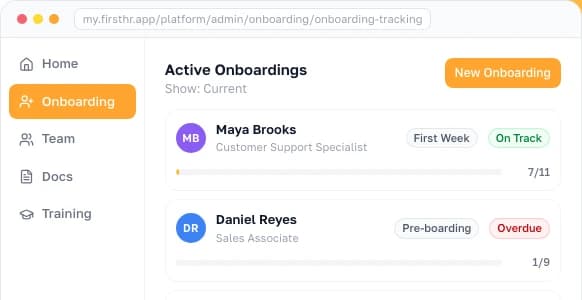
FirstHR handles the operational layer around this: employee records that stay organized as people cycle through, document management so I-9s and offer letters are retrievable rather than in a drawer, structured onboarding so every new server gets the same first week regardless of who is on shift, and job description templates so you are not rewriting the post each time. It is built for small businesses at flat-fee pricing rather than per-employee pricing, which matters in an industry with this much headcount churn.
What it does not do is find candidates or decide whether someone can handle a Friday rush. That is your judgment and the trial shift. What a system gives you is that the fourth line cook you hire this year goes through the same process as the first, at a point in the year when you have no attention left to improvise.
Frequently Asked Questions
How do I hire restaurant staff quickly?
Speed comes from removing steps rather than rushing the ones you keep. Respond to applicants within 24 hours, run a ten-minute phone screen instead of booking a full interview blind, combine the in-person interview with a paid trial shift on the same visit where practical, and make the offer the same day the trial ends. Restaurant candidates typically apply to several places at once and accept the first reasonable offer, so a process that takes a week loses to one that takes two days regardless of which restaurant is the better place to work.
What are the best ways to find restaurant employees?
Referrals from your existing staff cost nothing and produce hires who quit less, so ask specifically and repeatedly rather than once. Beyond that: job boards that restaurant workers actually use in your market, a sign in the window (still effective for front of house), local culinary programs for kitchen roles, and social media accounts your regulars already follow. For most independent restaurants, referrals plus one well-chosen job board covers the majority of hires. Posting everywhere produces volume rather than quality and creates a screening burden you do not have time for.
Should I do a trial shift when hiring restaurant staff?
Yes, and pay for it. A trial shift is the highest-signal screening tool in this industry because restaurant work is physical, fast, and social in ways an interview cannot test. What you learn in four hours on the floor exceeds what you learn in three interviews. The critical requirement is paying at least minimum wage for the hours worked. A person doing real work that benefits your restaurant is working, and an unpaid claim brings the back wages, an equal amount again in liquidated damages, and the employee’s attorney fee.
What should I ask in a restaurant interview?
Ask about specific past situations rather than hypotheticals. Useful questions: tell me about the busiest shift you have worked and what happened; describe a time a guest was angry and what you did; what did you like and dislike about your last kitchen; what does a good manager do differently from a bad one. Also ask directly about availability, transportation, and what they are looking for in a schedule, because mismatched expectations on hours cause more early departures in this industry than skill gaps do.
How much does restaurant employee turnover cost?
Thousands of dollars per hourly departure, though no survey publishes a current restaurant-specific number. Gallup estimates replacement at one-half to two times the person’s annual pay and calls that conservative. The nearest hospitality measurement, a 2006 Cornell Center for Hospitality Research study of twelve hotel properties, averaged $5,864 per departure within a range of $2,604 to $14,019. More useful than either figure is the shape of the bill: the Cornell data attributes 52 percent of it to lost productivity, meaning shifts that ran short and the weeks before a replacement works at full speed. That is why four departures in a year never appears as a line item anywhere.
Why is restaurant turnover so high?
Structural factors more than management failures, though management matters. The sector consistently posts the highest quit rate of any US industry: Bureau of Labor Statistics Job Openings and Labor Turnover data for July 2026 put accommodation and food services at 3.5 percent of employment quitting in that one month, where the private sector as a whole sat at 2.1 percent. The drivers are unpredictable schedules, physically demanding work, variable pay through tips, limited advancement in small operations, and a large share of workers treating the job as temporary. The operators who beat the industry average generally do it through schedule predictability and manager quality rather than pay alone.
What is the hardest restaurant position to fill?
Kitchen roles and management. According to the National Restaurant Association’s 2026 State of the Restaurant Industry report, operators expect to add about 100,000 jobs but report difficulty finding experienced managers and chefs. Line cooks are consistently among the hardest hourly roles because the skill takes time to build, the work is physically punishing, and the pool of trained candidates is smaller than the demand. Front-of-house roles are generally easier to fill but harder to retain.
How far in advance should I start hiring for a busy season?
Sixty to ninety days before you need people on the floor. That sounds excessive until you count backward: posting and sourcing takes two to three weeks, interviewing and trials another one to two, notice periods at their current job another two, and training before they are useful at least one more. Starting a month out means being understaffed through the first several weeks of your busy period, which is exactly when understaffing costs the most.
Should I hire experienced restaurant workers or train new people?
It depends on the role and on how much training capacity you actually have. Kitchen roles beyond entry level generally need experience because the skill curve is long. Front-of-house roles can often be trained if the person has the temperament, and hiring for attitude in these positions frequently produces better retention because you are not competing against every other restaurant for the same experienced servers. The honest test is whether you have someone who can genuinely train during service. If not, hire experience even at a higher rate.
How do I compete with chains for restaurant employees?
Not on hourly rate, generally. What an independent can offer that a chain structurally cannot: a schedule built around actual human requests, direct access to the owner, faster advancement because there is no corporate ladder, a shift meal worth eating, and a manager the person actually knows. None of those cost what a dollar an hour costs, and all of them are things a chain cannot replicate from a district office. Speed of hiring is also an advantage, since you can make an offer the same day while a chain routes it through an approval process.
Do I need to complete an I-9 for every restaurant employee?
Yes, for every employee hired in the United States, without exception. The form splits into two deadlines that restaurants routinely blur together. The employee completes Section 1 no later than their first day of work, and you complete Section 2 within three business days of the date employment begins, so a Monday start means a Thursday deadline. That second deadline is the one most often missed, because paperwork gets deferred to whenever a manager has a spare hour. The obligation applies to rehires, seasonal staff, part-time workers, and family members alike. Keeping completed forms somewhere retrievable matters as much as completing them, since the obligation includes being able to produce them on request.
Can I hire 16-year-olds in my restaurant?
Generally yes, and federal law puts no cap on the hours of a 16- or 17-year-old. What it does restrict at that age is the work itself: no operating, cleaning, or repairing power-driven meat slicers, grinders, or commercial mixers, and no driving as a regular part of the job. The rules tighten sharply below 16. A 14- or 15-year-old is capped at 3 hours on a school day and 18 hours in a school week, 8 and 40 when school is out, and may work only between 7 a.m. and 7 p.m., extended to 9 p.m. from June 1 through Labor Day. State rules frequently go further than federal ones, so check both before you build the schedule.
Make HR the easy part of running your business
Onboarding, e-signatures, training and core HR in one place. Up and running in 5 minutes.
- 7-day free trial
- No credit card required
- Cancel anytime