
Employer of Record Costa Rica: 6 Providers Compared
Hiring in Costa Rica through an employer of record: CCSS contributions, aguinaldo, severance, what a hire really costs, and six providers compared.

Employer of Record Costa Rica: 6 Providers Compared
What Costa Rican law imposes before any provider touches the hire, what a salary really costs once social contributions and the aguinaldo land, and six employer of record providers compared on published pricing
The first Costa Rican offer I helped put together had a clean monthly number and a footnote. The footnote turned out to be the whole story: thirteen salary payments a year rather than twelve, and a severance liability that starts building at the three-month mark whether or not anyone plans for it.
An employer of record solves the mechanics of that. The provider employs your hire through its own Costa Rican entity, enrolls them with the social security institute, runs local payroll in colones, and carries the employer obligations, while you keep the work, the salary decision, and the relationship.
What it does not do is change the arithmetic underneath. This guide covers what Costa Rican law imposes before any vendor is involved, what a hire costs on top of gross salary, and six providers compared on the prices they actually publish. Every legal and contribution figure below was checked against Costa Rican government sources in October 2026.
How an employer of record works in Costa Rica
An employer of record employs your Costa Rican hire through a local entity it already holds, so you can put someone on a compliant payroll without incorporating in Costa Rica. You choose the person and the pay; the provider signs the contract and takes on the employer obligations.
The Costa Rican mechanics run on a monthly rhythm that can trip up US employers used to twice-monthly cycles. The employer files a payroll return with the Caja Costarricense de Seguro Social, the social security institute everyone calls the Caja. The Caja publishes the filing window as running from the 26th of each month to the fourth working day of the next, with payment falling between the 16th and the 20th.
A missed filing costs money. The Caja adds a 2 percent surcharge on the health insurance contributions and another 2 percent on the pension contributions, charged against the employer registration, which under this arrangement is the provider’s rather than yours.
| Function | The provider | You |
|---|---|---|
| Employment contract | Drafts and signs it under the Costa Rican Labor Code | Agree on the role, the occupational category, and the salary |
| Social security enrollment | Registers the worker with the Caja before the first return | Return signed paperwork in time |
| Monthly payroll return | Files it, pays in colones, and remits the contributions | Fund each cycle |
| Workplace risk policy | Holds the mandatory cover with the national insurer | Describe the work honestly so the risk class is right |
| Statutory pay items | Aguinaldo, vacation, and public holiday pay | Decide anything above the minimum |
| Day-to-day management | Nothing | Objectives, direction, performance, and promotion |
| Termination | Executes it on Costa Rican notice and severance rules | Make the decision and give the provider warning |
The right-hand column is the part vendors underplay. A provider removes administration and legal exposure, not judgment. You still recruit, still decide, and still own whatever onboarding experience the person actually gets in their first month.
Minimum wage is set occupation by occupation
Costa Rica sets a separate minimum wage for each occupation rather than one national floor, and the entire list is reissued by executive decree every year. The floor that binds your hire depends on which occupational category the role falls into, not on what you call the job.
The Ministry of Labor publishes the private sector minimum wage list as a single document. The current list took effect on 1 January under decree 45303-MTSS, published in the official gazette on 5 December 2025. It carried a general increase of 1.63 percent, and a handful of categories, domestic work among them, received a further adjustment on top of that. The amounts below are in Costa Rican colones, written as CRC.
| Generic category | Monthly minimum | Typical roles named in the decree |
|---|---|---|
| Unskilled worker | CRC 373,092.30 | Messenger, general helper, warehouse hand |
| Semi-skilled worker | CRC 405,710.70 | Receptionist, telephonist, general office clerk |
| Skilled worker | CRC 419,755.80 | Cashier, sales agent, accounting assistant, secretary |
| Specialized worker | CRC 487,335.00 | Legal assistant, trainee teacher without qualification |
| Technical secondary credential | CRC 496,838.17 | Set by credential, for example a private accountant at that level |
| Next credential step up | CRC 585,484.58 | Set by credential, one rung above the technical secondary rate |
| Bachelor’s degree holder | CRC 664,078.07 | Set by credential, for graduate-level roles |
| Licentiate degree holder | CRC 796,921.00 | The highest generic category in the decree |
| Domestic work | CRC 268,731.31 | Set separately, with its own adjustment |
For most professional hires from a US company, the salary you intend to pay sits comfortably above every one of these figures, so checking the category takes ten minutes. The check still matters, because the category also drives the reference point for overtime, holiday pay, and the severance calculation later on.
Aguinaldo is a thirteenth salary, and it is statutory
Every Costa Rican employee earns an aguinaldo, a thirteenth month of pay that must reach them within the first twenty days of December. It is not a bonus, it is not discretionary, and no provider can structure it away.
The Ministry of Labor sets out the mechanics in its official guidance on the aguinaldo. The amount is one twelfth of all ordinary and extraordinary pay earned between 1 December of the previous year and 30 November of the current one, which means overtime, commissions, and shift premiums are all inside the calculation rather than outside it.
Three details matter for a US budget. Anyone with a single continuous month of service qualifies, including fixed-term and casual staff. Someone who leaves mid-year is paid the proportional amount at departure. And the ministry is explicit that nothing may be deducted from the aguinaldo except court-ordered family support, not even social contributions.
The practical consequence is simple arithmetic that plans get wrong anyway. A year budgeted at twelve monthly salaries understates the actual pay bill by 8.33 percent. A monthly figure quoted to a Costa Rican candidate is a thirteenth of their year, not a twelfth, so an annual number converted carelessly produces an awkward conversation in one direction or the other.
What a Costa Rican hire costs on top of gross
Mandatory employer contributions add about 27 percent to gross pay, and they arrive on a single monthly return rather than as one payroll tax. Health insurance and the pension fund are the two largest lines, and a set of smaller institutional levies makes up the rest.
| Employer contribution | Rate on gross pay | What it funds |
|---|---|---|
| Health and maternity insurance | 9.25% | The public health system that treats your employee |
| Pension fund (IVM) | 5.75% from 2029 (5.58% through 2028) | The state pension scheme, itemized separately from health cover |
| Other public institutions | 7.25% | Workers’ bank 0.25%, family allowances 5.00%, social assistance 0.50%, training institute 1.50% |
| Worker Protection Law items | 4.75% | Workers’ bank 0.25%, labor capitalization fund 1.50%, complementary pension 2.00%, insurance line 1.00% |
| Total employer load | 27.00% from 2029 (26.83% through 2028) | Before the provider fee and before any currency markup |
| Employee side, for reference | 11.00% from 2029 (10.83% through 2028) | Deducted from gross rather than added to your budget |
Put numbers on it. A salary of CRC 1,500,000 a month is CRC 18,000,000 across twelve months, plus an aguinaldo worth one more month, so CRC 19,500,000 of annual pay.
Employer contributions at 26.83 percent, the rate through 2028, apply to the twelve monthly salaries and add about CRC 4,830,000. That takes the employment cost to roughly CRC 24,330,000 a year, before the workplace risk policy and before the provider charges anything.
A $599 monthly platform fee then adds $7,188 a year, billed in dollars against a payroll denominated in colones, so currency conversion can add a cost on top of that. Comparing providers on the headline fee alone misleads badly, because the fee is a small fraction of the story and the true cost of employing someone is set by Costa Rican law long before you pick a vendor.
Leave, hours, and public holidays
Costa Rican statutory minimums are two weeks of paid vacation for every fifty weeks of continuous service, nine public holidays carrying mandatory pay, and ordinary hours capped at eight in a day and 48 in a week. None of that is negotiable downward, and a provider cannot soften it.
The vacation rule surprises people twice. Two weeks is the floor, which is lower than a European entitlement and closer to a US one, but it accrues against fifty weeks of service rather than a calendar year. If the contract ends before those fifty weeks are complete, the worker is owed at least one day of vacation for each month worked, paid out at departure.
| Term | Costa Rican position | What a US employer usually expects |
|---|---|---|
| Paid vacation | 2 weeks per 50 weeks of continuous service | 10 to 15 days of paid time off |
| Vacation on early exit | At least 1 day per month worked, paid out | Whatever the policy says, if anything |
| Ordinary day | 8 hours daytime, 6 hours at night, 7 hours mixed | 8 hours |
| Ordinary week | 48 hours | 40 hours |
| Paid public holidays | 9 days with mandatory pay | 6 to 11 days, by policy |
| Recognized holidays without mandatory pay | 3 further days on the calendar | No equivalent |
| Dismissal without cause | Allowed, but carries notice and severance | At-will in almost every state |
The nine paid holidays are 1 January, 11 April, Maundy Thursday, Good Friday, 1 May, 25 July, 15 August, 15 September, and 25 December. Three more days are recognized holidays (2 August, 31 August, and 1 December), but the Labor Code does not make paying for them compulsory.
The ministry guidance for 2026 adds a wrinkle that matters here: where pay is monthly, every day of the month is already paid for, so all twelve holidays are paid in practice. The paid-or-unpaid distinction therefore bites on weekly pay rather than on the salaried hire a provider is most likely to put on your payroll.
Working hours deserve one more look than they usually get. The ordinary week is 48 hours, longer than the US norm. For work that is neither unhealthy nor dangerous, the daytime ceiling can stretch to ten hours a day, but only if the week still stays inside 48. A US schedule copied across without checking can quietly breach that limit.
Notice and severance are calculated, not negotiated
Notice and severance in Costa Rica are formulas set by length of service, and severance peaks at 22 days of pay for every year worked. Both are laid out in the Labor Code published by the Ministry of Labor, in articles 28 and 29 respectively.
| Continuous service | Severance owed | Notice owed |
|---|---|---|
| Under 3 months | None | None |
| 3 to 6 months | 7 days of pay | 1 week |
| Over 6 months to 1 year | 14 days of pay | 15 days |
| Year 1 | 19.5 days per year worked | 1 month |
| Year 2 | 20 days per year worked | 1 month |
| Year 3 | 20.5 days per year worked | 1 month |
| Year 4 | 21 days per year worked | 1 month |
| Year 5 | 21.24 days per year worked | 1 month |
| Year 6 | 21.5 days per year worked | 1 month |
| Years 7 to 9 | 22 days per year worked | 1 month |
| Years 10 to 12 | 21.5, then 21, then 20.5 days | 1 month |
| Year 13 and later | 20 days per year worked | 1 month |
Two rules cap the exposure. No award may cover more than the last eight years of the relationship, however long the person has been with you, and the daily rate used in the calculation is the average of the last six months of pay rather than the current salary. That second rule quietly matters if you raise someone shortly before an exit.
The three-month line is the one to plan around. Below it there is no severance and no notice, so in practice it works as a probationary window, even though the Labor Code sets no general probationary period outside domestic work.
Above the three-month line the cost is arithmetic, so an exit becomes a scheduled expense you can price in advance rather than the same-day decision a US founder is used to. Notice can be paid rather than served, which is usually what happens, and it sits on top of severance rather than replacing it.
Severance is owed when the exit is the employer's decision or the employee resigns for a cause attributable to the employer. A straightforward resignation carries no severance, though accrued vacation and the proportional aguinaldo are still payable. If you are used to the US position where severance pay is a negotiated courtesy, treat the Costa Rican version as an accrued liability on the balance sheet instead.
Employer of record providers for Costa Rica compared
Six providers, compared on the fees they publish rather than the fees a salesperson mentions. All six publish a rate for employment, which is unusual in this category, though three of them publish a floor rather than a fixed number.
| Provider | Published employment fee | Contractor fee | Notes |
|---|---|---|---|
| Deel | $599 per employee monthly | $49 per contractor monthly | Publishes its rate; separate US professional employer organization (PEO) product at $125 per employee monthly |
| Remote | $599 on annual billing, $699 month to month | $29 per contractor monthly | Publishes a Costa Rica country guide and a payroll product at $29 |
| Papaya Global | From $499 per employee monthly | From $5 per contractor monthly | Lowest published employment fee among the full platforms here |
| Oyster | $699 per employee monthly | Free for 30 days, then $29 per contractor monthly | HR expert access included; project-based HR advisory at $300 an hour |
| Atlas HXM | From $599 per employee monthly | $199 per contractor monthly, as agent of record | States that it employs through its own entities rather than partners |
| RemoFirst | From $199 per employee monthly | Free, or $25 on the premium tier | Lowest published fee in this group |
Two patterns show up immediately. The published band is wide, running from $199 to $699 per employee monthly, which is a spread of $6,000 a year on a single Costa Rican hire. And the more useful differentiator here is not price at all but whether the provider will tell you, in writing, which entity employs your hire and which occupational category it will apply to the contract.
The six providers reviewed
Deel publishes its employment rate at $599 per employee monthly, and for a US company making a first Costa Rican hire the practical draw is that contractor management and employment sit in one account.
A common setup of two contractors in Colombia or Mexico and one employee in San José does not need two vendors. Moving someone from the contractor side to the employment side is then a change of product rather than a change of supplier.
What to press on is Costa Rica specifically. Neither the pricing page nor the Costa Rica hiring page names the entity that will employ your hire, and that entity is the one accountable when a payroll return is late or an occupational category is challenged. Ask for the Costa Rican contract template as well, and read the intellectual property clause, because your hire contracts with the provider rather than with you.
Remote publishes a Costa Rica country guide that covers the payroll cycle, the aguinaldo deadline of 20 December, and the public holiday calendar, and states that the company owns its own legal entity in Costa Rica. That guide makes Remote the easiest provider in this group to audit before you talk to anyone. Reading a vendor guide against the Ministry of Labor list is a twenty-minute exercise that tells you a great deal about how carefully a provider maintains its country content.
The trade is price, unless you commit for a year. Month to month, Remote charges $699 per employee, tied for the highest published fee here and roughly $1,200 a year more than the $599 tier on one Costa Rican employee. Annual billing brings it down to $599, level with Deel.
Remote also publishes a separate payroll product at $29 per employee monthly for companies that already hold a local entity, which is the product you move to if you eventually incorporate in Costa Rica.
Papaya Global publishes an employment rate starting at $499 per employee monthly, which undercuts every other full platform in this group. It was founded in 2016 to put finance, HR, payroll, and payments on one platform.
Papaya also maintains a Costa Rica entry in its public country reference, and its employment plan lists automated statutory payments. That matters more in Costa Rica than in most markets, because the employer load is not one number: health insurance, the pension fund, four institutional levies, and four separate Worker Protection Law lines make ten components, all settled on the same monthly return.
The caveat is the word in front of the price: a starting rate is not a Costa Rica quote, and its reporting depth earns its keep only when there is something to report on.
Atlas HXM describes its own model as direct rather than partner-routed. If that claim holds for Costa Rica, it buys something specific. Someone has to file the monthly return, choose the occupational category, and defend it if the classification is questioned, and a single named entity shortens that chain of accountability considerably. Treat the claim as a vendor statement to be confirmed in the contract rather than as a fact.
Its Costa Rica guide is one of the more detailed in this group, covering working hours, a two-year public holiday calendar, and the work permit process for foreign nationals, which is worth reading if your hire is not a Costa Rican national. The published rate is a starting point, and volume pricing for larger teams is a quote conversation.
Oyster publishes a rate, charges contractors $29 after a free first 30 days, and states that setup, onboarding, talking to its HR experts, and processing terminations are all included in the fee. That suits a founder who wants one Costa Rican employee and no standing relationship to manage. Account sign-up is free, and fees start only once someone is engaged.
The hourly advisory rate marks where the included service stops. Project-based HR advisory, the hands-on help a complicated case needs, runs at $300 an hour, so if you expect to lean on the provider through a difficult exit, price that in.
Oyster also markets misclassification protection through its paid Oyster Shell add-on. The protection is capped at $500,000 in aggregate, meaning across all claims combined, and it sits with the contractor product rather than with employment. That is the vendor's own description of the cover and worth reading in the policy rather than the brochure.
RemoFirst publishes the lowest fee in this group by a wide margin, starting at $199 per employee monthly, and states that no setup, onboarding, or termination fees apply. On one Costa Rican hire that gap is roughly $4,800 a year against the $599 tier and $6,000 against the $699 tier, which is real money at small headcount.
Two things to check before the number decides it. RemoFirst says openly that it works through in-country partners rather than owned entities, which lengthens the accountability chain, and it confirms that the fee can vary by country, so ask for the Costa Rican figure in writing. A low headline fee paired with a large deposit or a partner markup is not a low-cost arrangement.
A provider or your own Costa Rican company
Use a provider while your Costa Rican headcount is small, and model your own company once it is not. The provider fee scales with every head you add, while most of the cost of running a company does not, and the crossover usually arrives sooner than founders expect.
| Route | What it takes to start | What it costs to run | When it wins |
|---|---|---|---|
| Employer of record | A contract and a deposit; the provider already holds the entity | $199 to $699 published per employee monthly, plus the Costa Rican employer load | One to a handful of people in Costa Rica |
| Your own Costa Rican company | Incorporation, registration as an employer with the Caja, and a workplace risk policy | Monthly payroll returns, local accounting, corporate filings, and tax on profit | Sustained headcount in Costa Rica |
| Independent contractors | A contract, if the relationship is genuinely independent | Contractor management fees from free to $49 per person monthly | Genuinely project-based work only |
The contractor row deserves a warning rather than a recommendation. Engaging someone in Costa Rica as a contractor while directing their hours and methods is the fastest route to a misclassification finding, and the consequences are concrete: back contributions to the Caja, plus the severance and aguinaldo the person would have accrued as an employee. The product you buy does not decide the classification; the relationship does.
On the entity side, the obligations are the part to weigh rather than the incorporation itself. Registering as an employer, filing a monthly return, holding the mandatory workplace risk cover, and keeping local books are ongoing commitments that need someone to own them. One question to raise with your tax adviser separately: whether the way your Costa Rican hire works could create a taxable presence for your US company, regardless of who employs them.
What to ask before you sign
Before you choose
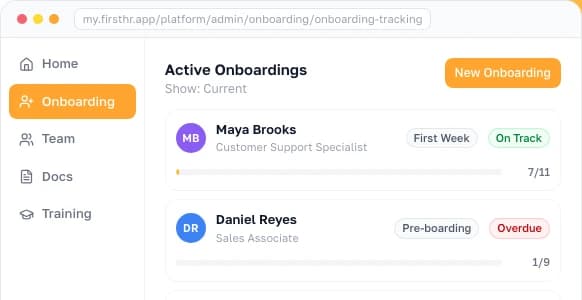
FirstHR covers the part of a Costa Rican hire that stays with you whichever provider employs the person: the onboarding, the signed documents, the training, and the records. FirstHR is an onboarding and HR platform, not a payroll provider, so the Costa Rican contract, the payroll in colones, and the employer obligations come from the providers above.
The provider decision and the HR decision are separate, and people conflate them. Several providers here include onboarding support and HR tools for the people they employ, so a separate layer earns its place when you want the first-week experience and the training your role requires to work the same way for everyone.
It also gives your employee records one home across your whole team.
That layer stays yours whichever route you take, and it is what we built FirstHR for: onboarding with e-signature, document management, training with completion tracking, and an employee record that holds together for a small business without a dedicated HR person, at a flat $98 a month for up to 10 people or $198 for 11 to 50.
Frequently Asked Questions
What is an employer of record in Costa Rica?
The party named as employer on the contract, the payslip, and the social security record, while the person works for you in every practical sense. It signs the Costa Rican contract, enrolls the worker with the Caja, files the monthly return, buys the mandatory workplace risk cover, and carries the legal exposure that a US company with no Costa Rican presence cannot carry itself.
How much does an employer of record cost in Costa Rica?
Published fees among the six providers here run from $199 to $699 per employee monthly, with three of them quoting from a floor rather than a fixed rate. Add the Costa Rican employer load of about 27 percent on gross, the thirteenth salary payment, a workplace risk premium priced by occupation, and any currency conversion cost, since the fee is billed in dollars against a payroll in colones.
What is the minimum wage in Costa Rica?
There is no single national figure to look up. The ministry decree in force from 1 January sets a minimum for each occupation, with monthly generic categories running from CRC 373,092.30 for unskilled work to CRC 796,921.00 at licentiate level, domestic work at CRC 268,731.31, and many occupations quoted per working day instead of per month.
What is aguinaldo in Costa Rica?
The thirteenth salary payment Costa Rican law requires, settled in the first twenty days of December and equal to a twelfth of everything earned from 1 December to 30 November. One continuous month of service qualifies, someone leaving mid-year takes the proportional share, and nothing may be deducted from it except court-ordered family support.
What are employer social security contributions in Costa Rica?
Employers pay 27.00 percent of gross from January 2029 (26.83 percent through December 2028), split across health and maternity insurance at 9.25 percent, the pension fund at 5.75 percent (5.58 percent through 2028), institutional levies of 7.25 percent, and Worker Protection Law items of 4.75 percent. Employees carry 11.00 percent of their own gross from 2029 (10.83 percent through 2028). The pension line totals 12.16 percent across employer, worker, and the state from 2029 (11.66 percent through 2028).
How much severance do I owe an employee in Costa Rica?
Nothing at all below three months, then a ladder that runs seven days of pay to six months, fourteen days to a year, and 19.5 days rising to a peak of 22 days for every year worked. The award covers at most the last eight years of service, and the daily rate is the average of the last six months rather than the current salary.
How much vacation and how many public holidays do employees in Costa Rica get?
The statutory floor is two weeks of paid vacation per fifty weeks of continuous service, with at least one day per month worked paid out if the contract ends earlier. Nine public holidays carry mandatory pay, three more are recognized without a pay obligation, and ordinary hours are capped at eight a day and 48 a week.
Should I use an employer of record or set up a Costa Rican company?
A provider first, and a company once the provider fees across your Costa Rican team cost more than running one. Your own entity means incorporation, registration as an employer, a workplace risk policy, monthly returns, local accounting, and the ongoing administration that comes with all of it, against a provider fee that grows with every person you add.
Make HR the easy part of running your business
Onboarding, e-signatures, training and core HR in one place. Up and running in 5 minutes.
- 7-day free trial
- No credit card required
- Cancel anytime