
Free Shipping and Receiving Job Description Templates
Free shipping and receiving job description templates: clerk, associate, coordinator, specialist, supervisor, and manager. Download as DOCX.

Shipping and Receiving Job Description Templates
6 free templates: clerk, associate, coordinator, specialist, supervisor, and manager. Download as DOCX or copy-paste.
The shipping and receiving job description is usually written by the person who least has time for it: the owner or operations manager of a small warehouse, distributor, or e-commerce fulfillment operation, hiring the one person whose counts the whole company will believe. The templates online treat the role as interchangeable boilerplate, a single generic block with a company-name placeholder, and treat the hiring company as if it had a recruiting department to fill in the rest. Meanwhile the real decisions go unaddressed: which of six distinct levels you are actually hiring, what the forklift rules legally require of you as the employer, and why accuracy, not warehouse tenure, is the competency that decides whether your inventory numbers mean anything.
At FirstHR, we build for small teams that hire without an HR department, and this page is built the same way: the complete role set in one place, clerk, associate, coordinator, specialist, supervisor, and manager, each written for an operation where the person posting the job is also the person who will onboard the hire. Fill in the brackets, pick the honest level, and post.
What Does a Shipping and Receiving Clerk Do?
A shipping and receiving clerk verifies and maintains the records on everything entering and leaving an operation: receiving and inspecting inbound freight against the paperwork, preparing and documenting outbound shipments, and keeping the inventory transactions that the rest of the company plans against. The federal occupational profile for shipping, receiving, and inventory clerks counts roughly 844,000 of them nationwide, and the O*NET profile puts the typical entry at a high school diploma or GED with on-the-job training ranging from a few days to about a year, which is exactly why the posting should gate on accuracy and reliability rather than credentials.
For the employer writing the posting, the first decision is the level, because the keyword covers a six-rung ladder: the associate doing the physical work, the clerk owning the paperwork, the coordinator owning the carrier schedule, the specialist owning regulated or specification-driven freight, and the supervisor and manager owning the team and the department. Small operations blur these in practice; the posting should not, and the six templates on this page are split exactly along those lines.
Shipping and Receiving Duties and Responsibilities
Shipping and receiving duties and responsibilities center on receiving and inspection, outbound shipping and freight documentation, inventory record-keeping, and the safety and equipment work the dock runs on. The level shifts the weights, an associate is heavy on the physical work, a coordinator on carriers and communication, but the four categories hold across the ladder. These are the responsibilities grouped the way the templates use them.
A strong posting picks 8 to 12 duties from these categories and grounds them in your operation: the WMS or ERP by name, the carrier mix, the dock schedule, the cycle count program. Candidates who have done the work read postings for those specifics, because they reveal whether the operation records reality or improvises it.
Clerk to Manager: Which Level Are You Hiring?
One keyword, six jobs. The scope, the pay structure, and the classification question all change as you climb, so place the role honestly before you pick a template.
| Level | Owns | Key additions | Typical structure |
|---|---|---|---|
| Associate | The physical work | Unloading, packing, scanning; trained from zero | Hourly, entry rate |
| Clerk | The paperwork and accuracy | Receiving verification, BOLs, inventory transactions | Hourly, core rate |
| Coordinator | The carrier schedule | Parcel/LTL booking, claims, cross-department communication | Hourly, above clerk |
| Specialist | Spec-driven freight | Regulated documentation, ERP discipline, stop authority | Hourly, above clerk |
| Supervisor | The dock team | Assignments, training sign-offs, safety calendar, KPIs | Hourly working lead, usually |
| Manager | The department | Budget, carrier negotiation, hiring, reporting | Salaried, exempt after analysis |
The classification line runs through the top two rungs: working supervisors usually remain hourly non-exempt, and the manager title earns exempt status only if the duties genuinely do.
Which Template Should You Use?
Pick the template by level; the systems, schedule, and pay go in the fields. All six share the same skeleton, operation context, four-category duties, accuracy-centered requirements, forklift certification as provided, honest physical demands, published pay, but the scope and the applicants differ enough that the matched version always reads more credibly to people who have worked a dock. Use this guide to choose.
6 Free Shipping and Receiving Job Description Templates
Download all six as separate Word files in one ZIP, or copy individual templates. Each follows the same structure: operation context with the systems named, duties across receiving, shipping, inventory, and safety, the education line stated plainly, forklift certification as company-provided, the schedule with peak expectations, and pay published. Fill in the brackets before you post.
Template 1: Shipping and Receiving Clerk
The core version: receiving verification, outbound documentation, inventory accuracy, and the dock paperwork the operation runs on.
Template 2: Shipping and Receiving Associate (Entry-Level)
The training version: unloading, packing, and scanning, honest physical requirements, paid equipment certification, and a clear path to clerk.
Template 3: Shipping and Receiving Coordinator
The scheduling version: carrier booking, bills of lading and claims, and the cross-department communication the dock depends on.
Template 4: Shipping and Receiving Specialist
The precision version: specification-driven shipping, ERP discipline, regulated documentation where applicable, and the authority to stop a bad shipment.
Template 5: Shipping and Receiving Supervisor
The leadership version: daily assignments, training sign-offs, ownership of the forklift certification calendar, and the dock KPIs.
Template 6: Shipping and Receiving Manager
The department version: the team, the budget, carrier negotiations, inventory control, and accountability for cost and accuracy.
Shipping and Receiving Requirements and Skills to Include
Shipping and receiving requirements should gate on the things that cannot be trained quickly, accuracy, documentation discipline, reliability, and the stated physical demands, while listing systems and equipment as trained, because the WMS, the scanners, and the forklift are all taught on the job. The SHRM job description tools describe a good job description as a plain-language summary of a position's tasks, duties, and responsibilities, and for dock work, plain language means stating the demands and the deal as facts. The difference shows in how the bullets are written.
| Weak requirement | Strong requirement |
|---|---|
| Detail-oriented | Records counts exactly as received and documents discrepancies the same day |
| Warehouse experience required | Shipping, receiving, or inventory experience preferred; we train our systems and workflows |
| Forklift certification required | Forklift certification provided and paid by the company within ____ days, per OSHA requirements |
| Physically fit | Able to lift up to ____ pounds and stand, bend, and move through a full shift |
| Computer skills | Comfortable with scanners and [WMS / ERP used]; spreadsheet basics for counts and logs |
Keep the formal gate at the high school diploma or GED the occupation standardly requires plus the physical demands stated honestly, and keep every line job-related and neutral: the EEOC rules on job advertisements prohibit postings that express preferences based on protected characteristics, and the lifting and schedule demands of dock work belong in the posting written as the job's demands, stated identically to every applicant.
How to Write a Shipping and Receiving Job Description
A strong shipping and receiving posting takes about twenty minutes once you settle the level, the systems, and the forklift line. Here is the process the templates are built around.
Shipping and Receiving Salary
Federal data benchmarks the work at two zoom levels: the broader clerk group and the specific occupation, with market rates clustering around the high teens to about twenty dollars an hour for the core clerk role. Anchor on the data, then price the level you are actually staffing.
The specific shipping, receiving, and inventory clerk occupation has run a few thousand dollars below that group median in recent detailed federal estimates, which matches what the market posts hourly. Within the band, the ladder sets the structure: associates start at the bottom, clerks sit near the occupation median, coordinators and specialists price above it for the carrier and documentation scope, and supervisors and managers move into salaried territory, commonly in the sixty-thousands and up by market and department size. The honest read on the decline projection: automation is shrinking the occupation slowly, but a hundred thousand replacement openings a year means a small operation still competes for reliable people against every warehouse in its labor market, and the posting that publishes its rate, its schedule, and its paid certification wins that comparison more often than the one that hides them.
Forklift Certification, Safety, and Classification
Three compliance lines belong in or behind every shipping and receiving posting. First, the forklift rules, which most postings get backwards: under the federal OSHA powered industrial truck requirements, the employer must ensure each operator completes the employer's own training and evaluation before operating independently, and the standard itself requires the employer to certify that training, with the operator's name, the training and evaluation dates, and the trainer's identity, and to re-evaluate each operator at least once every three years. A card from a prior employer does not transfer the duty, which is why the templates post certification as provided rather than required, and why the records and the three-year calendar need an owner from the first hire.
Second, the physical demands: dock work has real lifting, standing, and repetition requirements, and the legally sound posting states them as the job's demands, identically to every applicant, rather than describing the kind of person wanted. Third, classification: associate through specialist roles are hourly non-exempt, working supervisors usually stay non-exempt despite the title, and the manager role earns exempt status only on a genuine duties analysis, with overtime during peak season handled correctly either way. Operations that put these three lines in writing before the first hire spend their inspection conversations pointing at files instead of reconstructing memory.
Hiring Shipping and Receiving for a Small Warehouse
Distribution centers hire dock workers by the dozen with inventory control departments behind them. A small warehouse, distributor, or fulfillment operation hires one or two people and hands them the company's relationship with physical reality, usually with the owner or ops manager doing the hiring between everything else. Here is how to write the posting for that reality.
After You Hire: Onboarding a Shipping and Receiving Clerk
Shipping and receiving onboarding is a documents-and-certifications chain, and at a small operation it belongs to whoever made the hire. The paperwork track is standard, the offer in writing, the I-9 with documents verified, the W-4 and state tax forms, and state new hire reporting per the new hire paperwork guide, with one addition this role specifically rewards: a signed acknowledgment of the job description itself, so the duties, physical requirements, and safety expectations are agreed in writing on day one. Then the certification track: safety orientation before the first solo shift, forklift training and evaluation per the OSHA requirements with the certification documented and the three-year re-evaluation calendared, and the systems ramp, receiving workflows, shipping documentation, the WMS or ERP, with supervised transactions before independent ones, because early inventory errors compound quietly for months.
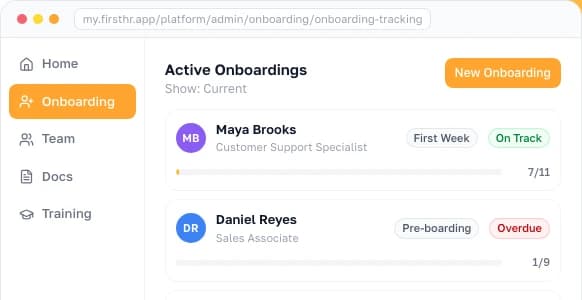
The documents around the hire follow the usual sequence: the offer letter template for the acceptance step, the employee onboarding template for the first weeks, the training plan template for the safety, equipment, and systems ramp with due dates, and the employee handbook template for the policies, attendance, safety, overtime, in writing. FirstHR connects all of it, the offer and the signed job description acknowledgment by e-signature, certification records with their dates, training assignments with completion tracking, and the onboarding checklist, in one place built for small operations without an HR department.
Frequently Asked Questions
What does a shipping and receiving clerk do?
A shipping and receiving clerk verifies and maintains the records on everything that enters and leaves an operation. On the receiving side, that means unloading inbound shipments, counting and inspecting them against packing slips and purchase orders, documenting shortages and damage the same day, and entering items into the inventory system. On the shipping side, it means picking and packing outbound orders, generating labels, packing slips, and bills of lading, verifying counts and weights, and meeting carrier pickups. Around both runs the documentation and inventory work: shipping and receiving logs, cycle count support, and discrepancy investigation. Federal occupational data counts roughly 844,000 shipping, receiving, and inventory clerks nationwide, typically entering with a high school diploma or GED and on-the-job training that ranges from a few days to about a year. At a small operation, this role effectively is the inventory system: what the clerk records is what the company believes it owns.
What are shipping and receiving duties and responsibilities?
Shipping and receiving duties fall into four areas. Receiving and inspection: unloading inbound freight, counting and inspecting against packing slips and purchase orders, documenting shortages, overages, and damage the same day, and receiving items into the WMS or ERP. Shipping and freight: picking, packing, and labeling outbound orders, generating packing slips and bills of lading, verifying counts and weights, and scheduling and meeting carrier pickups across parcel and LTL. Inventory and documentation: keeping shipping and receiving logs complete and same-day, supporting cycle counts, investigating discrepancies to root cause, and retaining shipping documents per policy. Safety and equipment: operating pallet jacks and forklifts once company-certified, keeping the dock and staging areas clean and clear, and reporting hazards immediately. Coordinator roles add carrier scheduling and cross-department communication; supervisor and manager roles add team leadership, training ownership, KPIs, and budget. A strong posting picks 8 to 12 duties matched to the actual level.
What is the difference between a shipping and receiving clerk, associate, coordinator, and specialist?
The ladder runs on scope. An associate is the entry-level rung: unloading, packing, scanning, and moving freight, with the systems and equipment trained on the job and no experience required. A clerk owns the paperwork layer on top of the physical work: receiving verification, outbound documentation, inventory transactions, and discrepancy investigation, and is the core role most operations mean by the keyword. A coordinator moves from the freight to the schedule: booking carriers across parcel and LTL, managing bills of lading and freight claims, and coordinating priorities across sales, purchasing, and production. A specialist handles the shipments that cannot go wrong: specification-driven, regulated, or high-value freight with exact documentation requirements, sometimes including hazmat or customs paperwork, plus the authority to stop a non-conforming shipment. Above them sit the supervisor, a working lead who runs the dock team and owns the safety and training calendar, and the manager, who owns the department, budget, and carrier relationships. Post the level the real task list matches.
What should a shipping and receiving job description include?
A complete shipping and receiving job description includes the operation context stated concretely, what you ship and receive, the dock setup, the team size, and the systems by name, since WMS and ERP familiarity is what experienced candidates scan for. Then the duties across receiving and inspection, shipping and freight, inventory and documentation, and safety and equipment, the level decided honestly against the clerk-to-manager ladder, requirements centered on accuracy and reliability rather than an experience checklist, the education line stated plainly, a high school diploma or GED is the standard entry per federal occupational data, with training on the job, the physical demands as facts, lifting requirements and a full shift on foot, forklift certification positioned as provided by the company per OSHA rules rather than required at the door, the schedule including peak-season expectations, the pay range, and an equal opportunity statement. At a small operation, add one honest line about scope, because the role usually touches more than the title says.
What skills does a shipping and receiving clerk need?
The skills that matter divide into trainable and not. Trainable, and therefore not worth gating the posting on: your specific WMS or ERP, RF scanners and barcode workflows, your carrier processes and label systems, and forklift operation, which the employer must train and certify under OSHA rules regardless of prior experience. Worth hiring for directly: counting accuracy and the habit of recording exactly what arrived rather than what the paperwork expected, same-day documentation discipline, the judgment to flag a discrepancy instead of absorbing it, physical capability for the stated lifting and standing demands, and reliability, because freight arrives on the carrier's schedule, not the employee's. For coordinator and specialist levels, add freight documentation literacy, bills of lading, claims, and where applicable hazmat or customs paperwork, plus communication that keeps sales, purchasing, and the dock working from the same facts. The education baseline is a high school diploma or GED, with on-the-job training covering the rest, per the federal occupational profile.
How much does a shipping and receiving clerk make?
Federal data benchmarks the work two ways. The broader material recording clerks group, which includes shipping, receiving, and inventory clerks, had a median annual wage of $46,120 as of May 2024, with the lowest ten percent under $34,270 and the highest above $71,520. The specific shipping, receiving, and inventory clerk occupation, roughly 844,000 jobs, has run a few thousand dollars below the group median in recent detailed federal estimates, with market aggregators commonly showing hourly rates in the high teens to around twenty dollars. Within that band, the levers are level and complexity: associates start at the bottom, clerks sit near the occupation median, coordinators and specialists price above it for the documentation and carrier scope, and supervisors and managers move into salaried ranges, commonly in the sixty-thousands and up depending on market and department size. Worth knowing as an employer: the occupation is projected to decline as automation spreads, yet replacement demand still generates over a hundred thousand openings a year across the group, so hiring competition for reliable people remains real.
Is forklift certification required to hire someone, and who provides it?
You provide it, and that is the law rather than a courtesy. Under the federal OSHA powered industrial truck standard, the employer must ensure each operator is competent through the successful completion of the employer's own training and evaluation before operating independently, must certify that training with the operator's name, the training and evaluation dates, and the identity of the trainer or evaluator, and must evaluate each operator's performance at least once every three years. A card from a previous employer or a third-party course does not discharge the duty, because the training has to cover your equipment, your loads, and your workplace conditions. The practical consequences for hiring: do not require forklift certification in the posting, since it shrinks the applicant pool for something you must redo anyway; instead, offer certification provided and paid within the first weeks, which widens the pool and signals a well-run operation; and treat the certification records and the three-year re-evaluation calendar as permanent files with an owner, because they are exactly what an inspection or injury claim examines first.
What happens after I hire a shipping and receiving clerk?
The standard paperwork comes first: the offer in writing, the I-9 with documents verified, the W-4 and state tax forms, and state new hire reporting. Then the role's specific ramp, which runs on documents and certifications. Have the new hire sign an acknowledgment of the job description itself, so the duties, physical requirements, and safety expectations are agreed in writing rather than assumed. Run safety orientation before the first solo shift: dock procedures, equipment rules, incident reporting. Schedule forklift training and evaluation per the OSHA requirements, document the certification with names and dates, and put the three-year re-evaluation on a calendar that outlives memory. Train the systems, receiving workflows, shipping documentation, the WMS or ERP, with supervised transactions before independent ones, because early inventory errors compound quietly. FirstHR handles the chain end to end for small operations: the offer and the signed job description acknowledgment by e-signature, document storage for certifications with their dates, training assignments with completion records, and the onboarding checklist in one place, built for teams without an HR department.
Make HR the easy part of running your business
Onboarding, e-signatures, training and core HR in one place. Up and running in 5 minutes.
- 7-day free trial
- No credit card required
- Cancel anytime