
Management Meeting: Agenda, Cadence, and Who Attends
How to run a management meeting at a small business: who belongs in the room, how often to meet, a 60-minute agenda, and a decision log that holds.

Management Meeting
Who belongs in the room, how often to meet, and a 60-minute agenda that ends in decisions instead of updates
The first management meeting I ran had six people in it, lasted 90 minutes, and produced nothing. Everyone gave an update. I nodded. We reached the one item that actually needed a decision with four minutes left, and agreed to pick it up the following week. We picked it up the following week too, and the week after that. That decision took five weeks and roughly six hours of collective attention to make, and it would have taken 15 minutes if we had put it first.
Almost every guide to this meeting is written for a company where leadership is a separate layer of the org chart. There is a chief of staff to assemble the agenda, a board pack to feed, and a quarterly offsite the meeting rolls up into. If you are the owner and your management team is three people who also do the work, that advice is describing a different job at a different scale.
The version that works at your size is shorter, smaller, and far more focused on decisions than on reporting. This guide covers what a management meeting is, how it differs from a leadership meeting and a manager meeting, who belongs in the room, how often to hold it, a 60-minute agenda, the decision log that makes it stick, what to keep off the agenda, and where these meetings usually fail.
Giving a small management team one shared view of onboarding, employee records, and open tasks is part of why I built FirstHR.
The Short Answer
A management meeting is the recurring session where everyone who runs part of the business meets to make the decisions that cross more than one team. At a small company it runs weekly or biweekly for 30 to 60 minutes, includes only people who own a team, a function, or a budget, and works through numbers, blockers, decisions, and people in that order.
The difference between one that works and one that fades out by month three is not the agenda template. It is whether decisions actually get made and written down before anyone leaves the room.
What a Management Meeting Is
The definition is not controversial. What varies wildly across the advice online is the assumed size of the company, and that assumption changes everything about the format.
Two properties define it, and neither is about seniority. Everyone in the room owns something: a team, a function, a budget, or a number. And the meeting decides rather than reports, which is the property most management meetings quietly lose somewhere in their second month.
That reporting drift is worth naming early, because it is what makes people privately resent the meeting. Once each person's slot becomes an update, the session turns into a status broadcast delivered in the most expensive format available, which is everybody in one room at the same time.
Anything that could be written down should be written down, and the time you free goes to the two or three items that actually need the group.
Management Meeting vs Leadership Meeting vs Manager Meeting
At a small business, a management meeting and a leadership meeting are the same meeting under two names. A manager meeting is the ambiguous one, because people use that phrase for both the meeting of all the managers and the private meeting between a manager and one employee.
Where a real distinction exists, it is in larger organizations that can fill two rooms: a leadership meeting for strategy and a wider management meeting for operations. At 30 people you are not running two formats. You are running one, and the useful question is not what to call it but which items belong in it.
| The item | Where it belongs | Why |
|---|---|---|
| A number moved and nobody can explain why | Management meeting | It affects planning across teams, and the explanation usually sits with more than one person |
| A decision two teams have been trading emails about | Management meeting | This is the item the meeting exists for, and it is the one most often cut for time |
| One person’s workload, growth, or morale | A one-on-one | It is individual, and a group setting changes what that person is willing to say |
| Coordination inside a single function | That team’s own meeting | Nobody else in the room can act on it, and half of them cannot follow the detail |
| A change the whole company needs to hear | The all-hands | Telling managers first is fine. Telling only managers is how a rumor starts |
The routing rule is simple: if an item concerns one team and one team only, it belongs in that team's meeting, and anything about one individual belongs in a one-on-one. Company-wide news gets repeated in the all-hands rather than left to travel by word of mouth.
Who Belongs in the Room
Everyone who owns a function, a budget, or a team belongs in the management meeting, and nobody else does. That rule applies even to people who are senior, long-tenured, excellent at the work, or simply interested. Attendance is a job description, not a status.
| Company size | Who is usually in the room | What tends to go wrong |
|---|---|---|
| Under 10 people | The owner plus whoever runs the largest share of the work, often 2 or 3 people in total | Holding a formal meeting for something a 15 minute conversation already covers |
| 10 to 25 people | The owner plus each team lead, typically 3 to 5 people | Inviting the person who is best at the work rather than the person who runs the team |
| 25 to 50 people | The owner plus function owners for sales, delivery, finance, and people, typically 5 to 7 | The room grows by one person every time somebody feels left out |
| Any size, guest slot | One person invited for a single agenda item, present for that item only | Guests who stay for the whole hour and become permanent members by default |
The guest slot is the release valve that keeps the core room small. Take the guest's item first, get the decision, and let them go. It also does something useful for the guest, because sitting in one management meeting teaches a future team lead more about how decisions get made than any amount of management training.
The hardest invitation to decline is the long-tenured employee who is not a manager and expects to be there. The honest answer is that the meeting is about running teams, and they do not currently run one.
You would rather explain the difference between a supervisor and a manager than let the room double in size. Saying it once is uncomfortable. Letting it slide is uncomfortable every week.
How Often to Hold It, and How Long
Weekly at 45 to 60 minutes is right for most small businesses with more than one team lead. Biweekly works when there are only two or three of you and you already speak every day.
Put it early in the week rather than late. A Monday or Tuesday slot means decisions have four working days to turn into action, while a Friday slot produces decisions that sit untouched over the weekend and get re-litigated on Monday because everyone half-remembers them.
The transition that catches founders off guard happens somewhere around 12 to 15 people. Below it, coordination happens by proximity and a standing meeting can be overhead. Above it, two team leads start making incompatible plans without either of them noticing, and the failure is invisible until something breaks in a handoff.
What the Meeting Costs You
Nobody prices this meeting. Doing the arithmetic takes about a minute, and it changes how seriously you treat the preparation. The wider trend comes first, then the sum for a six-person team.
Two conclusions come out of the arithmetic. The meeting is not free, which is the argument for keeping the room small and preparing properly instead of improvising. And it is cheap relative to a single bad cross-team decision, which is the argument against canceling it because the week is busy.
If you cannot fill the decision block two weeks running, that is real information rather than a failure. Shorten the meeting, or move to biweekly. Stretching thin content across a booked hour is the most reliable way to teach a management team that this hour does not matter.
A 60-Minute Agenda That Ends in Decisions
Five blocks, in a fixed order, every week. The order is the part that does the work, because whatever sits late in the hour is what gets squeezed when an earlier item runs long.
Numbers go first because they are the fastest block and they frame everything after them. Decisions sit in the middle, at the point where the room is warmed up and still fresh. People go near the end because that block expands to fill whatever time it is given, and putting it earlier reliably eats the decision block.
The pre-read discipline is what makes 55 minutes enough. Send the numbers and the framed decision items the day before, and open the meeting by asking whether anyone has not read them. If two people have not, run the meeting anyway and note it, because reading the material aloud to rescue the unprepared teaches everyone that the pre-read is optional.
The run sheet below is those five blocks as a page somebody fills in, one copy per meeting, with the open commitments from last week sitting at the top where they are hardest to skip.
Fill in the run sheet the day before rather than the hour before. The line that trips up most owners is the last one in the decisions block, where you name anything deliberately carried to next week and why. An item carried without a stated reason is an item that will be carried again.
What Does Not Belong on the Agenda
An item earns a place in the management meeting when it needs a group decision and affects more than one team. Everything else has a cheaper home, and the discipline of routing items out is what keeps the hour worth attending.
The fourth item in the second column is the corrosive one. Bringing a settled decision and framing it as a question wastes the room's time and, worse, teaches people that preparation is pointless.
People notice the first time it happens, mention it to each other the second time, and stop preparing by the third. If a decision is made, present it as made and use the time to explain the reasoning instead.
Individual performance is the other frequent trespasser. A group discussion about the output of one person almost always produces a worse outcome than a direct conversation would, and it puts their manager in the position of defending them in public.
Route that discussion to a one-on-one instead. If the situation is difficult, handle it through the process for a difficult employee conversation rather than by committee.
The Decision Log
A management meeting is worth exactly as much as its decision log: one place where every decision, its owner, and its due date are written down, and which gets read at the start of the next meeting. Without it, the meeting produces agreement rather than action.
What the log holds is the permanent part: the decision, the reasoning, and where it was written up, which belongs in whatever shared record your team already keeps. The sheet below is the other half, and it is built for one job only. It holds the commitments this meeting has made that have not landed yet, tagged with the agenda block they came out of, so the three minutes you spend reading them at the top of next week's meeting hit exactly the right rows.
| A | B | C | D | E | F | G | H | |
|---|---|---|---|---|---|---|---|---|
| 1 | Meeting it came from | Agenda block | What was committed | Owner, one name | Due before which meeting | Times carried | Read back on | Carry, clear, or close |
| 2 | Example, 3 weeks ago | Decisions | Move the second interview to a 45 minute panel | Ops lead | Next week's meeting | 0 | Carry | |
| 3 | Example, 3 weeks ago | Blockers | Get the warehouse lead the forecast she has asked for twice | Owner | This week's meeting | 2 | Clear it in the room | |
| 4 | Example, last week | People | Name an owner for the new starter's first day | Delivery lead | This week's meeting | 1 | Carry | |
| 5 | ||||||||
| 6 | ||||||||
| 7 | ||||||||
| 8 | ||||||||
| 9 | ||||||||
| 10 | ||||||||
| 11 | ||||||||
| 12 | Note | These rows are the three minute read-back at the top of the meeting, taken before the numbers | ||||||
| 13 | Note | Due dates are meetings, not calendar dates, because this sheet is read once a week and nowhere else |
Two columns do most of the work. Due dates are written as meetings rather than calendar dates, because a sheet that is only ever opened during this hour should be read in the units this hour runs on.
The carry count is the single number worth watching. An item on its third carry is not merely late, it is blocked or quietly unwanted, and the meeting should either clear the block in the room or close the row rather than move it a fourth time.
The owner column holds one name and never a team, because a commitment owned by two people is owned by neither and will still be open in three weeks.
Read the open rows out loud to start the meeting. Three minutes at the top of the hour, every week, does more for follow-through than any amount of encouragement, because an overdue commitment becomes visible to the whole room rather than only to the person avoiding it.
Running Your First One
The first meeting sets the format for the next hundred, so decide what it is before you send the invite. A company that has never held one will read a new recurring meeting as a signal that something has happened.
The People Block
Ten minutes of every management meeting should go to people: open roles, who is starting, who is leaving, who needs cover, and who is struggling. It is the block small companies cut first, and its absence surfaces months later as a hiring scramble or a resignation nobody saw coming.
Keep the block concrete. Every open role gets a stage and a next action, every person starting in the next two weeks gets a named owner for their first day, and every departure gets a handover list. Vague reports of how things are going belong in a one-on-one, not here.
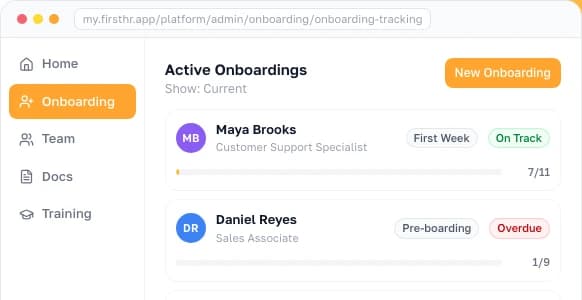
The part that repays the effort most is onboarding visibility. When every manager can see where each new hire actually is in their first weeks, checking on the new person stops being a memory test and becomes a two minute review of what is done and what is next. That shared view of onboarding is precisely what I built FirstHR around.
One boundary worth holding: the people block covers capacity, cover, and process, not verdicts on individuals. The moment a name is discussed rather than a role, move it out of the room and into the manager's next private conversation.
Remote and Hybrid Management Meetings
A distributed management meeting needs more structure than an in-person one, not less, because the informal repair that happens in a room after a meeting does not happen on a video call. The agenda and the decision log carry weight that body language used to carry.
| Setup | What works | What to avoid |
|---|---|---|
| Fully remote | One screen each, the decision log open and shared on screen while it is filled in | Filling the log afterwards from memory, which quietly rewrites what was agreed |
| Hybrid | Everyone joins individually, including the people sitting 20 feet apart in the office | A conference room plus two faces on a laptop, which turns remote managers into spectators |
| Across time zones | A fixed slot that is inconvenient for everyone equally, rotated only if it is genuinely unworkable | A slot that is always early for the same person, which is a resentment with a schedule |
| Shift-based operations | A short written summary posted the same day for managers who could not attend live | Assuming a manager on nights heard the decision because it was made in the meeting |
The hybrid row is where most companies go wrong. A room full of people with two colleagues on a screen at the end of the table is not a hybrid meeting. It is an in-person meeting with observers, and the observers tend to stop contributing within a few sessions. If anyone is remote, everyone joins from their own screen.
Keep the shared log on screen while you fill it in. It is the single highest-value habit for a remote management team, because it makes disagreement about what was decided visible immediately rather than a week later.
Where Management Meetings Go Wrong
Six patterns account for nearly every management meeting that people dread, and the first two are responsible for most of them.
Cancellation is the failure worth guarding hardest, because it feels entirely reasonable every single time it happens. There is always a reason this particular week is unusually busy. But a weekly meeting held 30 times a year is a meeting people stop planning around, and the second cancellation costs far more than the first.
The quieter failure is the meeting that is fine. It runs on time, everyone attends, nothing goes wrong, and nothing gets decided. If you cannot name two decisions the meeting made in the last month, the format has drifted back into reporting, and the fix is the same prompt every time: ask each person what decision they need from the group this week.
Frequently Asked Questions
What is a management meeting?
A management meeting is a standing session where the owner and everyone who runs a team, a function, or a budget settle the questions that no single team can settle alone. At a small business the agenda runs in five blocks: a short look at the few numbers everyone watches, the blockers that individual managers cannot clear on their own, the two or three decisions that need a call, the people items covering hiring, new starts, departures, and anyone who needs cover, and a five minute close that repeats every decision back with an owner and a date. What sets it apart from the other meetings on the calendar is that it makes decisions instead of reporting on them.
What is the difference between a management meeting and a leadership meeting?
At a small business there is no practical difference. The two names refer to the same recurring session for the people who run parts of the company, so the choice comes down to tone. Management meeting is the plainer name and tells everyone who belongs in the room. Leadership meeting signals seniority, which fits a company with an executive layer and can come across as exclusive at 15 people. In a larger organization the two can be separate meetings, one on strategy and a wider one on operations, but that only works when there are enough managers to fill two rooms. Choose one name, use it on every invite, and do not rename the meeting.
What is a manager meeting?
The phrase covers two different meetings, which is why it causes so much confusion on a calendar. Sometimes it means the meeting of all the managers, which is simply another name for the management meeting. Other times it means a conversation between one manager and one of their direct reports, which is a one-on-one and follows completely different rules: it is private, it is about the individual rather than the business, and it runs every week or two for about 30 minutes. Name the meeting precisely when you schedule it. An invite titled manager meeting that goes to five people who each expected a private conversation is a small disaster that takes a week to unwind.
Who should attend a management meeting?
Everyone who owns a team, a function, or a budget, and nobody else. Under 10 people that is usually the owner plus two others. Between 10 and 25 people, add each team lead, which puts three to five people in the room. Between 25 and 50 people, bring in the heads of sales, delivery, finance, and people, for five to seven. Paul Axtell, a corporate trainer quoted in SHRM guidance on meetings, advises keeping any meeting below eight participants if it is meant to be productive. Small management meetings drift past that number because declining an invitation feels unkind in the moment. A guest slot solves it: invite someone for a single agenda item, take that item first, and let them leave.
How often should you hold a management meeting?
For most companies with more than one team lead, a weekly meeting of 45 to 60 minutes is the right rhythm. Under 10 people, biweekly for 30 minutes is usually enough: you already speak daily, so the meeting exists mainly to force the decisions that daily talk keeps putting off. Between 25 and 50 people, a full hour every week is normal because functions have formed and work stalls in the handoffs between them. During a crunch period, add a short midweek check instead of stretching the main meeting, since a session twice as long does not produce twice as much. Consistency matters more than frequency. A weekly slot that survives busy weeks beats a longer meeting that gets canceled twice a quarter.
What should be on a management meeting agenda?
Five standing blocks in a fixed order. First come the numbers, about 10 minutes, circulated in advance so the room only discusses what moved. Blockers and risks follow, one sentence each, because a surprising number clear immediately once the person who can remove them hears about it. Decisions come third, as the largest block at about 20 minutes, with each item owned by someone who framed the options beforehand. People take the fourth slot, about 10 minutes, for open roles, starts, departures, and cover. A five minute close finishes the hour: each decision is repeated back together with its owner and its date. The blocks add up to 55 minutes, so a booked hour still leaves a few minutes in reserve for whichever item overruns.
How long should a management meeting be?
Plan on 45 to 60 minutes for most small businesses, and 30 minutes if there are only two or three of you. The instinct to book 90 minutes usually comes from having too many agenda items rather than from any of them being complex, and a longer meeting absorbs the extra items without ever making the choice to cut them. If the agenda will not fit, the fix is to move readable material into writing and route single-team items to that team, not to extend the block. One thing worth protecting: end on time even when the last item is unresolved. Deciding to carry an item to next week is itself a decision, and it should be logged like any other.
How do you make a management meeting productive?
Three changes do most of the work. First, send the numbers in advance and refuse to read them aloud, which gives back about 10 minutes a week that would otherwise go on a document everyone could have read alone. Second, require every decision item to arrive with framed options and a recommendation from a named owner, so the meeting chooses rather than starts thinking. Third, keep a decision log and review it at the top of the next meeting, because trainer Paul Axtell, cited by SHRM, estimates that most groups finish only 50 to 60 percent of their action items on time. A fourth change is cultural rather than procedural: never bring a decision you have already made and present it as an open discussion. People notice the first time, and stop preparing by the third.
Make HR the easy part of running your business
Onboarding, e-signatures, training and core HR in one place. Up and running in 5 minutes.
- 7-day free trial
- No credit card required
- Cancel anytime