
Pro Rata Calculator for Prorated Salary
Work out prorated pay for a partial pay period by every common method side by side, a part-time or part-year salary, or any pro rata share. Free, no sign-up.
Prorate
Prorated pay
Enter the yearly salary and the pay period's dates.
General information, not legal, tax or HR advice. See our Terms.
Starting a new hire mid-month?
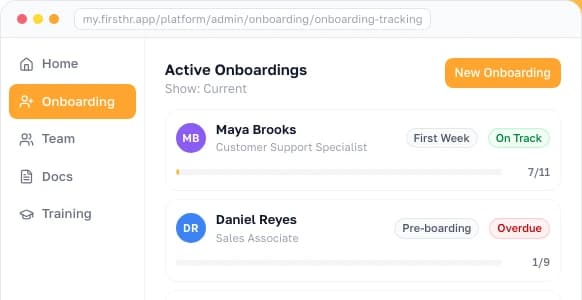
See who is on track and who is stuck
Active Onboardings lists every new hire in progress. Late items are marked, so you see them without messaging anyone.


Prorated pay, worked out
| Case | Calculation | Result |
|---|---|---|
| Starts Nov 16, $60,000 paid monthly, by workdays | $5,000 ÷ 21 workdays × 11 | $2,619.05 |
| Same, by calendar days | $5,000 ÷ 30 days × 15 | $2,500.00 |
| Same, yearly ÷ 260 workdays | 11 workdays × $230.77 | $2,538.46 |
| Same, deducting the days missed | $5,000 less 10 workdays × $230.77 | $2,692.31 |
| 30 hours of a 40-hour week, $60,000 full-time | $60,000 × 30 ÷ 40 | $45,000.00 a year |
| Annual bonus for 3 of 12 months | $1,200 × 3 ÷ 12 | $300.00 |
Proration is arithmetic: pick the method your policy states and use it for everyone.
Frequently asked questions
A calculator that shares an amount in proportion to the time it covers. This pro rata calculator prorates a salary, a bonus or any other amount for the days or months that apply: it is the pro rate calculator people look for when a hire starts or leaves mid-period.
Divide the pay for the period by the days in it, then multiply by the days worked. $5,000 for November has 21 workdays; someone who starts November 16 works 11 of them and earns $5,000 ÷ 21 × 11 = $2,619.05.
Any of them, as long as your policy says which and you apply it the same way to everyone. The period's own workdays or days always pay a whole period in full; a fixed daily rate (yearly ÷ 260 workdays or ÷ 365 days, or a 30-day month) is worth the same in every period. For the November 16 start the methods give $2,465.75 to $2,692.31; the calculator shows them side by side.
Most often the yearly salary ÷ 260 workdays (52 weeks of 5 days), the weekly salary ÷ 5: $60,000 is $230.77 a day. Other policies use ÷ 365 calendar days ($164.38), the monthly salary ÷ 30 ($166.67) or the period's own workdays (November 2026 has 21: $238.10).
With the period's own days both give the same pay. With a fixed rate they differ: for the November 16 start at $60,000 ÷ 260, paying the 11 workdays worked is $2,538.46, and deducting the 10 missed from $5,000 is $2,692.31. Either works if the policy says which.
In proportion. A pro rata share is the whole amount times the part that applies, divided by the whole: a $1,200 annual bonus for 3 of 12 months is $300.
Multiply the full-time salary by the share of full-time hours worked: 30 hours of a 40-hour week is 75%, so a $60,000 full-time salary becomes $45,000.
For the first and last week of employment, yes: the employer may pay a proportionate part of the full salary for the time actually worked (29 CFR 541.602(b)(6)). In any other week with work in it, only full days off come out of the salary, for personal reasons other than sickness or disability, or for sickness or disability under a bona fide plan, policy or practice; unpaid FMLA leave may come out even for part of a day.
Related calculators
- Payroll CalculatorTake-home pay and the employer's cost of a paycheck in any state: the 2026 federal W-4 math, FICA caps, state withholding and unemployment.Calculate a paycheck
- PTO CalculatorPTO accrual per paycheck or per hour worked, the balance on any date, carryover and caps, and each state's paid sick leave floor.Calculate PTO
- FTE CalculatorFull-time equivalents at your own full-time week, the IRS count for the ACA's 50 month by month, the tax credit FTE, and an FTE chart.Count FTE
Make HR the easy part of running your business
Onboarding, e-signatures, training and core HR in one place. Sign-up takes a couple of minutes.
- 7-day free trial
- No credit card required
- Nothing to cancel
4.7 on G2300+ companies trust FirstHR