Six new hire employee information form templates for small business: a standard one-page record, a version with payroll and tax setup, a quick intake sheet, a remote and multi-state form, an information change form, and a contractor and vendor form. Identity, address, position, direct deposit, and emergency contact fields in every relevant one. Editable DOCX, export to PDF in one step. No signup.
My first hire gave me his home address three times in one week. Once on the offer letter, once on a form I emailed him at midnight, and once on the back of a receipt when I admitted I had lost the other two. He was gracious about it. I was not proud of it, and by the third hire I had a single sheet that asked for everything once.
That sheet is what this page is. A new hire employee information form is the one document every other system gets populated from: payroll, the emergency contact list, the org chart, the badge, the laptop shipment. Fill it in before the first day and the first week runs quietly. Skip it and you spend that week sending small, slightly embarrassing questions to somebody who has not started yet.
There are six versions here, because a salaried office hire, a remote employee two states away, and a contractor on an eight-week engagement do not need the same sheet. Each downloads as an editable Word document, free, with no email required.
TL;DR
A new hire employee information form collects an employee's legal name, home address, date of birth, Social Security number, contact details, position data, and emergency contacts on one signed sheet before the first day. Download six free DOCX versions below, export to PDF from Word, and file the completed form in the personnel record.
What This Form Is
A new hire employee information form is a single sheet a new employee completes so the company holds one accurate copy of their details. It covers identity, contact information, the position, and emergency contacts, and it ends with a dated signature confirming the details are correct.
It is an internal record rather than a government form, which is why no two employers write it the same way. That freedom is the point. You decide what belongs on it, and the sensible answer is everything you would otherwise ask for one question at a time over the first two weeks.
It sits alongside the required forms rather than replacing them. The W-4, the I-9, and your state withholding certificate are still separate documents with their own rules, and they appear as a checklist on the standard template so nothing quietly goes missing from the new hire paperwork stack.
One Sheet Does Not Mean One File
Collecting everything on one page is efficient. Storing everything in one folder is not. The Social Security number and bank details need tighter access than a phone number, Form I-9 is kept as its own file so an inspection can be answered without opening the personnel record, and anything medical an employee volunteers belongs in a separate confidential file. Gather once, then split the sections when you file them. The company-use block at the bottom of each template exists to record where each part went.
Which Version Should You Use?
Match the form to the person and the moment. A regular hire gets the standard version. Someone starting before the packet is ready gets the quick sheet. The other four cover the situations that break a one-size form: payroll setup in the same sitting, a remote or out-of-state hire, a change to details already on file, and a contractor who is not an employee at all.
Standard Employee Form
The default
The full one-page record for a regular hire: legal name, address, date of birth, Social Security number, position details, emergency contacts, and a paperwork checklist. Use this one unless a situation below fits better.
With Payroll and Tax Setup
One sheet, first check ready
Adds pay rate, classification, work state and residence state, a compact direct deposit block, and a benefits eligibility date. Built for the owner who runs onboarding and payroll setup in the same sitting.
Quick Intake Sheet
One page, signed on arrival
A short version for the day somebody starts before the packet is ready. Identity, contact, one job line, two emergency contacts, and a tracked list of what is still owed with due dates on it.
Remote and Multi-State
When the address is the point
For anyone working from home or from another state. Adds the remote work address, residence versus work state, expected travel days, equipment shipping, and a short home workspace attestation.
Information Change Form
Keeps the record honest
The version most template sets forget. A single form for a legal name change, a move, new contact details, new emergency contacts, or a new bank account, with an effective date and a verification line.
Contractor and Vendor
Not an employee record
For a freelancer or vendor: entity type, taxpayer ID, a Form W-9 prompt, engagement scope and rate, insurance, and a line stating the form does not create an employment relationship.
When in Doubt, Start With the Standard Form
If nothing above obviously fits, use the standard employee form. It carries every field a small business actually needs, and the paperwork checklist at the bottom keeps the W-4, the I-9, and the direct deposit authorization visible instead of forgotten. Add the payroll version when you are setting up pay in the same sitting, and keep the change form somewhere your team can find it, because that is the one you will reach for every few months for the rest of the company's life.
6 Free New Hire Employee Information Form Templates
Download all six as one bundle, or take the individual versions you need. Every file is an editable Word document, so you can drop in your company name, delete a section you do not want, and print or send it as it is. There is no email gate and no signup on any of them.
Download All 6 New Hire Employee Information Form Templates
Standard employee form, payroll and tax setup, quick intake sheet, remote and multi-state, information change form, and contractor and vendor form. All as editable DOCX files in one download.
Template 1: New Hire Employee Information Form (Standard)
The default. Identity, contact and address, a company-completed position block, primary and backup emergency contacts, a checklist of the separate forms still owed, a signed acknowledgment, and a company-use block that records where each section was filed.
New Hire Employee Information Form (Standard)
NEW HIRE EMPLOYEE INFORMATION FORM
Company: [Company Name]
Return this form to: [Name, email]
Due back by: [Date, ideally before the first day]
SECTION 1: PERSONAL INFORMATION
Legal name, exactly as it appears on your Social Security card:
DISCLAIMER: This is a sample template provided for general information only and
is not legal or tax advice. Confirm your federal, state, local, and industry
requirements before use.
Template 2: New Hire Information Form With Payroll and Tax Setup
For the owner who runs onboarding and payroll setup in one sitting. Adds pay rate and basis, overtime classification, work state versus state of residence, local tax jurisdictions, benefits eligibility, and a compact direct deposit block with its own authorization line.
New Hire Information Form With Payroll and Tax Setup
NEW HIRE INFORMATION AND PAYROLL SETUP FORM
Company: [Company Name]
Payroll contact: [Name, email]
First pay date: [Date] Pay frequency: [Weekly, biweekly, semimonthly, monthly]
Use this version when one sheet has to carry the employee record and everything
payroll needs to run the first check. The federal Form W-4 and the state
withholding certificate are still separate government forms, and this sheet does
not replace either one.
SECTION 1: PERSONAL INFORMATION
Legal name, exactly as on your Social Security card:
I confirm the information above is accurate, and I will report any change to my
name, address, work location, or bank account promptly, since each one can change
my pay or my withholding.
Employee signature: __ Date: ___
Printed name: __
FOR COMPANY USE ONLY
Entered into payroll by: __ Date: ___
Prenote sent: [ ] Yes [ ] Not applicable First live deposit: ___
New hire report filed with the state: [ ] Yes Date: ___
Bank details stored in: [Restricted location]
DISCLAIMER: This is a sample template provided for general information only and
is not legal, tax, or financial advice. Withholding rules and wage payment rules
vary by state. Confirm your obligations before use.
The withholding elections themselves still live on the government forms. This sheet records where the employee works and lives so payroll knows which jurisdictions apply, then points to the W-4 and state withholding certificates that carry the actual choices.
Still Using Spreadsheets for Onboarding?
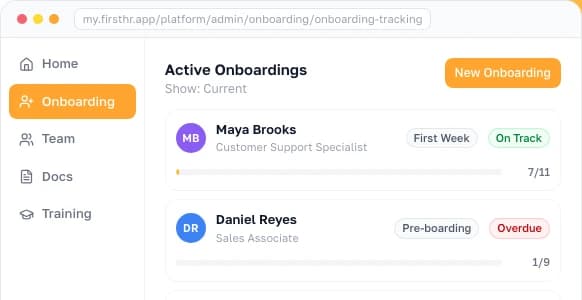
Automate documents, training assignments, task management, and track onboarding progress in real time.
Template 3: Quick New Hire Information Sheet (One Page)
A single printable page for the day somebody starts before the packet is ready: a seasonal push, an urgent backfill, a shift arranged over a weekend. Identity, contact, one job line, two emergency contacts, and a tracked list of what is still owed with real due dates against it.
A short intake sheet for the day someone starts before the full packet is ready:
a seasonal push, an urgent backfill, a first shift arranged over a weekend. Get
this signed on arrival, then collect the full form within the week.
EMPLOYEE
Legal name (as on your Social Security card): __
Preferred name: __
Date of birth: ___ Social Security number: _
Home address: __
City, state, ZIP: __
Mobile: _ Personal email: __
THE JOB
Job title: __
Start date: ___ Work location or shift: __
Manager: __
Employment type: [ ] Full time [ ] Part time [ ] Seasonal [ ] Temporary
EMERGENCY CONTACT
Primary name: __ Relationship: ___
Mobile: _ Second number: _
Backup name: __ Relationship: ___
Mobile: _ Second number: _
STILL OWED (COMPANY TO TRACK)
[ ] Form W-4 Due: ___
[ ] Form I-9 Due: within three business days of the start date
[ ] State withholding form Due: ___
[ ] Direct deposit form and voided check Due: ___
[ ] Full employee information form Due: ___
SIGNATURE
I confirm the details above are accurate and I will complete the remaining forms
by the dates listed.
Signature: __ Date: ___
DISCLAIMER: This is a sample template provided for general information only and
is not legal or tax advice. A short intake sheet does not replace the federal and
state forms listed above. Confirm your requirements before use.
Template 4: Remote and Multi-State New Hire Information Form
For anyone working from home or from another state. Adds the remote work address, residence versus work state, expected days worked elsewhere, equipment shipping details, a home workspace attestation, and a company-use line for confirming state tax registration.
Remote and Multi-State New Hire Information Form
REMOTE EMPLOYEE INFORMATION FORM
Company: [Company Name]
Remote work policy version: [Version and date]
Form completed on: [Date]
Use this version for an employee who works from home, from another state, or
across more than one state. The extra questions exist because the answers decide
which state gets the withholding, which state labor rules apply, and where your
equipment physically sits.
SECTION 1: PERSONAL INFORMATION
Legal name, as on your Social Security card: [Full name]
Preferred name: [Name]
Date of birth: [MM/DD/YYYY]
Social Security number: [XXX-XX-XXXX]
Personal mobile: [Number] Personal email: [Email]
SECTION 2: WHERE YOU WORK
Primary remote work address (street, city, state, ZIP): [Address]
Is this address also your legal residence? [ ] Yes [ ] No: [Residence address]
County or municipality, if a local tax applies: [Name]
Time zone: [Zone] Core hours you will be reachable: [Hours]
Do you expect to work from any other state during the year?
[ ] No
[ ] Yes: [States and approximate number of days in each]
Will you visit a company site? [ ] No [ ] Yes: [Site and frequency]
Nearest company location, for equipment and mail: [Site]
Note: tell us before you move or before you work from another state for an
extended period, because it can change our tax registration and your withholding.
SECTION 3: POSITION DETAILS
Job title: [Title] Department: [Department]
Manager: [Name] Employee ID: [ID]
Start date: [Date]
Employment type: [ ] Full time [ ] Part time [ ] Seasonal [ ] Temporary
Nearest hospital or urgent care to the work address, if you wish to share it:
[Name and city]
SECTION 7: ACKNOWLEDGMENT
I confirm the information above is accurate. I will notify [Company Name] before
I change my work address, move to another state, or work from a different state
for an extended period, and I understand that those changes can affect payroll,
taxes, and which policies apply to me.
Employee signature: __ Date: ___
Printed name: __
FOR COMPANY USE ONLY
Work state confirmed with payroll: [ ] Yes Date: ___
State tax registration in place: [ ] Yes [ ] Being opened State: ___
New hire report filed in the correct state: [ ] Yes Date: ___
Equipment shipped: [ ] Yes Tracking: ___
DISCLAIMER: This is a sample template provided for general information only and
is not legal or tax advice. Hiring across state lines can create registration,
withholding, insurance, and employment law obligations in the employee’s state.
Confirm your obligations with qualified counsel before use.
The address questions are not administrative padding. Where an employee physically works can decide which state gets the withholding, which state files the new hire report, and which employment rules apply, so a remote hire in a state you have never employed anyone in deserves a check before the first payroll run.
Companies Using FirstHR Onboard 3x Faster
Join hundreds of small businesses who transformed their new hire experience.
The version most template sets forget, and the one you will use most often after the first year. A legal name change with a prompt about the Social Security Administration, a move with a withholding warning, new contact details, replacement emergency contacts, and a new bank account with a verification line.
Employee Information Change Form
EMPLOYEE INFORMATION CHANGE FORM
Company: [Company Name]
Employee name: [Name] Employee ID: [ID]
Date submitted: [Date] Effective date of the change: [Date]
Use this form for any change to the details already on file. Submit it at least
one pay period ahead when the change touches pay, taxes, or benefits.
SECTION 1: WHAT IS CHANGING
[ ] Legal name
[ ] Home or mailing address
[ ] Phone or personal email
[ ] Emergency contacts
[ ] Bank account for direct deposit
[ ] Work location or work state
[ ] Other: [Describe]
SECTION 2: LEGAL NAME CHANGE
Previous legal name: [Name]
New legal name: [Name]
[ ] I have updated my name with the Social Security Administration
[ ] I have not yet updated it (payroll records must match the Social Security
card, so we will keep the previous name on tax filings until you have)
Preferred name going forward: [Name]
SECTION 3: ADDRESS CHANGE
Previous address: [Address]
New address (street, city, state, ZIP): [Address]
New mailing address, if different: [Address]
Effective date: [Date]
Does this change your work state or local tax jurisdiction?
[ ] No [ ] Yes [ ] Not sure, please check
SECTION 4: CONTACT DETAILS
New mobile: [Number]
New alternate phone: [Number]
New personal email: [Email]
SECTION 5: EMERGENCY CONTACTS
[ ] No change to the contacts on file
[ ] Replace the primary contact:
[Name], [relationship], [mobile], [second number]
[ ] Replace the backup contact:
[Name], [relationship], [mobile], [second number]
SECTION 6: DIRECT DEPOSIT
[ ] No change
[ ] New account (attach a voided check, and keep the old account open until the
I confirm the changes above and authorize [Company Name] to update my records.
Employee signature: __ Date: ___
Printed name: __
FOR COMPANY USE ONLY
Verified with the employee directly: [ ] Yes Method: ___
Updated in the HR system: [ ] Yes Date: ___
Updated in payroll: [ ] Yes Date: ___
Previous version archived: [ ] Yes Date: ___
DISCLAIMER: This is a sample template provided for general information only and
is not legal or tax advice. Verify any bank account change directly with the
employee before acting on it. Confirm your requirements before use.
Template 6: Contractor and Vendor Information Form
For a freelancer or vendor rather than an employee. Entity type, taxpayer identification number, a Form W-9 prompt, engagement scope, rate and payment terms, insurance details, and a plain statement that the form does not create an employment relationship.
Contractor and Vendor Information Form
CONTRACTOR AND VENDOR INFORMATION FORM
Company: [Company Name]
Engagement owner: [Name, email]
Form completed on: [Date]
Use this form for an independent contractor, a freelancer, or a vendor. It is
not an employee record: it collects the details needed to set up payment and
reporting, and it does not create an employment relationship.
SECTION 1: WHO YOU ARE
Legal business name: [Name]
Doing business as, if different: [Name]
Contact person: [Name] Title: [Title]
Business address (street, city, state, ZIP): [Address]
Remit-to address, if different: [Address]
Phone: [Number] Email: [Email]
Website, if any: [URL]
SECTION 2: TAX AND ENTITY DETAILS
Entity type: [ ] Sole proprietor [ ] Single-member LLC [ ] LLC taxed as a
corporation [ ] Partnership [ ] C corporation [ ] S corporation [ ] Other
Taxpayer identification number (EIN or SSN): [Number]
[ ] A completed Form W-9 is attached
State of formation or registration: [State]
States where the work will be performed: [States]
SECTION 3: THE ENGAGEMENT
Description of services: [Description]
Start date: [Date] Expected end date: [Date]
Rate and basis: $[Amount] per [hour, day, project, milestone]
Not-to-exceed amount, if any: $[Amount]
Invoicing frequency: [Monthly, per milestone, on completion]
Account number: [Number] Account type: [ ] Business checking [ ] Business
savings
Do not send bank details by unsecured email or text message.
SECTION 5: INSURANCE AND ACCESS
Certificate of insurance attached? [ ] Yes [ ] Not required for this engagement
General liability carrier and policy number: [Details]
Workers compensation coverage, if applicable: [Details]
Site access needed? [ ] No [ ] Yes: [Areas, badge number]
Emergency contact for anyone working on our site:
[Name], [relationship or agency], [mobile]
SECTION 6: ACKNOWLEDGMENT
I confirm the information above is accurate. I understand this form is used to
set up payment and tax reporting, that I am responsible for my own taxes and
insurance, and that this form does not create an employment relationship with
[Company Name].
Authorized signature: __ Date: ___
Printed name and title: __
FOR COMPANY USE ONLY
Form W-9 on file: [ ] Yes Date: ___
Signed agreement or statement of work on file: [ ] Yes Date: ___
Classification reviewed: [ ] Yes Reviewed by: ___
Vendor record created: [ ] Yes Vendor ID: ___
DISCLAIMER: This is a sample template provided for general information only and
is not legal or tax advice. Worker classification is decided by the facts of the
relationship, not by the form used or the label on the agreement. Confirm your
obligations with qualified counsel before use.
Keep this one visibly separate from your employee forms. Classification is decided by the facts of the working relationship rather than by the paperwork, so treat this sheet as part of contractor onboarding and not as a lighter version of an employee record.
Getting a New Hire Employee Information Form PDF
Every template here downloads as an editable Word file, and a PDF is one step away: open the document in Word, then save it as a PDF. In Google Docs the same export sits under Download in the File menu. Put your company name in and delete any section you do not use before you export.
Word is the format to edit in, and PDF is the format to hand out. A PDF prints the same on every machine, will not be altered by accident, and drops straight into a first-day packet. Keep the Word file as your master so next year's revision starts from something you can still change.
What Every Form Should Include
A complete new hire information form covers four groups of fields: identity, contact and address, the job, and emergency contacts. Everything else is refinement around those four.
Identity
Legal name as on the Social Security card
Preferred name
Date of birth
Social Security number
Contact and address
Home address with ZIP
Mailing address if different
Personal mobile and a second number
Personal email
The job
Title, department, and manager
Work location or remote address
Start date and employee ID
Employment type and classification
Emergency contacts
Primary contact and relationship
A backup who is a different person
Two numbers for each
Voicemail permission
Two details separate a form that works from one that merely looks complete. The first is the instruction to write the legal name exactly as it appears on the Social Security card, because a nickname on a tax filing creates a correction nobody enjoys. The second is a plain line telling the employee that a change of home address can change their withholding, which turns a housekeeping field into something they will actually report.
The table below is the part most template lists leave out: who fills each group in, and why the field is there at all.
Field group
Who completes it
Why it is on the form
Legal name, date of birth, Social Security number
Employee
Tax reporting and federal recordkeeping
Preferred name and pronouns
Employee
How the team and the systems address them
Home address and mailing address
Employee
Recordkeeping, mail, and state withholding
Personal mobile, alternate number, email
Employee
Reaching them before systems access exists
Title, department, manager, work location
Company
The record the org chart and payroll read from
Start date, employee ID, employment type
Company
Deadlines, identifiers, and eligibility dates
Overtime classification and scheduled hours
Company
Pay rules and time tracking setup
Primary and backup emergency contacts
Employee
Someone to call, plus a fallback
Signature and date
Employee
Turns the sheet into a record you can rely on
Assign your own employee ID in the position block and use it everywhere afterward. It gives you a safe identifier for schedules, rosters, and equipment logs, which is what keeps the Social Security number confined to payroll and tax filing.
Keep the emergency contact block short here and collect the full version separately when the job warrants it. A warehouse, a clinic, or a crew working on a site has a stronger case for allergy, medication, and physician details, and those belong on a dedicated emergency contact form that can be filed apart from the personnel record.
What the Law Requires You to Record
No federal law names this form, but almost everything on it is required somewhere else. The identifying data is a recordkeeping duty, the Social Security number is a tax reporting duty, the state expects a new hire report within 20 days, and Form I-9 runs on its own three business day clock.
The identifying data is a federal recordkeeping duty
The FLSA recordkeeping regulation tells covered employers to keep, for each employee, the full name as used for Social Security recordkeeping plus any identifying number used in its place, the home address including ZIP code, the date of birth if the employee is under 19, and the sex and occupation in which employed (29 CFR 516.2). No rule says those items have to be gathered on one sheet, but one sheet is the simplest way to gather them, and the retention clock in 29 CFR 516.5 runs three years from the last entry.
The Social Security number has a specific purpose
The IRS instructs employers to get each employee’s name and Social Security number and to enter them on Form W-2, so the number on this form is collected for tax reporting rather than for general identification. Record it exactly as it appears on the card, and do not use it as an internal employee number. Assign your own ID instead, keep the number restricted to the people who file taxes and run payroll, and store the completed sheet accordingly.
The state gets a report within 20 days
Federal law requires employers to report each newly hired employee to a state directory, and the report has to carry the employee’s name, address, and Social Security number along with the employer’s name, address, and identifying number, no later than 20 days after the date the employer hires the employee. Electronic filers may transmit twice monthly, 12 to 16 days apart. Everything the report needs is already on the standard form, which is the practical argument for collecting it before day one.
Form I-9 stays a separate document
The employer side of Form I-9 has its own deadline: Section 2 has to be completed within three business days of the date employment begins, or by the first day if the person is hired for less than three business days. Keep the I-9 as its own file rather than folding it into the information sheet or the personnel file, so you can produce I-9s for an inspection without handing over everything else you hold on your employees.
The Identifying Data the FLSA Expects on File
The FLSA recordkeeping regulation requires covered employers to keep, for each employee, the name in full as used for Social Security recordkeeping purposes plus any identifying number used in its place, the home address including zip code, the date of birth if under 19, and the sex and occupation in which employed (29 CFR 516.2). Payroll records carrying that data are preserved for at least three years from the last date of entry under 29 CFR 516.5. This is general information, not legal advice.
The tax side is short and specific. The IRS tells employers to get each employee's name and Social Security number and to enter them on Form W-2, and to ask every new employee for a signed Form W-4 when they start work. That is the whole reason the number sits on this sheet, and it is why the field asks for the name as written on the card.
New hire reporting is the deadline small employers miss most. Federal law requires a report to a state directory carrying the employee's name, address, and Social Security number together with your own name, address, and identifying number, no later than 20 days after the date you hire them, as set out at 42 U.S.C. 653a. Employers filing electronically may transmit twice a month instead, 12 to 16 days apart. Your state new hire reporting program may set a shorter window, so check it.
Form I-9 keeps its own schedule and its own file. The USCIS Handbook for Employers states that Section 2 must be completed within three business days of the date employment begins, or no later than the first day when someone is hired for less than three business days. Do not fold I-9 documentation into this sheet or into the personnel file.
Item
Deadline
Where the requirement comes from
Employee information form
No legal deadline; collect before day one
Your own practice
Form W-4, signed
Ask for it when the employee starts work
IRS guidance for employers
Form I-9, Section 2
Within three business days of the start date
USCIS Handbook for Employers
New hire report to the state
No later than 20 days after the date of hire
42 U.S.C. 653a
Identifying data on file
Kept for at least three years from the last entry
29 CFR 516.2 and 516.5
Where Each Section Goes
Gather the sheet once, then file its sections separately. The core record goes in the personnel file, bank details go somewhere narrower, the I-9 gets its own file, and anything medical goes in a separate confidential file with its own short access list.
The reason is practical before it is legal. The person who needs an emergency phone number at seven in the evening is a shift lead, and the person who needs a routing number is whoever runs payroll. One combined folder forces you to give both of them everything, which is how a small team ends up with bank details in a shared drive.
Section of the form
Where it is filed
Who should be able to open it
Identity, contact, address, position
Personnel record
Owner, HR, the employee’s manager
Social Security number
Restricted payroll and tax records
Whoever runs payroll and files taxes
Bank account and routing number
Restricted payroll file
Whoever runs payroll only
Emergency contacts
Personnel record, plus the on-call roster
Anyone who might place the call
Form I-9 and its documents
Its own file, separate from everything
Owner or HR only
Volunteered medical detail
Separate confidential medical file
HR plus designated first aid staff
Signed acknowledgment page
Stays with the sheet it signs
Owner or HR only
Separating medical detail is a rule as much as a habit. Under the ADA regulations at 29 CFR 1630.14, medical information an employer obtains about an employee has to be collected on separate forms and kept in separate medical files as a confidential record, with a narrow exception allowing first aid and safety personnel to be told when a condition might need emergency treatment. None of the templates on this page asks a medical question for exactly that reason.
Retention is the other half of filing. The three year clock on payroll records is a floor rather than a ceiling, and other rules run longer, so settle how long you keep employee records once and write it into the same place your employee files are described.
Paper works, and plenty of small teams run this way for years. Where it strains is version control: which sheet is current, who holds the payroll copy, and whether the manager on shift tonight can reach a phone number. FirstHR keeps the form against the employee profile, captures the acknowledgment with built-in e-signature, and holds each document with its own access so the payroll copy is not sitting in the same folder as the org chart. Applicant tracking is coming soon to FirstHR.
Collect It Early, Then Keep It Current
Send the form when the offer is accepted, not on the morning somebody arrives. The window between a signed offer and a start date is the only stretch when a new hire has nothing else competing for their attention, and a form returned in that window means the first day is about the job rather than about data entry.
Send it with the offer acceptance
The window between a signed offer and the first day is the only time a new hire has nothing else competing for attention. Send the form then, not on the morning they arrive.
Get the acknowledgment signed
The signature is what makes the sheet a record rather than a draft. It also captures the promise to report a change of name, address, or bank account.
File each section where it belongs
Personnel record for the core sheet, restricted payroll file for the bank details, separate binder for the I-9, separate confidential file for anything medical.
Re-confirm once a year
Send the change form annually and after any move, marriage, or new bank. File the reply even when the answer is that nothing changed, so the file carries a date.
Fold it into the sequence you already run rather than treating it as a separate errand. It belongs in the same packet as everything else that gets signed, which is why it appears as a line item on most new hire checklists.
The annual re-confirmation is the habit that separates a live file from a stale one. Send the change form to everyone on the same date each year, ask for it back even when nothing changed, and archive the version it replaces. A home address that is quietly wrong can put withholding in the wrong state for months, and nobody notices until a tax notice arrives.
Treat a bank account change as a security event rather than an administrative one. Verify it with the employee directly, through a channel other than the one the request arrived on, and keep the signed direct deposit authorization with your other payroll records. A convincing fake change request is one of the simplest ways a small business loses a paycheck.
Once you are running this across a whole team, the tracking becomes the work. FirstHR collects the form as part of onboarding, captures the signature, updates the employee profile when a change form comes back, and archives what it replaced so there is one current record with a dated history behind it, the same way it handles the rest of your HR documents. Applicant tracking is coming soon to FirstHR.
FirstHR is an onboarding and HR platform, not a payroll provider, a tax adviser, or a law firm. It collects the sheet, tracks the signature, and keeps the sections filed where they belong, while decisions about withholding, classification, and what your state expects of employee data stay with you and a qualified professional. Applicant tracking is coming soon to FirstHR.
Key Takeaways
A new hire employee information form gathers identity, contact, position, and emergency contact details on one signed sheet before the first day.
Ask for the legal name exactly as it appears on the Social Security card, and assign your own employee ID so the Social Security number stays confined to payroll and tax filing.
The FLSA recordkeeping regulation expects full name, home address with ZIP code, date of birth if under 19, and sex and occupation on file for each employee.
New hire reporting to a state directory is due no later than 20 days after the date of hire, and Form I-9 Section 2 within three business days of the start date.
Gather the details once, then file the sections separately: personnel record, restricted payroll file, a standalone I-9 file, and a confidential medical file.
Re-confirm the record annually with the change form, and verify any bank account change directly with the employee. This is general information, not legal advice.
Frequently Asked Questions
What is a new hire employee information form?
A new hire employee information form is the single sheet a new employee completes so an employer has one accurate copy of their details. It collects identity data such as the legal name exactly as it appears on the Social Security card, a preferred name, date of birth, and Social Security number; contact data such as the home address with ZIP code, a personal mobile, a second number, and a personal email; the position details the company fills in, including title, manager, start date, work location, employee ID, and overtime classification; and at least two emergency contacts. Most versions close with a paperwork checklist and a signed acknowledgment in which the employee promises to report a change of name, address, or bank account. It is an internal record rather than a government form, which is why the wording and the field list vary from one employer to the next. This is general information, not legal advice.
What information should a new hire form include?
Four groups, plus a signature. Identity: legal name as written on the Social Security card, preferred name, date of birth, and Social Security number. Contact: home address including ZIP code, a mailing address when it differs, a personal mobile, an alternate number, and a personal email. The job: title, department, manager, work location or remote address, start date, employee ID, employment type, overtime classification, and scheduled hours, all of which the company fills in rather than the employee. Emergency contacts: a primary contact with a relationship and two phone numbers, and a backup who is a different person. Close with a dated acknowledgment. Two additions earn their space on a small team: a line telling the employee that a change of address can change their tax withholding, and a checklist of the separate forms still owed. This is general information, not legal advice.
Is a new hire employee information form legally required?
No federal law names this specific form, but most of what sits on it is required, so employers collect it anyway. The FLSA recordkeeping regulation directs covered employers to keep, for each employee, the full name used for Social Security recordkeeping, the home address including ZIP code, the date of birth if the employee is under 19, and the sex and occupation in which employed. The IRS instructs employers to get each employee’s name and Social Security number for Form W-2. Federal law also requires new hire reporting to a state directory, carrying the employee’s name, address, and Social Security number, no later than 20 days after the date of hire. Nothing says those items must be gathered on one page. One page is simply the cheapest way to gather them once and stop chasing them. This is general information, not legal advice.
How do I get a new hire employee information form as a PDF?
Every template on this page downloads as an editable Word file, and a PDF is one step from there. Open the document in Word, add your company name, delete any section you do not use, then choose Save As and pick PDF. In Google Docs the equivalent export lives under Download in the File menu. Word is the format to edit in and PDF is the format to hand out, because a PDF prints identically on every machine and will not be altered by accident on the way back to you. Keep the Word file as your master so the next revision starts from something you can still change. If you want the employee to complete it on screen rather than on paper, either send the Word file for editing or use a PDF tool that adds form fields, and collect the signature through whatever electronic signature method you already use. This is general information, not legal advice.
Can an employer ask a new hire for a Social Security number and date of birth?
Yes, and both have a defined purpose on this form. The IRS instructs employers to get each employee’s name and Social Security number and to enter them on Form W-2, so the number is collected for tax reporting. Date of birth supports benefits administration and age-related rules, and the FLSA recordkeeping regulation specifically requires it for an employee under 19. Two practices keep the collection clean. First, ask for each item once, at the point it is needed, rather than repeating the Social Security number across half a dozen documents. Second, never use it as an internal identifier: assign your own employee ID and use that on schedules, badges, and rosters. Restrict the completed sheet to the people who run payroll and file taxes, keep it out of shared drives and email threads, and treat a change request the way you would treat a bank change request. This is general information, not legal advice.
Where should the completed form be stored?
Split it by section rather than filing the whole packet in one place. The core sheet, meaning identity, contact details, position data, and emergency contacts, belongs in the personnel record. Bank details and anything used to run pay belong in a payroll file with narrower access. Form I-9 is kept as its own file, separate from the personnel record, so an inspection can be answered without exposing everything else you hold. Any medical detail an employee volunteers goes in a separate confidential medical file. The reason for the split is practical as well as legal: the people who need an emergency phone number at seven in the evening are not the people who need a routing number, and one combined folder forces you to grant everyone the highest level of access. Write down who can open each file, keep the list short, and review it whenever someone changes roles. This is general information, not legal advice.
How often should employee information be updated?
Once a year as a standing habit, plus immediately after any change the employee is asked to report. Addresses, phone numbers, emergency contacts, and bank accounts decay faster than anything else in a personnel file, and a home address that is quietly wrong can put withholding in the wrong state for months before anyone notices. The routine that works is a short confirm-or-correct form sent to everyone on the same date each year, returned even when nothing changed, so the file holds a dated confirmation rather than an assumption. Between those cycles, the change form covers a legal name change, a move, new contact details, new emergency contacts, or a new bank account. Verify a bank change with the employee directly through a channel other than the one the request arrived on, because a fake change request that appears to come from an employee is a common way small businesses lose a paycheck. This is general information, not legal advice.
Make HR the easy part of running your business
Onboarding, e-signatures, training and core HR in one place. Up and running in 5 minutes.