Training Manual Template for Small Business (Word DOCX)
Six free training manual templates: standard, role-specific, software guide, safety, new manager, and a one-page module. Editable Word DOCX, no signup.
Six templates covering the structure, the sample content, and the design decisions: a blank manual skeleton, three worked examples, a software training guide, and a one-page module you can print. Editable Word documents, no email form in the way.
The first training manual I wrote ran to forty pages and nobody read past page four. It described the whole business. What the new person actually needed was the six things they had to do in week one, in the order they would meet them, with the mistake to avoid written underneath each one.
That is the gap in most training manual templates. You get a contents page and a heading called Introduction, then you are left to invent the part that matters: the module block, the check at the end of it, and the version line that stops the manual describing a system you replaced in March.
So there are six templates here. One is the blank skeleton, three are worked examples you can adapt (a customer-facing shift role, a safety manual, and a manual for a first-time manager), one is a software training guide, and one is a single page you can print and pin up where the task is done. Each downloads as an editable Word file, free, with no email form.
TL;DR
A training manual template gives you the structure of a working manual: a cover and version block, how to use it, measurable objectives, numbered modules with a check at the end of each, a quick-reference page, sign-off lines, and a revision history. Six free DOCX templates below, no signup.
What a Training Manual Template Is
A training manual template is a reusable document skeleton for teaching someone a job: the sections a manual needs, in the order a learner meets them, with placeholders where your specifics go. It supplies the shape so you spend your time on content instead of on deciding what a manual looks like.
The consistency is the real payoff. Once two manuals share a structure, a person who finished the first already knows how the second works, and you stop re-inventing the module block every time you add a role. That matters more than any single template being perfect.
A manual is one document inside a wider set. The training plan says what training happens and when, the manual is the content people learn from, and the training records prove it happened. Confusing the three is the most common reason a download turns out to be the wrong file.
Manual, Guide, SOP, or Plan
A training manual teaches a whole role, a training guide walks one person through one system, an SOP records how a single procedure is performed, and a training plan schedules who learns what and by when. Four documents, four questions.
Document
Answers
Typical length
Who opens it first
Training manual
What this job is, and how it is done here
4 to 8 modules, under 30 pages
A new hire in week one
Training guide
How do I do this task in this tool
5 daily tasks plus troubleshooting
Anyone given access to the system
SOP
How this one procedure is performed, step by step
1 to 2 pages
Whoever is covering the task today
Training plan
Who is trained on what, and by when
1 page or a schedule grid
The manager, before the hire starts
The failure mode is writing one document that tries to be all four. It becomes too long to teach with and too general to look things up in. Keep the manual for learning, the guide for the tool, the SOP for the procedure, and the plan for the schedule.
What Goes in a Training Manual
A complete training manual has eight parts, and they sort into four groups: the front matter, the promise, the teaching, and the back matter. Everything else is optional.
The front matter
Cover, version, owner, review date
How to use this manual, and who to ask
The promise
What the learner will be able to do
What they need in place before starting
The teaching
Modules: why it matters, steps, the common mistake
A check the trainer can observe at the end of each
The back matter
Quick reference page and glossary
Sign-off lines and a revision history
The promise section is the one people write badly. Objectives written as understanding cannot be checked by anyone, which is why university teaching-center guidance says objectives should be learner-centered, use action verbs, and be measurable (Carnegie Mellon University, Eberly Center). Write what the person will do, and the standard they will do it to, and the modules more or less pick themselves.
The other reliably skipped part is the revision history. It costs four lines and it is the only thing that tells the next reader whether they are holding something current or something abandoned two systems ago.
Still Using Spreadsheets for Onboarding?
Automate documents, training assignments, task management, and track onboarding progress in real time.
Training manual design is about making the document scannable rather than attractive. Almost nobody reads a manual straight through twice, so the layout decisions that matter are the ones that let someone find one answer in fifteen seconds three weeks later.
Decision
What to do
Why it matters
Headings
Use real heading styles, not bold text
Builds a table of contents automatically and gives the document a structure screen readers can follow
Sentences
One idea per sentence, short paragraphs
Dense construction is the main reason people stop reading partway down a page
Sequence
Numbers for ordered steps, checkboxes for unordered tasks
The numbering itself tells the reader whether order matters
Images
Add one only where words would be slower, then label and date it
Screenshots age faster than the text around them and quietly make the manual wrong
Type and contrast
A body size that survives a photocopy, strong text-to-background contrast
Manuals get printed, photocopied, and read under bad lighting more often than anyone plans for
Quick reference
One printable page for what people look up repeatedly
Stops the whole manual being opened to find a phone number
Two federal sources settle most of the remaining questions at no cost. Plain-language guidance recommends expressing only one idea per sentence, opening each paragraph with a topic sentence, and keeping paragraphs to 150 words across three to eight sentences, with 250 words as the hard ceiling (Digital.gov, Plain Language guide). Treat those figures as a limit rather than a target in a training manual, where a wall of text reads as optional.
For the document itself, federal accessibility guidance for authoring in a word processor comes down to five habits: build headings with styles, use the built-in list features rather than typed dashes, give tables real header rows, add alternative text to every image, and check that the contrast between text and background is high enough. Following those makes the manual easier for everyone to skim, and it is the same work either way (Section508.gov, creating accessible documents).
The One Design Rule That Beats the Others
Put the quick reference on its own page and design it to be printed. In a small business the manual is read once and the quick reference is used every day: the phone list, the override limit, the opening sequence, the code. Separating them means the manual can be thorough without being in the way, and it is the single change that gets the most use out of a document people were never going to reread.
Which Template Should You Use?
Pick the blank skeleton if you are documenting a role nobody has written up before. Pick one of the three worked examples if it is close to your situation, since adapting a finished manual is faster than filling in an empty one.
Standard Training Manual
Blank structure, start here
The full skeleton with nothing filled in: cover and version block, how to use it, measurable objectives, prerequisites, repeatable module blocks, quick reference, glossary, sign-off, and revision history. The right first download for any role.
Role Manual Example
Customer-facing shift role
A finished manual rather than a blank one. Five modules covering opening and closing, taking an order, payments and refunds, the five questions customers ask, and what to do when something goes wrong, each with a check the trainer observes.
Software Training Guide
One system, one person
Task-shaped rather than feature-shaped. Access and lockouts, the five things you do every day with the exact on-screen wording, what not to touch, occasional tasks, a symptom table for when it breaks, and a dated note on which screens it describes.
Safety Training Manual
Hazards and certification
Hazard and equipment tables you complete from your own walkthrough, safe work procedures, emergencies, near-miss reporting, and a certification block that carries the trainer, the dates, the content summary, and the refresher due date.
New Manager Manual
Promoted from the team
Six modules for a first-time manager: what the job changed to, one to ones, correction in private, time and pay questions, bringing a new person onto the team, and an escalation list that says what goes up immediately and what waits a week.
Single Training Module
One page, one task
Why it matters, prerequisites, six steps, the mistake people make, the observable check, and a sign-off line. Works as a module inside a longer manual and as a single sheet pinned where the task is done.
If This Is Your First Manual
Take the Standard template and write one module, not the whole thing. Pick the task a new person is most likely to get wrong in week one, write why it matters, the steps, the mistake people make, and the check. That single page is more useful on Monday than a complete manual that is still in draft in November. Add a module a week and you have a finished manual by the end of the quarter without ever setting aside a day for it.
6 Free Training Manual Templates
Download all six together or copy an individual template. Each is an editable Word document with no email form. Fill in the brackets, delete what does not apply, and change any wording that does not match how your business actually runs.
Download All 6 Training Manual Templates
Standard manual, role example, software guide, safety manual, new manager manual, and single module. All as DOCX files in one download.
Word rather than PDF is deliberate. A training manual is meant to be edited, and the version that gets followed should be the one that matches this month rather than the one that was finished and locked. When you need a fixed copy for a file or a print run, save the finished document as a PDF from Word and keep the editable original.
Template 1: Standard Employee Training Manual
The full skeleton with nothing filled in. Cover and version block, how to use it, objectives, prerequisites, a repeatable module block with the check built in, quick reference, glossary, sign-off, and revision history.
Employee Training Manual Template (Standard)
EMPLOYEE TRAINING MANUAL
[Company Name]
COVER AND VERSION BLOCK
Manual title: [Role or topic] Training Manual
Version: [1.0] Effective date: [MM/DD/YYYY]
Owner: [Name, title] Next review: [MM/DD/YYYY]
Written for: [who this manual is for, by role]
Time to complete: approximately [ ] hours across [ ] modules
1. HOW TO USE THIS MANUAL
[Two or three sentences. Say whether it is read in order or used as reference.
Say who trains alongside it. Say what the reader does when the manual does not
match what they see on the screen or on the floor, and name the role to ask.]
Your trainer for these modules: [role]
If something here is wrong or unclear, tell: [role, contact]
2. WHAT YOU WILL BE ABLE TO DO
By the end of this manual you will be able to:
1. [Action verb, task, and the standard. "Count the drawer at close to within
one dollar without help" beats "understand cash handling."]
2. [ ]
3. [ ]
4. [ ]
5. [ ]
3. BEFORE YOU START
Accounts and access needed: [ ]
Equipment or tools: [ ]
Read first: [handbook, safety orientation, other manuals]
[One or two sentences in terms of the customer, the money, or the safety risk.
Not "this is important." Say what goes wrong when it is done badly.]
WHAT YOU NEED TO KNOW
•[ ]
•[ ]
•[ ]
HOW TO DO IT
1. [One action. Start with a verb.]
2. [ ]
3. [ ]
4. [ ]
THE MISTAKE PEOPLE MAKE
[The one that actually happens, and what it causes. Every task has one, and
writing it down does more for consistency than the steps above it.]
CHECK YOURSELF
[The task or question that proves this module landed. Something observable.]
Module complete: Employee Trainer Date _
MODULE 2: [Title]
[Repeat the block above for each module. Four to eight modules is normal for one
role. Past ten, this is two manuals and should be split.]
5. QUICK REFERENCE
[The three or four things people look up again and again: a phone list, a code,
an opening sequence, a threshold that needs approval. Keep it to one page so it
can be printed and pinned where the work happens.]
6. GLOSSARY
[Term] - [what it means here, in one line. Include anything your industry uses
differently from everyone else.]
7. FINAL SIGN-OFF
Employee: I completed the modules above, and I know where to find this manual
and who to ask when something is not covered.
Employee signature: __ Date: _
Trainer: I observed this employee perform the tasks listed in section 2.
Trainer signature: __ Date: _
8. REVISION HISTORY
Version | Date | Changed by | What changed
1.0 | [MM/DD/YY] | [Name] | Initial version
| | |
| | |
DISCLAIMER: This is a sample template for general information only and is not
legal advice. Where training is required by a regulation, confirm the content
and recordkeeping requirements of the standard that applies to your business.
Template 2: Role Training Manual Example
A finished manual for a customer-facing shift role rather than a blank one. Five modules with real content, each ending in something the trainer watches the person do. Useful as a model even if your roles look nothing like a front counter.
Role Training Manual Example (Customer-Facing Shift Role)
TRAINING MANUAL: FRONT COUNTER
[Company Name]
Version: 1.0 Effective date: [MM/DD/YYYY]
Owner: [Store manager] Next review: [MM/DD/YYYY]
Written for: new front counter staff, first two weeks
Time to complete: about 6 hours across 5 modules, spread over week one
HOW TO USE THIS MANUAL
Work through the modules in order with your trainer. Each one ends with a short
check you do in front of them, not a quiz. If what you see here does not match
what is on the screen or on the counter, that means this manual is out of date.
Tell the manager so it gets fixed for the next person.
WHAT YOU WILL BE ABLE TO DO
By the end of week one you will be able to:
1. Open and close the counter using the checklist, unassisted.
2. Take, enter, and correct an order without asking for help.
3. Handle a card decline, a refund, and a price override to policy.
4. Answer the five questions customers ask most, accurately.
5. Say what to do, and who to call, when something goes wrong.
MODULE 1: OPENING AND CLOSING
Time: 45 minutes Trainer: shift lead Method: shadow, then do
WHY THIS MATTERS
An opening done out of order costs the first twenty minutes of trading. A close
done wrong is found the next morning by someone who then starts late.
HOW TO DO IT
1. Unlock, disarm, and turn on the lights and the screens in that order.
2. Count the drawer against the float sheet and record the figure.
3. Check the display case dates and pull anything short.
4. Read the shift notes from yesterday before the doors open.
5. At close, reverse the list and write the note for tomorrow.
THE MISTAKE PEOPLE MAKE
Writing "all fine" in the shift note. The note exists for the one thing that was
not fine. If nothing happened, write what was low on stock.
CHECK YOURSELF
Open the counter tomorrow with the trainer watching and no prompting.
Module complete: Employee Trainer Date _
MODULE 2: TAKING AN ORDER
Time: 90 minutes Trainer: shift lead Method: shadow, then do
WHY THIS MATTERS
Most complaints start with an order entered wrong, not with the product.
HOW TO DO IT
1. Greet, then listen to the whole order before touching the screen.
2. Enter items in the order they were said, so you can read it back.
3. Read the order back before taking payment. Every time.
4. Confirm the total out loud.
THE MISTAKE PEOPLE MAKE
Skipping the read-back when there is a line. That is exactly when it is needed.
CHECK YOURSELF
Take ten orders in a row with the trainer at your shoulder and no corrections.
Module complete: Employee Trainer Date _
MODULE 3: PAYMENTS, REFUNDS, AND OVERRIDES
Time: 60 minutes Trainer: manager Method: walk through, then do
WHY THIS MATTERS
This is where money goes missing, and where a customer decides whether to come
back. Both happen in under a minute.
HOW TO DO IT
1. Card decline: offer to try again once, then offer another method. Never
comment on why it declined.
2. Refund: find the original sale, refund to the original payment method only,
Task-shaped rather than feature-shaped. Getting in, the five things you do every day using the exact on-screen wording, what not to touch, occasional tasks, a symptom table for when it breaks, and a dated note on which version of the screens it describes.
Software Training Guide Template (System Walkthrough)
TRAINING GUIDE: [SYSTEM NAME]
[Company Name]
Version: [1.0] Effective date: [MM/DD/YYYY]
Owner: [Name, title] Next review: [MM/DD/YYYY]
Written for: [role or roles] Screens current as of: [MM/DD/YYYY]
A guide is not a manual. A manual teaches a role; a guide walks one person
through one system until they can use it without help. Keep it task-shaped:
every heading below is something a person needs to do, not a feature name.
1. WHAT THIS SYSTEM IS FOR
[Two sentences. What the business uses it for, and what it replaced. People
learn a tool faster when they know why it is there.]
We use it for: [ ]
We do not use it for: [the thing people assume, and where that lives instead]
2. GETTING IN
Address: [ ]
Your account comes from: [role]
Password rules: [ ]
Two-factor: [ ]
If you are locked out: [role, and how long it usually takes]
3. THE FIVE THINGS YOU WILL DO EVERY DAY
TASK 1: [Task name, written as an action]
When you do this: [trigger]
1. [Click or type, one action per step, using the exact on-screen wording.]
2. [ ]
3. [ ]
You know it worked when: [the confirmation, number, or record that appears.]
Watch out for: [the field people fill in wrong, and what it breaks downstream.]
TASK 2: [ ]
[Repeat the block. Five tasks covers the daily job for most systems. Anything
rarer belongs in section 5.]
4. WHAT NOT TO DO
•[The button that looks harmless and is not.]
•[The action that cannot be undone, and who to ask before doing it.]
•[The field that must never be edited after the fact, and why.]
5. OCCASIONAL TASKS
[Month end, a correction, a new record, an export. One short block each, same
shape as section 3. These are the ones people forget, so write them for someone
who has not done it in six weeks.]
6. WHEN IT BREAKS
Symptom First thing to try Then who to tell
[Will not load] [ ] [role]
[Wrong number on a report] [ ] [role]
[Cannot find a record] [ ] [role]
Vendor support: [contact and hours]
Do not raise a ticket before: [the internal check that resolves most of them]
7. GLOSSARY OF ON-SCREEN TERMS
[Term as it appears in the system] - [what it means in our business]
8. SIGN-OFF AND REVISION HISTORY
I can complete the five daily tasks without help.
Employee signature: __ Date: _
Trainer signature: __ Date: _
Version | Date | Changed by | What changed
1.0 | [MM/DD/YY] | [Name] | Initial version
NOTE: A software guide goes out of date faster than any other training document,
because the vendor changes the screens and nobody tells you. Date the screens in
the header and check the guide after every major update.
DISCLAIMER: This is a sample template for general information only and is not
legal advice.
Template 4: Safety Training Manual
Hazard and equipment tables you complete from your own walkthrough, safe work procedures, emergencies, near-miss reporting, and a certification block carrying the trainer, the dates, the content summary, and the refresher date. Pair it with safety training that is actually delivered rather than only documented.
Safety Training Manual Template
SAFETY TRAINING MANUAL
[Company Name]
Version: [1.0] Effective date: [MM/DD/YYYY]
Owner: [Name, title] Next review: [MM/DD/YYYY]
Written for: [role, department, or site]
Applicable standards: [list the standards that apply to your operation]
1. HOW SAFETY WORKS HERE
[Three or four sentences. Who is responsible for what, how a hazard gets
reported, and the promise that reporting one never causes trouble. Write this in
the owner’s voice, because people believe it or they do not.]
Report a hazard to: [role, contact]
Emergency: [number] Assembly point: [location]
First aid kit: [location] Trained first aiders: [names]
2. WHAT YOU WILL BE ABLE TO DO
By the end of this manual you will be able to:
1. Name the hazards specific to your work area and the control for each.
2. Use the required protective equipment correctly and know when it is required.
3. Report a hazard, a near miss, and an injury, and say who you report each to.
4. Follow the evacuation route and say where to assemble.
3. HAZARDS IN YOUR WORK AREA
Hazard What could happen Control Your part in it
[ ] [ ] [ ] [ ]
[ ] [ ] [ ] [ ]
[ ] [ ] [ ] [ ]
[List the real ones from your own walkthrough, not a generic list. A hazard your
staff have never seen makes the whole manual feel like paperwork.]
4. PROTECTIVE EQUIPMENT
Task Equipment required Where it is kept Replace when
[ ] [ ] [ ] [ ]
[ ] [ ] [ ] [ ]
Fit, inspection, and cleaning: [ ]
If equipment is damaged or missing: [do not start the task; tell [role]]
5. SAFE WORK PROCEDURES
PROCEDURE: [Task name]
Before you start: [checks, isolation, permissions]
1. [Action]
2. [Action]
3. [Action]
Stop and get help if: [the conditions that mean this procedure no longer applies]
[Repeat for each task that carries a real risk. Link each one to the written
procedure if you keep them separately.]
6. EMERGENCIES
Fire: [ ]
Injury: [ ]
Chemical spill or release: [ ]
Power failure: [ ]
Severe weather: [ ]
Threat or violence: [ ]
Evacuation route from your area: [ ]
Who accounts for the team: [role]
7. REPORTING
Injury: [form, who, and by when]
Near miss: [form, who, and by when]
Hazard: [form, who, and by when]
A near miss is reported the same as an injury here. It is the cheapest warning
you will ever get.
8. TRAINING RECORD AND CERTIFICATION
Employee: I received this training, had the chance to ask questions, and
understand what I am responsible for.
Employee name (print): __
Employee signature: __ Date: _
Trainer or employer certification:
I certify that the training described above was delivered to this employee.
Topic and content summary: _____
Date(s) of training: _ Duration: _
Trainer name and qualifications: __
Trainer signature: __ Date: _
Refresher due: _
Filed in employee record: [ ] Yes
9. REVISION HISTORY
Version | Date | Changed by | What changed
1.0 | [MM/DD/YY] | [Name] | Initial version
NOTE: For regulated safety training, the record that satisfies the requirement is
often a certification signed by the employer or the trainer, listing who was
trained, the dates, and the trainer. An employee signature is good practice but
is not what every standard asks for. Content and retention requirements are set
by the standard that applies to your operation.
DISCLAIMER: This is a sample template for general information only and is not
legal advice or a hazard assessment.
Template 5: New Manager Training Manual
Six modules for someone promoted out of the team: what the job changed to, one to ones, correction in private, time and pay questions, bringing a new person onto their team, and an escalation list separating what goes up immediately from what waits a week.
New Manager Training Manual Template
NEW MANAGER TRAINING MANUAL
[Company Name]
Version: [1.0] Effective date: [MM/DD/YYYY]
Owner: [Owner or HR lead] Next review: [MM/DD/YYYY]
Written for: a first-time manager promoted from the team
Time to complete: about 8 hours across 6 modules, spread over the first month
HOW TO USE THIS MANUAL
You were promoted because you were good at the job. This manual is about the
different job you now have. Work through one module a week with [owner or HR
lead] and bring a real situation from your own team to each conversation.
WHAT YOU WILL BE ABLE TO DO
1. Run a weekly one to one that the employee finds useful.
2. Give corrective feedback the same day, in private, about behavior.
3. Approve time off and timesheets to policy, and know what you cannot approve.
4. Onboard a new person on your team without waiting to be told what to do.
5. Say what to escalate, to whom, and how fast.
6. Write down what happened, in the moments where writing it down matters.
MODULE 1: THE JOB CHANGED
Time: 45 minutes With: [owner] Method: read and discuss
What you are now measured on: the output of the team, not your own.
The three habits that cause the most trouble in month one: doing the work
yourself, avoiding the awkward conversation, and answering everything instantly
so nobody learns to decide.
DISCUSS
Name one task you should hand back to the team this week, and to whom.
MODULE 2: ONE TO ONES
Time: 60 minutes With: [owner] Method: watch one, then run one
The employee brings the agenda. You bring one piece of feedback and one question
about what is getting in their way.
Write three lines afterwards: what they raised, what you agreed, and by when.
DISCUSS
Run your first one to one this week and bring your three lines.
MODULE 3: FEEDBACK AND CORRECTION
Time: 60 minutes With: [owner] Method: role play
Same day, in private, about the behavior and its effect, then agree what changes.
Praise can be public. Correction never is.
If the same issue comes back a third time, it stops being a conversation and
becomes a documented one. That is the point to involve [owner or HR lead].
DISCUSS
Bring a real situation and practice the opening sentence out loud.
MODULE 4: TIME, ABSENCE, AND PAY QUESTIONS
Time: 45 minutes With: [owner] Method: read, then do
What you approve: [ ]
What you never approve alone: [ ]
Timesheet deadline: [ ] Who fixes an error: [role]
Never promise a raise, a bonus, or a schedule change outside policy. Say you will
find out, then find out.
DISCUSS
Approve this week’s timesheets with [owner] watching.
MODULE 5: BRINGING SOMEONE NEW ONTO YOUR TEAM
Time: 90 minutes With: [owner or HR lead] Method: do
Before day one: [equipment, access, the welcome message, the first-week plan].
Day one: [who meets them, what they do, who eats lunch with them].
Week one: [the training manual for the role, the buddy, the end-of-week check].
Day 30: [the review, and what good looks like by then].
DISCUSS
Write the first-week plan for the next person joining your team.
MODULE 6: WHAT TO ESCALATE
Time: 45 minutes With: [owner] Method: read and discuss
Escalate immediately: any safety incident, any allegation of harassment or
discrimination, any suspected theft, any threat, any request for a legal or
medical accommodation, any resignation.
Escalate the same week: a performance issue you have raised twice, a pay error,
a conflict between two people you cannot resolve.
When you are unsure: escalate. Nobody here has been in trouble for asking.
DISCUSS
Say who you contact for each item on the immediate list, and on what number.
FINAL SIGN-OFF
Manager signature: __ Date: _
Owner signature: __ Date: _
REVISION HISTORY
Version | Date | Changed by | What changed
1.0 | [MM/DD/YY] | [Name] | Initial version
DISCLAIMER: This is a sample template for general information only and is not
legal advice. Employment, leave, and accommodation obligations are set by federal
and state law and change over time. Confirm current requirements before adopting
any escalation rule in this manual.
Template 6: Single Training Module
One page, one task: why it matters, prerequisites, six steps, the mistake people make, the observable check, and a sign-off line. Works inside a longer manual and as a single sheet pinned where the work happens.
Single Training Module Template (One Page)
TRAINING MODULE: [TASK NAME]
[Company Name] Version [1.0] Reviewed [MM/DD/YYYY] Page 1 of 1
[One or two sentences. The cost, the risk, or the customer impact of getting it
wrong. Concrete beats important.]
BEFORE YOU START
[ ] [Access, equipment, or information needed]
[ ] [ ]
THE STEPS
1. [One action. Verb first.]
2. [ ]
3. [ ]
4. [ ]
5. [ ]
6. [ ]
[Six steps fits a page and gets followed. If yours runs to fifteen, it is two
modules.]
THE MISTAKE PEOPLE MAKE
[The step that gets dropped when it is busy, and what it causes.]
HOW YOU KNOW IT WORKED
[The observable check. A screen, a number, a record, a signature.]
IF IT GOES WRONG
[What to do, and who to tell. Include the situation where the answer is to stop
rather than improvise.]
SIGN-OFF
Employee Trainer Date
Use this page two ways. As a module inside a longer manual, and as a single
sheet printed and kept where the task is done. The second use is what makes
people read it twice.
DISCLAIMER: This is a sample template for general information only and is not
legal advice.
Training Manual Examples
The manuals small businesses actually finish are a short list, and the same ones recur across industries. Below are eight, with the modules that belong in each and the part that gets left out when the manual is written in a hurry.
Manual
Modules that belong in it
The part that gets left out
Front counter or reception
Opening and closing, taking an order, payments and refunds, the questions customers ask, when to escalate
The exact wording for the five questions, so every person answers the same way
Restaurant front of house
Sections and flow, the menu and allergens, order entry, service standards, close down
Allergen handling written as steps rather than as a warning
Retail floor
Opening, the stock system, fitting and returns, loss prevention, close
What an employee is not expected to handle alone during a suspected theft
Warehouse or field crew
Site rules, equipment checks, the core task, incident reporting, end of shift
The near-miss report, which is the cheapest warning anyone gets
Office administrator
Systems and access, the weekly cycle, filing and retention, phones and email, month end
The retention rule for each document type, written next to the filing step
What gets recorded at the visit rather than at the end of the day
New manager
The job changed, one to ones, feedback, approvals, onboarding a hire, escalation
The escalation list, split into immediate and same-week
System or software guide
Access, the five daily tasks, what not to touch, occasional tasks, troubleshooting
The date of the screens, so readers know when it went stale
The last column is the one worth stealing. Every manual has a section people leave out because it feels obvious to the person writing it, and that section is usually the one a new hire needed. Ask whoever currently does the job which question they get asked most, and write that answer down first.
How to Write a Training Manual
Start with what the person needs to be able to do, then work backwards to the modules. The template solves the structure; the writing fails for one recurring reason, which is describing the job as it is supposed to work rather than as it does.
Write it next to the person doing the job
Watch the task once and write what actually happens, including the shortcut nobody mentioned. A manual written from memory describes the job as it was two systems ago.
Test it on someone who has never done it
Hand the draft to a new person and watch them follow it without helping. Every hesitation marks a missing step, and twenty minutes of this beats an hour of rereading.
Version it and put a review date on the cover
Number every version, record what changed and who changed it, and set the next review. An undated manual gives nobody a way to judge whether it is still true.
Attach it to the role, not to a folder
A manual in a shared drive nobody opens is not in use. Assign it to the role and to the onboarding task it belongs to, and capture the sign-off when it is done.
Objectives, Delivery, Evaluation, Revision
Federal guidance on training programs sets out a seven-part sequence: decide whether a worksite problem can be solved by training at all, decide what training is needed, identify goals and objectives, design the learning activities, conduct the training, determine its effectiveness, and revise the program based on feedback from employees, supervisors, and others (U.S. Occupational Safety and Health Administration, Voluntary Training Guidelines, 49 Federal Register 30290). Four of those seven leave a mark inside the manual itself: the objectives section, the modules, the checks at the end of them, and the revision block. That is why those four are structure rather than decoration.
The step worth insisting on is the newcomer test. Hand the draft to someone who has never done the task and watch them try to follow it without help. Every place they hesitate marks a step the author performs without thinking and therefore never wrote down.
Three habits cover most of the rest. Start each step with a verb. Keep one action per step, so anything containing the word "and" is probably two steps. And write for the person in their first week rather than the one who already knows, because the second reader does not exist.
Where a task is genuinely a procedure rather than a lesson, write it as an SOP and reference it from the manual instead of duplicating it. Manuals that copy procedures inline are the ones that go stale twice as fast, because now two documents have to be updated and only one of them will be.
Without an HR Department
Writing a training manual without an HR department means writing one manual, for the role you hire most often, a module at a time. Every large template library assumes a training team, a designer, and a review committee. At fifteen people those are the same person, and that person is also covering a shift.
Three things go wrong at this size, and they are the same three every time.
The manual is written for a reader who does not exist
Most template libraries assume a training department, a graphic designer, and a reviewer. At your size the person writing the manual is also the person who will deliver it and the person covering the shift when someone calls in sick. Write it for the reader who starts Monday and has forty minutes, and cut every section that exists only to look complete.
It is one long document instead of six short ones
A manual long enough to look like a project gets put off rather than started. The same content in six numbered modules, each ending in a check the trainer watches, gets finished, because every module is a place to stop and a place to resume. Split by task, not by chapter, and let a new person clear one module a day rather than facing the whole thing.
It went stale and nobody noticed
The fastest way to make a training manual worthless is to change a system and leave the manual describing the old one, because the next new hire will follow it and be corrected in front of a customer. A version number, a review date on the cover, and a line telling readers to report anything that does not match reality fixes most of this for free.
The practical answer is smaller than it looks. A single manual finished a module a week beats a complete library that never leaves draft. Then reuse it: the modules that are not role-specific, such as safety basics and the systems walkthrough, carry straight into the next manual you write. Applicant tracking is coming soon to FirstHR, so the offer, the first-day paperwork, and the first assigned module will run on one timeline.
Assign, Sign, and Update
A training manual only works if it is assigned to someone, signed when it is done, and updated when the work changes. The templates handle the document. The three habits around it are what stop a finished manual becoming a file nobody opens.
Assign it to the role rather than to a person, so the next hire inherits it automatically. Capture the sign-off with a date, because completion you cannot show is completion you cannot prove during a review or a dispute. And put the review date on the cover so the manual has an expiry rather than an assumption.
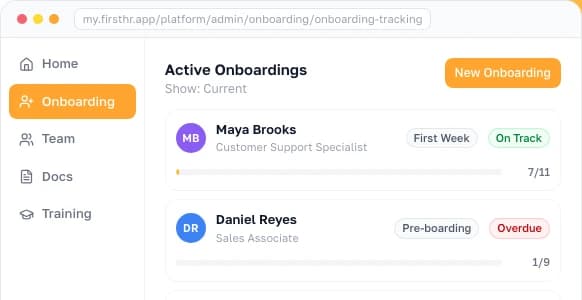
That is the part FirstHR handles. A manual attaches to the role and to the onboarding workflow instead of sitting in a drive, the sign-off comes back e-signed with a timestamp, training modules and tasks track who still owes what, and the completion lands on the employee profile as a training history you can produce on demand. Applicant tracking is coming soon to FirstHR, which will let the role you hired against decide which manual the new person is assigned. To be clear about scope, FirstHR is an onboarding and HR platform, not a payroll provider and not a course-authoring tool, so the writing stays yours.
Key Takeaways
A training manual template supplies the structure so you write content, and the consistency across manuals is worth more than any one template being perfect.
Eight parts make a complete manual: cover and version, how to use it, objectives, prerequisites, modules, quick reference, sign-off, and revision history.
Write objectives as observable actions with a standard attached, because an objective phrased as understanding cannot be checked by anyone.
Design for scanning: real heading styles, one idea per sentence, numbers for ordered steps, and a printable quick-reference page.
Four to eight modules per role, each ending in a check the trainer watches, gets finished; a manual long enough to look like a project gets put off instead.
Put a version number and a review date on the cover, because a manual describing a system you replaced is worse than no manual at all.
Frequently Asked Questions
What is a training manual template?
A training manual template is a reusable document structure for teaching someone a role or a topic, with the sections already in place so you supply the content rather than the shape. A complete one carries a cover and version block, a short note on how the manual is used and who to ask, the list of things the learner will be able to do at the end, the prerequisites, the modules themselves, a quick-reference page, a glossary, sign-off lines, and a revision history. The value of using the same template across manuals is consistency: a person who has finished one manual already knows how the next one works, and you stop re-deciding the structure every time a new role appears.
What should a training manual include?
Eight parts. A cover block with the version, owner, effective date, and next review. A short section on how the manual is used, who trains alongside it, and who to tell when it is wrong. A list of what the learner will be able to do, written as observable actions rather than as understanding. The prerequisites: access, equipment, and anything to read first. The modules, each with why the task matters, the steps, the mistake people actually make, and a check the trainer can watch. A quick-reference page of the things people look up repeatedly. A glossary. And sign-off lines plus a revision history. The two skipped most often are the observable check and the revision history, and both cause trouble later.
How do you design a training manual?
Design a training manual for scanning, not for reading straight through, because almost nobody reads one straight through twice. Use real heading styles rather than bold text, so the document has a structure that assistive technology and a table of contents can both read. Keep one idea per sentence and one topic per paragraph. Number anything sequential and use checkboxes for anything that is not. Put the quick reference on its own page so it can be printed. Choose a body size that survives a photocopy and enough contrast between text and background to be readable under bad lighting. Add a screenshot or a photo only where words would be slower, label it, and date it, because pictures of a system age faster than the text around them.
What is the difference between a training manual and a training guide?
A training manual teaches a whole role or subject and is usually finished once; a training guide walks one person through one system or process and is usually kept open while they work. The manual answers what this job is and how it is done here, so it covers several tasks and normally ends in a sign-off. The guide answers how do I do this thing in this tool, so it is task-shaped, uses the exact on-screen wording, and goes out of date the moment the vendor changes a screen. In practice a small business needs both: a manual per role, and a guide per system that more than one person touches. The templates on this page include one of each so you are not adapting the wrong shape.
How long should a training manual be?
Short enough that someone finishes it, which for most small-business roles means four to eight modules and well under thirty pages. Length is the main reason manuals go unread, because a document long enough to look like a project gets put off rather than started. Divide it by task instead of by chapter so every module ends somewhere a learner can pause and resume the next day, which is what makes the thing finishable at the pace a first week allows. If a single manual runs past about ten modules, that is two manuals: usually a core role manual plus a separate guide for one system or one specialty. Anything a person looks up repeatedly rather than learns once belongs on the quick-reference page instead of in a module.
Are these training manual templates free to download?
Yes. All six download as editable Word documents with no account, no email form, and no upgrade tier. That is worth saying because many training manual template pages route the file through a lead capture form or hold the more complete versions behind a paid plan. Free is not the same as finished, though: a template is a structure, and the value sits in the specifics you add, which is why three of these six are worked examples rather than blank forms. Start from whichever one sits closest to your situation, replace the bracketed placeholders, cut the sections you have no use for, and rewrite any sentence phrased in a way your own team would not recognize. Word rather than PDF is deliberate, because a manual is meant to be edited.
How often should a training manual be updated?
Review it once a year as a default, and rewrite the affected part immediately whenever the underlying work changes. The calendar matters less than the trigger: a new system, a new piece of equipment, a changed policy, or a new person owning the task all make the existing manual wrong in a way nobody notices until a new hire follows it and gets corrected in front of a customer. Software guides age fastest, because the vendor changes the screens and does not tell you, which is why a date on the screenshots is worth more than a general review note. Put the version number and the next review date on the cover, and add one line inviting readers to flag whatever no longer matches what they see in front of them.
Make HR the easy part of running your business
Onboarding, e-signatures, training and core HR in one place. Up and running in 5 minutes.