Sales LMS: 11 Platforms Compared
Sales LMS options compared: 11 platforms by published price, AI role play, ramp cost for 10 reps, and whether you need an LMS or an enablement platform.

Sales LMS: 11 Platforms Compared
Two different categories answer to the phrase sales LMS: learning platforms that teach and certify, and enablement platforms that also manage content and analyze calls. Four of the eleven here publish a price, and the rest want a demo first
My third sales hire is the one who taught me what a sales LMS (learning management system) is for. The first two sat ten feet away and learned by listening to my calls, asking questions between them, and copying what worked. The third started remote, in another time zone, with nothing to overhear.
So I went shopping, and found two categories wearing the same clothes. One is a learning platform: courses, practice, certification, and a completion record. The other is an enablement platform: a content library, call analysis, deal rooms, and coaching built on that data. Both answer to the phrase sales LMS, and they are priced an order of magnitude apart.
This page compares eleven platforms for a team of 10 reps, names the four that publish a price, and works through the ramp math that decides whether any of them is worth buying this quarter. Every capability and rate here was checked against the vendor's own pages in October 2026.
What a sales LMS is
A sales LMS is a learning platform used to ramp, update, and certify a revenue team: product and pricing knowledge, the pitch, objection handling, and process, assigned as courses and recorded as scored completions. The mechanics are the same as any learning system. What changes is the clock attached to them, because a rep who is not yet productive is carrying a quota nobody is hitting.
Three demands separate sales training from the rest of the training you run. Content goes stale fastest, since pricing, packaging, and competitors change between quarters. Practice matters more than comprehension, because reading an objection response teaches nobody to say it under pressure. And the certification is a gate rather than a certificate, since it decides who is allowed to talk to a paying customer.
LMS or sales enablement platform
Buy a learning platform if new reps pick things up by osmosis and no record exists; buy an enablement platform if reps cannot find current collateral and nobody hears what is said on calls. The two categories overlap on training and diverge on everything else, and the overlap is what makes shopping for one so confusing.
| Sales LMS | Sales enablement platform | |
|---|---|---|
| What it optimizes | Learning, practice, and certification | Content in the seller’s hands during a live deal |
| Who owns it | A founder, an operations lead, or a small learning function | A staffed enablement or revenue operations team |
| Price visibility | Often published, per user or per band | Quoted after a demo, licensed per seat |
| What lives inside it | Courses, quizzes, practice, and SCORM packages | Decks, one-pagers, call recordings, and deal rooms |
| What it will not fix | Finding the right case study mid-call | A new rep with no structured first month |
| What it costs at 10 reps | Between $80 and $198 a month, published | Unknown until a sales call, and priced above that |
The category is also consolidating, which matters when a multi-year contract is on the table. Highspot now describes itself as part of Seismic, and Seismic says the two have come together. The product formerly sold as WorkRamp is now Learn:Up inside Confirm, its new owner. A merger is not automatically bad news for a customer, but roadmaps get renegotiated after one, and the smallest accounts are the ones that feel it.
11 sales training platforms at a glance
The table below groups the eleven platforms by what each one is genuinely built around, then by whether you can learn the price without booking a call. At this size, the last two columns decide more shortlists than any feature grid does.
| Product | Category | Built around | Published price | Fit at 10 reps |
|---|---|---|---|---|
| FirstHR | HR platform | Onboarding, tasks, and training modules | $98 to $198 flat | Reachable |
| TalentLMS | Learning platform | Courses, quizzes, and certification | $119/mo yearly, to 40 users | Reachable |
| 360Learning | Learning platform | Peer-authored courses and feedback | $8/user/mo to 100 | Reachable |
| Learn:Up | Learning platform | Academies and structured onboarding | From $9/user/mo | Stretch |
| iSpring LMS | Learning platform | Authoring plus role-play simulation | Quoted under 100 users | Stretch |
| Second Nature | AI role play | Scored practice calls | Quote only | Stretch |
| Mindtickle | Enablement platform | Readiness: training, coaching, and calls | Quote only | Overkill |
| Seismic | Enablement platform | Content management with learning | Quote only | Overkill |
| Highspot | Enablement platform | Revenue execution with training | Quote only | Overkill |
| Allego | Enablement platform | Content, learning, and call intelligence | Quote only | Overkill |
| Showpad | Enablement platform | Content-first selling for field teams | Quote only | Overkill |
How we evaluated these platforms
We used four tests, chosen to match how a founder with 10 reps and no enablement hire would actually shop.
The platforms you can price without a call
Four products here publish enough of a rate card to budget from, and a fifth publishes rates once you pass 100 users. For a small team, that transparency is worth more than most feature differences.
TalentLMS is the most practical starting point for a team this size, because the whole rate card sits on the website and the Core band covers up to 40 users, which is usually the whole company rather than just the reps. You build modules for product, pricing, and objection handling, assign them with deadlines, and get scored completion records you can check before a rep runs a deal alone.
It is a general learning platform rather than a sales product. Nothing in it knows what a pipeline is, and there is no call recording. Its ready-made course library, TalentLibrary, is a paid add-on, and the pitch material is yours to write either way.
Purchased courses in SCORM format, a common packaging standard for e-learning content, do load properly. That matters if you buy off-the-shelf negotiation or compliance content rather than recording everything.
360Learning is the cheapest credible option for 10 reps, and its core assumption fits a sales team unusually well: the person who knows how to answer the pricing objection is the person who should record the answer. Authoring is collaborative, learners can flag a module as wrong or out of date, and that feedback loop is built into the product rather than left to a suggestion box.
The Team plan caps at 100 users and bills monthly with no annual commitment, which suits a team that hires in bursts and would rather not sign a year. Underneath, it is still a general learning platform: no call intelligence, no deal context, and analytics that answer who completed what rather than who closed more. Peer authoring also needs an owner, or the courses nobody was assigned to build simply do not appear.
Learn:Up is the product formerly sold as WorkRamp, now part of Confirm's scale-up line beside Practice, Perform, Academy, and Create, and the sales-academy shape survived the rebrand. It is built around structured onboarding programs with certification, which makes it the closest thing on this list to a purpose-built sales LMS that still publishes an entry rate.
That rate carries a condition worth reading twice. The published $9 per user per month assumes a 200-person company, so a 10-rep team gets a quote rather than the number on the page.
The rename matters too. When a product changes owner and name inside a short window, ask three questions out loud on the first call: how long the contract runs, who owns the roadmap, and what happens to your content if the line is discontinued.
iSpring LMS (formerly iSpring Learn) pairs the platform with authoring that runs inside PowerPoint, which is exactly why it turns up on sales shortlists. Product training goes stale at every release, and someone who can build a deck can build the replacement module in an afternoon. The vendor lists role-play simulations among what the toolkit produces, so branching conversation practice is available without a second purchase.
The pricing model points the wrong way for a small team. Rates fall as user counts rise and published tiers start at 100 users, so a 10-rep buyer starts from a quote rather than a rate card. Active-user billing is the consolation: somebody who touches training twice a year costs nothing in the other ten months, which suits a company where only the reps train every week.
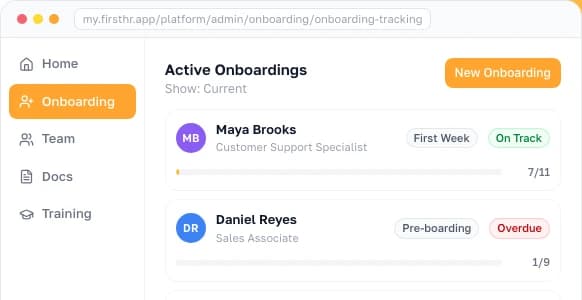
FirstHR is our product, and its place on this page is narrow enough to state plainly. Training modules with completion tracking sit inside an HR platform beside onboarding workflows, e-signature, task lists, and employee records.
A new rep signs the offer letter, acknowledges the comp plan, and works through product basics in one place during sales onboarding. The price is flat within each plan, so adding two reps in a quarter changes the bill only when the company crosses the 10-person or 50-person ceiling.
What we ship for training is a builder for your own material. The Training Wizard turns a pricing sheet, a recorded demo, or your objection notes into step-by-step courses, assigns them with an optional deadline, and records each completion with a signature.
Purchased SCORM courses, a ready-made course library, scored role play, call recording, and a managed library for decks come from the other platforms on this page. If pitch certification is the requirement, TalentLMS or Learn:Up belongs on your shortlist, and if practice volume is the requirement, a dedicated role play product will serve a rep better.
The enablement platforms, sold by quote
These five are the best-known enablement platforms, and none of them publishes a price. All five are strong products built for companies that employ someone to run enablement, which is the part most rankings leave out.
Mindtickle is the readiness platform, which in practice means it treats training, practice, coaching, and call analysis as one loop rather than four separate purchases. Its own site lists an AI copilot, an AI role play simulator, coaching, content management, digital sales rooms, and conversation intelligence, gathered under a platform the company calls ElevateOS.
That breadth is exactly what 10 reps cannot absorb. Somebody has to design the certifications, maintain the scorecards, and act on the readiness data, and when that somebody is the founder who also runs the pipeline, the platform ends up reporting on a program nobody is running. No rate is published anywhere, which tells you where the buying process is expected to start.
Seismic sells the enablement cloud, and its center of gravity is content: the library, the personalization, and getting the right asset into a seller's hands at the right moment, with learning and coaching running alongside. Its site states that Seismic and Highspot have come together, which puts two of the platforms on this page under one company.
For 10 reps, content management is the wrong problem to buy for. A team that size has three decks and a price list that one person keeps current, not version sprawl across four hundred assets. Pricing is quoted, implementation is a project rather than a signup, and the learning module you actually came for arrives attached to a platform sized for an enterprise content operation.
Highspot positions itself as an AI platform for revenue execution, pairing content management with sales training, coaching, adaptive learning paths, and AI role play. Among the enablement platforms here it is the one that treats training as a first-class product rather than as an attachment to the content library, which is why it belongs in a sales LMS comparison at all.
It is also now part of Seismic, per its own site, and that is the single most useful fact for anyone weighing a multi-year commitment in this category. No rate appears anywhere on the site; pricing arrives on request. The product is built around enablement programs that somebody has to run, and running them is a job rather than a Friday afternoon.
Allego is the most evenly balanced of the enablement platforms between content and learning, and its module list reads that way: content management, learning experiences, AI role play with instant feedback, conversation intelligence, and buyer-facing deal rooms. A team that wants practice and call review behind one login gets both without stitching two vendors together.
Pricing is quoted and nothing on the site suggests a small-team entry point. The practical caution repeats across this group: conversation intelligence is only as useful as the volume of recorded calls feeding it, and a 5-rep team records very few. The coaching habit still has to exist before software can scale it.
Showpad is the content-first option, built for teams who present from a tablet in a room with a buyer and need the current deck, the right case study, and a signal about what the buyer opened afterward. Its three packages are named Professional, Advanced, and Expert, and the platform is licensed on a per-user basis, per the vendor pricing page.
That page names no rate for any of the three, so the entry cost sits behind a quote request. Training and coaching exist inside the platform, but the reason anyone buys Showpad is content in the field. A company whose real problem is a new rep with no structured first month would be buying Showpad for its training side and paying for the whole content platform anyway.
AI role play, and what it replaces
AI role play buys repetition, which is the part of sales training that a small company schedules twice and then quietly drops. It replaces practice sessions you were never going to run on a Thursday evening, not the manager's judgment about what a good call sounds like.
Second Nature is a practice product rather than a platform, and that focus is the reason it belongs in this comparison. Reps hold a spoken conversation with an AI persona through discovery, cold calls, objection handling, and demos, get scored on the attempt, and run it again.
Second Nature does not have to replace anything, because it integrates into a learning platform you already own through SCORM and LTI (Learning Tools Interoperability, a standard for connecting outside tools to an LMS).
Pricing is not published, though sample role plays are open without a sales conversation, which is a fairer trial than most of this category offers. The honest limit is what a simulation can measure: it scores what a rep said, not whether a buyer would have signed. Keep one real recorded call reviewed every week alongside it, or you are certifying fluency rather than competence.
Role play is no longer only a standalone category, which changes how you should shop. Mindtickle, Highspot, and Allego all list AI role play inside their platforms, Confirm sells Practice as a separate module alongside Learn:Up from a published $4 per user per month, and iSpring counts role-play simulations among its authoring output.
Ask where practice lives before you ask about the course catalog, because that answer separates a rep who has read the objection handling from one who has said the words out loud.
What this costs for 10 reps
Published options for 10 reps run from $80 to $198 a month, and six of the eleven platforms here will not give you a number without a call. The table below models one sales team of 10 reps inside a company of roughly 25 people.
| Option | How it is priced | Monthly for 10 reps | Annual | What the number hides |
|---|---|---|---|---|
| 360Learning Team | $8 per user per month, billed monthly | $80 | $960 | Caps at 100 users; deeper tiers are quoted |
| TalentLMS Core | $149 flat for 1 to 40 users, billed monthly | $149 | $1,428 | Yearly billing cuts Core to $119 a month |
| FirstHR | $98 for up to 10 people, $198 for 11 to 50 | $198 | $1,980 | Priced on company-wide headcount, not on the sales team |
| Learn:Up | From $9 per user per month, billed annually | Quoted | Quoted | The published rate assumes a 200-person company |
| iSpring LMS | Per active user, from $6.91 at 100 users | Quoted | Quoted | A 10-rep team sits below the 100-user floor |
| Second Nature | Quote only | Quote | Quote | Sample role plays are open without a contract |
| Mindtickle | Quote only | Quote | Quote | Priced for a staffed enablement function |
| Seismic | Quote only | Quote | Quote | Implementation is a project rather than a signup |
| Highspot | Quote only | Quote | Quote | Pricing is offered on request only |
| Allego | Quote only | Quote | Quote | No small-team entry point is published |
| Showpad | Quote only | Quote | Quote | Three named packages, none of them priced publicly |
The difference between $80 and $198 matters less than it looks. The spread that matters is between a price you can act on this afternoon and one that takes two calls, a demo, and a procurement conversation to discover. For a small team, that gap usually decides whether training starts this month or next quarter.
The ramp math behind the budget
A month of extra ramp costs more than a year of any published-price platform on this page, and that single comparison settles most of the buy-or-wait question. The math is worth working through, because it also tells you how much content effort is justified.
Set that against the software. A year of 360Learning for 10 reps is $960, and a year of TalentLMS Core on yearly billing is $1,428. If a written, assigned ramp program removes four weeks from one hire's time to first closed deal, the platform has paid for itself several times over on that hire alone. If it changes nothing, the cheapest option was still the right one to have chosen.
Volume is the other half of the argument. The same handbook projects little or no change in employment for these sales representatives between 2025 and 2035, and still projects about 123,400 openings a year, most of them from people leaving the occupation or moving to another job. Sales hiring is replacement hiring, so your ramp program runs again and again, and a module recorded once is amortized across every hire that follows.
Manager time is the line nobody budgets. The handbook also puts the median annual wage for sales managers at $148,270 in May 2025, so the hour each week your sales manager spends re-explaining the pricing sheet to a new hire is not free either. That hour is precisely what a recorded module, or a role play library, is supposed to buy back.
Recorded modules pay off when they sit inside a written first month. A simple version, with a check at each stage, looks like this.
| When | What the rep works through | How you know it landed |
|---|---|---|
| Week 1 | Product, pricing, and the ideal customer, as short modules | A five-minute explanation of what you sell, recorded |
| Week 2 | The pitch and the five objections you hear most, said out loud | A scored role play, or a mock call with the manager |
| Week 3 | The CRM, the sales process, and where deals actually stall | A clean pipeline entry on a real opportunity |
| Week 4 | Live calls with review, one recording looked at each day | A call you would send to the next new hire |
| Day 30 | Certification before the rep runs a deal without a second person | A pass or fail decision, written down and dated |
That plan is the product you are actually buying, and it exists before any software does. Write it as a 30-60-90 day plan first, run it manually for one hire using the plan template, then decide which platform should hold it. A shortlist built after that exercise is short, because you know exactly which three things you need.
Training hours are hours worked
Assigned, job-related training counts as working time for a nonexempt employee (one entitled to overtime pay), so the role play homework you push into an evening is payroll rather than enthusiasm. Software makes assigning training frictionless, which is exactly what makes this easy to get wrong at speed.
The Department of Labor fact sheet on hours worked states that attendance at lectures, meetings, and training programs can be excluded from working time only when four criteria are all met: it is outside normal hours, it is voluntary, it is not job related, and no other work is performed at the same time.
The same four conditions appear in the federal regulation itself, 29 CFR 785.27. Sales training you assign to your own reps fails at least two of them: you required it, and it is about their job.
The verdict by team shape
A single ranking assumes every sales team has the same gap, but the right answer depends on the shape of your team. The seven rows below cover the common shapes, so find the one that describes your week.
| Your situation | What usually fits | What to avoid |
|---|---|---|
| 1 to 5 reps, founder-led selling | A written ramp plan plus the HR system you already pay for | Per-seat enablement software sized for an enablement team |
| 5 to 15 reps, no enablement hire | TalentLMS or 360Learning, with content you write yourself | Quote-only platforms that demo before they price |
| Practice is the gap, not knowledge | Second Nature, or the Practice module sold beside Learn:Up | Buying an entire platform to get role play |
| Product or pricing changes every release | iSpring LMS, for authoring plus simulation in one place | A platform where editing a course needs a specialist |
| Reps cannot find the current collateral | An enablement platform, once content volume is genuinely real | An LMS, which will not solve a content problem |
| Ramp is paperwork and product basics | FirstHR at a flat rate, plus one live call review a week | A sales LMS whose course engine you will never use |
| 50 or more reps with a staffed function | Mindtickle, Seismic, Highspot, Allego, or Showpad | Assuming a small-team tool will scale with the headcount |
The pattern across those rows is consistent. The smaller the team, the more the answer is a written plan plus the cheapest platform that will hold it, and the larger the team, the more the platform does something a person genuinely cannot. Most small sales teams sit in the first half of that sentence.
How to choose a sales LMS
Five questions settle this, and the first two remove most of the market before you open a single trial.
Getting the order right saves money. Before you shortlist anything, record two modules: the product overview and the five objections you hear most often. If that takes an afternoon and the reps use it, you have learned exactly what the platform has to do. If nobody finds the afternoon, no purchase on this page will fix that, and you found that out for free.
Frequently Asked Questions
What is a sales LMS?
A sales LMS is training software aimed at the revenue team rather than the whole company. It covers what reps need to know and say, from product and pricing to the pitch, objections, and process, and assigns it as courses with scored records. It runs on the same mechanics as any training platform. What sets it apart is the yardstick: time to first closed deal and a certification gate before a rep runs a deal alone, rather than training hours logged.
What is the difference between a sales LMS and a sales enablement platform?
A learning platform teaches and certifies, while an enablement platform also puts content into a seller's hands during a live deal and analyzes the calls afterward. Enablement adds a versioned content library, digital sales rooms, conversation intelligence, and coaching built on that data, and assumes somebody is employed to run it. The test is which failure you recognize: reps who were never taught, or reps who cannot find the current deck.
How much does a sales LMS cost?
Among the options that publish a rate, it runs between $80 and $198 a month for 10 reps, and everything else is quoted. 360Learning is $8 per user per month to 100 users, TalentLMS Core is $149 a month for 1 to 40 users or $119 billed yearly, and FirstHR is flat at $98 or $198 by seat tier. Learn:Up publishes $9 per user on a 200-person basis, so smaller teams are quoted.
What is the best sales LMS for a small business?
For most small teams, the answer is TalentLMS or 360Learning, because both publish a price and neither assumes an enablement hire. TalentLMS fits when you want scored certification and the ability to load purchased courses; 360Learning fits when your best rep should be authoring the material. If the gap is practice, add a role play tool to either one rather than upgrading tiers, which is usually cheaper than moving to a bigger platform.
Do you need AI role play to train a sales team?
No, though it is the cheapest way to buy repetition once a manager's calendar is full. A new rep needs to say the words twenty times, and a small company seldom keeps a practice slot on the calendar long enough for that. Two cautions: a simulated buyer rewards fluency rather than judgment, and scenario quality depends on how well you wrote the personas. Keep one real call review each week beside it.
Do you have to pay reps for time spent in sales training?
For nonexempt employees, yes in almost every realistic case. Federal rules exclude training from working time only when attendance is outside normal hours, voluntary, unrelated to the job, and free of other work, and training you assign fails the voluntary and job-related tests immediately. Inside sales roles are frequently nonexempt, so confirm the classification before scheduling evening practice, and capture the hours when it happens.
Can you run sales training without buying a sales LMS?
Yes, and for a team under 5 reps that is usually the better call. What changes outcomes is a written ramp plan, recorded answers to the objections you really hear, one call reviewed every week, and a dated certification decision. Software earns its price when you can no longer remember who completed what, or when a rep starts in a time zone where nobody is awake to answer questions.
Make HR the easy part of running your business
Onboarding, e-signatures, training and core HR in one place. Up and running in 5 minutes.
- 7-day free trial
- No credit card required
- Cancel anytime