
Free Social Worker Job Description Templates
Free social worker job description templates: general, clinical LCSW, school, healthcare, case manager, and nonprofit. Copy or download as DOCX.

Hiring a social worker is different from most other hires because the title hides enormous variety. A social worker can be a therapist diagnosing mental health conditions, a school staff member supporting students, a hospital team member coordinating discharge, or a case manager connecting families with benefits.
Each of those is a different job with a different license, a different salary, and a different candidate pool. The job description is where you make that unmistakable, so the right people apply and the wrong ones screen themselves out.
At FirstHR, we build for small organizations that hire without a dedicated HR department, where a practice owner or an executive director writes the posting between everything else. The six templates below cover the most common versions of the role, and each is ready to use.
Fill in the bracketed fields, adjust to match your organization, and post. Before you do, here is the test I would apply to any draft: could a stranger tell from the first paragraph which kind of social work this is?
- Sign the offer letter
- Sign the employee handbook
- Workplace Safety course
What Is a Social Worker Job Description?
A social worker job description is a short document that explains the role's purpose, responsibilities, qualifications, and compensation so you can post a job and attract the right candidates. It typically covers a job summary, the population served, key responsibilities, the required license, preferred qualifications, the salary range, and how to apply.
According to the Society for Human Resource Management's job description guide, a job description outlines the tasks, duties, and responsibilities of a position, and that standard applies whether you are a county agency or a small counseling practice.
For social work specifically, the document does double duty. It attracts applicants, and once someone is hired it becomes the reference point for their caseload, documentation expectations, and supervision.
Which Template Should You Use?
Pick the template that matches the setting and license you are hiring for. The core structure is the same across all six, but each one emphasizes the responsibilities, license, and language that fit a specific kind of social worker. Use this guide to choose.
6 Free Social Worker Job Description Templates
Download all six as separate Word files in one ZIP, or copy individual templates. Each one follows the same structure: organization overview, job summary, key responsibilities, qualifications, compensation, and how to apply. Fill in the brackets before you post.
Template 1: General Social Worker
The universal baseline. Covers assessment, service planning, case management, advocacy, and documentation. Use this if your role does not fit cleanly into a specific setting.
Template 2: Licensed Clinical Social Worker (LCSW)
For a clinician providing direct therapy, diagnosis, and treatment. Requires an active LCSW license. Built for private practices and clinics that need clinical capability.


Template 3: School Social Worker
For a social worker supporting students' social, emotional, and behavioral wellbeing. Covers counseling, family resources, and collaboration with teachers and administrators.
Template 4: Healthcare / Medical Social Worker
For a social worker on a healthcare care team. Covers psychosocial assessment, discharge and transition planning, care coordination, and HIPAA-compliant documentation.
Template 5: Case Manager / Human Service Worker
For coordination and resource navigation without clinical therapy. Often open to a bachelor's degree, which widens your applicant pool. Ideal when you need help, not therapy.
Template 6: Small Nonprofit / Community Generalist
For a versatile social worker at a lean nonprofit who combines direct client service with program work, community partnerships, and administrative tasks. The common small-org reality.
Social Worker Duties and Responsibilities
Social worker duties fall into four broad categories. A good job description picks the specific duties from each category that apply to your setting and license level rather than listing every possible task. These are the responsibilities most often expected of the role.
The mix shifts by setting: a clinical role weighs heavily toward assessment and therapy, while a case manager role weighs toward coordination and resource navigation. At a small organization, the role usually expands to include program and community work too.
How the Duties Shift in School and Medical Settings
A school social worker owns counseling, intervention plans, and the attendance and special education work that keeps a student in class. A medical social worker owns psychosocial assessment and the discharge plan, sitting inside a clinical care team. The table sets both beside the other four versions of the role.
| Setting | Signature duties | Coordinates with |
|---|---|---|
| General | Needs assessment, service plans, advocacy, case notes | A supervisor and community providers |
| Clinical (LCSW) | Diagnosis, psychotherapy, treatment planning | Referring providers and payers |
| School | Student counseling, crisis intervention, intervention plans, attendance and special education support | Teachers, counselors, administrators, and parents |
| Healthcare / Medical | Psychosocial assessment, discharge and transition planning, benefit and resource connection | Physicians, nurses, and the care team |
| Case Manager | Resource navigation, eligibility paperwork, progress tracking | Benefit agencies and service providers |
| Nonprofit Generalist | Direct client service plus program and community work | An executive director and partner organizations |
The minimum license moves with the setting as well. The school template asks for a master's in social work (MSW) plus any school certification your state requires, while the medical template accepts a bachelor's-level license, where your state offers one, for coordination work that is not therapy. Pick the row that matches your opening and the responsibilities list mostly writes itself.
Social Work Licenses: LBSW, LMSW, and LCSW
Social work licensing is tiered, and the license you require is the most important decision in your posting: it determines who can legally do the work, how large your applicant pool is, and what you will pay.
The tiers covered here are the LBSW (licensed baccalaureate social worker), the LMSW (licensed master social worker), and the LCSW (licensed clinical social worker). The exact names and the number of tiers vary by state.
| License | Education | What it allows | Typical use |
|---|---|---|---|
| LBSW | Bachelor's in social work (BSW) | Non-clinical practice, case management | Case management, resource navigation |
| LMSW | Master's in social work (MSW) | Broader practice, often supervised | Generalist roles, agency work |
| LCSW | MSW plus supervised clinical hours and exam | Independent diagnosis and therapy | Clinical roles, private practice |
The clinical tier is the one constant. According to the Bureau of Labor Statistics, all states require clinical social workers to be licensed, while only some states license nonclinical social workers. The LCSW path runs through an MSW, supervised clinical experience that may take several years, and a clinical exam.
Which lower tiers exist depends on your state. The Texas Behavioral Health Executive Council issues all three licenses in the table, while the New York Office of the Professions licenses only the LMSW and LCSW. Check your state board before you name a license in the posting.
Match the license to the work first, then write everything else around it. If you are unsure whether you need clinical capability at all, the case manager template describes the non-clinical version of this role and may be the better fit and the cheaper, faster hire.
What to Include in a Social Worker Job Description
Every strong social worker job description includes the same core sections, and each one has a job to do. The summary says who you are and what the role owns, and the population served tells candidates whether the work fits them. The responsibilities show the day-to-day work, and the required license sets who can apply.
Preferred qualifications let you ask for more without turning away good candidates, the salary range sets expectations, and the apply steps tell people what to do next. The templates above already include every section, so the work that remains is making the duties concrete. The table below shows the difference.
| Weak bullet | Strong bullet |
|---|---|
| Help clients | Assess client needs and develop individualized service plans |
| Provide counseling | Conduct biopsychosocial assessments and deliver evidence-based therapy |
| Connect to resources | Connect clients with housing, benefits, and community support services |
| Keep records | Maintain timely, confidential case notes in compliance with privacy rules |
| Coordinate care | Develop discharge plans and coordinate with physicians and providers |
Specific, measurable duties attract candidates who can actually do the work and signal a serious employer. Keep the language neutral and inclusive too, since the Equal Employment Opportunity Commission (EEOC) prohibits job advertisements that show a preference based on protected characteristics.
How to Write a Social Worker Job Description
A strong social worker job description is quick to write if you follow a clear structure. Here is the process the templates are built around.
Before you post, double-check that the role names a required license and reports to a named person.
Social Worker Salary
Set your salary range using government data as a baseline, then adjust for license level, specialization, and location. Pay varies widely across the social work profession, and a clinical LCSW role sits well above a bachelor's-level case manager role.
Pay also varies sharply by specialization. According to the same BLS data (May 2025), healthcare social workers earn a median of $67,880, while child, family, and school social workers earn $59,550. Position your range against the type and license you are hiring.
Always publish a salary range. Publishing one is now legally required in many states and it attracts more qualified applicants. Federal wage and hour rules also apply, so learn the basics on the Department of Labor's Fair Labor Standards Act (FLSA) page before you set pay and classify the role.
Hiring a Social Worker for a Small Practice or Nonprofit
A small counseling practice or nonprofit needs a different posting than a large agency. Its social worker is often a generalist who reports straight to the owner or executive director and does program and community work alongside direct service.
Large agency templates assume a big team, narrow specialized roles, and layers of supervision. A small practice or nonprofit has none of that, so here is how to write the posting for that reality.
From Hiring to Onboarding
The job description is step one. Once a candidate accepts, the same document becomes the foundation for the offer letter and the onboarding plan. A social worker needs careful onboarding because they handle sensitive client information and pick up a caseload quickly, and any clinical role carries compliance and confidentiality stakes from day one.
Verify the new hire's license, set up secure access to your case management and records systems, and set clear expectations about documentation, confidentiality, and supervision in the first weeks.
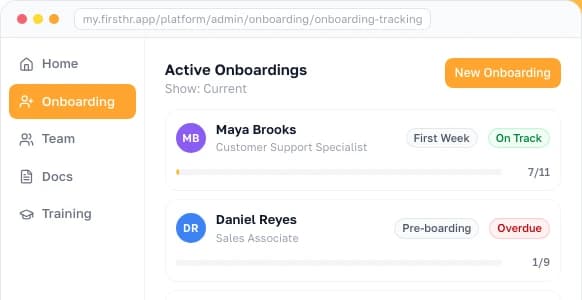
The offer letter template handles the next step once your offer is ready, and an onboarding template gives the new hire a structured start. FirstHR connects the offer, paperwork, and onboarding workflow in one place so a small practice or nonprofit can manage the full process without a dedicated HR department.
Employers also have recordkeeping obligations from day one, and the Department of Labor lists the records an FLSA-covered employer must keep for each nonexempt worker.

Frequently Asked Questions
What does a social worker do?
A social worker helps people cope with challenges and connects them to the resources and support they need. Core duties include assessing client needs, developing and monitoring service or care plans, providing counseling, connecting clients with community resources and benefits, advocating on their behalf, and maintaining confidential case records. The exact work depends heavily on the setting. A clinical social worker provides therapy and diagnoses mental health conditions, a school social worker supports students, a healthcare social worker coordinates patient care and discharge, and a case manager focuses on resource navigation. A clear job description matters because it tells candidates which kind of social work the role actually involves and what license it requires.
What should a social worker job description include?
A strong social worker job description includes a short job summary, the population you serve, 8 to 10 specific responsibilities, required and preferred qualifications, the exact license required, the reporting line, a salary range, and how to apply. Because social work spans clinical, school, healthcare, and case management roles, the most important detail is the setting and the license. State clearly whether you need an LCSW for clinical work or whether a bachelor's-level or case manager role will do. Specific, concrete duties such as “conduct biopsychosocial assessments” or “coordinate discharge planning” attract the right candidates far better than vague phrases like “help clients.”
What is the difference between LBSW, LMSW, and LCSW?
These are tiered social work licenses, and the exact names and the number of tiers vary by state. An LBSW (Licensed Baccalaureate Social Worker) is based on a bachelor's degree in social work and typically covers non-clinical roles like case management. An LMSW (Licensed Master Social Worker) requires a master's degree and allows broader practice, often under supervision. An LCSW (Licensed Clinical Social Worker) requires a master's degree plus supervised clinical hours and a clinical exam, and it permits independent diagnosis and therapy. Only an LCSW can usually provide independent clinical treatment. Match the license to the work: therapy calls for an LCSW, while case management can often go to a bachelor's-level hire, which opens up more applicants wherever your state offers that license.
Do I need to require an LCSW?
Only if the role involves clinical therapy or diagnosis. Independent clinical practice requires an LCSW, so a job that provides psychotherapy or mental health diagnosis has to ask for one. For a role that is really case management or resource navigation, though, the same requirement needlessly shrinks the applicant pool and pushes up the pay you will have to offer. Non-clinical roles can usually go to someone with a bachelor's-level license such as an LBSW, where your state issues one, or to a case manager with a related degree. Decide what the role actually does, then require the lowest license level that legally covers that work.
What salary range should I list for a social worker?
Anchor the range on government wage data, then move it up or down for the license you require, the specialty, and where the job is located. The Bureau of Labor Statistics put the median social worker wage at $61,780 a year in May 2025, with the bottom 10 percent earning less than $42,790 and the top 10 percent more than $100,090. Specialty matters: the healthcare social worker median was $67,880, against $59,550 for child, family, and school social workers. Expect a clinical LCSW role to cost more than a bachelor's-level case manager role. Always include a range, since many states now require pay transparency and a clear range attracts more qualified applicants.
How do I write a social worker job description for a small practice or nonprofit?
Write the posting for the job as it really is, which at a small practice or nonprofit is often broader than a large agency's narrow role. The social worker frequently splits time between direct client service, program work, community partnerships, and administrative tasks, so say so plainly. Name the exact license you require, keep the qualifications realistic instead of a long institutional wish list, and lean on what small organizations offer better than big ones: mission, variety, and direct impact. The small nonprofit generalist and case manager templates here are written specifically for lean teams without a dedicated HR department.
What is the difference between a social worker and a case manager?
The roles overlap, but the key difference is clinical scope and licensing. A licensed social worker, especially an LCSW, can assess, diagnose, and in clinical roles provide therapy, and the title usually implies a social work degree and license. A case manager focuses on coordinating services, connecting clients with resources, and tracking progress, and the role is often open to a bachelor's degree in a related field without a clinical license. Many social workers do case management, but not all case managers are licensed social workers. Before you post, decide whether you need clinical capability or coordination, since that determines the title, the required license, and the salary.
What happens after I hire a social worker?
After a candidate accepts, the job description feeds straight into the offer letter and the onboarding plan. Social workers need a careful start because they handle sensitive client information and take on a caseload quickly. In the first weeks, check their license, give them secure access to your case management and records systems, and spell out your expectations for documentation, confidentiality, and supervision. A strong start protects both clients and your organization. FirstHR handles the offer letter, document storage, and onboarding workflow in one place, so a small practice or nonprofit can move a new social worker from hire to fully effective without a dedicated HR department.
Make HR the easy part of running your business
Onboarding, e-signatures, training and core HR in one place. Up and running in 5 minutes.
- 7-day free trial
- No credit card required
- Cancel anytime