
Employee Feedback Form Templates (6 Types)
Free employee feedback form templates for small business: general, peer, upward, anonymous, project debrief, and a manager feedback log. DOCX.

Employee Feedback Form Templates
Six feedback forms for a team without an HR department: manager to employee, peer to peer, employee to manager, an anonymous version, a project debrief, and a running feedback log. Editable Word files, downloaded directly, with no email form in the way.
The first feedback form I ever wrote was one line long, and it was a bad line. Something about attitude. The employee read it, asked what he was supposed to do differently, and I had no answer, because there was nothing in the sentence he could act on. That was the day I stopped writing conclusions and started writing what actually happened.
An employee feedback form is a page that forces that discipline. It asks for the situation, the behavior, the impact, and the next step, and it leaves almost nowhere to put a vague judgment. Most versions online sit behind a performance platform that wants an account first, which is a lot of friction when you want to print six copies.
There are six forms here, one for each direction feedback travels in a small team: manager to employee, colleague to colleague, employee to manager, an anonymous version about the company, a project debrief, and a running log for the manager. Each downloads as an editable Word document, free and without an email.
What an Employee Feedback Form Is
An employee feedback form is a short document that captures one piece of feedback in writing: what happened, what the person did, what it caused, and what should change. It covers a single situation rather than a whole period, which is what separates it from a review form.
Feedback travels in more than one direction, and the form changes with the direction. A manager records praise or a correction. A colleague describes how the two of them work together. An employee tells their manager what to start, stop, and keep doing. An anonymous version asks about the company rather than about a person. The structure underneath is the same in all four cases.
The point of writing it down is not formality. It is that specific written feedback survives: the employee can reread it, the next step has a date on it, and a review six months later can be built from a record rather than from whatever happened most recently.
What to Include in a Feedback Form
Four blocks cover everything a feedback form needs: who and when, the situation and its impact, what to keep and change, and the response and sign-off. Every form below is built from these, and anything outside them tends to reduce how often the form gets used at all.
The middle block is where feedback forms succeed or fail. Situation, behavior, impact is a well-worn structure precisely because it leaves no room for a conclusion about the person: you write what an observer could have seen, then what it caused. The last block matters more than it looks, because a signature confirming the conversation happened, with a line saying it does not mean agreement, removes an argument that otherwise happens every time.
Which Form Should You Use?
Pick the form by who is giving feedback to whom. Manager to employee: the general form. Colleague to colleague: peer. Employee to manager: upward. About the company rather than a person: anonymous. After a project or a busy season: the debrief. For your own running record: the log.
6 Free Employee Feedback Form Templates
Download all six together or take the ones you need. Each is a complete form with the prompts already written, ready to print or attach. Delete any section that does not apply rather than sending it with blanks in it.
Template 1: General Employee Feedback Form
Situation, behavior, and impact, followed by what to keep doing, what to change, an agreed next step with a date, and space for the employee to respond. The default when a manager needs to put one piece of feedback in writing.
Template 2: Peer-to-Peer Feedback Form
Five statements about how two people actually work together, plus one thing that helped and one that would make it easier. Written to be summarized into themes by the manager rather than passed on rater by rater.
Template 3: Upward Feedback Form (Employee to Manager)
Start, stop, and keep, wrapped around seven statements about clarity, information, and whether it is safe to disagree. Pair it with a regular one-on-one so the answers have somewhere to go.
Template 4: Anonymous Employee Feedback Form
Five open questions and four ratings about the company rather than a person, with a section naming the matters that cannot be handled anonymously. Lighter than a full employee survey and quicker to act on.
Template 5: Project and Busy Season Debrief Feedback Form
What worked, what did not, where the work got stuck waiting on someone, and one change with an owner and a date. For the end of a project or a busy season, filled in within a week while the detail is still there.
Template 6: Manager Feedback Log (Running Record)
One page per person, a few sentences per entry, added the same week something happens. This is the document that makes a review form easy to write, because the year is already on paper.
Writing Feedback a Form Can Hold
Written feedback works when a stranger could read the entry and know what happened. That is a higher bar than spoken feedback clears, because tone and context do not survive the page, and it is the reason so many completed forms are useless.
The test I use is simple: could the employee do something different tomorrow based on this sentence? If the answer is no, the sentence is a judgment. Judgments feel accurate to write and impossible to act on, which is the worst combination a feedback form can produce.
| Situation | Entry that cannot be used | Entry that can |
|---|---|---|
| Missed handovers | Careless about process. | The shift handover notes were skipped on three of five days last week, and the closing team stayed late to reconstruct what happened. |
| Difficult client call | Handled it well, great job. | On the Tuesday call you repeated the client’s complaint back before answering it, the call ended calmly, and the renewal was signed the same week. |
| Quiet in meetings | Needs to be more of a team player. | In the last three planning meetings you raised concerns afterward rather than in the room, so decisions were reopened twice. |
| Slipping deadlines | Poor time management. | Two of the last four reports arrived after the Friday cutoff, which pushed payroll prep into Monday morning. |
| Helping a new hire | Good attitude toward onboarding. | You spent three afternoons walking Priya through the ordering system, and she processed her first order alone in week two. |
| Pushback on a decision | Resistant to change. | You said in the meeting that the new checklist would not work on the floor, and you were right, so we changed two steps before rollout. |
Notice that the usable version of a positive entry is just as specific as the corrective one. Praise written as an adjective evaporates. Praise written as an event is something the employee can repeat on purpose, and something you can point at in a review.
Anonymous, Named, or Optional
Anonymity should follow the subject of the feedback, not the sensitivity of it. Feedback about the company, the workload, or a process gets more honest without names. Feedback about one person gets more useful with them, because you can check the detail and follow up.
The optional middle ground works better than most employers expect. Making the name field optional lets the people who want a conversation identify themselves and lets the rest stay quiet, and it stops you from promising a level of confidentiality that a team of eight cannot deliver anyway.
| Approach | What it fits | What you give up | What to say on the form |
|---|---|---|---|
| Named | Feedback about one person, peer input a manager will act on, anything needing follow-up | Candor on sensitive topics, especially anything involving the boss | Who will read it and whether comments will be quoted or summarized |
| Anonymous | Company-wide questions, workload, process, morale, upward feedback in a tense period | The ability to ask a clarifying question or check a claim | That answers are reported as themes, and which matters cannot be anonymous |
| Optional name | Most small-team situations, upward feedback, peer forms in a first cycle | A consistent basis for comparison across responses | That leaving the name blank is genuinely fine, and what changes if it is filled in |
How Often to Ask, and How Often to Write It Down
Feedback should be frequent and the paperwork should not be. The conversation happens whenever something happens; the form is for the moments worth keeping, which in a small business is a handful per person per quarter.
SHRM makes a related point about timing: a manager who saves a year of criticism for the annual evaluation delivers it in one dose that lands badly, where the same content given in small pieces through the year is ordinary (SHRM). The log template exists for exactly that reason.
A rhythm that holds up for a small team: talk when something happens, write a form for anything significant or repeated, add a log entry the same week for everything else, and run a structured collection such as the upward or anonymous form once or twice a year. That is enough to make a review defensible without turning a nine-person company into a paperwork exercise.
Four Mistakes Worth Avoiding
These four turn up constantly, and each one quietly wastes the effort of writing anything down at all.
The thread through all four is the gap between recording feedback and using it. A form is cheap to write and easy to file unread, which is why it is worth deciding what you will do with an answer before you hand the page out.
Feedback Forms for a Small Business
A large company runs feedback through a platform, a cycle, and an HR function. A small business gets most of the value from six pages and a habit. Here is where the gap between the two actually matters, and what to do about it.
Collect, Read, and Keep
A feedback form is worth the paper only if it gets returned, read, acted on, and kept. The form is the easy part. The routine around it is what turns individual comments into something a personnel record can carry.
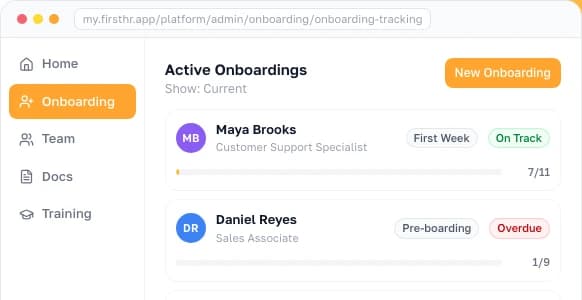
The templates above work on paper, and for a shop floor or a kitchen that is often the right choice. To run it without paper, FirstHR assigns the form as a task with a due date, lets people complete it through the self-service portal, and stores the signed result on the employee profile so feedback, onboarding paperwork, and training history sit in one record rather than four inboxes. New hire feedback in the first weeks is part of onboarding, and the onboarding workflow can carry it as a step. To be clear about scope, FirstHR is an onboarding and HR platform, not a payroll provider, and it does not run payroll or administer benefits. Applicant tracking is coming soon to FirstHR.
Frequently Asked Questions
What is an employee feedback form?
An employee feedback form is a one-page record of a single piece of feedback, written close to the event: the situation, the observable behavior, the effect it had, and the step agreed on afterwards. It is used in both directions. A manager uses it to record praise or a correction for someone on the team, a colleague uses a peer version to describe how the two of them work together, and an employee uses an upward version to tell their manager what to start, stop, and keep doing. Anonymous versions ask about the company rather than about a person. Unlike a review form, it covers a single situation rather than a whole period, and it is written close to the event while the detail is still accurate. Its job is to make feedback specific and repeatable, not to produce a score.
What should an employee feedback form include?
Four things. First, the basics: who the feedback is about, who wrote it, the date, and whether it is positive, corrective, or both. Second, the situation, the behavior, and the impact, written as things an observer could have seen rather than as conclusions about the person. Third, what to keep doing and what to change, kept separate so the positive half does not disappear. Fourth, one agreed next step with an owner, a date, and space for the employee to respond, plus a signature confirming the conversation happened. A signature confirms discussion, not agreement, and saying so on the form removes a common argument. Anything beyond those four sections tends to reduce how often the form actually gets filled in.
Should employee feedback forms be anonymous?
It depends on what the form is about. Questions aimed at the business itself, its processes and how much work people are carrying, draw franker answers with no name attached, so anonymous is the better default there. Feedback about one person is more useful named, because you can follow up, check the detail, and act on it fairly. Be careful about what you promise on a small team: with eight people, a comment about a specific route, shift, or account identifies its author regardless of the blank name field. Say plainly that answers are reported as themes and will not be quoted word for word, and state which matters cannot be handled anonymously at all, including harassment and safety concerns, which need a name so they can be investigated properly.
What is the difference between a feedback form and a performance review form?
Scope and timing. A feedback form covers one situation and gets written within days of it happening, while a review form covers a whole period and is completed on a schedule, usually with ratings and an overall assessment. Feedback is meant to change something this week. A review is meant to summarize and formalize. The two work best together: feedback forms and a running log through the quarter give the review something to be built from, which is why reviews written from a record read as fair and reviews written from memory tend to reflect whatever happened in the last few weeks. Use both, and do not let the review be the first time a piece of feedback appears in writing.
How often should you use a feedback form?
Feedback itself should be frequent, but the written form is for the moments worth keeping. Gallup puts full engagement at 80% among workers who report meaningful feedback within the past week, and finds a 3.6 times higher likelihood of strongly agreeing that they are motivated toward outstanding work where the manager gives feedback daily instead of annually. That is a case for constant conversation, not constant paperwork. In a small business the pattern that holds up is roughly this: say it out loud as things happen, put anything serious or recurring on a form, note the rest in the log within the week, and run one or two structured rounds a year using the upward or anonymous version.
Can a feedback form be used in a termination decision?
It can be part of the record, which is exactly why the wording matters. Feedback forms written in specifics, dated close to the event, and shown to the employee at the time make a consistent picture. Forms full of conclusions like bad attitude, or written months later when a decision was already being considered, tend to undermine the case rather than support it. Keep feedback separate from formal discipline: once a situation calls for a warning or a performance improvement plan, switch to those documents, which state consequences and timelines. Write every entry as though the employee will read it, because they may. This is general information, not legal advice, and an employment attorney should review anything that leads toward termination.
Where should completed employee feedback forms be stored?
With the employee record, in one place that is still findable in two years. Completed forms that live in a manager’s inbox are effectively lost by the time a review, a promotion decision, or a dispute needs them, and they disappear entirely when that manager leaves. There is also a retention floor to respect. Under Equal Employment Opportunity Commission rules the minimum is a year for personnel and employment records, measured from the termination date where the exit was involuntary, and records tied to the issues under investigation must be preserved for longer once a charge lands. Anonymous feedback is the exception. Keep it aggregated and separate from individual files so it stays anonymous. This is general information, not legal advice.
Make HR the easy part of running your business
Onboarding, e-signatures, training and core HR in one place. Up and running in 5 minutes.
- 7-day free trial
- No credit card required
- Cancel anytime