
How to Hire Cleaning Employees: A Guide for Cleaning Business Owners
How to hire cleaning employees for a residential or commercial cleaning business: sourcing, working interviews, pay, probation, and day-one compliance.

How to Hire Cleaning Employees
Sourcing, working interviews, pay benchmarks, key control, and a probation plan for owners who do their own hiring
A residential cleaning company owner once told me a number she was embarrassed to say out loud. To keep fourteen positions filled over twelve months, she had hired forty-one people. Most never made it past the second week. She was not running a bad company. She was running a hiring process that consisted of posting an ad, meeting whoever answered, and handing them a caddy.
Cleaning is one of the few businesses where the hiring problem and the operations problem are the same problem. Every unfilled route is revenue you cannot invoice, and every new face in a client's home is a trust decision you are making on that client's behalf. Get it wrong and you lose the account, not just the employee.
So this guide is written for the person who owns the cleaning business and also does the hiring. Where cleaners actually come from, how to screen without burning a full day, how to run a group session and a paid working interview, the wage and safety rules that catch cleaning companies specifically, and what to do in the first ninety days so you are not filling the same route twice in one year.
Why Hiring Cleaners Is Hard, and What Actually Fixes It
Hiring cleaners is hard because almost every opening is a replacement opening. The demand is not coming from a growing industry, it is coming from people leaving, which means you are always hiring into a churn rather than into an expansion.
That number is more useful than it looks. It says your constraint is retention rather than scarcity, so the question worth answering is whether the job you offer is one a person can build a week around. Three things drive early quits in this trade, and a small owner can fix all three: a schedule that changes without warning, a route the cleaner was never actually shown, and chemicals nobody trained them on.
Fixing those does not require a recruiting budget. It requires the process below to exist on paper instead of in your head, which is the same thing that separates a company that hires fourteen people a year from one that hires four.
Decide What You Are Hiring For Before You Write the Post
The most common cause of a two-week quit in cleaning is a mismatch between the job the person accepted and the route they were actually given. Residential, commercial, and specialty work are three different jobs with three different candidate pools, and posting one generic cleaner ad for all of them guarantees mismatches.
Decide two more things at the same time. First, solo or team: a two-person team finishes a home faster and gives you a built-in trainer, but it doubles the impact of one absence. Second, part-time or full-time. Evening janitorial shifts fill easily with candidates who need a second job, while daytime residential routes need someone whose whole week is available.
Write those decisions down before you touch the ad.
W-2 Employee or 1099 Contractor: Settle This First
If you assign the route, set the schedule, supply the chemicals and equipment, and require a uniform, the cleaner is a W-2 employee regardless of what the agreement is titled. The IRS weighs behavioral control, financial control, and the nature of the relationship, and none of those tests care what the document says at the top.
This matters more in cleaning than in almost any other small business, because the trade has a long habit of calling recurring crew members independent contractors. The classification test is not close in most of those cases.
| The question | Points to W-2 employee | Points to 1099 contractor |
|---|---|---|
| Who decides the order and the method? | You hand over a route sheet and a checklist | The cleaner decides how and in what order the work gets done |
| Who supplies chemicals, vacuums, and cloths? | You do, and you restock the caddy | They bring their own equipment and consumables |
| Whose client is it? | Yours. You bill the client and pay the cleaner a wage | Theirs. They invoice the property owner directly |
| Can they realistically work elsewhere? | No. Your schedule fills their week | Yes, and they actively market to other clients |
| Who absorbs a redo? | You do, at your cost, on your time | They return and fix it under their own contract |
| Uniform and branding | You require your shirt and your vehicle | They arrive in their own branding or none |
| What being wrong costs | Not applicable | Back employment taxes with interest, unpaid overtime for the entire period, and state penalties on top |
If you want scheduling flexibility, the legal way to get it is part-time employees with variable hours, not contractor paperwork over an employee relationship. The difference between the two is control, and control is the thing a cleaning company cannot give up without losing the account.
What to Pay Cleaners, and What an Hour Actually Costs You
Start from the national wage ladder, then adjust for your metro. According to the Bureau of Labor Statistics Occupational Employment and Wage Statistics survey (May 2025), the median hourly wage is $17.71 for janitors and cleaners and $17.07 for maids and housekeeping cleaners.
| Percentile | Janitors and cleaners | Maids and housekeeping cleaners |
|---|---|---|
| 10th | $13.77 | $13.29 |
| 25th | $15.50 | $14.59 |
| 50th (median) | $17.71 | $17.07 |
| 75th | $21.18 | $19.03 |
| 90th | $24.17 | $23.35 |
Those are national hourly figures from the same BLS survey, and cleaning wages swing hard between markets, so treat the ladder as a shape rather than a target. What it tells you is that the gap between the 25th and the 75th percentile runs from roughly four to six dollars an hour, and that spread is the room you have to pay for reliability.
Then calculate what an hour actually costs you. Add employer FICA at 7.65% of wages, federal and state unemployment tax, workers' compensation at your cleaning class code, supplies and equipment, and any mileage reimbursement. Layer those on and the wage is roughly three-quarters of the real number.
Where to Find Cleaning Employees
Two channels produce most of the good hires at a small cleaning company: referrals from the crew you already have, and the local community networks that crew already belongs to. Everything else is volume, and volume is a screening cost you cannot afford when you are also running routes.
| Channel | Best for | Cost | Time to hire | What you get |
|---|---|---|---|---|
| Crew referrals with a staged bonus | Any route, any shift | $100 at start plus $200 at 90 days | 1 to 2 weeks | Best retention. Pre-screened by someone whose own shifts depend on it |
| Client referrals | Residential | A small service credit or nothing | 1 to 3 weeks | Candidates who already understand the standard you are held to |
| Local community and neighborhood groups | Residential and commercial | Free | Days | Fast and local, but needs more screening than any other channel |
| Bilingual outreach and Spanish-language posts | All routes | Free to low | 1 to 2 weeks | Reaches a large part of the available workforce that English-only ads never see |
| Sponsored local job board post | Commercial and evening routes | A modest daily budget | 1 to 2 weeks | High volume, uneven quality, useful when you need bodies on a new contract |
| Vehicle and jobsite signage | Residential | One-time print cost | Ongoing trickle | People who have already watched your crew work |
| Temporary staffing | Post-construction and one-time deep cleans | A markup on the hourly rate | Days | Fast and expensive. Poor economics for a recurring route |
For most owners the winning combination is crew referrals plus one community channel plus a bilingual version of every post. Add a sponsored listing only when you win a contract that needs four people at once.
Writing a Cleaning Job Post That Gets Real Applicants
A cleaning job post converts when it answers the four questions every candidate has before they call: what will I earn, when do I work, how do I get to the jobs, and what exactly will I be cleaning. Seven elements cover all four.
Post the same content in Spanish where your market warrants it, and check your state and city rules before you publish. A growing number of jurisdictions have pay transparency requirements that make the salary range mandatory rather than optional.
The Ten-Minute Phone Screen
A ten-minute call before you book anything longer removes most of the candidates who were never going to start. Call the same day the application arrives, ask the same questions in the same order, and write the answers on the same form every time.
Six things to confirm: reliable transportation to addresses that change, availability against the actual shift rather than in general, work authorization as a simple yes or no, comfort with pets and stairs and cleaning chemicals, what they earned last and what they are looking for, and why they are leaving. Six minutes of questions, four minutes of you describing the job honestly.
Keeping the order fixed is what turns a phone screen into data you can compare. A structured format is also your best defense if a rejected candidate ever asks why.
Group Interviews and the Paid Working Interview
Group interviews solve the no-show problem in cleaning, and a paid working interview solves the can-they-actually-clean problem. Use both, in that order, and you will spend less time interviewing than you do now while learning far more.
The group session works because no-shows are common at individual cleaning interviews, and one person failing to appear costs you an empty half hour instead of your whole morning. Book eight candidates into a single forty-five minute session and plan around half arriving. Spend the first twenty minutes covering the job, the pay, the schedule, the driving, and the standard, in detail and without softening any of it. Some candidates will opt out during that part, which is a win, not a loss.
Then take five minutes with each remaining person individually, using the same three questions for everyone. What did you like and dislike about your last cleaning job. Walk me through how you would clean a bathroom, in order. Tell me about a time a client was unhappy with something you did.
What a group session cannot do is tell you whether someone can clean. That is what the working interview is for, and it is the highest-signal tool in this trade.
Trust, Keys, and Background Checks
In cleaning you are handing someone a key and leaving them alone in a client's home or office, so the trust checks belong in the process rather than in your gut. Write the policy once and apply it identically to every candidate for the same role.
If you use a third-party screening company, the Fair Credit Reporting Act applies to you. The Federal Trade Commission requires a written disclosure in a stand-alone document, the applicant's written permission before the report is pulled, and a pre-adverse action notice with a copy of the report and a summary of rights before you finalize a rejection based on it. Skipping the stand-alone disclosure by burying it in the application is the most common mistake, and it is the one that generates claims.
Decide in writing, before you read anyone's report, which findings actually disqualify a candidate for a role with unsupervised property access. Deciding that after the fact is how a background check turns into a discrimination claim, and several states and cities restrict when you may ask about conviction history at all.
Key control is the part owners skip. Number every key and fob, never label one with an address, log every issue and return with a signature, and deactivate access the same day someone separates. Alarm codes get the same treatment. A client whose code is still working for a cleaner who left two months ago will not stay a client.
That log is two tabs and takes a minute per hire. The first records physical keys and fobs against a property code, with a signature on the way out and a date on the way back. The second records who holds an alarm, gate or lockbox code and when it was changed, without ever writing the code itself down.
| A | B | C | D | E | F | G | H | I | |
|---|---|---|---|---|---|---|---|---|---|
| 1 | Key or fob number | Property code (never the address) | Issued to | Issued on | Issued by | Signature collected? (yes or no) | Returned on | Returned to | Notes |
| 2 | |||||||||
| 3 | |||||||||
| 4 | |||||||||
| 5 | |||||||||
| 6 | |||||||||
| 7 | |||||||||
| 8 | |||||||||
| 9 | |||||||||
| 10 | |||||||||
| 11 | |||||||||
| 12 | Number every key | Use a property code that means nothing to a stranger who finds the ring, and keep the code key in one place only | |||||||
| 13 | Close the row on the last day | A key with no return date is a key still in circulation, whatever the schedule says |
The Offer, Day One, and the Paperwork That Cannot Slip
Two deadlines govern the start of a cleaning hire. Form I-9 Section 2 must be completed within three business days of the date employment begins, per the USCIS employer handbook, and hazard communication training has to happen before the cleaner uses a hazardous chemical, not at the end of the first week.
Everything on that list is either a legal deadline or the reason a new hire quits in week two. The I-9 rules and the new hire reporting deadline in your state are not negotiable, and the route readiness items are what separate a first day that produces a clean home from one that produces a callback.
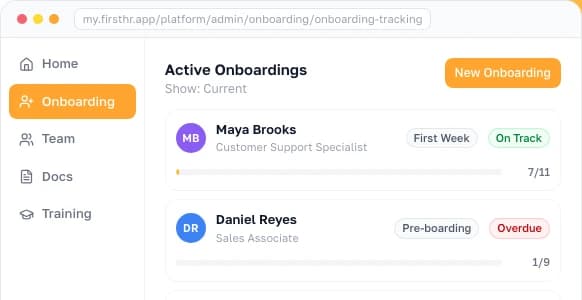
This is the workflow I built FirstHR to run for owners who do their own hiring. The offer letter, the I-9 and W-4, the handbook acknowledgment, and the chemical safety sign-off all go out with built-in e-signature before the first shift, so day one is a ride-along instead of an hour of forms in a parked van. The AI onboarding wizard builds the checklist from the role, the training modules hold your chemical and route standards, and every signed document lands in the employee profile where you can produce it if anyone asks.
Wage, Hour, and Safety Rules That Catch Cleaning Companies
The violations that hit cleaning companies are not exotic. They are drive time, waiting time, supply deductions, overtime across two crews, and untrained chemical use, and every one of them starts as a habit rather than a decision.
| Practice | The rule | What owners get wrong |
|---|---|---|
| Drive time between jobs | Travel from job site to job site during the work day is part of the principal activity and counts as hours worked under the FLSA. The ordinary commute to the first job and home from the last is generally not compensable. | Paying only for cleaning hours and treating the driving between stops as the cleaner’s own time |
| Waiting time | An employee who is engaged to wait is working. A cleaner held outside a locked building because the client is late is on the clock. | Unpaid waiting at a job that could not be started on schedule |
| Overtime across crews | Time and a half for hours over 40 in a workweek. Hours are added together across every route and every crew the person worked that week. | Splitting one person’s hours between a residential and a commercial crew and calculating each one under 40 separately |
| Supply and uniform deductions | A deduction can never bring pay below the minimum wage in a workweek, and many states restrict deductions further or bar them outright without written consent. | Docking a first or final check for a vacuum, a uniform shirt, or a lost key |
| Chemical training | The OSHA hazard communication standard requires labels, accessible safety data sheets, and employee training on the hazards of the chemicals in use. | Training on the equipment but not on the chemicals, and keeping the safety data sheets only at the office |
| FLSA coverage | Enterprise coverage applies at $500,000 in annual sales or business done, but individual coverage reaches employees whose work involves interstate commerce, and the Department of Labor names janitorial work in facilities producing goods for commerce as an example. | Assuming a small cleaning company is outside the FLSA because it is under the enterprise threshold |
The drive time rule is the one that costs the most, because it applies to every residential route every day. The Department of Labor states plainly that travel from job site to job site during the work day is work time that must be counted as hours worked. Track it on the same clock as the cleaning, and price your routes accordingly. Read the FLSA basics and the overtime rules in your state before you set a pay structure, since several states add daily overtime on top of the federal weekly rule.
On the safety side, the OSHA hazard communication standard is the one that applies to every cleaning company in the country. Training has to cover the health and physical hazards of the products your crew actually uses, and it has to happen before they use them. Spend ninety seconds of that training on the mixing rules, because bleach with ammonia and bleach with acidic cleaners are the two combinations most likely to be sitting in the same residential caddy.
The First 90 Days: A Probation Period That Works
A probation period is only useful if it has checkpoints and written standards. Ninety days is the practical window in cleaning because it covers enough visits to see whether quality holds after the novelty wears off, but the length matters far less than what you actually do inside it.
| Checkpoint | What happens | What it tells you |
|---|---|---|
| Day 1 | Ride-along with a named lead cleaner on a real route, plus the full paperwork and chemical briefing | Whether they follow a sequence or improvise, and whether they ask when unsure |
| Day 3 | First property cleaned with the lead present but not helping | Pace under a realistic time budget rather than a training pace |
| Day 7 | First documented quality inspection against your photo standard | Whether the standard survived without someone watching |
| Day 30 | A sit-down conversation, written and signed by both of you | Whether the schedule and the pay are actually working for them, before they quietly start looking |
| Day 90 | An explicit keep-or-release decision, with the reason written down | Whether you are hiring on evidence or on hope |
Two cautions. A probation period does not change at-will employment in most states, and it does not create a promise of continued employment once it ends, so write the policy carefully enough that it cannot be read as a guarantee.
The other caution is that the checkpoints only work if you actually hold them. A probation period that ends with nobody remembering to have the day-30 conversation is just ninety days of hoping, and hoping is what produced the forty-one hires in twelve months.
Keeping Cleaners Past Six Months
Retention in cleaning is bought with predictability rather than with pay. The companies that hold people are rarely the ones paying the most per hour. They are the ones where a cleaner can look at next month and know what their week is.
| What cleaners want | What that means in practice | What it costs you |
|---|---|---|
| A schedule they can plan around | Same route, same days, changes announced ahead of time rather than the night before | Planning discipline. No money at all |
| Route ownership | The same properties every visit instead of a floating pool | Slightly harder scheduling, much lower quality variance |
| Not paying out of pocket | Supplies stocked, equipment maintained, mileage reimbursed on a real schedule | A real line item, and the cheapest retention you will ever buy |
| A path above cleaner | Two named steps, lead cleaner and trainer or inspector, each with a pay step attached | A wage differential and an hour to define the roles |
| Being seen by the owner | You ride along on one route a week and know every cleaner’s name | One morning a week of your time |
The economics favor this heavily. Every replacement hire costs you the sourcing time, the paid working interview, the ride-along, the quality risk on a client account, and the days the route ran short. Running the numbers on what turnover costs usually makes the case for the mileage reimbursement by itself.
Frequently Asked Questions
How do I hire cleaning employees quickly without lowering my standards?
Speed comes from cutting the waiting, not the checking. Ask your current cleaners for referrals before you post anywhere, because a referral arrives pre-screened by someone whose own shifts depend on the new person showing up. Then run a ten-minute phone screen the same day the application lands, book a group session inside three days, and offer a paid working interview to anyone who clears it. The whole sequence fits in a week without skipping a single verification step. What slows most cleaning companies down is not the screening, it is the four days between an application and the first phone call, by which time the candidate has already accepted somewhere else.
Should cleaners be W-2 employees or 1099 contractors?
Almost always W-2. Control is what decides it, so a cleaner working the route you built, on the hours you set, with the caddy you stocked, is an employee whatever the contract is called. The IRS looks at behavioral control, financial control, and the nature of the relationship rather than at paperwork. A genuine contractor markets to their own clients, brings their own supplies, decides how the work gets done, and carries their own insurance. Misclassifying a recurring crew is expensive when it unwinds: back employment taxes with interest, unpaid overtime for the whole period, and state penalties on top. If you want the flexibility of contractors, hire part-time employees with variable schedules instead. That is legal and it is far cheaper than an audit.
How much should I pay a cleaner?
Start from the national wage ladder and adjust for your metro. The Bureau of Labor Statistics Occupational Employment and Wage Statistics survey (May 2025) puts the median hourly wage for janitors and cleaners at $17.71, with the 25th percentile at $15.50 and the 75th at $21.18. For maids and housekeeping cleaners the median is $17.07, with the 25th percentile at $14.59 and the 75th at $19.03. Those are national numbers, and cleaning wages swing widely between markets, so treat them as a floor and check your local range. Posting a real number rather than the word competitive is what wins you the candidate who is comparing four ads at once.
Do I have to pay cleaners for drive time between houses?
Yes. Under the Fair Labor Standards Act, travel from job site to job site during the work day is part of the principal activity and counts as hours worked. The ordinary commute from home to the first job and from the last job back home is generally not compensable, but everything in between is. This is the most common wage exposure in residential cleaning, because owners think of the day as cleaning hours and treat the driving as the cleaner’s own time. Waiting time follows the same logic: a cleaner sitting outside a locked building because the client is late is engaged to wait, and that time is paid. Track it on the same clock as the cleaning.
Do I need a background check to hire a cleaner?
It is not federally required, but it is standard in a trade where employees hold keys and work alone in homes and offices. If you use a third-party screening company, the Fair Credit Reporting Act applies. You must give the applicant a written disclosure in a stand-alone document, get their written permission before pulling the report, and if the report is why you are turning them down, send a pre-adverse action notice with a copy of the report and the summary of rights before you make the decision final. Apply the same policy to every candidate for the same role, and write down in advance which findings actually disqualify someone. Deciding that after you read a specific report is how discrimination claims start.
Is a working interview legal, and do I have to pay for it?
Working interviews are legal, and you have to pay for the time. The moment a candidate cleans a property you invoice, those hours are compensable, and unpaid trial shifts turn up repeatedly in wage and hour enforcement. Run the money through payroll at no less than the applicable minimum wage, never as cash from your own pocket. Practically, that means treating the trial as a first shift: collect the paperwork first, put the person on the clock, and pair them with a lead cleaner. Three or four hours on a real property tells you more about pace, thoroughness, and attitude than any interview, and the cost of those hours is trivial next to a bad hire.
How long should a probation period be for a new cleaner?
Ninety days suits most cleaning companies. It is long enough for a new hire to run each property on the route several times, which is when you learn whether the standard survives without anyone watching. What matters more than the length is what happens inside it: a ride-along on day one, a first quality inspection in the first week, a documented conversation at thirty days, and a clear decision at ninety. A probation period does not change at-will employment in most states, and it does not create a promise of continued employment when it ends, so write the policy carefully and avoid language that sounds like a guarantee. Used properly it is not a countdown to a termination. It is the schedule that forces you to give feedback while it can still change the outcome.
Make HR the easy part of running your business
Onboarding, e-signatures, training and core HR in one place. Up and running in 5 minutes.
- 7-day free trial
- No credit card required
- Cancel anytime