
Company Culture Training: A Guide for Employers
How to run company culture training that changes behavior: what to teach, who facilitates, session formats, whether it is paid time, and how to measure it.

Company Culture Training
How to teach values and behaviors to the team you already have
A few years ago I paid for a values workshop. A facilitator came in, ran a deck about our five words, split eleven people into breakout groups, and had everyone write what ownership meant to them on sticky notes. People enjoyed it. I enjoyed it. Two weeks later a customer email sat unanswered for three days because two people each assumed the other had it, which is the exact failure ownership was supposed to prevent.
The workshop was not badly run. It was aimed at the wrong thing. It taught people what our values meant as concepts, when what they needed was a rule: if a message lands in a shared inbox and nobody has replied by end of day, whoever read it first owns it. That sentence took ten minutes to write and it changed behavior inside a week. The deck never did.
This guide covers company culture training for the team you already have: what it is, what it should cover, how to run sessions your own managers can facilitate, how to handle inclusion and leadership modeling, whether the time is paid, and how to tell whether any of it worked.
Culture transmission during a new hire's first weeks is a different job with a different design, and onboarding and company culture is covered separately.
What Is Company Culture Training?
Company culture training is structured, repeated practice that teaches current employees the specific behaviors your stated values require, so the values show up in how work actually gets done. It is a training program with modules, a facilitator, and a schedule, not a presentation about what the words on the wall mean.
Three things separate it from the neighboring programs. It targets people who already work here, so it cannot rely on the first-week attention window that onboarding gets for free. It teaches behavior rather than policy, which is what makes it different from code of conduct training. And no statute requires it, which means nothing outside your own judgment forces you to run it well, or at all.
Company Culture, Workplace Culture, and Organizational Culture Training
These are the same program sold under different names, and the label tracks who is selling it rather than what gets taught. The only line worth drawing is between training people and changing what the company rewards, and that line falls in the last row of the table below.
| Term | Where you see it | What it means in practice |
|---|---|---|
| Company culture training | Small and mid-sized employers running programs in house | Teaching current employees the behaviors the company’s values require |
| Workplace culture training | Consultants, job ads, and state training catalogs | The same content, framed around day-to-day conduct rather than strategy |
| Organizational culture training | Academic and enterprise learning and development language | The same content, framed around systems, structure, and change management |
| Corporate culture training programs | Vendors selling multi-session curricula | A packaged sequence of sessions, usually designed for large headcounts |
| Culture change program | Consulting engagements | Training plus structural change to process, incentives, and who gets promoted |
Training changes what people know how to do. A culture change program changes what the organization rewards, which is a bigger and slower project. If your problem is that people are promoted for behavior the values prohibit, no amount of training fixes it, and you should read the signs of a bad company culture before you book a facilitator.
Why Most Culture Training Changes Nothing
Most culture training fails because it teaches values as ideas and never checks whether behavior moved. People leave able to recite the words and unable to name one thing they will do differently on Monday, which is the difference between a talk and a training program.
It Teaches Vocabulary Instead of Behavior
A session that explains what integrity means produces nodding. A session that ends with the sentence "if you promise a date you cannot hit, you say so the day you know, not the day it is due" produces something you can watch for next week.
An earlier Gallup survey shows the same gap. Only 23% of U.S. employees strongly agree they can apply their organization's values to their work, and 27% strongly agree they believe in those values (Gallup, 2022). The application number sits below the belief number, which is a training problem rather than a belief problem.
It Happens Once
An annual offsite is exposure, not practice. Skills that involve other people change through repetition with feedback, the same way soft skills training does, and a single session is one repetition. Four short sessions across a year outperform one long day, because the second and third pass are where people stop performing the answer and start using it.
Leadership Sits It Out
A founder who skips the culture session tells the room that the work is for everyone else. The U.S. Equal Employment Opportunity Commission (EEOC) promising practices guidance makes the same point about harassment prevention training, calling for senior leaders who champion the effort. Attendance by the people in charge is not symbolic. It is the content.
What a Company Culture Training Program Should Cover
Five modules cover the ground for a business without a dedicated HR department. Each one takes 30 to 45 minutes, each is built from your own incidents rather than stock case studies, and each ends with a small number of commitments somebody writes down.
Run them in that order the first time through. Behavior has to be defined before decisions, feedback, or standards can reference it, and the respect module lands better once the team has already practiced disagreeing in public without it going badly. After the first cycle, order stops mattering and you can pick whichever module matches the problem in front of you.
How to Build the Program in Six Steps
Building a culture training program takes about a day of work spread over two weeks, and none of it requires a training background. The sequence below assumes you already have values written down somewhere; if you do not, write those first.
Step two is the one people skip, and skipping it is why so many programs teach the module the company least needs. A training needs assessment here is not a formal exercise: it is you, a list of the last five interpersonal failures, and an honest answer about which of the five modules would have prevented them.
Session Formats That Work on a Small Team
The format that works best is a 45-minute session with one real example, one genuine argument, and three written commitments. Every other format in the table below is a supplement to that, useful for reinforcement between sessions rather than as a replacement for them.
| Format | How it runs | Time | What it is good for |
|---|---|---|---|
| Scenario session | One anonymized incident, one case with no obvious answer, and three commitments written down at the end | 45 min | The core of the program. This is where behavior actually changes. |
| Standing-meeting segment | One behavior, one recent example of it going well or badly, no discussion beyond five minutes | 10 min | Keeping a module alive between quarterly sessions |
| Paired shadowing | Someone spends half a day working alongside a colleague in a different role and reports back one thing that surprised them | Half day | The respect and standards modules, especially across departments |
| Written case debrief | Facilitator posts a decision the team faced, everyone writes their call before seeing others’ answers | 20 min, asynchronous (not live) | Remote and hybrid teams, and people who will not speak first in a room |
| Manager-only session | The same module the team just did, run again with managers, focused on what they modeled during it | 45 min | Leadership modeling, and catching a manager who is teaching the opposite |
| Microlearning module | A short assigned module in your HR system with one behavior and one question | 5 min | Reinforcement and a record of who has seen what |
Two format rules, both learned the hard way. Never run a culture session as a lecture with slides, because the room adopts the posture of an audience and audiences do not change behavior.
The second rule is to keep every session to an hour or less: attention drops, and the session itself starts teaching that meetings here overrun, which is a culture lesson you did not intend.
One sheet carries that format: the behavior the session is about, the real incident it works from, the case with no obvious answer, and the three commitments it has to end with.
Print one per session and keep the bottom half. The check-back box is the part that separates a program from a series of pleasant meetings, because a commitment nobody revisits was never really made. Short reinforcement between sessions works the same way microlearning does anywhere else: frequency beats depth.
Corporate Culture Training Programs: Build, Buy, or Blend
Build it in house. Culture training is the one training category where the outside expert is at a structural disadvantage, because the material is your own incidents, your own decisions, and your own standard for good work, and a facilitator who arrives on Tuesday has none of that.
| Option | What you get | Cost profile | When it fits |
|---|---|---|---|
| Built in house | Sessions written from your own incidents, facilitated by your own managers, adjusted every quarter | Time only: roughly a day to build, three hours per employee per year to run | Almost always, and always for the behavior, decisions, and standards modules |
| Bought as a curriculum | A packaged multi-session sequence with slides, workbooks, and generic scenarios | Per seat or per program, and the highest cost per unit of behavior change | Rarely. Consider it only when you need structure to copy, then rewrite the scenarios. |
| Outside facilitator, once | A neutral person in the room for a session nobody internal can run safely | Per session, the largest single line item in the program | One specific case: a conflict where the founder is part of the problem |
| Blended | In-house sessions as the spine, one bought element for a genuine skill gap such as facilitation or mediation | In-house cost plus one course for one or two managers | Most common sensible answer once you have more than three managers |
The one thing worth buying is facilitation skill for the person who will run the sessions, not the sessions themselves. A manager who can hold a room through an uncomfortable ten minutes is the whole program, and that skill transfers to every difficult conversation they will have afterward.
Training Managers to Model the Culture
Managers are the culture curriculum whether or not anyone trains them, because employees learn what is really rewarded here by watching what their manager does under pressure. The Gallup culture indicator finds that 24% of U.S. employees say leadership is committed to the stated cultural values, against 20% who say the same of their coworkers, which is a narrow lead for the people who are supposed to set the example.
Repeat one module a year with managers alone, and make it the one where the team session exposed the widest gap between what a manager said and what the team watched them do. The manager version covers the same behavior and adds the question the team version cannot ask: what did each of you model in that room, and what would your people have taken from it?
The last row does more work than the other four combined. A manager who names a decision that did not work, in front of the team, teaches more about psychological safety in 90 seconds than a module on the subject does in 45 minutes.
The manager session comes after the team session rather than before for the same reason: managers need a live example of their own to work with.
Inclusion and Respect Training Without a DEI Department
Inclusion training at a small company, without a diversity, equity, and inclusion (DEI) department behind it, works when it is about ordinary observable behavior and fails when it is about identity categories in the abstract. The content is who gets interrupted, whose idea gets attributed to whom, who is in the conversation where the decision actually happens, and how a joke lands on the person it is about.
Keep it strictly separate from legally mandated harassment prevention training. Several states require that training with prescribed content, frequency, and documentation, and a culture session does not satisfy the requirement no matter how good it is. Check what your states require and run sexual harassment training as its own compliance item with its own records.
California shows how specific those mandates get. Employers with five or more employees owe supervisors two hours of interactive training and everyone else one hour, within six months of taking the role and every two years after (California Civil Rights Department).
New York sets a different shape entirely: every employer trains every employee annually, whatever the headcount.
The EEOC promising practices guidance on what makes harassment prevention training effective is a useful design brief for the inclusion module too. It calls for qualified, live, interactive trainers, or, where live training is not feasible, a design that gets participants actively engaged.
That EEOC guidance also asks for content tailored to the specific workplace and workforce, and for reinforcement repeated regularly rather than delivered once. An in-house session gives you all three by default, which is the argument for running the inclusion module yourself rather than assigning a video.
Do You Have to Pay for Culture Training Time?
For nonexempt employees (the ones owed overtime), almost always yes. Training time can be excluded from hours worked only when all four conditions in the federal regulation (29 CFR 785.27, from the Code of Federal Regulations) are met at the same time, and company culture training normally fails at least two of them.
The practical consequence is a scheduling rule rather than a legal headache. Put culture sessions inside normal working hours, count the time, and do not call attendance optional if a manager would notice an absence. Calling something voluntary when everyone knows it is not costs you the wage argument and the credibility of the session in the same move.
How to Measure Whether Culture Training Worked
Measure the behaviors each module named, not attendance. Completion tells you people were in the room; the signals below tell you whether anything they heard survived contact with a normal week.
| Signal | What it tells you | How to track it |
|---|---|---|
| Commitment survival | Whether the three sentences from the last session are still happening | Read them out at the start of the next session and ask who has actually done it. Anything below half means the commitments were too vague. |
| Time from disagreement to decision | Whether the feedback and decision modules landed | Note the date a disagreement surfaces and the date it is resolved. A shrinking gap is the clearest evidence you will get. |
| New hire speaking time by week three | Whether the stated norms match the real ones | Ask the manager, not the new hire. If the person is still silent in meetings at week three, the culture the team performs differs from the one you teach. |
| Problems raised early | Whether the response to bad news has changed | Count the issues that reach you while they are still cheap to fix, against the ones that arrive as emergencies. |
| Exit conversation language | How work actually got done here, told by someone with nothing to lose | Ask departing employees to describe a decision they saw made. Compare the description to the decisions module. |
| Engagement question trend | Whether the connection gap is closing | One question in whatever check-in you already run: can you apply our values to your work? Track the trend, not the absolute number. |
None of the six needs survey software, and most of them cost nothing but the attention of whoever runs the sessions. If you want a formal evaluation structure on top, the Kirkpatrick model gives you the four-level ladder.
Of those four levels, the one that matters here is the third, behavior, which is also the level almost every culture program skips. A short set of training survey questions covers the first two levels if you want them.
Common Mistakes in Company Culture Training
Six mistakes account for most culture training that produces nothing. Every one of them is a design choice made before the first session, which means every one is cheap to avoid.
If you do one thing this month, pick the value your team argues about most, write the two or three behaviors that show it, and book a 45-minute session built on one real incident from your own business. Everything after that is repetition.
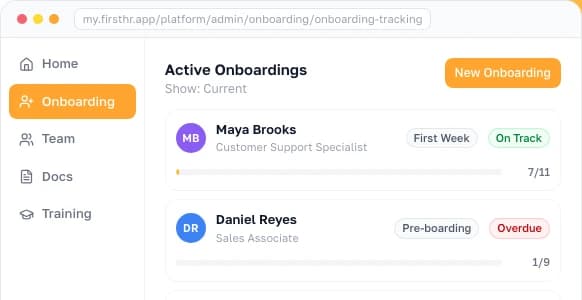
I built training modules and task workflows into FirstHR so a culture module can be assigned with a deadline and tracked alongside onboarding, with completion recorded as each person finishes it. The sessions still have to be yours. The record of who has done what should not be a recurring act of willpower.
Frequently Asked Questions
What is company culture training?
Company culture training is a recurring program in which current employees practice the specific behaviors their company’s values call for. It is a set of working sessions, not a talk about what the values mean. A good program turns each value into actions people can be seen doing, then covers decision rights, the handling of feedback and disagreement, what everyday respect looks like, and what counts as good work in your business. Sessions are short, led by your own managers, built from real incidents at your company, and repeated on a calendar. Because it is aimed at people who already work for you, it differs from the culture introduction new hires get during onboarding, and again from legally mandated compliance training.
What should company culture training cover?
Five modules are enough for most small employers. The first turns each value into two or three observable behaviors. The second covers decision rights: which calls belong to whom, which ones need a second opinion, and which ones people should settle on their own. The third is feedback and disagreement, taught with your own anonymized conflicts instead of invented scenarios. The fourth is inclusion and everyday respect, meaning interruptions, credit, invitations, and jokes rather than policy language. The fifth is what good work looks like here, shown through real examples of work that met the bar and work that did not. Add a sixth module only when a specific problem in the business demands it.
How long should a culture training session be?
Forty-five minutes is the right length for a whole-team culture session, and 30 minutes works for a single narrow topic such as decision rights. A session shorter than 30 minutes cannot hold a real example, an argument, and a set of commitments. A session longer than an hour loses the room and teaches the team that meetings here run long. Frequency matters more than duration: four 45-minute sessions spread across a year change more behavior than one long offsite, because behavior changes through repetition rather than through exposure. Book the whole year at once so the sessions survive a busy quarter.
Does company culture training actually work?
It works when it teaches behavior and fails when it teaches vocabulary. You can see the difference before anyone leaves the room: if no one can state one concrete change in how they will work, nothing was trained. As of May 2026, Gallup’s organizational culture indicator shows that only 20% of U.S. employees strongly agree they feel connected to their organization’s culture. A Gallup analysis of February 2025 data on that indicator found that connected employees are 4.3 times as likely to be engaged and have a 47% lower chance of job hunting. A low connection score is not a communication problem. It shows the distance between values that are announced and behaviors that are taught, practiced, and modeled by the people in charge.
Is company culture training the same as diversity training?
No. Inclusion and everyday respect make up one module of a culture training program, not the whole program, and neither one is the same as the harassment prevention training some states legally require. A state mandate dictates what the course must contain, how often it runs, and what records you keep, and a culture session cannot stand in for it however well it is run. The inclusion module deals with everyday behavior that determines whether people feel able to speak up: who gets talked over, who is credited for an idea, who is in the room when the real decision is made, and how teasing or a joke feels to the person on the receiving end. Treat the two as separate programs with separate records, so the required course never eats the time and budget meant for culture work.
Do you have to pay employees for culture training time?
For nonexempt employees, almost always yes. The federal rule at 29 CFR 785.27 lets you leave training time out of hours worked only when four conditions hold at the same time. The session must fall outside the employee’s regular hours, attendance must truly be voluntary, the course must not be directly related to the employee’s job, and no productive work may be done during it. Culture training is directly related to the job, and attendance is rarely genuinely voluntary, so it usually fails at least two of the four tests and counts as paid working time. Hold sessions during the normal schedule, include the hours in the weekly total that drives overtime, and never label attendance optional when it effectively is required.
How often should you run culture training?
Quarterly is the cadence that holds for most small teams: four whole-team sessions a year, each on a different module, plus one manager-only session. That is roughly three hours per employee per year, which is small enough to survive a busy quarter and frequent enough that the behaviors stay live. Add a session out of cycle after any event that changes how the team works together: a reorganization, a bad incident, a wave of new hires, or a shift to remote or hybrid work. What does not work is an annual offsite treated as the whole program, because a single exposure teaches recognition rather than habit.
How do you measure company culture training?
Measure behavior and outcomes, not attendance. Four signals do most of the work, and none of them needs survey software. Track whether the specific commitments from each session are still happening at the next one, since a commitment nobody repeats was never adopted. Track how long disagreements take to reach a decision. Track whether new hires are contributing in meetings by their third week, which tells you whether the stated norms match the real ones. And read exit conversations for the language of the modules, because departing employees describe how work actually got done here more honestly than anyone still on the payroll.
Make HR the easy part of running your business
Onboarding, e-signatures, training and core HR in one place. Up and running in 5 minutes.
- 7-day free trial
- No credit card required
- Cancel anytime