Employee Task Tracker: 12 Tools Compared
Employee task tracker tools compared: what 12 options cost at 10 employees, which handle recurring shift checklists, and which only do projects.

Employee Task Tracker: 12 Tools Compared
Task tracking software splits into three groups that do not compete with each other: frontline apps that attach a checklist to a shift, task boards built for project work, and time trackers that hang tasks off recorded hours. Twelve options priced for a year at 10 people, plus the paid-time rule that assigning work after hours quietly triggers
A bakery owner I worked with ran her closing routine off a whiteboard by the back door. Eleven lines, written once, understood by everyone. It held up for two years and then fell apart in a week, because the person who wrote it went on vacation and nobody else knew that line seven meant the proofer, not the oven.
That is the real problem an employee task tracker solves. Not laziness, and not visibility in the dashboard sense. It is that the definition of done lives in one person's head, and the moment that person is off, the work quietly changes shape.
The trouble is that three completely different kinds of software answer to this search term: one group repeats a checklist every shift, one moves project cards across a board, and one hangs tasks off tracked hours so they can end up on an invoice.
This comparison sorts 12 products into those groups, prices each for a year at 10 people, and covers the paid-time rule that assigning work outside a shift quietly triggers.
What a task tracker actually does
An employee task tracker holds four things together: the assignment, the owner, the deadline, and the record that it was finished. Everything else in this category is packaging around those four fields, which is why a free plan and a $1,300-a-year subscription can both be the right answer depending on the shape of your work.
The distinction that matters is repetition. A project task exists once, gets closed, and disappears. A shift task exists every single day, and the useful information is not that it was completed but that it was completed on Tuesday at 10:40 by Marcus. Software built for the first case models the second one badly, and you find that out about three weeks in.
Three jobs hide behind one search term
Sorting your own problem into one of three rows will narrow this decision faster than reading any feature list. The products inside a row genuinely compete; the products across rows do not.
| Group | The question it answers | Who builds it | Buy it when |
|---|---|---|---|
| Frontline apps | Did the routine get done on this shift, at this site? | Connecteam, Homebase, Sling, Deputy | The same list repeats daily and the people doing it are not at desks |
| Task boards | Where has this piece of work got to? | Trello, ClickUp, Asana, monday.com, Todoist, Basecamp | Work is one-off, has an end date, and passes between people |
| Tasks on tracked time | How many hours went into this task, and who owes for them? | Hubstaff, Time Doctor | Hours are the billable unit and a client will see the breakdown |
Almost every disappointed buyer in this category picked the right product from the wrong row. A cleaning company on a project board ends up duplicating cards forever. A design studio on a shift app ends up with a beautifully repeating checklist that describes none of its work.
Task tracker, task manager, work management: the same thing?
Broadly yes, and the label usually reveals which row a vendor started in rather than what the product now does. Work management is the term boards use as they grow upward into project portfolios. Task manager is what lightweight personal tools call themselves. Digital checklist is what frontline apps say when they are selling to restaurants and clinics. Judge by whether the task repeats, not by the noun on the homepage.
12 employee task trackers at a glance
The table groups products by what they are built for and shows the lowest paid tier that permits assigning a task to somebody else, which is not always the tier the vendor advertises first. The last two columns decide more purchases than price does.
| Tool | Group | Entry price | Free plan | Shift checklists | Billed per user |
|---|---|---|---|---|---|
| Connecteam | Frontline app | Free to 10 users | |||
| Homebase | Frontline app | $13 add-on per location | |||
| Sling | Frontline app | $3.40 per user | |||
| Deputy | Frontline app | $6.50 per user | |||
| Trello | Task board | $5 per user | |||
| ClickUp | Task board | $7 per user | |||
| Asana | Task board | $10.99 per user | |||
| monday.com | Task board | $9 per seat | |||
| Todoist | Task board | $8 per user | |||
| Basecamp | Task board | $25 flat monthly | |||
| Hubstaff | Tasks on time | $4.99 per seat | |||
| Time Doctor | Tasks on time | $6.67 per user |
How we evaluated these tools
We evaluated for a US small business where the person choosing the software also runs the schedule, the hiring, and the payroll. Four tests, applied the same way to all 12.
Frontline apps for recurring shift work
These four attach a reusable checklist to a shift or a location and repeat it without anyone recreating it. That single behavior is what separates them from everything else on this page, and it is the reason a restaurant, a clinic, a shop, or a field crew should start here.
The free plan is the headline, and it is not a crippled trial. Up to 10 users get tasks, checklists, and forms with full feature access, which covers a small shop or a single-site crew outright. Above that, one flat $29 a month carries the first 30 users, so the cost per person falls as the team grows, which is the opposite of how almost everything else here behaves.
The catch is the hub structure. Tasks and checklists live in the Operations Hub, while the Communications and HR hubs are priced separately on the same ladder and include only limited Operations access. A business that wants full task lists plus an internal news feed ends up buying twice. Connecteam's breadth also makes setup a real afternoon rather than a five-minute signup.
Sling has the cleanest model of shift-attached work in this comparison. A checklist belongs to a shift rather than to a person or a project, so whoever is rostered inherits it. That removes the reassignment work that kills most task systems in a business with turnover. At $3.40 per user on annual billing, it is also the cheapest per-user route to that behavior.
The gating is the thing to notice. Shift tasks arrive on Business, the top of the three tiers, so the free plan and the $1.70 Premium plan are scheduling products rather than task trackers. The free tier is generous at 30 users and will mislead anyone who signs up expecting checklists to be in it.
Per-location pricing is the argument for Homebase, and it is a strong one at a busy single site: 20 people at one address cost the same as 8. Task Manager itself does the ordinary job well, letting a manager build a list, assign it, and see completion from a phone or a browser without chasing anyone.
Task Manager is an add-on at $13 a month per location, and it is not folded into any plan, including the $120 All-in-One tier. That is the fact to carry into a comparison, because it is easy to assume task lists come with a scheduling plan.
Per-location billing turns against you the moment you open a second site, since the fee repeats in full whether that site has 15 people or 3.
Deputy takes procedures more seriously than anything else in this group. Task templates let a manager write a cleaning routine or an opening sequence once and assign it repeatedly across teams and locations, and the completion dashboard answers the multi-site question directly: which jobs are finished, when they were completed, and which are still open.
Two things temper it. The pricing page lists Lite, Core, and Pro without stating which of them includes tasking, so the tier you need is a sales question rather than a published fact. And the add-on ladder is long: HR, messaging, and analytics are each priced separately per user, so the $6.50 Core rate is a floor rather than a forecast.
Task boards for project work
These six move a piece of work through stages until it is closed, and then it is gone. They are the right answer when assignments are one-off, pass between people, and have an end date, and the wrong answer when the same 15 lines repeat every single day.
Trello wins on the only metric that decides most small-team software: people actually use it. A card, a name, and a date is the whole mental model, and a manager can teach it in one conversation. The free plan allows 10 collaborators and 10 boards in a workspace, which covers a useful amount of small-business work for nothing.
Its ceiling arrives early. Reporting is thin, automation on the free tier is metered at 250 workspace command runs a month, and there is no native sense of how long anything took. Teams that outgrow it usually move to ClickUp or Asana rather than to a higher Trello tier, which is worth knowing before you standardize on it.
No seat minimum at any tier is the quiet advantage here, and it matters more than the headline rate for a business with a fluctuating contractor count or a very small core team. The free plan carries the whole team rather than capping at a handful of people, and $7 per user on annual billing buys more structure than anything else at that price.
The free tier is capped in ways that bite later: 60MB of storage, 5 spaces, 40 lists per space, 1 form, and 3 whiteboards. Every plan also caps the AI it includes, and unlimited AI is a separate Brain AI add-on at $9 per user.
ClickUp has the largest configuration surface in this comparison, and in a small business that means somebody has to own it or the workspace slowly becomes unreadable.
Asana is among the easiest products in this group for people who do not enjoy software. Work assigned in it tends to get done without chasing, and the timeline view at the Starter tier is genuinely useful for a project that spans several people. For a team where the bottleneck is cross-function handoffs, it is the safest choice here.
The free plan has narrowed sharply. Personal now allows up to 2 users to collaborate, so the old advice that Asana is free for a small team is out of date and worth checking before you plan around it. Starter at $10.99 is the most expensive entry point on this page, and Advanced at $24.99 is a large single step for goals and portfolios.
Basecamp is the only board here that does not charge by the head, and past roughly 15 people that changes the arithmetic completely. Studio at $59 a month covers unlimited users across 10 active projects, which is less than a 10-person team pays for Asana and less than half what 25 people would pay. To-dos with assignees are on every plan, including the free one.
The cap moves rather than disappears: instead of seats you are limited by active projects, which suits agencies with a handful of live engagements and pinches teams that run many small ones. There is nothing here for recurring shift work, and the free plan at 1 project and 5 users is an evaluation tier rather than a working one.
Todoist is the least ceremonial way to give someone a task and know when it is done. There is no board to design and no workflow to configure, which is exactly right for a small office where the work is a stream of individual jobs rather than a set of projects. Entry is fast enough that adoption is rarely the problem.
Two structural limits matter. Every plan can assign tasks, but below Business a shared project holds at most 5 people, so a team of 10 needs Business: $8 per user on annual billing, up from $6 on December 10, 2025. The free plan also keeps only 1 week of activity history, which makes it useless as a record of what got completed and when.
monday.com is the most immediately legible product in this group. Color-coded status columns tell an owner who is behind without anyone reading a report, which is the right shape for a marketing team, an operations function, or a client-facing business where the board goes on a screen in the office.
Its seat model works against the smallest teams. The three-seat minimum means the $9 Basic tier really starts at $27 a month even for a pair of people, so the cheapest possible monday.com bill is higher than the per-seat rate suggests. Automations and integrations sit above Basic, which makes Standard at $12 the honest entry point for most buyers.
Trackers that attach tasks to hours
These two answer a different question: not whether a task was finished but how many hours it consumed. That makes them the right group when tasks turn into invoices, and the wrong group when you simply want a closing checklist done.
Hubstaff has the lower entry price of the two time trackers here and a genuine answer for work that happens away from an office. Tasks, tracked hours, and location evidence land in the same record, which is exactly what a service business needs when a client asks how four hours were spent at their address.
The add-on list is where the money is. Locations is restricted to Team and above: $3.33 per seat on Team, included on Enterprise. Insights and extra screenshots are $2.50 each and data retention another $1.67, so a working configuration lands well above the $4.99 headline. The free plan is a single seat, which means it is a personal trial rather than a team option.
Time Doctor puts projects and tasks on the entry plan rather than gating them, so the cheapest tier already does the job this page is about. Annual billing works out to two free months against the monthly rate. For a business that bills by the hour against named work, the task-to-invoice line is shorter here than anywhere else in this comparison.
It is a monitoring product first, and that decides who should buy it. Screen capture and activity data are the core of the platform, which brings state notice obligations along with the purchase and changes how a team reads the rollout. There is also no permanent free plan, so evaluation is a 14-day window rather than an open trial.
What a year costs at 10 people
At 10 people on one site, a year of task tracking runs from nothing to about $1,319. The table prices the tier that actually covers task assignment for the whole team, which is the number that matters and rarely the one on the pricing banner.
| Option | Rate | One year at 10 people | What the rate leaves out |
|---|---|---|---|
| Connecteam Small Business | Free to 10 users | $0 | Tasks, checklists, and forms inside the cap |
| Homebase Task Manager | $13 per location | $156 | An add-on price, on top of whatever plan you run |
| Basecamp Freelancer | $25 flat monthly | $300 | Covers 20 users but only 3 active projects |
| Sling Business | $3.40 per user | $408 | Shift tasks only appear on the top tier |
| Hubstaff Starter | $4.99 per seat | $599 | Locations, Insights, and extra screenshots cost more |
| Trello Standard | $5 per user | $600 | Cheapest paid board, no time or shift features |
| Deputy Core | $6.50 per user | $780 | Scheduling and timesheets sit in the same product |
| Time Doctor Basic | $6.67 per user | $800 | Tasks are attached to tracked time, not to shifts |
| ClickUp Unlimited | $7 per user | $840 | No seat minimum at any tier, AI priced separately |
| Todoist Business | $8 per user | $960 | Cheaper plans share a project with at most 5 people |
| monday.com Basic | $9 per seat | $1,080 | Three-seat floor, and the $9 rate needs annual billing |
| Asana Starter | $10.99 per user | $1,319 | Goals and portfolios need Advanced at $24.99 |
Three things fall out of it. The cheapest genuine option is free and not crippled, because Connecteam includes tasks, checklists, and forms inside its 10-user cap. The pricing model matters more than the rate as you grow: Basecamp and Connecteam hold steady while every per-user option climbs in a straight line. And the most expensive row here, Asana at $1,319, is a board that cannot do the thing the frontline group does for a fraction of the money.
Free employee task trackers, ranked by what the free tier allows
Free plans in this category vary by more than an order of magnitude, and the number that matters is the user cap rather than the feature list. Connecteam covers 10 users with tasks included, Sling covers 30 users but no tasks, Trello covers 10 collaborators, ClickUp covers the whole team with storage caps, Basecamp covers 5 users on 1 project, monday.com and Asana cover 2, and Hubstaff covers 1.
Assigned tasks and paid time
If you assign a task to an hourly employee and they do it, that time is paid, whether or not it happened inside the scheduled shift. This is the part of buying a task tracker that nobody mentions, and it becomes a live issue the moment assignment gets as easy as typing a line and hitting send.
The Department of Labor states that work not requested but suffered or permitted to be performed is work time that must be paid for by the employer. In plain terms, work you allow to happen is paid work, even if nobody asked for it.
The agency gives the example of an employee who keeps working past the end of a shift to finish an assigned task. The reason, it says, is immaterial. The hours are compensable, which means they have to be paid.
| What you do in the app | What it looks like from outside | What it means for pay |
|---|---|---|
| Attach a checklist to a shift | The work happens between clock-in and clock-out | Nothing changes, since the hours are already recorded |
| Assign a task the evening before | A notification lands outside scheduled hours | Time spent acting on it is hours worked and has to be paid |
| Ask for a photo of a closed-up site | Completion is timestamped after the shift ended | Work after clock-out is still hours worked, and now it is documented |
| Set a task due before opening | Someone arrives early to complete it | Early arrival for assigned work counts toward the workweek |
| Let a manager reply to task comments at home | An exempt manager is unaffected; an hourly lead is not | Non-exempt staff must be paid for that time |
The practical rule I give people is simple: tasks are done on the clock. Write it into the policy, say it out loud when the app is introduced, and check the first month of completion timestamps against the schedule. If they disagree, you have either an overtime problem or a staffing one, and both are cheaper to find in week one.
Why task trackers get abandoned
Task trackers die when the tasks inside them stop describing the actual work. Nobody announces it. The board simply goes stale, people return to asking each other, and eight months later somebody cancels a subscription that three people still had installed.
The fix is upstream of the tool. Guidance on delegation from the Society for Human Resource Management (SHRM) is blunt about it: be specific about the goals, deadlines, and desired outcomes when assigning a task, and encourage people to repeat the instructions back to confirm they understood. That takes thirty seconds and removes most of the ambiguity a board will otherwise preserve forever.
The verdict by team type
A single ranking assumes every small business runs the same way. Across the seven situations below, the right answer changes every time, and the deciding variable is almost always whether the work repeats.
| Your situation | What usually fits | What to avoid |
|---|---|---|
| Hourly team, one site, 10 people or fewer | Connecteam Small Business, free with tasks and checklists included | Paying per user for something a free plan covers completely |
| Shift business where the checklist should follow the roster | Sling Business at $3.40 per user on annual billing | The Sling free and Premium tiers, which have no task feature |
| One busy location with a large staff | Homebase, where per-location billing works in your favor | Assuming task lists are included; Task Manager is $13 extra per location |
| Several sites running identical procedures | Deputy task templates, with the tier confirmed before you sign | Boards, which make you recreate the same checklist per location |
| Small office team, one-off work, no methodology | Trello Standard at $5, or Todoist Business at $8 per user | Enterprise-shaped platforms priced for headcounts you do not have |
| Growing fast and worried about per-seat costs | Basecamp Studio at $59 a month flat for unlimited users | Per-user plans, which repeat the growth problem every year |
| Agency billing clients by the hour against named tasks | Time Doctor Basic, or Hubstaff if location has to be provable | Buying a board and a separate tracker to do one job |
The honest summary is that most small hourly teams at a single site are served by a free plan, and most office teams are served by the cheapest paid board. The products that market hardest in this category are priced for businesses a stage further along.
Before you choose
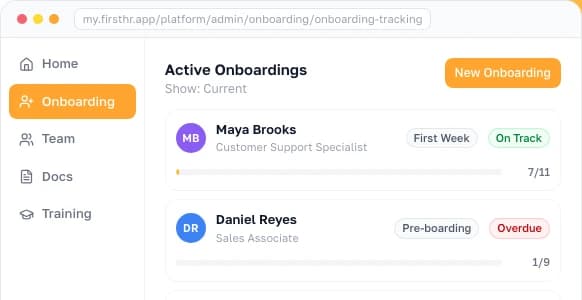
FirstHR covers the other kind of task a small business has to chase: the employment ones. An HR platform for teams without a dedicated HR person, it runs onboarding task lists with deadlines, training assignments, e-signature, and document management at a flat $98 a month for up to 10 people or $198 for 11 to 50. Shift checklists and project boards come from the 12 products above.
Draw that distinction before you buy, because the two kinds of task behave differently, and the difference shows most clearly in onboarding workflows.
A closing checklist repeats nightly and nobody keeps the history. An onboarding checklist runs once per person, has a compliance record attached, and has to be produced years later if anyone asks. Putting the second kind on a project board is how signed policies end up in an archived card.
One connection is worth naming whichever tracker you pick. The rule that assigned work is paid work belongs in writing, and the place it survives is the handbook and the new hire paperwork, not a pinned message in the app. Decide where that acknowledgment lives before the first checklist goes out.
How to choose an employee task tracker
Five questions settle this, and the first one eliminates two thirds of the market before you open a trial.
The last step is a live test. Run one real week through your two finalists with the actual list your team uses, not a demo list. Nearly everything here is free or on trial long enough to allow it, and a genuine week surfaces the thing no feature comparison can: whether people close their tasks without being chased.
Frequently Asked Questions
What is an employee task tracker?
Software that records who was asked to do what, by when, and whether it actually happened. The term covers three groups that are not substitutes: frontline apps attaching reusable checklists to shifts and sites, task boards moving one-off work through stages, and time trackers hanging tasks off recorded hours. Choosing the right group matters more than choosing the right product inside it.
What is the best free employee task tracker?
Connecteam, for an hourly team, because its free plan covers 10 users and includes tasks, checklists, and forms rather than gating them. For office work, ClickUp Free Forever has no seat minimum and Trello Free allows 10 collaborators and 10 boards per workspace. Watch the caps that listicles gloss over, because free tiers vary hugely: Sling has 30 users but no tasks, Asana allows 2 collaborators, and Hubstaff allows 1 seat.
How much does employee task tracking software cost?
Between $0 and about $1,319 for 12 months, for a team of 10 at one site. Connecteam is free inside its cap, the Homebase Task Manager add-on is $156 a year at $13 a month per location, Sling Business is $3.40 per user, Hubstaff Starter $4.99 a seat, Trello Standard $5, Deputy Core $6.50, Time Doctor Basic $6.67, ClickUp Unlimited $7, Todoist Business $8, monday.com Basic $9, and Asana Starter $10.99. Basecamp Freelancer is flat at $25 a month.
What is the difference between a task tracker and project management software?
A tracker answers whether a named person finished a specific job. Project management answers whether a body of work with an end date is on schedule, which brings dependencies, milestones, and resource views along with it. The two overlap in the middle, which is why several products on this page appear under both labels. For work that repeats daily, neither framing fits as well as a frontline app with reusable checklists.
Do I have to pay hourly employees for tasks assigned outside their shift?
Yes, when the work happens and you are aware of it. Federal rules treat hours suffered or permitted as compensable, including time an employee spends after a shift ends to finish an assigned task. A task app increases the risk because assignment is effortless and notifications ignore the schedule, and it also increases the evidence because completion is timestamped. Make tasks-on-the-clock an explicit rule and keep the time record as the basis for pay.
How do you track employee tasks without software?
On a shared list with five columns: the task, the owner, the due date, the priority, and the status. Most teams that feel disorganized have never written this down, and the exercise costs an afternoon. It also diagnoses which software you need, since repeating lines point at a frontline app and unique lines point at a board. Our task list templates cover daily, weekly, and team formats.
Do task trackers work for deskless teams?
Only the frontline group does. Connecteam, Homebase, Sling, and Deputy assume a phone, a location, and a shift with a start and an end, so checklists attach to the roster and repeat without anyone recreating them. Boards assume a desk and work with an end date. Deputy goes furthest on repeatable procedures with task templates and a dashboard showing what is done, when, and what is outstanding across sites.
Is an employee task tracker the same as employee monitoring?
No. Recording that an assignment was completed is ordinary supervision with no special notice duty. Electronic monitoring means screenshots, activity scoring, application logs, or location capture, and several states require written notice before any of it is switched on. Two products here do both: Hubstaff and Time Doctor attach tasks to tracked time and also sell monitoring, so buying either for tasks alone means deciding explicitly what stays off.
Make HR the easy part of running your business
Onboarding, e-signatures, training and core HR in one place. Up and running in 5 minutes.
- 7-day free trial
- No credit card required
- Cancel anytime