
Aviation LMS: 11 Platforms Compared
Aviation LMS compared for flight schools, charter operators, and repair stations: what each costs, which dates expire, and why no software is FAA approved.

Aviation LMS: 11 Platforms Compared
Nothing on this page is FAA approved, because the agency approves your training program rather than the software that delivers it. This compares eleven options across flight schools, charter certificates, and repair stations, prices every one that publishes a number, and lists the expiry dates a general platform will quietly fail to track
If you are choosing an aviation LMS (learning management system) for a flight school, a charter certificate, or a repair station, this page gets you to a shortlist before the first sales call. It compares eleven options, prices each one that publishes a number for a twenty-person operator, and lists the expiry dates that decide whether a general platform can do the job.
A charter operator once told me his entire training system was a whiteboard with twelve pilot names and a column of dates in red marker. He was not disorganized. He had asked four vendors for a price, and three of them wanted a discovery call before they would give him one.
That is the shape of this category. Products sold as an aviation LMS run from a package of recurrent ground courses, to a flight school operating system priced per aircraft, to an airline training management suite, and most of them quote privately. The term covers three different purchases at three very different prices.
It also carries one claim worth settling before you shop. No learning platform is FAA approved. Your program is the thing that gets approved, and the software is where you happen to run it.
Three purchases, one search
Aviation training software is sold as one category but bought as three separate purchases, each priced its own way. Before comparing vendors, decide which of the three rows below is unsolved at your operation. It takes ten minutes and usually eliminates most of the shortlist.
| What you might be buying | What it actually is | How it is priced | You need it when |
|---|---|---|---|
| Course content for your program | Ground training somebody else wrote, mapped to your approved segments | Per package or per seat, usually quoted | You run recurrent indoc, hazmat, or crew resource management and do not write it yourself |
| Currency and qualification tracking | A record of checks, certificates, medicals, and the dates they expire | Per user, or bundled inside an operations system | Somebody has to know today who is legal to fly, teach, or sign |
| A delivery platform | Somewhere to host, assign, and record your own material | Per user, per aircraft, or a flat monthly fee | Your operations manual, SOPs, and shop procedures are yours to teach |
FirstHR is our product and it appears below in one narrow place: operators whose real bottleneck is hiring paperwork rather than ground training. We list its gaps the way we do for everything else here, which for us means no FAA courseware, no currency tracking, and no packaged course support. Several recommendations on this page send readers to competitors for exactly those reasons.
No platform is FAA approved
Approval attaches to your training program, never to the software delivering it. That single distinction settles more vendor conversations than any feature comparison.
Under 14 CFR 135.341, a certificate holder other than a single-pilot operator establishes and maintains an approved pilot training program, and an approved flight attendant training program where flight attendants are employed.
Under 14 CFR 135.323, the certificate holder keeps the training material, examinations, forms, instructions, and procedures current for each aircraft type, and an instructor certifies proficiency, with that certification entered in the crewmember record. Computerized records are explicitly allowed there, and signatures are not required for a digital entry.
This matters commercially because approval language is used to justify price. A vendor whose courseware genuinely maps to your curriculum segments saves you real work, and that is worth paying for. A vendor implying that buying the software meets the obligation for you is describing something that does not exist.
11 aviation training options at a glance
The table puts all eleven side by side, grouped by what each product is rather than ranked in one list, because a package of ground courses and an airline training suite are not competitors.
| Product | Built for | Entry price | Aviation-specific | Ships course content | Published pricing |
|---|---|---|---|---|---|
| CTS | Part 135 and 91 operators | Quote, by package | |||
| Aviatize | Flight schools and ATOs | From 29 euros/aircraft | |||
| Flight Schedule Pro | US flight schools | Quote, per aircraft | |||
| Talon Systems | Collegiate and large ATOs | Quote only | |||
| CORRIDOR | Repair stations and MROs | Quote only | |||
| Comply365 | Airlines | Quote only | |||
| AQT Solutions | Airlines and defense | Quote only | |||
| eLeaP | General LMS, aviation pages | $5/user, 25 minimum | |||
| TalentLMS | General LMS | $119 to 40 users | |||
| iSpring LMS | General LMS | Quoted below 100 users | |||
| FirstHR | HR platform | $98 to $198 flat |
How we evaluated these options
We evaluated for a small US operator: a flight school with a handful of aircraft, a Part 135 certificate with eight to twenty pilots, or a repair station where the accountable manager also runs training.
Built for flight schools
These three products are built around a syllabus, a fleet, and a schedule rather than a course catalog. For a Part 141 or Part 61 school these are the category, and a corporate learning platform is not a substitute.
Aviatize is the rare product in this category that publishes a number, and the pricing shape suits a flight school better than per-seat billing does. Students, instructors, and dispatchers cost nothing to add, so an intake of twenty new students leaves the invoice where it was.
The vendor lists scheduling and booking, training and grading, billing and payments, maintenance, compliance and documents, and reporting as separate modules inside the same subscription, and offers a 30-day guided trial after a fit call.
The euro pricing is a signal worth reading. This is a European product sold in euros with European e-invoicing among its add-ons, so a US school should confirm how well the compliance and documents module maps to Part 141 record keeping rather than assuming it.
Per-aircraft billing also works against a school with a large fleet and few students, and the white-glove onboarding bundle is a 5,000 euro line item before anybody has flown.
Flight Schedule Pro is a long-established name among US flight schools, and the training hub is built for the record rather than for course delivery. Per the vendor, it carries unlimited courses and enrollments, student progress tracking, an iOS app, and Part 141 and 61 record keeping, sitting beside scheduling that handles dispatch and maintenance reminders on the same aircraft.
The hub structure is the thing to price carefully. Training, scheduling, billing, and maintenance are sold as separate hubs, and nothing is published. The per-aircraft suite bundles scheduling, training, billing, and advanced reporting, but maintenance sits outside it, and hub buyers get advanced reporting only as a separate quote. As a result, two schools of the same size can pay very different amounts depending on scope.
A school that only wants a training record is buying into a fleet management platform to get it, and a charter operator or repair station is outside the target entirely.
Talon is the option for programs large enough that curriculum, scheduling, and records have to be one system. Per the vendor, TalonETA is a web-based training management system where the curriculum drives everything downstream, covering student records, dispatch, flight operations, and billing, with instructor and aircraft currency checked before a booking is allowed. The companion maintenance product extends the same records into the shop.
The fit gets worse as the school gets smaller. A three-aircraft school with two instructors does not have a curriculum administration problem worth a quoted enterprise system, and the implementation is a project rather than a signup. Nothing is published, and the reference customers are university programs rather than small operators. If a ground module is all you need, a general small business platform will deliver it far faster.
Built for repair stations
A repair station has a different problem from a flight school. The question is whether the person who signed for a task was qualified for that task on that date, not who completed a course.
CORRIDOR is not a learning platform, and that is the point. Per the vendor, its training and qualifications module manages personnel certifications, qualifications, and training records, reports them with their expiration dates, and ensures only qualified personnel perform work order tasks. That tie between a person's qualifications and the work they sign for is exactly what 14 CFR 145.163 is driving at, and no general platform does it.
The catch is that you are buying an MRO (maintenance, repair, and overhaul) business system. Work orders, inventory, and invoicing come with it whether you wanted them or not, and a shop that already runs something else for those functions is paying twice.
CORRIDOR publishes no rate, and the vendor sells deployment options and professional services alongside the software. The course content is still yours to produce, because nobody sells training on your specific equipment and procedures.
Where the ground training comes from
For a charter operator, the expensive gap is usually content, not software. Somebody has to write indoc (indoctrination), hazmat, crew resource management, and aircraft systems material, and producing it in house is a substantial project.
CTS sells what most of this category does not: the actual courses. Indoc, hazmat, crew resource management, and aircraft-specific systems review arrive written, and per the vendor the packages are delivered online with tracking and record keeping attached. For an operator whose pilots need recurrent ground training before a check ride, that is the requirement rather than a nice extra.
Two things to be clear about. First, the content still has to be accepted into your approved program, which is a conversation with your principal operations inspector rather than a purchase. Second, the tracking here is completion rather than currency across every certificate, medical, and check your operations office watches.
CTS quotes by package, so comparing it against a per-user platform requires converting both to a cost per pilot per year.
Airline-scale platforms
The two airline-scale platforms below are the names that come up first when you research aviation training management, and neither is a realistic purchase for a small operator. Both are here so you can recognize them early and stop.
| Platform | What it is genuinely good at | Why it is not for a 20-person operator |
|---|---|---|
| Comply365 | Course, exam, and instructor management with automated grading and scheduling at airline scale | Quote only, sold into airlines and large training organizations |
| AQT Solutions | Training management with a built-in LMS across airline, military, and advanced air mobility programs | Quote only, with defense-grade configuration depth as overhead |
Comply365 announced its acquisition of MINT Software Systems on December 17, 2025, and, per the company's own announcement, MINT will serve as a foundational element of TrainingManager365, which the company calls its next-generation training management solution.
AQT Solutions describes itself as a leader in training management systems since 1998, and names military training programs among its deployments. Both are capable, both quote privately, and both become plausible several sizes above the operator this page is written for.
General platforms, your content
These three are general training platforms rather than aviation products, and they are frequently the right answer anyway, because the material only you can write is the material that matters most.
eLeaP is a general platform that markets directly to Part 135 and Part 145 operators. Per the vendor, it tracks pilot recurrency and proficiency checks, alerts crew and training managers 90, 60, and 30 days before a qualification expires, and produces per-person training files for an audit.
The eLeaP subscription includes packaged course support, on-the-job training records, and credential management, and the pricing is published, which is unusual here.
Read the aviation layer as configuration rather than as an aviation product. The recurrency rules are ones you set up, the content library is general workplace material rather than FAA ground training, and nothing in it schedules an aircraft or dispatches a flight. The 25-user minimum also means a 12-pilot operator pays for 25 seats, which changes the arithmetic against a flat-rate competitor.
TalentLMS is a quick way to get your operations manual, company procedures, and safety briefings assigned and recorded with scored results.
TalentLMS publishes its Core, Grow, and Pro rates, and the Core bracket covers up to 40 users at a flat rate. Support for packaged course standards means bought content loads properly rather than sitting in a folder somewhere.
It knows nothing about aviation. No indoc, no hazmat, no aircraft systems, no awareness that a competency check expires on a rolling 12-month clock. An operator choosing it is committing to source the ground training elsewhere and to run currency somewhere else, which for a school or a shop with a working training matrix is a perfectly reasonable division of labor.
iSpring LMS (formerly iSpring Learn) pairs the platform with authoring that works inside PowerPoint, which suits the material a maintenance shop actually needs: a quizzed walkthrough of a specific process, recorded by the person who knows it.
iSpring bills only for the people who log in during a month rather than for everyone on the roster, so a recurrent cycle that clusters into two months a year is a different cost profile from flat per-head billing.
The pricing direction works against a small operator. Published rates start at 100 users and improve with volume, so twenty people sit below the published band and get quoted rather than priced. The included course library is general rather than aviation material, the Suite authoring tool needs Windows and PowerPoint, and a busy recurrent month is exactly when active-user billing peaks.
When the problem is onboarding
For a share of operators reading this, ground training is already handled and the actual bottleneck is somewhere else. A line mechanic starts Monday and the paperwork is a folder on somebody's desk.
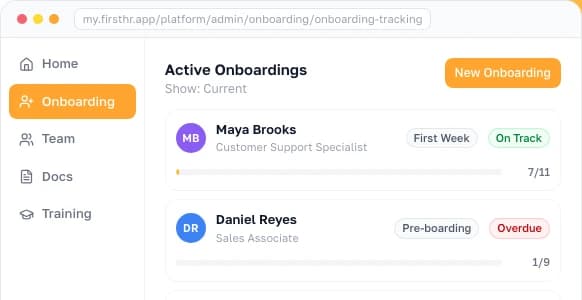
FirstHR is our product and its place here is narrow. Training modules with completion tracking sit inside an HR platform alongside onboarding workflows, built-in e-signature, employee records, and document management, so a new hire signs the offer letter, acknowledges the company policies, and works through orientation in one place on their first morning. The Business rate is flat from 11 to 50 people, so hiring three mechanics for a busy season does not change it.
Those training modules are built from your own files, with completion recorded by signature, and each stored document can carry an expiry date and be filtered as valid or expired, though nothing sends a reminder. That suits company procedures and uploaded certificates rather than aviation currency.
Everything an aviation LMS adds on top comes from the tools above. CTS sells recurrent ground training, eLeaP or an operations system watches currency across a crew, and the flight school platforms run curriculum and dispatch together. Our product adds no FAA courseware, packaged course support, scheduling, dispatch, or maintenance records.
What actually expires
Almost none of the six dates in the table below are course completions, and that is what decides whether a general platform can do the job.
| What expires | Interval | Rule | Tracked by a general LMS? |
|---|---|---|---|
| Part 135 competency check | 12 calendar months | 14 CFR 135.293 | No |
| Part 135 pilot in command line check | 12 calendar months | 14 CFR 135.299 | No |
| Hazardous materials training | 24 months | 14 CFR 135.505 | Only as a course completion |
| First-class medical, pilot aged 40 or over | 6 calendar months | 14 CFR 61.23 | No |
| Flight instructor recent experience | 24 calendar months | 14 CFR 61.197 | No |
| Inspection authorization | Expires March 31 of each odd-numbered year | 14 CFR 65.92 | No |
Only one row there, hazardous materials training, is a training record in the sense a learning platform understands, and even that one needs more than a completion date. Under the hazardous materials requirement, training has to sit within the preceding 24 months, and the record has to survive 90 days past the day the person stops performing the function.
The rest are qualifications with their own clocks, issued by somebody else, and a platform that records its own completions shows nothing for a pilot who arrived with a current check from a previous employer.
The instructor row works differently from the others. Under 14 CFR 61.19, a flight instructor certificate issued on or after December 1, 2024 carries no expiration date, and the 24-calendar-month clock now runs on recent experience under 61.197. A certificate issued before that date still expires 24 calendar months after it was issued or renewed.
What the inspector asks to see
Retention periods differ by certificate, and they are shorter than most operators assume. What matters is producing a complete, attributable file for one named person on request.
| Record | Who keeps it | How long | Rule |
|---|---|---|---|
| Pilot and flight attendant training records | Part 135 certificate holder | At least 12 months | 14 CFR 135.63 |
| Employee training records | Part 145 repair station | At least 2 years | 14 CFR 145.163 |
| Student training records | Part 141 pilot school | At least 1 year after graduation, termination, or transfer | 14 CFR 141.101 |
| Hazardous materials training records | Part 135 certificate holder | While the person performs the function, plus 90 days | 14 CFR 135.507 |
The pilot school rule is the strictest about what the record contains. Under 14 CFR 141.101, a school keeps a current and accurate record of each student covering enrollment, attendance, the subjects and stage checks completed, and the graduation or termination date. A student logbook by itself does not satisfy it.
This record requirement is why flight school products are built around a syllabus rather than a course list, and why a corporate platform struggles to produce the report at all.
What 20 people actually cost
The table below models twenty people, monthly and across a first year, with quote-only vendors marked rather than estimated. How often the word quote appears is the finding.
| Option | How it is priced | Monthly at 20 | First year at 20 | What the number hides |
|---|---|---|---|---|
| TalentLMS | Flat bracket to 40 users, annual billing | $119 | $1,428 | No aviation content, no currency dates, nothing on a fleet |
| eLeaP | $5 per user, 25-user minimum | $125 | $1,500 | You pay for 25 seats at 20 people; aviation logic is configured |
| FirstHR | Flat $198 for 11 to 50 people | $198 | $2,376 | Onboarding and company training, no FAA courseware or currency |
| Aviatize | Per aircraft, unlimited users | 232 euros | 2,784 euros | Modeled at 8 aircraft; onboarding bundles run to 5,000 euros |
| iSpring LMS | Active user, published from 100 users | Quote | Quote | Rates fall with volume, so 20 people sit below the published band |
| CTS | Per package, quoted | Quote | Quote | Buys the ground training itself, which no other row here does |
| Flight Schedule Pro | Per aircraft for the suite, quoted | Quote | Quote | Hubs are priced separately, so scope decides the number |
| Talon Systems | Quote only | Quote | Quote | Sized for collegiate and multi-campus flight programs |
| CORRIDOR | Quote only | Quote | Quote | You are buying an MRO business system with training inside it |
| Comply365 | Quote only | Quote | Quote | Airline training management, not a small-operator purchase |
| AQT Solutions | Quote only | Quote | Quote | Airline, military, and advanced air mobility programs |
Seven of eleven will not give a number without a call. That is not an accident of this sample. Aviation software is sold through relationships, and the smaller the operator, the worse that trade is, because the same discovery call costs the vendor as much for a twelve-pilot certificate as for a regional airline.
Budget the evaluation time alongside the license cost, because for a small operator it is often the larger of the two.
The SMS deadline in the middle of this
A safety management system (SMS) requirement now applies to operators who never had one, and it carries a training and records obligation that lands on whatever platform you own.
The FAA final rule published in the Federal Register extends the Part 5 SMS requirements to Part 135 certificate holders and to commercial air tour operators flying under a Section 91.147 letter of authorization. The rule took effect on May 28, 2024, and those operators have 36 months from that date to develop and implement an SMS.
Under 14 CFR 5.91, the organization trains each individual identified in its SMS so that they attain and maintain the competencies their SMS duties require.
The verdict by operation
A single ranking assumes every operator shopping in this category has the same problem. Across the six operations below, the right answer is different for each one.
| Your operation | What usually fits | What to avoid |
|---|---|---|
| Part 61 or Part 141 school, small fleet | Aviatize for published pricing, or Flight Schedule Pro for US depth | A corporate LMS with no syllabus, dispatch, or fleet |
| Collegiate or multi-campus flight program | Talon Systems, with implementation budgeted | Per-aircraft pricing without modeling it on your fleet |
| Part 135 charter, 8 to 20 pilots | CTS for the ground training, plus a system that watches dates | An airline training suite; the demo alone will cost you weeks |
| Part 145 repair station | CORRIDOR if work orders and training belong together | A platform that records completions but cannot gate a task |
| Own manual and procedures, content handled | TalentLMS at $119, or eLeaP at $125 with expiry alerts | Paying for an aviation product to host material you wrote |
| The bottleneck is hiring and paperwork | FirstHR at a flat $198 for 11 to 50 people | An aviation LMS bought for one onboarding module |
The uncomfortable summary is that a twenty-person operator with a working currency spreadsheet and bought ground training is fully served for about $119 a month, while the platforms that come up first in this category are built for organizations a hundred times that size.
How to choose
Five questions settle this, and the first two remove most of the market before you open a trial.
Whatever you end up buying, get the currency question answered first, because it is the part with a hard external requirement and a real consequence attached. Once someone reliably knows who is legal to fly, teach, or sign, the remaining decision about where the courses live is small, cheap, and reversible. You can make it after putting one real module in front of one real crew.
Frequently Asked Questions
What is an aviation LMS?
A product that both delivers training and keeps some record of who is qualified, sold to flight schools, charter certificates, and repair stations. The term covers three separately purchasable things: bought ground training content, a record of checks and certificates with their expiry dates, and a delivery platform for material only you can write. Most small operators need one or two of them.
Is any LMS FAA approved?
No, and the claim is worth testing early. A Part 135 operator maintains an approved training program under 14 CFR 135.341, and a repair station has an FAA-approved employee training program under 14 CFR 145.163. Software is where the program runs, not the thing that gets approved. The better questions are which curriculum segments the content covers and what a record export for one person looks like.
How much does an aviation LMS cost?
Four of eleven options publish a rate. TalentLMS is $119 a month to 40 users, eLeaP is $5 per user with a 25-user minimum, so about $125 at twenty people, FirstHR is a flat $198 for 11 to 50 people, and Aviatize starts at 29 euros per aircraft with unlimited users. CTS, Flight Schedule Pro, Talon Systems, CORRIDOR, Comply365, AQT Solutions, and iSpring below 100 users all quote privately.
Can a general LMS be used for Part 135 recurrent training?
Yes for delivering ground training and recording completion, usually no for currency. A general platform stores a completion date, while an operations office needs a competency check and a line check both inside the preceding 12 calendar months and hazardous materials training inside 24 months. Those are rolling calculations, and completion trackers are built for a different question.
What training records does a Part 145 repair station have to keep?
Individual employee training records, retained at least 2 years under 14 CFR 145.163. The rule ties the training program to each employee assigned to maintenance, preventive maintenance, alterations, and inspection functions being capable of the assigned task. The join an inspector wants is between the signature on a task and the training behind it, which is why compliance training records alone are rarely enough in a shop.
What does a flight school need to keep for Part 141?
A current and accurate student record, kept at least 1 year after graduation, termination of enrollment, or transfer, under 14 CFR 141.101. It covers enrollment, attendance, the subjects and stage checks completed, and the end date, and a logbook alone does not satisfy it. The record has to show progression through an approved syllabus rather than that a video was watched.
Does the SMS rule mean I need new training software?
Not necessarily. The rule adds people you have to train and then evidence, rather than a product you have to buy. The final rule effective May 28, 2024 gives Part 135 certificate holders and Section 91.147 air tour operators 36 months to implement an SMS, and 14 CFR 5.91 requires training for the people your SMS identifies. The platform you already use for indoc can carry it if assignments map to named roles and exports name individuals with dates.
What is the best aviation LMS for a small flight school?
Aviatize where published per-aircraft pricing and unlimited users matter, and Flight Schedule Pro where you want an established US product covering scheduling, billing, and Part 141 and 61 records at once. Talon Systems is the answer a size or two up, for collegiate and multi-campus programs. A general platform is the cheaper answer only when curriculum and dispatch are already handled elsewhere.
Make HR the easy part of running your business
Onboarding, e-signatures, training and core HR in one place. Up and running in 5 minutes.
- 7-day free trial
- No credit card required
- Cancel anytime