
Asynchronous Learning: Examples and How to Run It
Asynchronous learning examples for small teams: self-paced modules, recorded sessions, and discussion boards, plus what to keep live and how to measure it.

Asynchronous Learning
Self-paced modules, recorded sessions, and discussion boards that people actually finish
The first asynchronous training I shipped was a 40 minute recording of a live session that half the team had missed. I posted the link in a channel and asked people to watch it when they had a moment. Two weeks later, four of nine had opened it, and the average watch time was under six minutes.
The second attempt used the same material. I cut it into four modules of about seven minutes, each one ending with something the person had to do in the actual tool, and sent them out as assigned tasks with names and due dates. Everyone finished inside a week, and the work they handed back told me exactly which part had not landed.
That comparison is the whole subject. Asynchronous learning is not a recording you make available. It is a design decision about what people can learn on their own clock without losing the accountability, the questions, and the correction that a live session hands you for free.
Below: what asynchronous learning actually means, how it compares with live sessions, examples across the three formats that carry most of the load, what should never go async, the pay and interactivity rules employers miss, and how to tell afterward whether any of it worked.
What Asynchronous Learning Is
Asynchronous learning is training a person completes on their own schedule, with no requirement that the instructor and the learner are present at the same moment. Content is prepared once, delivered on demand, and consumed whenever the learner opens it.
For a small team the appeal is not the technology. It is that async training does not require several people to leave the floor during the same hour, which is the constraint that kills most training plans before anything gets built.
Gallup put a number on that constraint in Addressing the Barriers Blocking Employee Development (July 21, 2025): 89 percent of chief human resources officers named time away from day-to-day responsibilities as the biggest obstacle to employee development. Async does not remove that cost, since learning still takes hours. It moves the hours to where they fit.
Asynchronous Learning vs Self-Paced Learning
Self-paced learning is one kind of asynchronous learning rather than a synonym for it. Asynchronous describes timing: the teaching and the learning happen at different moments. Self-paced describes control: the learner sets the speed, the stopping points, and the order.
The difference shows up in deadlines. A recorded module due Friday is asynchronous but not fully self-paced, because you own part of the pace. A written library someone opens when a question arises is both. Most workplace training should be asynchronous with a deadline, because pure self-pacing plus a busy week reliably produces nothing.
If your team already runs on written updates and recorded decisions, async training fits habits that exist. Asynchronous work and asynchronous learning also fail for the same reason: nobody owns the follow-up, so the thing that was supposed to happen later never happens at all.
Asynchronous vs Synchronous Training
Synchronous training buys attention and correction in real time. Asynchronous training buys repeatability, schedule freedom, and a record of what was delivered. The choice is made per topic, not per company.
| Dimension | Synchronous (live) | Asynchronous (on demand) |
|---|---|---|
| When it happens | Everyone present at the same hour, on site or on a call | Each person on their own schedule, inside a deadline you set |
| Cost of the next learner | The same again: another session, another hour of the trainer | Close to zero once the module exists |
| What it teaches well | Judgment calls, practice with feedback, sensitive topics, anything that needs a conversation | Procedures, tools, policy, terminology, and refreshers |
| Questions | Answered in the moment, and everyone in the room hears the answer | Answered later, and only if you built a route for them |
| Accountability | Attendance is visible in the room | Invisible unless the module is assigned with an owner and a due date |
| Record it leaves | A sign-in sheet and whatever the trainer remembers | Completion data, submitted work, and the exact version delivered |
| Updating it | Retrain the room, or the change never reaches the people who left it | Edit once, and everyone from that point forward gets the new version |
| How it fails | Scheduled, postponed, postponed again, then quietly dropped | Published, ignored, and counted as done anyway |
Read the last row as the honest comparison. Live training fails loudly, because a canceled session is visible to everyone on the calendar. Async training fails silently, because nobody complains about a module they never opened. Every recommendation in this guide exists to make that silent failure visible.
The second row is why async wins for anything repeated. If you hire four people a year and teach each of them the same procedure in person, you pay for that lesson four times. Build it once as a module and the fifth hire costs you nothing beyond the assignment, which is the same argument behind a structured onboarding process.
Asynchronous Learning Examples
Three formats carry most asynchronous learning in a small business: self-paced modules, recorded sessions, and discussion boards. Written job aids and assigned reading with a comprehension check sit alongside them and cost the least of all to produce.
The eight examples below are the ones I see working most often, each with the artifact that proves it landed. Note that none of them is judged by a completion tick, because a completion tick tells you the file opened.
| Situation | Async format | What the learner hands back | Realistic effort to build |
|---|---|---|---|
| A new hire needs the refund and exchange flow | A six minute screen recording plus a one page job aid | A test refund processed in the system, with the confirmation number | About 90 minutes, once |
| The handbook changes mid-year | A two page summary of what changed, with three questions at the end | A signed acknowledgment naming the current version | About an hour per revision |
| A first-time manager is about to run interviews | A four part module released one part per week | A draft scorecard for the role they are actually hiring | Half a day to build, reused for every new manager |
| You move the team to a new scheduling tool | A chaptered walkthrough recorded during the real migration | Their own schedule rebuilt in the new tool | Recorded live, plus 20 minutes to trim and chapter |
| Two shifts never overlap and repeat the same mistakes | A weekly discussion thread owned by the shift lead | One documented fix per week, posted in the thread | About 15 minutes a week from the owner |
| The seasonal peak is six weeks out | A refresher module assigned with a due date before the peak | A short scenario answer reviewed by the manager | Two hours, reused every season |
| One person is the only one who knows a rare procedure | A walkthrough recorded while they perform it for real | A second person completing it once under observation | The length of the task, plus 20 minutes |
| A state mandates annual harassment prevention training | An interactive course that meets the state format rules | A completion record with the date and the version delivered | Buy it rather than build it |
Two patterns run through all eight. Format follows content: anything you can demonstrate on a screen becomes a recording, anything with ordered steps becomes a written job aid, and anything with judgment in it becomes a thread where people can disagree in writing.
And every row ends in something handed back. That artifact is what makes async training defensible later, whether the question comes from a manager asking if the new hire is ready or from an auditor asking what training happened and when.
What Should Go Async, and What Should Not
Send training async when the content is stable, identical for everyone, and possible to judge from an artifact. Keep it live when the point is practice with feedback, a judgment call, or a conversation people would not have in writing.
| Type of training | Async, live, or both | Why |
|---|---|---|
| Tool and system walkthroughs | Async | A screen recording shows the real interface, and people rewatch the 30 seconds they need |
| Standard procedures and policy | Async | Stable content, identical for everyone, and the acknowledgment is the proof |
| Annual refreshers | Async | The audience already knows the material and needs what changed, not the whole course |
| Practice with feedback: sales calls, difficult conversations, interviewing | Both, async first and live for the reps | Watching is not practicing, and the correction has to arrive while someone is doing it |
| First-time performance of a hazardous task | Live, with supervision | Nobody can be corrected by a video at the moment they get it wrong |
| Conduct, complaints, and performance conversations | Live | People ask their real questions out loud, or not at all |
| Onboarding paperwork and orientation basics | Async, ahead of the start date or in quiet week-one hours | It clears the first week for the parts that need a person |
| State-mandated compliance training | Async only if the format meets the rule | Several states set interactivity and duration requirements a plain video does not satisfy |
The row people get wrong is practice. A module about handling an upset customer teaches the vocabulary and the escalation path, both of which are useful. It does not teach anyone to stay calm on the phone. Async carries the knowledge half; live time carries the reps. When there is budget for only one, keep the reps and cut the lecture.
Onboarding is where async pays fastest, because so much of week one is intake rather than teaching. Documents, policy reading, tool setup, and the first module can run before the start date or during quiet hours, which leaves the scheduled time for the introductions, the questions, and the hands-on work that only a person can deliver. If the new hire is nonexempt, that pre-start time is paid like any other assigned work.
How to Build a Self-Paced Module People Finish
A module gets finished when it is short, named after a task, assigned with a deadline, and ends in something the learner has to produce. Everything else is production value, and production value is not what makes people press play.
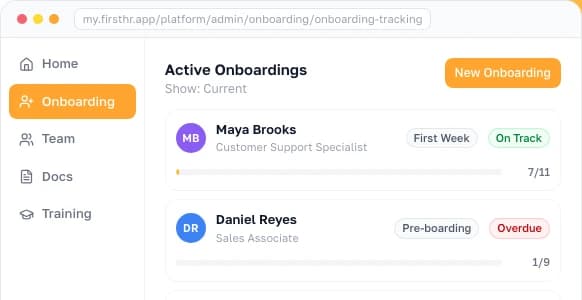
Assignment is the step small teams underestimate most. FirstHR delivers training modules as onboarding tasks with owners and due dates, so a module scheduled for week one carries a deadline and a completion record instead of living as a link somebody meant to send.
The other underestimated step is the question route. Watch what happens without one: the learner hits a screen that does not match the recording, guesses, and either does the task wrong or gives up and interrupts a colleague, which was the interruption you were trying to prevent.
The scoping decisions above happen once, while you are building. What decides whether the module lands afterward is everything around it, and that is the part nobody writes down: what comes back, who assigned it and by when, where a stuck learner asks, and whether the minutes are paid. I keep those on one page beside the module.
Recorded Sessions That Are Worth Watching
A recording of a live session is the most common asynchronous learning example and the weakest one, because it was made for the people in the room. The person watching alone three weeks later gets the tangents, the inside references, and none of the context.
Four steps turn a recording into something usable, and together they take about 20 minutes. Trim the opening small talk and the closing scheduling talk. Add chapter markers so nobody hunts for the two minutes that matter. Write a two-line summary saying what the viewer should be able to do afterward. Then assign only the segment that applies to each person.
That last one is the highest-value habit. A 45 minute session usually contains three or four separate lessons aimed at different people, and sending the whole file to everyone guarantees most of them skip most of it. Cut it into pieces and it becomes a small library rather than one intimidating file.
Two housekeeping rules keep recordings out of trouble. Tell people the session is being recorded before it starts, and cut anything that names a customer or discusses an individual employee before you publish it. A training recording circulates further and lives longer than the meeting did, which is the point and also the risk.
Recordings are also the cheapest way to capture knowledge that exists in one person's head. When somebody performs a rare procedure, record it while they do it rather than asking them to write it up afterward. The write-up rarely happens, and what does get written skips the steps the expert stopped noticing years ago. Filing those recordings alongside your written standard operating procedures gives you both the reference and the demonstration.
Discussion Boards That Do Not Die
An asynchronous discussion board survives when one person owns it, answers arrive inside a promised window, and the thread is attached to real work rather than to a training topic in the abstract. Boards that fail tend to fail the same way: a burst of activity in week one, silence by week four.
Three thread types earn their keep in a small business. A shift handover thread where the closing shift posts what the opening shift needs to know. A weekly thread where anyone posts one thing that went wrong and the fix they applied. And a question thread attached to each module, so the question one learner asks becomes the answer the next four read.
The owner matters more than the tool. Someone has to answer inside a day, ask a follow-up when a post is too vague to act on, and periodically fold repeat answers into a written guide. Without that, a board becomes a wall of unanswered questions, which teaches everyone to ask in a private message instead.
The best signal a board is working is that answers stop being repeated. When the same question keeps coming back, the answer needs to graduate out of the thread and into your knowledge base or a short module, with the thread linking to it. A board is where knowledge is generated, not where it should permanently live.
Blending Async With the Live Time You Keep
The pattern that works is async first and live second: people take in the content on their own schedule, and the scheduled hour goes to practice, questions, and correction. Reversing that order wastes the most expensive resource in the plan, which is everyone being in the same place at once.
In practice this means the live session has no lecture in it. Send the module three days out with a due date the day before. Open the session with the two questions the discussion thread produced, then spend the rest of the time on role plays, real examples, and decisions people got wrong in the hand-back exercise.
When half the group has not done the pre-work, treat that as data about the module rather than about the people. Usually it was too long, sent too early, published rather than assigned, or covering something the group already knew. Fix that before blaming attendance, and consider whether the topic belongs in team training at all.
Asynchronous Training and Pay Rules
For a nonexempt employee, time spent on assigned asynchronous training is hours worked, and the fact that the person chose the hour does not change that. Async makes off-clock training easy to create by accident, which is exactly why the rule deserves attention before you launch a library.
Under 29 CFR 785.27, training time can be excluded from hours worked only when all four conditions are met: attendance is outside regular working hours, attendance is in fact voluntary, the course is not directly related to the employee's job, and the employee performs no productive work during it. A module you assigned about the person's own job fails at least two of those, usually three, and failing one condition is enough.
The practical rules follow directly. Tell nonexempt employees to complete modules on the clock, and make sure the minutes land in your time records and in the overtime calculation. Do not build a program that quietly depends on people watching training at home. And check your state agency, because state wage and hour rules can be stricter than the federal floor.
Where Async Training Is Not Enough by Law
Some required training carries format rules, and a video that plays to the end does not satisfy them. This is the part of async training that catches small employers by surprise, because the content can be correct while the delivery method fails the requirement.
New York State requires sexual harassment prevention training to be interactive. The state guidance for employers states that an individual watching a training video or reading a document only, with no feedback mechanism or interaction, would not be considered interactive. Web-based training qualifies when it asks questions the learner must answer, lets them submit a question and get an answer in a timely manner, or collects feedback. Employees must be trained at least once per year, and a live trainer is not required.
California is more prescriptive about the async format itself. Under 2 CCR 11024, e-learning means individualized, interactive, computer-based training created by a trainer and an instructional designer. The course must provide a link or directions for reaching a trainer who answers questions within a reasonable period and no more than two business days, and that trainer keeps the written questions and responses for two years. The program has to take at least one hour for a nonsupervisory employee and two hours for a supervisor, and bookmarking that lets someone pause is allowed as long as the program still runs that long.
For most small employers the practical conclusion is to buy state-mandated courses rather than build them, and to spend your own production time on the operational training nobody sells. Whichever route you take, the recordkeeping is yours: assign by name, capture the completion date, and keep the version of the content that was actually delivered, because compliance training is proved by records rather than by intentions.
How to Tell Whether Async Training Worked
Completion rate is the weakest signal available and the one every platform reports first. Judge asynchronous training on the artifact the learner handed back, the questions that stop arriving, and the error rate in the work itself.
| Signal | When to check | What good looks like | What it means when it is missing |
|---|---|---|---|
| Completed by the due date | On the due date | Everyone assigned finished without a second reminder | The module is too long, badly timed, or was published rather than assigned |
| The hand-back artifact | Within a few days of completion | A test transaction, draft, or scenario answer showing the person can do the task | The module taught recognition, not capability. Add a real task or move the topic live |
| Repeat questions to managers | About 30 days after rollout | The questions the module covers stop reaching the manager | People cannot find the module, or they tried it once and did not trust it |
| Error rate in the actual process | 60 to 90 days | Fewer reworks, fewer escalations, and fewer corrections on the step the module covers | Training was not the constraint. Look at the tool, the staffing, or the incentive instead |
| Content still true | At every review trigger | Someone verified the module against the current process and dated it | The library is decaying, and the first wrong module costs you trust in all of them |
The second row is the one worth defending in a budget conversation. A completion report proves the file opened. A stack of hand-back artifacts a manager reviewed proves people can do the work, and it is the only async evidence I have ever seen change someone's mind about whether the training was worth building.
If you want the formal version of this ladder, the Kirkpatrick model arranges the same idea across four levels, from reaction to results. The practical short version for a small team: the first two levels are cheap and tell you little, and the last two are the ones that justify the next module.
One caution about survey data. Asking people whether they liked a module measures production quality and mood, not learning, so keep training survey questions focused on whether anything was unclear and whether they could apply it, and weight the answers below the artifact.
Where Asynchronous Learning Goes Wrong
Six failure patterns account for nearly every async library that quietly stops being used. All of them are cheap to prevent and expensive to notice late, because async failure never announces itself.
Frequently Asked Questions
What is asynchronous learning?
Asynchronous learning is training a person completes on their own schedule, without the instructor and the learner being present at the same time. The content is prepared once and consumed on demand: a self-paced module, a recorded session, a written guide, or a discussion thread. The word describes timing only. It says nothing about whether the content is good, whether anyone is accountable for finishing it, or whether the learner can ask a question. Those have to be designed in. For a small employer the practical appeal is scheduling: async training does not require several people to leave the floor during the same hour, which is the constraint that stops most training plans before they start. The trade is that async removes the ambient accountability of a room, so every item needs an owner, a deadline, and something the learner hands back.
What are examples of asynchronous learning at work?
The common workplace examples are self-paced modules, recorded sessions, written job aids, discussion boards, and assigned reading with a comprehension check. Concretely: a six minute screen recording of the refund flow that a new hire follows by processing a test refund, a two page summary of what changed in the handbook with an acknowledgment at the end, a four part module for a first-time manager released one part per week, a chaptered walkthrough recorded during a real tool migration, a weekly discussion thread where two shifts that never overlap post the fix they made, and a seasonal refresher assigned with a due date before the busy period starts. Each one is built once, delivered on demand, and judged by an artifact rather than by attendance.
What is the difference between asynchronous and synchronous training?
Synchronous training happens with everyone present at the same hour, and asynchronous training happens on each person’s own schedule inside a deadline you set. Synchronous buys real-time correction: the trainer sees confusion, answers the question everyone had, and adjusts. Asynchronous buys repeatability: the second learner costs almost nothing, the content stays identical, and one edit updates it for everyone who comes later. The failure modes differ too, and that matters more than the definitions. When a live session collapses, the whole calendar sees it and someone reschedules. When an async module goes unopened, no one raises a hand, so the gap sits there until it shows up as a mistake in the work. Most small teams should run async by default and reserve live time for practice, judgment calls, and sensitive conversations.
Do you have to pay employees for asynchronous training time?
For a nonexempt employee, assigned asynchronous training is almost always hours worked, and letting the person choose when to do it does not change that. 29 CFR 785.27 sets four conditions, and every one of them has to hold before the time can be left out of hours worked: attendance falls outside regular working hours, it is genuinely voluntary, the subject is not directly related to the employee’s job, and no productive work is performed. A module you assigned about the person’s own job fails at least two of those conditions, and failing a single one is enough to make the time compensable. Practical rules follow: tell nonexempt employees to complete modules on the clock, make sure those minutes are recorded, count them toward the overtime calculation, and do not build a program that quietly depends on people watching training on their phone after a shift. State wage and hour rules can be stricter than the federal floor.
Can compliance training be delivered asynchronously?
Often yes, but several mandates set format rules that a plain video does not meet. New York State requires sexual harassment prevention training to be interactive, and the state guidance says an individual watching a training video or reading a document only, with no feedback mechanism or interaction, would not be considered interactive. California is more prescriptive about the async format itself: under 2 CCR 11024, e-learning means individualized, interactive, computer-based training created by a trainer and an instructional designer, the course must give the learner a way to reach a trainer who answers within two business days, and the program has to run at least one hour for a nonsupervisory employee and two hours for a supervisor. The practical answer for a small employer is to buy mandated courses rather than build them, then keep the completion date, the name, and the version delivered.
How long should an asynchronous training module be?
Under 10 minutes, covering one outcome, unless a regulation sets a minimum duration. Anything longer competes with the rest of someone’s day and loses, so a large share of the audience ends up carrying only the opening section of the material. Splitting by outcome fixes more than completion. It makes the module findable, because the title can name the exact task. It makes maintenance cheap, because a process change touches one short module instead of a 40 minute course. And it lets you assign only the part a given person needs. The exception is state-mandated training with a stated length, where the rule sets the floor and your preference does not matter. Everything else should be short enough that someone can finish it between two other things.
How do you stop people from ignoring asynchronous training?
Assign it to a named person with a due date, and require something back at the end. Those two changes do more than any amount of production quality. A completion checkbox tells you a video played, so ask for a test transaction, a draft, a screenshot, or a two-line answer to a scenario instead, and have a manager look at it. Add a route for questions with a promised response time so people are not stuck, keep each module short enough to finish in one sitting, and name the module after the task rather than the topic so it can be found again later. If a module is still being ignored after all that, the content is usually the problem: too long, badly timed, or teaching something the person already knows.
Make HR the easy part of running your business
Onboarding, e-signatures, training and core HR in one place. Up and running in 5 minutes.
- 7-day free trial
- No credit card required
- Cancel anytime