
Greenhouse Alternatives: 8 Platforms Compared
Greenhouse alternatives compared on published pricing, what each one costs in a year, and which fits a team hiring without a recruiter.

Greenhouse Alternatives
Eight applicant tracking systems a small company can realistically move to, matched to the three reasons people actually leave: pricing you cannot see, a process built for a recruiting team you do not have, and a bill that outgrew the hiring it pays for
Nobody leaves Greenhouse because the software is bad. It is one of the most disciplined hiring systems on the market, the structured interview model it is built around genuinely produces better decisions, and companies that grow past a hundred people usually keep it. For everyone who leaves anyway, this page compares eight applicant tracking systems a small company can realistically move to.
When founders tell me they are looking elsewhere, the reason is duller than a missing feature. It is usually that they cannot see a price. Three founders I have talked to went through the same sequence: a demo, a discovery call, a quote that arrived a week later, and a renewal number twelve months on that nobody could sanity check against anything public.
Sometimes the problem is the opposite: a 25-person company that bought the structure and then discovered it had nobody to maintain it. Each alternative below is matched to the situation it actually suits, and every rate was read off the vendor pricing page in October 2026. Where a vendor publishes nothing, the table says Quote, because two of the eight genuinely do not put a number anywhere.
Why employers leave Greenhouse
Three reasons account for most departures, and none of them is that the product stopped working. Pricing is available only by quote, the structured hiring model assumes a recruiting function you may not have, and the platform is sized for hiring volume a small company reaches slowly if at all. Those three split into six practical situations, and the fix is different in each.
| The reason | What it looks like | Where to look instead |
|---|---|---|
| No published rate | Every comparison starts with a demo and a week of waiting | Workable, Ashby, Breezy HR, and JazzHR |
| The renewal number | Year two arrives with no public benchmark to check it against | Any product on this page that publishes a rate |
| Nobody owns the process | Interview kits and scorecards go unmaintained after month two | Breezy HR, Tellent Recruitee, and Manatal |
| Low hiring volume | Four searches a year against a platform built for forty | JazzHR, Breezy HR, and Manatal |
| Cost per hire | The subscription costs more than the roles it filled | Breezy HR, Manatal, and JazzHR |
| You are hiring at scale | Hundreds of hourly requisitions across locations | SmartRecruiters or Lever |
The quote-only problem
Greenhouse names three plans on its pricing page (Core, Plus, and Pro) and attaches no figure to any of them. The page says the cost is influenced by the plan you choose, your hiring volume and organizational complexity, and the capabilities you need. That is a fair description of how enterprise software is sold. It is also, in my experience, the most common thing small buyers complain about.
The practical cost is the process, not the price. You cannot shortlist three systems in an afternoon when one of them takes two weeks to produce a number, and you cannot check a renewal quote against anything public.
Five of the eight alternatives below publish a rate you can budget against and quote back at your account manager, and a sixth publishes a starting figure without saying what period it covers. That changes a negotiation more than any feature comparison does.
Structured hiring is the product, not a setting
Greenhouse builds around structured interviewing: defined stages, interview kits, scorecards, and a decision record that several people contribute to. Done properly, it beats a conversation and a gut call. According to the Office of Personnel Management, interviews with more structure show higher validity and rater reliability, with less adverse impact (selection rates that work against members of a race, sex, or ethnic group).
Greenhouse's rigor is why companies with a real recruiting function stay put. Structured interviewing is the design principle of the product here, not an optional module you can leave switched off.
The catch is maintenance. Somebody has to write the kits, keep the stages current, and hold hiring managers to the scorecard. In a company where hiring is a founder's fourth job, that person does not exist, and within two months the structure is a set of fields nobody fills in. A lighter tracker that gets used beats a rigorous one that does not.
What the plan tiers actually gate
The tier boundaries matter because they decide whether you are comparing against Core or against something considerably more expensive. Here is what each plan adds, read off the pricing page. CRM in the table is candidate relationship management, the tools for staying in touch with people you may want to hire later.
| Plan | What it is positioned for | What it adds |
|---|---|---|
| Core | Establishing a consistent hiring process | Sourcing and CRM, interview kits and scorecards, an AI notetaker, scheduling, reporting, and single sign-on |
| Plus | Adding teams, locations, or brands | AI-powered report filters, a business intelligence connector, sourcing automation, and texting |
| Pro | Operating across regions and business units | Unlimited CRM events, enterprise data configuration and security, an audit log, and a developer sandbox |
Read that ladder against your own company and the fit question answers itself. Texting candidates and a business intelligence connector sit in Plus. Audit logs and a developer sandbox sit in Pro. A small team hiring a handful of roles is buying Core and comparing it against products that put reporting, and sometimes texting, in their entry plan.
8 Greenhouse alternatives at a glance
The table below puts Greenhouse in the first row as the baseline, then the eight alternatives on published price, pricing model, and whether you can start without a sales call. Read the Publishes Rates column first, because that fork decides how long your evaluation takes.
| Platform | Leave For This Reason | Published Price | Pricing Model | Free Tier Or Trial | Publishes Rates | Typical Size |
|---|---|---|---|---|---|---|
| Greenhouse | The baseline you are comparing | Quote | Plan, volume, and complexity | Demo first | Scaling to enterprise | |
| Workable | A published rate and an HR bundle | $299/month | Plan plus size band | 15-day trial | 1 to 1,000 plus | |
| Ashby | Reporting depth at a company-wide rate | From $300/month | Size band to 100 employees | None published | Up to 100 | |
| Breezy HR | The monthly bill is the problem | $157/month | Flat per plan | Free forever plan | 1 to 200 | |
| JazzHR | You hire a few roles a year | $1,000/year | Flat annual per plan | 14-day trial | 1 to 100 | |
| Manatal | You pay per recruiter, not per firm | $15/user/month | Per user | 14-day trial | Agencies and small teams | |
| Lever | Sourcing matters more than tracking | Quote | Size and hiring volume | Demo first | 50 to 1,000 | |
| Tellent Recruitee | Hiring managers run the process | Quote | Plan, headcount, and term | Free trial | 10 to 500 | |
| SmartRecruiters | High volume across many locations | From $14,995 | Quote above Essential | Demo first | Mid-market and up |
How we evaluated these alternatives
Every platform here is one a small or mid-size US company could actually buy and run without an implementation team. We excluded products whose pricing we could not confirm on the vendor site as either a figure or an explicit quote-only policy, because a comparison built on third-party estimates is worse than no comparison at all.
The 8 alternatives reviewed
Workable is the closest thing here to a like-for-like replacement that will tell you a price without a call. Standard recruiting costs $299 a month billed annually, which is $3,588 for the year, or $360 a month billed monthly.
Workable's pricing page carries a company-size selector that starts at 1 to 20 employees and runs past 1,000, so the published figure is the entry band rather than a flat rate for any company.
What separates it from most of this comparison is the second half of the product. Every plan includes self-service employee profiles, a company directory, and an org chart next to the applicant tracking system. Workable's HR product adds an HR information system, onboarding, time off, and e-signatures for company files.
Bundled with recruiting on Standard, Workable's HR product brings the total to $359 a month billed annually at the 1 to 20 band, so the accepted offer does not hand off to a second vendor. Premier at $599 adds referrals and folds in texting, video interviews, and assessments, which are add-ons on Standard.
Every paid Workable account starts with 3,000 free AI credits for the Workable Agent. More are sold from $0.12 down to $0.095 each depending on volume, and purchased credits expire a year after purchase.
Ashby is where companies land when they liked the Greenhouse discipline and wanted the numbers to be better. Foundations covers companies of up to 100 employees with one figure for the whole business rather than a per-seat rate that grows every time a hiring manager needs access.
Ashby prices Foundations by company size band: $300 a month at 1 to 10 employees, $400 at 11 to 25, $500 at 26 to 50, $700 at 51 to 75, and $900 at 76 to 100, with 10 percent off for an annual commitment.
The ceiling is stated plainly, and that honesty cuts both ways. Cross 100 employees and you move to Plus or Enterprise, both priced on company size, usage, and commitment through a sales conversation. The deeper Ashby Analytics product is sold separately on usage, with a 100-employee minimum.
The pricing transparency you enjoy at 40 people is exactly the thing that expires as you grow, which is worth knowing before you migrate a year of hiring metrics into Ashby.
Breezy HR has the cheapest published company-wide rate on this page for unlimited positions and the only free plan that will run a real search. Bootstrap covers one active position or candidate pool with unlimited users, a customizable and mobile-friendly career site, resume parsing across more than 20 languages, and distribution to more than 50 job boards.
Startup at $157 a month on annual billing removes the single-position cap and adds the parts a working process needs: a customizable pipeline, candidate questionnaires, interview self-scheduling, Equal Employment Opportunity (EEO) and Office of Federal Contract Compliance Programs (OFCCP) reporting, calendar and email integration, and mobile apps.
Paid month to month, Startup is $189. Read the Breezy HR add-on list before you compare it with anything, because texting starts at $41 a month and onboarding at $49, so a low-cost tracker can quietly become a mid-price one.
JazzHR is the only product here that publishes a straight annual price list, and its entry plan is the lowest company-wide price of anything paid on this page. Hero is $1,000 a year, starting at three job postings a month, and covers the tracker, email templates, and job distribution without a sales conversation.
Check the add-on column before you set that $1,000 against a Greenhouse quote. Offers and e-signature, the step that actually closes a hire, are not on Hero at all, are an add-on on Plus, and only become a plan feature on Pro at $5,508 a year. Advanced visual reporting works the same way.
JazzHR Plus at $3,480 a year is the sweet spot for most small employers: up to 200 active jobs, AI candidate matching, structured interviews and assessments, and configurable task automation.
Manatal is the only per-user product in this comparison, which is why a two-person hiring team pays $30 a month for a real tracker instead of several hundred. Professional is $15 per user per month on annual billing, covering up to 15 jobs and 10,000 candidates, with unlimited hiring managers who cost nothing to add.
The model inverts the economics of everything else here. On the other seven platforms your bill is set by your company size or your plan tier; on this one it is set by how many people actually run recruiting, which for most small employers is one or two.
The trade-off of per-user pricing at Manatal is depth and headroom. The advanced report builder waits for Enterprise Plus at $55 per user, and the 15-job ceiling on Professional pushes a company with a busy recruiting funnel up to Enterprise at $35 per user.
Lever is the closest philosophical peer to Greenhouse, and it makes exactly the same demand of you: a form, a call, and a tailored quote. The company describes the product as an applicant tracking system and recruiting CRM combined, which is the honest positioning and also the reason to consider it.
The case for moving here is a sourcing bottleneck rather than a tracking one. If your problem is that you post a role and wait, a tracker will not fix it. In Lever, nurture campaigns, talent pools, and re-engaging candidates you interviewed for an earlier role are first-class parts of the product rather than a bolt-on.
If your problem was that nobody would show you a price, understand that switching to Lever reproduces that exactly.
Tellent Recruitee, formerly sold simply as Recruitee, is the collaborative option: the product assumes hiring managers rather than a dedicated recruiter do most of the work, which describes a lot of companies leaving Greenhouse. The rate is not published, but the plan boundaries are, and they are unusually specific about where each tier stops.
Start covers five active job posts, a single-page careers site, multi-board posting, pipeline automation, and standard reporting. Advance removes the job cap and adds employee referrals, knockout questions (screening questions that rule out applicants who miss a must-have), candidate self-scheduling, offer letter generation, an AI screening assistant with 100 credits a month, and AI matching capped at three searches a month.
The Optimize tier adds single sign-on, a dedicated customer success manager, full AI screening, 65 matching searches, bias tooling, and requisition approval workflows. API access is listed on every tier. Contracts carry a one-year minimum whichever tier you pick.
SmartRecruiters, now an SAP company, is the one product here that publishes a number and still leaves you guessing. The Essential plan is listed as starting at $14,995, with no billing period stated anywhere near it, and the Professional, High Volume, and Complete tiers above it all route to a sales contact.
What that plan covers is broad: applicant tracking, a CRM, onboarding, SMS messaging, job distribution, and dynamic scheduling in one product. SmartRecruiters also sells a dedicated tier aimed at retail, seasonal, hospitality, and healthcare employers.
If you are running hundreds of hourly requisitions across sites, SmartRecruiters is the right shape, and the breadth of the Essential plan matches the work it replaces. If you are filling fifteen roles a year, it is the wrong answer to a high-volume hiring question you do not have.
What each alternative costs in a year
A year of published pricing runs from free to about $15,000, and this is the table that decides most switches. It converts every published rate into twelve months of subscription, which is the only way to compare a monthly product against an annual price list against a single starting figure with no period attached.
| Plan | Published rate | Cost for a year | What the number covers |
|---|---|---|---|
| Breezy HR Bootstrap | Free | $0 | One active position with unlimited users |
| Manatal Professional | $15 per user per month | $540 | Three recruiter seats, capped at 15 jobs |
| JazzHR Hero | $1,000 per year | $1,000 | Job postings starting at three a month |
| Breezy HR Startup | $157 per month | $1,884 | Unlimited positions on annual billing |
| Ashby Foundations | $300 per month | $3,240 | Companies of 1 to 10 employees, annual rate |
| Breezy HR Growth | $273 per month | $3,276 | Adds e-signatures and multiple pipelines |
| JazzHR Plus | $3,480 per year | $3,480 | Up to 200 active jobs, plus AI matching |
| Workable Standard | $299 per month | $3,588 | Recruiting only; with the HR bundle, $359 a month |
| JazzHR Pro | $5,508 per year | $5,508 | Offers and e-signature inside the plan |
| Workable Premier | $599 per month | $7,188 | Adds texting, video interviews, assessments, and referrals |
| SmartRecruiters Essential | From $14,995 | From $14,995 | No billing period stated on the page |
| Greenhouse, Lever, and Tellent Recruitee | Quote | Quote | No rate published at any tier |
Three patterns fall out of it. First, the middle of the published range is crowded: Ashby Foundations at its smallest size band, Breezy HR Growth, JazzHR Plus, and Workable Standard all land between $3,240 and $3,588 a year while doing noticeably different jobs. At that price the real question is whether you want reporting depth, employee profiles next to the tracker, or a higher job ceiling, not which plan is cheapest.
Second, the cheapest plan is rarely the cheapest bill. JazzHR Hero at $1,000 looks unbeatable until you notice that it cannot send an offer for signature at all. Breezy HR adds electronic signatures only from Growth at $3,276 a year, not on Startup at $1,884. Price the plan that contains the features you will use in month one, not the entry row.
Third, the quote-only row at the bottom is a different buying process, not a footnote. Greenhouse, Lever, and Tellent Recruitee all require a conversation before a number exists, and Ashby joins them above 100 employees. That is a legitimate model, and at real scale a negotiated rate often beats a list price. It also means your cost per hire depends on how well you negotiate rather than on a page you can read.
What switching off Greenhouse actually involves
A tracker migration is four jobs: getting the candidate data out, getting the attachments and feedback out, rebuilding the configuration, and timing the cutover so no live search is mid-flight. The structured data is usually the easy part, and the interview record is usually the part that goes wrong.
Candidate names, emails, stages, and source fields export cleanly from almost any applicant tracking system. Resumes, scorecards, interview feedback, and the email threads attached to a candidate are files and free text, and they either come out in a bulk archive nobody can map back to a person or they do not come out at all. Ask both vendors specifically what happens to the interview record, not just to the candidate record.
| Migration step | What to confirm | Common mistake |
|---|---|---|
| Candidate export | Field-level export in a documented format | Assuming a CSV report equals a migration file |
| Attachments and feedback | Resumes, scorecards, and notes mapped to each candidate | Discovering the archive is unlabeled after canceling |
| Record retention | One year on personnel and employment records | Deleting the old tenant before the retention clock runs |
| Career page and live jobs | Redirects from every published job URL | Leaving applicants at a dead link for a month |
| Integrations | Background check, assessment, and calendar connections | Rebuilding a screening connector mid-search |
| Cutover timing | A window with no offer out and no search at final stage | Timing the move to the renewal date instead |
The retention line is the one with legal weight, because it comes from the Equal Employment Opportunity Commission. The EEOC requires personnel and employment records to be kept for one year, which covers application materials for people you did not hire. The records of an employee who is involuntarily terminated (fired or laid off) must be kept for one year from the termination date.
Once a discrimination charge is filed, all relevant records must be held until the charge or any lawsuit based on it is finally disposed of, which means the lawsuit has ended or the time to file one has run out.
Switching off the old tenant, your account on the old system, before those obligations live somewhere else is how a routine software change becomes a discovery problem in a lawsuit. Treat record retention as part of the migration plan rather than an afterthought.
How to choose a Greenhouse alternative
Start from the reason you are leaving, not from a feature matrix. Five questions narrow eight options down to two in about twenty minutes, and four of the five have nothing to do with features.
One last piece of process. Whichever way you go, run a single real search end to end in the new system before you cancel the old one, keep both readable until an offer has been signed on the new platform, and write down the stage definitions you are carrying across rather than rebuilding them from memory.
Before you choose
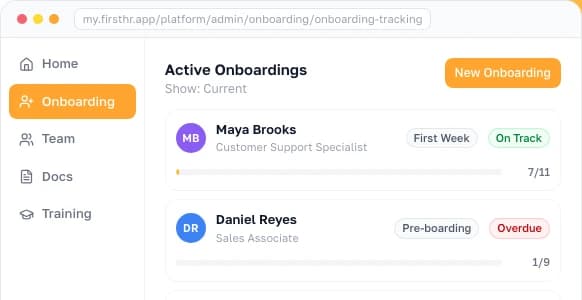
FirstHR covers the half of hiring that begins the moment an offer is accepted: e-signature on the offer letter and on policy acknowledgments, onboarding task workflows, training assignments, and an employee record with the documents attached, on flat plans at $98 a month for up to 10 people or $198 for 11 to 50.
Form I-9, the W-4, and the rest of the new hire paperwork go on the new hire's first-day list as tasks, and the completed forms are kept in the employee file. The I-9 and the tax forms themselves are completed outside the platform.
Pipeline management comes from the platforms above. Applicant tracking is coming soon to FirstHR. Until it ships, every product reviewed here covers the front half of hiring for you. The common small-business setup is a published-price tracker for the search and a separate platform for everything after the signature, which is usually cheaper than buying an HR suite for a recruiting module you barely open.
Frequently Asked Questions
What are the best alternatives to Greenhouse?
It depends on why you are leaving. Pick Workable when you want a rate on a page and onboarding from the same vendor through its HR bundle, Ashby when reporting is the thing you missed, Breezy HR when the bill is the problem, JazzHR when you fill a handful of roles a year, and Manatal when you would rather pay per recruiter than per company. Lever, Tellent Recruitee, and SmartRecruiters are the moves when sourcing depth or hiring volume outranks price transparency.
Does Greenhouse publish pricing?
No. The three plans are listed by name and capability only, with no dollar figure beside any of them. Cost is attributed to your plan, hiring volume, organizational complexity, and required capabilities, and the page then sends you to a demo. Any annual number you see in a roundup is a third-party estimate rather than a rate the vendor stands behind.
How much does an applicant tracking system cost compared with Greenhouse?
The field runs from zero to roughly $15,000, and the middle of it is where most small employers land. Breezy HR is free for one position and $157 a month for unlimited ones, JazzHR publishes $1,000, $3,480, and $5,508 a year, Workable is $299 to $719 a month for recruiting, Ashby is $300 to $900 a month by company size, and Manatal is $15 per user. Greenhouse, Lever, and Tellent Recruitee publish nothing at all.
Is there a cheaper alternative to Greenhouse for a small team?
Very likely, though only your own quote proves it. Breezy HR Startup is $1,884 a year for unlimited positions, Manatal is roughly $540 a year for three recruiter seats, and JazzHR Hero is $1,000 a year but leaves offers and e-signature out of the plan. The free Breezy HR plan covers one active position with unlimited users, which is enough to find out whether recruiting software is your bottleneck at all.
Which Greenhouse alternative is best for a company without a recruiter?
Breezy HR if budget is the binding constraint, Workable if coordination is. Greenhouse assumes somebody maintains interview kits and scorecards, and that person does not exist in most small companies. Breezy HR gives you a pipeline, a career site, and self-scheduling without designing a process first, while Workable costs more and, with its HR bundle, keeps the offer, the paperwork, and the employee record together.
What do you lose by leaving Greenhouse?
Enforced consistency, and the breadth of its integrations. The interview kit and scorecard model holds a hiring process together across teams. Greenhouse says it offers hundreds of pre-built integrations, and the upper plans add governance for companies running several brands or regions. If you use those daily, a cheaper product will feel like a step down and the migration lands on top of it.
What should I check before switching applicant tracking systems?
Confirm the candidate export format, whether resumes and scorecards come out mapped to each person, your retention position under the one-year EEOC rule, redirects for every live job URL, and which integrations exist on the new platform. Then pick a cutover window with no offer outstanding, because candidate experience is what breaks when a search moves mid-stream.
Is Greenhouse worth it for a small business?
Sometimes, and the test is how often you hire rather than how many people you employ. A company running several open roles with multiple interviewers gets real value from the structure. A company hiring eight people a year with one decision maker is paying a negotiated rate for coordination it does not need. If you cannot name three things you would configure in month one, buy something you can price on a page.
Make HR the easy part of running your business
Onboarding, e-signatures, training and core HR in one place. Up and running in 5 minutes.
- 7-day free trial
- No credit card required
- Cancel anytime