
LMS for Automotive Industry: 12 Compared
Automotive LMS compared: 12 options for dealerships, repair shops, and parts operations, with real cost at 15, 40, and 100 employees.

LMS for the Automotive Industry Compared
Twelve options sorted into the four categories a dealership, a repair shop, and a parts operation actually choose between, priced at fifteen, forty, and one hundred employees where seven vendors will not give a number at all, and the credential records the software has to be able to produce
The first shop owner who asked me about this ran four bays and eleven people, and he had three training problems that had nothing to do with each other: a technician whose certifications were about to lapse, a safety file he could not produce on request, and a new hire being trained by whoever happened to be free that morning.
No single product on this page fixes all three, and the ones marketing hardest to him addressed the problem he cared about least. This page sorts the twelve options into four categories first, says plainly who publishes a number, prices what can be priced at fifteen, forty, and one hundred employees, and grounds it all in the records a shop must be able to produce.
Sorting comes first because seven of the twelve options publish no price at all, and the four categories differ by an order of magnitude. Left unsorted, the list has a small shop weighing a $29 subscription against a five-figure annual contract without being told which is which. Pricing verified October 2026.
Three businesses, one search term
Three very different operations shop for automotive training software, and they are not buying the same thing. A franchised dealership, an independent repair or collision shop, and a parts or counter operation each start from a different pile of training that already exists.
The table below goes a little finer than those three operations, giving collision centers and multi-rooftop groups their own rows, because each one needs something different from the software.
| Buyer | The training that dominates | What the software has to do | Check this first |
|---|---|---|---|
| Franchised dealership | Product, warranty, and fixed ops skill | Add compliance and onboarding records to programs you do not control | What your manufacturer already supplies, and where it runs |
| Independent repair shop | Diagnostics, credentials, and shop safety | Hold certifications with expiry dates and prove hazard training | Which credentials your state and your insurer ask to see |
| Collision center | Paint, refinish, and respiratory safety | Fire annual retraining and keep named, dated completions | Whether retraining can be triggered by a change, not just a date |
| Parts or counter operation | Product knowledge, forklift, and shipping rules | Assign by site and record evaluations on a cycle | How many of your people have a company email address |
| Multi-rooftop group | Everything above, repeated per location | Separate reporting per store without separate accounts | Whether the vendor charges per rooftop or per user |
The independent shop is the buyer this category serves worst. Dealer compliance platforms are packaged for dealership rooftops, automotive training programs sell a curriculum rather than a system, and the enterprise platforms assume somebody owns training as a job. A small shop with written procedures and a veteran technician needs delivery and records, which is the cheapest thing on this page.
What the records have to prove
Before comparing products, write down what you must be able to produce on request, because that list is shorter and more specific than the category implies. It is driven by the work in your bays rather than by your headcount.
| Requirement | Who it covers | When it repeats | What the record must show |
|---|---|---|---|
| Section 609 certification | Anyone servicing vehicle air conditioning for payment | Held by the technician, not by the shop | A certificate from an EPA-approved program |
| Hazard communication training | Everyone working around shop chemicals | At initial assignment and on a new chemical hazard | Who was trained, and on which hazards |
| Respirator training | Painters and anyone required to wear one | Annually, and when equipment or conditions change | Named completion, with the date, every year |
| Forklift evaluation | Operators in parts, tire, and body storage | Evaluation at least once every three years | Operator, training date, evaluation date, and evaluator |
| ASE certification | Technicians who hold or want the credential | Five years from the test date | The credential, the test date, and the expiry |
| Manufacturer certifications | Franchised dealership staff | On the program’s own cycle | Completion you can show without opening someone else’s portal |
Two features follow from that table, and they are the ones to shortlist against. First, these requirements run on different clocks, and only some of those clocks are calendars. The hazard communication standard requires training at the time of initial assignment and whenever a new chemical hazard is introduced, not on the anniversary of a course.
In a shop, hazard communication training can come due the day a new brake cleaner or refrigerant brings a hazard nobody was trained on. Respirator training is the clearest calendar case: retraining is administered annually and again whenever workplace or respirator changes make previous training obsolete, which a collision center can feel when the booth or the product line changes.
Second, the record has to identify a person and a date, which sounds trivial until somebody asks for three years of it after the technician has moved to the dealership across town.
12 options at a glance
The table puts all twelve options side by side, grouped by category in the same order as the reviews below. The Publishes pricing column is the one to read first, because it decides whether you can evaluate a product this week or next quarter.
| Product | Category | Entry price | Publishes pricing | Free plan or trial | Built around | Best for |
|---|---|---|---|---|---|---|
| KPA | Dealer compliance | Quote only | Dealership compliance and safety | Franchised dealers and collision centers | ||
| ComplyAuto | Dealer compliance | Quote only | Dealer privacy, safety, and F&I rules | Dealers consolidating compliance | ||
| Today’s Class | Training program | Quote only | A few minutes of training daily | Keeping techs and advisors sharp | ||
| DealerPRO | Training program | Quote only | Service and parts coaching | Dealership service departments | ||
| ATI | Training program | Quote only | Coaching and peer groups | Independent mechanical and collision owners | ||
| TalentLMS | General purpose | Free tier, then $119 | Self-serve course management | Shops that want to start this week | ||
| Connecteam | General purpose | Free tier, then $29 | A phone app for deskless staff | Technicians with no work email | ||
| 360Learning | General purpose | $8 a user | Experts writing the courses | Capturing a master tech’s knowledge | ||
| iSpring LMS | General purpose | Quoted under 100 users | Authoring from slide decks | Turning your own procedures into courses | ||
| Absorb LMS | Enterprise | Quote only | Administration at scale | Dealer groups with a training lead | ||
| Litmos | Enterprise | From $8,000 a year | A large ready-made library | Buying compliance content off the shelf | ||
| Docebo | Enterprise | Quote only | Multi-site learning at scale | Groups training hundreds of learners |
How we evaluated these options
The reference buyer is a small or mid-size US automotive business at one or two locations, where training is owned by the service manager or the owner rather than by a training department.
Built for dealer compliance
Two platforms built specifically for automotive retail, where training is one part of a compliance program covering safety, privacy, and finance and insurance rules. Both quote rather than publish, and both are built around dealership rooftops, although KPA also packages programs for collision centers and auto care shops.
The argument is consolidation, and for a dealership it is a strong one. Safety data sheets, storage tanks, harassment training, and finance and insurance rules otherwise live with four different suppliers, and the person chasing all four is usually the same overworked general manager. The vendor reports clients completing more than three million courses in the past year, which is a scale claim rather than an audited figure, but the packaging is genuinely dealership-shaped.
Nothing is published, so an independent shop discovers the range only after a demo, and pricing driven by rooftop count fits a group better than a single location. As a general training platform it is narrower than the options further down this page, so a dealer that also wants sales skills or product training frequently ends up with a second system anyway.
Breadth is the pitch here, and the training module arrives as part of it rather than as the product. The vendor reports serving more than ten thousand dealers and endorsement from forty-four of the fifty state dealer associations, which are vendor claims worth confirming in your own state. The fifty-state rule tracking is the part a group operating across state lines cannot easily reproduce internally.
For a shop whose actual problem is safety training and credential expiry, this is a large purchase aimed at a wider problem. Nothing is published, the learning system is a module rather than a competitive platform, and an independent repair shop with no finance and insurance department is buying capability it will never open.
Programs that sell the training, not the software
Three programs that sell the training itself rather than the software to run it. This is the category general learning platforms cannot substitute for, because none of them carries automotive technical content.
The hiring numbers show why that content matters. The Bureau of Labor Statistics Occupational Outlook Handbook counts 825,800 automotive service technicians and mechanics in 2025, projects five percent growth through 2035, and expects about 66,200 openings a year at a May 2025 median wage of $50,620. You are training the technician you hired, not the one you wanted.
The delivery model fits the constraint every shop actually has, which is that nobody can leave the bay for two hours. Short daily questions that adapt to what a given technician keeps missing produce retention a once-a-year course does not. Covering service advisors in the same stream matters more than owners expect, because the advisor conversation decides what work the customer approves.
Nothing is published, so budget starts with a call, and this is content rather than a records system. It will not hold your hazard communication file or track a forklift evaluation, so pair it with something that does. For a shop where the real constraint is diagnostic capability rather than paperwork, that pairing is the right shape and this is the half that matters.
This is not software and should not be compared as software. When service gross is flat because advisors do not present recommended work consistently, no assignment engine changes that, and a trainer standing on your drive for two days will. The virtual chapters give the program an ongoing shape between visits rather than leaving it as an event.
It is dealership-scoped, so an independent shop with two advisors is outside the intended audience, and travel-based delivery carries a cost structure that has nothing in common with a per-user subscription. Nothing is published at all, and the outcome depends on management enforcing what the trainer taught after the trainer leaves.
DealerPRO Training has been part of APCO Holdings, a dealer finance and insurance products group, since September 2025, and it still sells under the DealerPRO name.
The honest place for this in a software comparison is as the alternative purchase. An owner with eleven people and no system usually has a management problem rather than a training problem, and a coach who runs a shop will find that faster than any platform will. Peer groups do work no vendor can sell.
It documents nothing. There is no completion record, no credential expiry, no export, and nothing an inspector or an insurer would accept, so a shop that buys coaching still needs somewhere to file evidence. Pricing is invisible until a call, and the value depends entirely on the owner doing the work between sessions.
General platforms you can price today
Four learning platforms that carry no automotive content and that most small shops end up using anyway, because they publish a price, start without a sales call, and do the part the automotive programs leave out: assignment, delivery, and records.
Certification expiry with automatic re-enrollment is the feature that earns this a place in an automotive comparison. A system that knows a forklift evaluation is due, and re-enrolls the operator without anyone remembering, turns a recurring scramble into a program. From the Grow plan up, branches also let two locations run separate assignments under one account.
It carries no automotive content at all, so hazard courses are bought or built from your own procedures, and building them takes real hours the first time. Core pricing also climbs in brackets: crossing forty users moves it from $119 to $159, and crossing seventy moves it to $219, which a growing group feels in jumps rather than gradually.
The login problem is the one that quietly kills automotive rollouts, and this is the product that solves it. Technicians sign in on an app on the phone already in their pocket, training sits next to the schedule and the shop chat, and the free tier costs a ten-person shop nothing, with every hub included.
Per-hub pricing is the structure to understand: training, scheduling, and messaging are separate fees, so a shop wanting the roster and the training pays twice. The seat count is the other thing to watch, because each person past the first thirty adds a monthly fee. Authoring and reporting also stay basic next to a real learning platform.
Every shop I have seen has one person who diagnoses what nobody else can, and in a decade that person retires. A platform designed for that technician to record and refine a course gets further than any purchased library, because the valuable material is your equipment, your customers, and the failures you actually see.
Per-user pricing runs above bracket-priced rivals as you grow: forty people costs $320 a month against $119 elsewhere, and the Team plan caps at one hundred users before moving to a quote. The collaborative model also needs participation, and a shop where nobody has an hour to write is buying a philosophy it will not use.
Authoring from what already exists is the practical advantage of iSpring LMS, formerly iSpring Learn. Most shops have a written intake process, a torque spec sheet, and a safety induction deck sitting in a folder, and a tool that converts those into tracked courses with knowledge checks removes the reason internal training never gets built. Offline access suits a bay with poor signal.
The pricing model points away from small shops. Rates are published only from one hundred users up and improve with volume, so a fifteen-person shop is quoted rather than priced from the published table. Active-user billing helps a workforce that trains in bursts, but you cannot budget without a written quote.
Enterprise platforms, and why they are here
Three general-purpose platforms sold at enterprise scale. All three rank near the top of most comparisons for this term, all three are capable software, and none is a realistic purchase for a single shop or rooftop, which the lists ranking them rarely mention.
Administration is what you are paying for, and at a few hundred employees across several rooftops that becomes real value: automated enrollment rules, permissions per store, and reporting that survives an audit. The learner bands in the quote form start low enough that a small buyer is not turned away, which is more than Docebo offers.
Nothing is published against any band, so the only way to size it is a conversation, and the capability assumes a person to configure it. A fifteen-person shop evaluating this is buying an administration layer for a program that currently fits on one page.
Content breadth is the case for Litmos, and for a group facing an insurer review in ninety days it is a real one. Buying a catalog that already covers your standard hazard topics beats authoring them, and the vendor sells the platform on rapid deployment, which matters when the deadline comes from outside.
The catalog is general workplace content rather than automotive technical training, so it complements an automotive training program rather than replacing one. Plans start at $8,000 a year for Foundation and $15,000 for Platinum, but the content libraries are add-ons on every plan. The bundled content therefore changes the total substantially, and a written quote is the only basis for a decision.
Multi-portal delivery is the structural capability. A group running eleven rooftops, a collision network, and a set of independent service partners can run separate branded programs from one system with consolidated reporting. The active-user models also mean seasonal staff do not cost you year-round.
The vendor itself points at 250 learners as the sensible floor, which settles the question for most readers of this page. It is here because every comparison in this category lists it, not because a small shop should book the demo.
What it costs at 15, 40, and 100 employees
Where a vendor publishes a usable rate, a shop pays $29 to $120 a month at fifteen employees, about $34 to $320 at forty, and roughly $64 to $800 at one hundred. The table applies every published rate the same way to one business at those three sizes, on annual billing where the vendor discounts it.
| Option | How it is priced | 15 employees | 40 employees | 100 employees | What the number hides |
|---|---|---|---|---|---|
| Connecteam HR and skills hub | $29 covers 30 users, then $0.50 to $3 each | $29 | About $34 | About $64 | Scheduling and messaging are separate hubs with their own fees |
| TalentLMS Core | User brackets with no per-head charge inside | $119 | $119 | $219 | Crossing 40 users steps to $159, and 70 steps to $219 |
| 360Learning Team | $8 a user a month, to 100 users | $120 | $320 | $800 | Above 100 users the plan moves to a quote |
| iSpring LMS | Active users, published only from 100 up | Quoted | Quoted | About $691 | Every active user is billed, and accounts under 100 are quoted |
Two conclusions follow. At fifteen employees, working training and records are an ordinary software decision rather than a project, and the gap between the cheapest and the most expensive published option at one hundred employees is roughly twelve to one.
The eight missing rows are the real finding: most of this category cannot be put on a spreadsheet at all, which is exactly why comparison pages in this space write custom pricing and move on.
Credentials you did not issue
Most of the credentials that carry work through your bays were awarded by somebody else, and that is the requirement general learning platforms handle worst. A course completion recorded inside a platform is easy; a certificate issued by a testing body, an EPA-approved program, or a manufacturer is a different data problem.
| Credential | Who issues it | What the shop has to watch | What the system must do |
|---|---|---|---|
| ASE certification | A testing body, by examination | Five years from the test date, then a recertification test | Store an expiry and warn before the registration window closes |
| Section 609 certification | An EPA-approved program | It belongs to the technician and leaves with them | Hold the certificate on the employee file and check it at hire |
| Manufacturer certification | The manufacturer | Progress lives in a portal you do not administer | Record completion you can produce without that portal |
| Forklift evaluation | You, the employer | An evaluation at least once every three years | Record operator, both dates, and the evaluator by name |
| Respirator training | You, the employer | Annual, plus retraining when changes make earlier training obsolete | Fire retraining on a schedule and on a change trigger |
| State or insurer requirements | Your state agency or carrier | Rules that differ by location and by policy | Let you add a custom credential type with its own expiry |
Recertification is also a budget line, not just a calendar entry. The National Institute for Automotive Service Excellence (ASE) currently charges $34 for registration per order, $62 for most tests, and $124 for the advanced L1 through L4 tests. A single order of recertification tests is capped at $220, registration included. For a shop carrying four certified technicians, that is a recurring cost worth putting on a training matrix beside the expiry dates.
Test this specifically during a trial. Add a credential nobody earned inside the platform, attach a PDF of the certificate, set an expiry two months out, and see whether anyone gets warned. Products that treat credentials as a first-class record do this in a minute, and products that only track courses cannot do it at all, which you would rather learn before the renewal than after.
The verdict by shop type
A single ranking assumes every automotive business has the same problem. Across this audience the right answer changes at least eight times, and the differences are structural rather than a matter of preference.
| Your situation | What usually fits | What to avoid |
|---|---|---|
| Independent shop, under 10 people | Connecteam free, with every hub included | Paying for a platform before anything is written down |
| Independent shop, 10 to 40 people | TalentLMS Core at $119, or Connecteam at $29 | Per-head pricing while you are still hiring |
| Technical capability is the constraint | An automotive training program, plus a record system | Buying delivery software and calling it training |
| Collision center with paint work | A platform that fires annual retraining on schedule | Anything that cannot show a named person and a date |
| Franchised dealership, one rooftop | A dealer compliance platform, plus onboarding records | Duplicating what the manufacturer program already covers |
| Dealer group, several rooftops | KPA or ComplyAuto, quoted for the whole group | Running a separate small subscription at every store |
| Service gross is the problem | DealerPRO or ATI coaching, not software | An LMS purchase, which does not change advisor behavior |
| Parts and counter operation | A general platform that records forklift evaluations | Assuming the safety file belongs to somebody else |
The uncomfortable summary is that an independent shop under about forty people is served completely for between nothing and $119 a month. The products ranked highest for this term are built for groups one or two orders of magnitude larger. Write down which credentials you must produce, count how many people have a work email address, and only then start comparing.
Before you choose
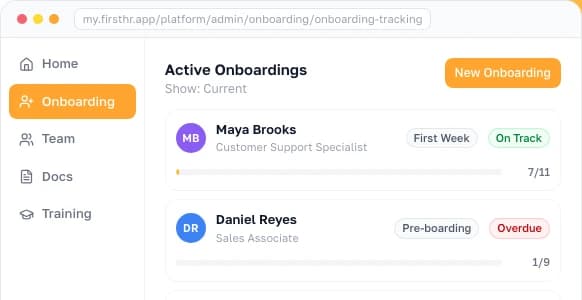
FirstHR covers the employment layer underneath a shop's training program: an HR platform for small and growing US teams that handles onboarding and employee records, at a flat $98 a month for up to 10 people or $198 for 11 to 50.
The platform's document management stores each certificate with an expiry date, and its Training Wizard turns your own procedures, slides, and videos into step-by-step courses, with training assignment and e-signature acknowledgment of each completion. An automotive course library, packaged course import, recertification workflows, and technical content come from the options above.
One distinction is worth drawing before you buy anything. Getting a new technician through day one is an onboarding problem, and an HR system does it well.
Day one means the handbook acknowledged, the safety policy signed, the certificates collected, and the first-week modules assigned.
Proving that a named technician completed hazard communication training on a date, was retrained when a new product brought a new hazard, and holds a current forklift evaluation is a training-system problem. That proof rests on the change-triggered retraining and evaluation records the platforms above are built around. Most shops need both, and buying only one is how a program ends up half documented.
How to choose an automotive LMS
Five questions, in this order. The first two eliminate most of the list before you book a single demo.
Once a product survives those five questions, run one real requirement through its trial end to end instead of clicking through a demo. Assign an actual hazard course to two technicians, and have one finish it while the other ignores it. Then add a certificate the platform did not issue, set it to expire, export the record, and check that it shows names, dates, and the person who did the evaluating.
The whole exercise takes an afternoon and tells you more than any comparison table, including this one.
Frequently Asked Questions
What is an automotive LMS?
Training software for a dealership, repair shop, collision center, or parts operation that assigns training, reaches people away from a desk, and keeps the records. Four products share the name: dealer compliance platforms, automotive training programs, general training platforms, and enterprise learning systems. They rank together and suit very different buyers.
How much does an automotive LMS cost?
Among the options with published rates, a fifteen-person shop pays $29 to $120 a month: Connecteam at $29 for thirty users, TalentLMS Core at $119 for up to forty, and 360Learning at $8 a user. At one hundred employees TalentLMS Core costs $219 and 360Learning reaches $800. Of the other nine options, seven quote, Litmos lists only annual starting prices, and iSpring LMS publishes only from one hundred users up.
What training does an auto shop have to document?
It depends on the hazards in your building rather than on your headcount. Hazard communication training is required at initial assignment and whenever a new chemical hazard appears. Respirator retraining is annual and repeats when a change makes earlier training obsolete. Forklift operators need an evaluation at least every three years, certified with the operator, the dates, and the evaluator. Servicing vehicle air conditioning for payment requires section 609 certification.
Does a small repair shop need an automotive-specific platform?
Most shops do not, at least not for the platform half. The automotive-specific products sell compliance programs or technical curriculum with delivery attached, and a shop that needs assignment, records, and credential expiry dates is describing a general platform with a published price. For content, often yes, because no general small business platform ships automotive courses.
Can an LMS track ASE certifications and EPA 609 cards?
Some can, and many cannot. The test is whether a credential can exist as a record with an expiry date and an attached certificate, rather than only as a course finished inside the platform. ASE certifications are valid for five years and then need a recertification test, and a section 609 card belongs to the technician, so both have to be tracked rather than administered.
Is there a free LMS for an auto shop?
Two real ones, with limits. Connecteam is free for up to ten users with every hub included, which covers every seat in a small shop and suits staff with no work email. TalentLMS is free forever for five users and ten courses, a genuine product but a low ceiling. The other ten options offer a trial at best, and six require a demo first.
Can technicians use an LMS without a company email address?
Only on platforms designed for it, so test this early. Products built for deskless teams offer sign-in by phone number or join code and work on a shared device. The quiet failure is a service manager completing modules for everybody to clear a dashboard, which leaves you with compliance training records that document nothing.
Should technician training and onboarding paperwork live in the same system?
They serve two different purposes, and most shops run both. Handbook acknowledgment, the signed safety policy, and first-week orientation are records an HR system handles. Proving a named technician was trained on a hazard, retrained when a new one arrived, and holds a current evaluation is a training-system job, built on change-triggered retraining and evaluator records.
Make HR the easy part of running your business
Onboarding, e-signatures, training and core HR in one place. Up and running in 5 minutes.
- 7-day free trial
- No credit card required
- Cancel anytime